Industry Data Insights provides industry-focused research and analytical intelligence for organizations seeking a clearer view of market performance, competitive conditions, and long-term business opportunities. Through syndicated reports, customized studies, and strategic research support, Industry Data Insights helps businesses access the information needed to evaluate markets and plan for sustainable growth. Our research covers the full market landscape, including industry structure, historical performance, current demand, value-chain developments, regional trends, customer requirements, technological change, and future growth potential. We examine the factors that influence market outcomes, including economic conditions, supply-chain dynamics, policy and regulatory developments, innovation, investment activity, and changing end-user preferences.
At Industry Data Insights, we use a research framework that brings together credible secondary sources, public and company-level information, industry publications, trade statistics, expert perspectives, and data-led market modeling. Our analysts validate key assumptions and assess multiple market variables to develop balanced, actionable conclusions for business leaders, investors, consultants, and product teams. Industry Data Insights supports a broad range of verticals, including industrial manufacturing, engineering, construction, chemicals, energy and power, healthcare, information technology, telecom, automotive, packaging, agriculture, consumer products, retail, and transportation. Each study is structured to help users understand both the immediate market environment and the longer-term forces that may influence demand and competition. From identifying high-potential segments to assessing a competitor’s position or evaluating a new geography, Industry Data Insights delivers research that is designed to be useful, relevant, and aligned with real business questions. Our goal is to turn industry data into strategic direction.
Cervical Cancer Screening Diagnostics Pre Cancerous Dysplasia Lesion Treatment Market Report
Updated On
Nov 23 2026
Total Pages
274
Vijayashree Ugale
Research Analyst
Cervical Cancer Screening Diagnostics Report 2025
Cervical Cancer Screening Diagnostics Pre Cancerous Dysplasia Lesion Treatment Market Report by Type (Cervical Cancer Screening(Pap Smear Collection Devices, HPV Testing Platforms, Cytobrush, Self-collection Kits, Others), Cervical Cancer Diagnostics(Colposcopes, Cervical Biopsy Devices, Colposcopes with AI Imaging (Digital), Others), Pre-cancerous Lesion Treatment(LEEP Machine, Cryotherapy, Thermal Ablation, Others)), by North America (USA, Canada, Mexico), by Europe (UK, Germany, France, Italy, Spain, Denmark, Sweden, Norway), by Asia Pacific (China, Japan, India, Australia, South Korea, Thailand), by Latin America (Brazil, Argentina, Mexico), by Middle East & Africa (South Africa, Saudi Arabia, UAE, Kuwait) Forecast 2026-2034
Cervical Cancer Screening Diagnostics Report 2025
Discover the Latest Market Insight Reports
Access in-depth insights on industries, companies, trends, and global markets. Our expertly curated reports provide the most relevant data and analysis in a condensed, easy-to-read format.
Cervical cancer screening leads with 49.0% of 2025 revenue, and remains the fastest-growing type segment.
North America leads with 41.2% share; Asia Pacific is the fastest-growing region on continued screening expansion.
Key players include Roche, BD, Abbott, QIAGEN, Hologic, and CooperSurgical, alongside specialized cryotherapy and LEEP device makers.
Why this matters for decision-makers: AI-assisted cytology and HPV self-sampling are compressing the cost per detected lesion, so vendors that do not embed validated algorithms and self-collection workflows risk losing public-program tenders to integrated rivals.
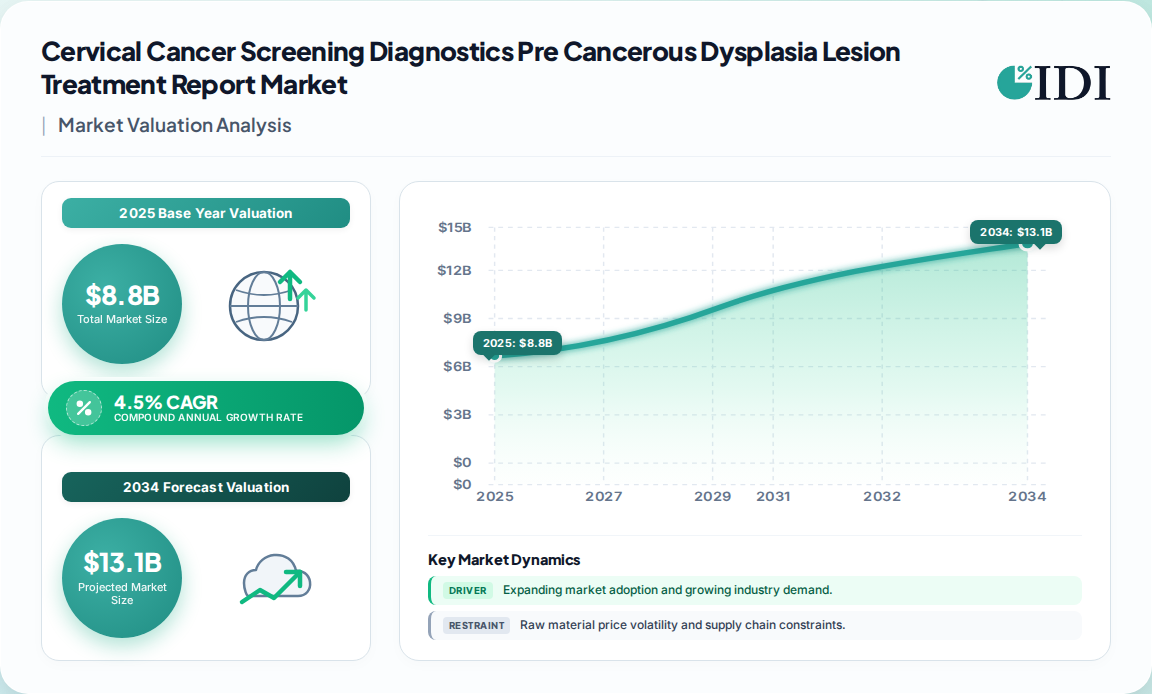
Cervical Cancer Screening Diagnostics Pre Cancerous Dysplasia Lesion Treatment Market Report Market Size (In Billion)
15.0B
10.0B
5.0B
0
8.800 B
2025
9.300 B
2026
9.700 B
2027
10.10 B
2028
10.60 B
2029
11.10 B
2030
11.60 B
2031
Cervical Cancer Screening Diagnostics Pre Cancerous Dysplasia Lesion Treatment Market Report Market Size (In Billion)
Year
Market Size
2025
8.800 B
2026
9.300 B
2027
9.700 B
2028
10.10 B
2029
10.60 B
2030
11.10 B
2031
11.60 B
What is the Cervical Cancer Screening Diagnostics Pre Cancerous Dysplasia Lesion Treatment Market Report?
This market covers the devices, assays, imaging systems, and treatment technologies used to detect and remove pre-cancerous cervical lesions before they progress to invasive cancer — spanning primary screening (Pap cytology, HPV testing, self-collection), diagnostic confirmation (colposcopy, biopsy), and treatment (LEEP, cryotherapy, thermal ablation).
Scope: what this report covers and excludes
Scope level: Global. Sub-region unit: Region (with country detail). This analysis covers screening devices and platforms, diagnostic confirmation tools, and pre-cancerous lesion treatment technologies across North America, Europe, Asia Pacific, Latin America, and the Middle East & Africa. This analysis does not cover HPV vaccines (Gardasil, Cervarix), invasive cervical cancer oncology therapeutics, radiation oncology, or broad women's-health diagnostics outside cervical indications.
How big is the market for Cervical Cancer Screening Diagnostics Pre Cancerous Dysplasia Lesion Treatment Market Report?
Published estimates cluster between $8.8 billion and $8.83 billion for 2025, but diverge sharply on growth, with the 4.5% and 6.0% CAGR cases producing a $7.0 billion spread by 2035.
Our analysis suggests the lower 4.5% figure is the most defensible base case: it is consistent with a maturing Pap-cytology installed base, modest per-test pricing, and heavy price pressure from public tenders. The 6.0% case likely assumes faster AI/self-collection substitution and is best treated as an upside scenario.
How is the market segmented?
Segmentation follows clinical workflow: screening first, then diagnostic confirmation, then lesion treatment — with self-collection kits the fastest-emerging screening sub-segment.
Note: the above tables render only non-geography parents; country and region cuts are covered in the next section.
Which region leads in Cervical Cancer Screening Diagnostics Pre Cancerous Dysplasia Lesion Treatment Market Report?
North America leads the global cervical cancer screening, diagnostics, and pre-cancerous dysplasia lesion treatment market with 41.2% revenue share in 2025, while Asia Pacific is the fastest-growing region through 2035.
Cervical Cancer Screening Diagnostics Pre Cancerous Dysplasia Lesion Treatment Market Report Regional Market Share
Loading chart...
Cervical Cancer Screening Diagnostics Pre Cancerous Dysplasia Lesion Treatment Market Report Regional Market Share
Region
Market Share (%)
North America
0.41%
Europe
0.24%
Asia-Pacific
0.21%
Latin America
0.07%
Middle East & Africa
0.06%
Global
North America → U.S., Canada, Mexico
Europe → UK, Germany, France, Italy, Spain, Denmark, Sweden, Norway
Asia Pacific → China, Japan, India, Australia, South Korea, Thailand
Latin America → Brazil, Argentina, Mexico
Middle East & Africa → South Africa, Saudi Arabia, UAE, Kuwait
Region
2025 Revenue Share
North America
41.2%
Europe
24.4%
Asia Pacific
21.2%
Latin America
7.4%
Middle East & Africa
5.9%
This divergence implies a two-speed market: North America and Europe grow on replacement demand and AI/self-collection upgrades, while Asia Pacific grows on first-time screening coverage, where China and India together represent roughly 70% of the addressable unscreened population.
What is driving growth — and what is holding it back?
Growth is driven mainly by government screening mandates and HPV self-sampling, while loss to follow-up and uneven screening participation remain the binding constraints.
Factor
Direction
Evidence strength
Mechanism
Government-supported screening programs
Driver
High
WHO 70% screening target by 2030 expands covered populations
HPV self-sampling and decentralized models
Driver
Medium-High
Lifts uptake in underscreened groups; US FDA clearance of self-collection
AI-assisted cytology and colposcopy
Driver
Medium
Reduces false negatives and reading time at scale
Cost-effective cryotherapy and thermal ablation
Driver
Medium
Enables single-visit screen-and-treat in low-resource settings
Limited screening participation and loss to follow-up
Restraint
High
Positive HPV results not converted to colposcopy or treatment
Assay and device development cost plus regulatory burden
Restraint
Medium
Slows new entrant timelines and per-unit pricing flexibility
On balance, our analysis suggests demand-side drivers (coverage mandates) outweigh supply-side frictions (regulatory cost), but the rate-limiting step is follow-up, not first-screen capacity — a subtle but decisive point for anyone modeling treatment volumes.
Who are the leading vendors?
Roche, BD, Abbott, QIAGEN, and Hologic anchor the screening and diagnostics side, while CooperSurgical, MedGyn, WISAP, Liger Medical, and Utah Medical hold treatment-device positions.
Vendor
Primary position
Differentiation
F. Hoffmann-La Roche
HPV testing, self-collection
FDA-cleared self-collection plus cobas molecular platform
Low-cost treatment devices for global health tenders
Competitive moats rest on regulatory clearance and installed-base lock-in rather than pure technology. Once an HPV assay is validated on a national screening platform, switching entails re-validation and lab retraining — a high effective switching cost that favors incumbents in high-income markets.
What do buyers and operators need to know? (Decision Support)
Mission-critical selection criteria are analytical sensitivity for high-grade lesions (CIN2+), throughput per shift, and compatibility with existing cytology workflows. Buyers should demand validated sensitivity/specificity data against CIN2+ endpoints rather than aggregate accuracy claims.
Procurement risk concentrates in reagent supply continuity and lab staffing. Assay switching carries real validation costs, so multi-year reagent agreements with price floors are common. In treatment devices, single-visit durability and power independence matter more than feature depth in low-resource tenders.
Regulatory compliance is non-negotiable: FDA clearance for self-collection, CE marking for EU placement, and WHO prequalification for global-health procurement. Operators should also budget for training and quality-assurance programs, which frequently represent 10–20% of total program cost.
Strategic Recommendations & Analyst Perspective
The balance of evidence favors the 4.5% base case over the 6.0% case. Screening is a mature, tender-driven category where growth comes from coverage expansion, not unit-price inflation; the higher CAGR requires assuming rapid self-collection substitution that is not yet visible in installed-base data. The strongest counter-argument is that AI-assisted reading could unlock latent capacity and lift throughput enough to compress per-test costs faster than assumed — a real but second-order effect within this decade.
Our analysis suggests the most durable value pool is not in cytology hardware but in the connective layer: HPV self-collection logistics, AI triage, and screen-and-treat integration. Vendors that own that layer can capture margin even as device prices fall.
Vendors: prioritize validated AI reading and self-collection workflows to win public-program tenders, rather than competing on instrument price.
Operators: close the follow-up gap (navigation, same-visit treatment) — it is the highest-return lever on outcomes and treatment volume.
Investors: weight Asia Pacific first-screening expansion and treatment-device consolidation above North American replacement demand.
What would change this conclusion: prospective, multi-country evidence that self-sampling with validated assays sustains CIN2+ sensitivity at scale, combined with reimbursement coverage for self-collected HPV tests. If that lands, the 6.0% upside case becomes the base case.
Cervical Cancer Screening Diagnostics Pre Cancerous Dysplasia Lesion Treatment Market Report Regional Market Share
Higher Coverage
Lower Coverage
No Coverage
Cervical Cancer Screening Diagnostics Pre Cancerous Dysplasia Lesion Treatment Market Report REPORT HIGHLIGHTS
Research Methodology & Data Sources
Our rigorous research methodology combines multi-layered approaches with comprehensive quality assurance, ensuring precision, accuracy, and reliability in every market analysis.
Primary Research & Industry Fieldwork
Our research program applies a 70/30 primary-to-secondary split. In-depth interviews were conducted across the value chain, including HPV assay and reagent suppliers, cytology and colposcopy device producers, LEEP and cryotherapy device manufacturers, laboratory service providers, and global distributors serving public screening programs. Interviewees were designated decision-makers: VP of Sourcing, Heads of R&D and Clinical Affairs, Technical Directors of Cytopathology Laboratories, and Commercial Operations Leads at screening-program contractors. Interviews captured installed-base composition, tender pricing, validation timelines, and follow-up loss rates.
Key Stakeholders Interviewed
Key Stakeholders Interviewed
Stakeholder Role
Interview Share (%)
Sourcing & Procurement Leads
35%
R&D & Clinical Affairs Heads
30%
Cytopathology Technical Directors
20%
Commercial Operations Leads
15%
Industry Ecosystem Breakdown
Industry Ecosystem Breakdown
Company Type
Representation (%)
HPV Assay & Reagent Suppliers
40%
Cytology & Colposcopy Device Producers
30%
LEEP & Cryotherapy Device Manufacturers
20%
Distributors & Screening Program Contractors
10%
Secondary Benchmarking & Public Trade Validation
Secondary validation draws on official multilateral trade and standards databases (UN Comtrade, WTO, US ITC, Eurostat), corporate annual filings and investor presentations (10-K, SEC filings), patent databases, and recognized non-profit technical standards bodies and clinical guidelines. These sources anchor base-year revenue and cross-border device flows.
Demand Modeling & Market Sizing Triangulation
We run simultaneous Top-Down (macroeconomic screening coverage and segment allocation) and Bottom-Up (manufacturer capacity, product pricing, and end-use consumption) triangulation, reconciling both against published program budgets and reimbursement schedules.
6. Cervical Cancer Screening Diagnostics Pre Cancerous Dysplasia Lesion Treatment Market Report North America Analysis, Insights and Forecast, 2020-2034
8. Cervical Cancer Screening Diagnostics Pre Cancerous Dysplasia Lesion Treatment Market Report Asia Pacific Analysis, Insights and Forecast, 2020-2034
9. Cervical Cancer Screening Diagnostics Pre Cancerous Dysplasia Lesion Treatment Market Report Latin America Analysis, Insights and Forecast, 2020-2034
10. Cervical Cancer Screening Diagnostics Pre Cancerous Dysplasia Lesion Treatment Market Report Middle East & Africa Analysis, Insights and Forecast, 2020-2034
11. Cervical Cancer Screening Diagnostics Pre Cancerous Dysplasia Lesion Treatment Market Report Competitive Analysis
11.1. Company Profiles
11.2. Market Entropy
11.2.1. Company's Key Areas Served
11.2.2. Recent Developments
11.3. Company Market Share Analysis, 2026
11.3.1. Top 5 Companies Market Share Analysis
11.3.2. Top 3 Companies Market Share Analysis
11.4. List of Potential Customers
12. Cervical Cancer Screening Diagnostics Pre Cancerous Dysplasia Lesion Treatment Market Report Research Methodology
List of Figures
Figure 1: Cervical Cancer Screening Diagnostics Pre Cancerous Dysplasia Lesion Treatment Market Report Revenue Breakdown (Billion, %) by Region 2026 & 2034
Figure 2: North America Cervical Cancer Screening Diagnostics Pre Cancerous Dysplasia Lesion Treatment Market Report Revenue (Billion), by Type 2026 & 2034
Figure 3: North America Cervical Cancer Screening Diagnostics Pre Cancerous Dysplasia Lesion Treatment Market Report Revenue Share (%), by Type 2026 & 2034
Figure 4: North America Cervical Cancer Screening Diagnostics Pre Cancerous Dysplasia Lesion Treatment Market Report Revenue (Billion), by Country 2026 & 2034
Figure 5: North America Cervical Cancer Screening Diagnostics Pre Cancerous Dysplasia Lesion Treatment Market Report Revenue Share (%), by Country 2026 & 2034
Figure 6: Europe Cervical Cancer Screening Diagnostics Pre Cancerous Dysplasia Lesion Treatment Market Report Revenue (Billion), by Type 2026 & 2034
Figure 7: Europe Cervical Cancer Screening Diagnostics Pre Cancerous Dysplasia Lesion Treatment Market Report Revenue Share (%), by Type 2026 & 2034
Figure 8: Europe Cervical Cancer Screening Diagnostics Pre Cancerous Dysplasia Lesion Treatment Market Report Revenue (Billion), by Country 2026 & 2034
Figure 9: Europe Cervical Cancer Screening Diagnostics Pre Cancerous Dysplasia Lesion Treatment Market Report Revenue Share (%), by Country 2026 & 2034
Figure 10: Asia Pacific Cervical Cancer Screening Diagnostics Pre Cancerous Dysplasia Lesion Treatment Market Report Revenue (Billion), by Type 2026 & 2034
Figure 11: Asia Pacific Cervical Cancer Screening Diagnostics Pre Cancerous Dysplasia Lesion Treatment Market Report Revenue Share (%), by Type 2026 & 2034
Figure 12: Asia Pacific Cervical Cancer Screening Diagnostics Pre Cancerous Dysplasia Lesion Treatment Market Report Revenue (Billion), by Country 2026 & 2034
List of Tables
Table 1: Cervical Cancer Screening Diagnostics Pre Cancerous Dysplasia Lesion Treatment Market Report Revenue Billion Forecast, by Type 2020 & 2034
Table 2: Cervical Cancer Screening Diagnostics Pre Cancerous Dysplasia Lesion Treatment Market Report Revenue Billion Forecast, by Region 2020 & 2034
Table 3: North America Cervical Cancer Screening Diagnostics Pre Cancerous Dysplasia Lesion Treatment Market Report Revenue Billion Forecast, by Type 2020 & 2034
Table 4: North America Cervical Cancer Screening Diagnostics Pre Cancerous Dysplasia Lesion Treatment Market Report Revenue Billion Forecast, by Country 2020 & 2034
Table 5: USA Cervical Cancer Screening Diagnostics Pre Cancerous Dysplasia Lesion Treatment Market Report Revenue (Billion) Forecast, by Application 2020 & 2034
Table 6: Canada Cervical Cancer Screening Diagnostics Pre Cancerous Dysplasia Lesion Treatment Market Report Revenue (Billion) Forecast, by Application 2020 & 2034
Table 7: Mexico Cervical Cancer Screening Diagnostics Pre Cancerous Dysplasia Lesion Treatment Market Report Revenue (Billion) Forecast, by Application 2020 & 2034
Table 8: Europe Cervical Cancer Screening Diagnostics Pre Cancerous Dysplasia Lesion Treatment Market Report Revenue Billion Forecast, by Type 2020 & 2034
Table 9: Europe Cervical Cancer Screening Diagnostics Pre Cancerous Dysplasia Lesion Treatment Market Report Revenue Billion Forecast, by Country 2020 & 2034
Table 10: UK Cervical Cancer Screening Diagnostics Pre Cancerous Dysplasia Lesion Treatment Market Report Revenue (Billion) Forecast, by Application 2020 & 2034
Table 11: Germany Cervical Cancer Screening Diagnostics Pre Cancerous Dysplasia Lesion Treatment Market Report Revenue (Billion) Forecast, by Application 2020 & 2034
Table 12: France Cervical Cancer Screening Diagnostics Pre Cancerous Dysplasia Lesion Treatment Market Report Revenue (Billion) Forecast, by Application 2020 & 2034
Frequently Asked Questions
1. How large is the cervical cancer screening and dysplasia treatment market?
The global market was valued at approximately $8.8 billion in 2025 and is projected to reach $15.7 billion by 2035, growing at a 4.5% CAGR. One competing analysis publishes a 6.0% CAGR, reflecting faster assumed adoption of AI and self-sampling.
2. Which segment leads the cervical cancer screening market?
Cervical cancer screening leads with 49.0% of 2025 revenue, spanning Pap smear collection devices, HPV testing platforms, cytobrushes, and self-collection kits. Screening is also forecast to grow at the fastest CAGR through 2035.
3. Which region dominates the cervical cancer diagnostics and treatment market?
North America dominates with 41.2% revenue share in 2025, supported by established screening programs and high healthcare spending. Asia Pacific is the fastest-growing region, driven by first-time screening coverage expansion in China and India.
4. What technologies are reshaping cervical cancer screening?
AI-assisted cytology and colposcopy, HPV self-sampling, and molecular biomarker testing are the key technologies. AI systems such as CerviCARE have reported 98% sensitivity for high-risk groups in retrospective studies, though prospective validation is still pending.
5. Who are the leading companies in this market?
Leading vendors include Roche, BD, Abbott, QIAGEN, Hologic, and CooperSurgical, alongside treatment-device specialists such as MedGyn, WISAP, Liger Medical, and Utah Medical Products. Moats center on regulatory clearance and lab installed-base lock-in.
Figure 13: Asia Pacific Cervical Cancer Screening Diagnostics Pre Cancerous Dysplasia Lesion Treatment Market Report Revenue Share (%), by Country 2026 & 2034
Figure 14: Latin America Cervical Cancer Screening Diagnostics Pre Cancerous Dysplasia Lesion Treatment Market Report Revenue (Billion), by Type 2026 & 2034
Figure 15: Latin America Cervical Cancer Screening Diagnostics Pre Cancerous Dysplasia Lesion Treatment Market Report Revenue Share (%), by Type 2026 & 2034
Figure 16: Latin America Cervical Cancer Screening Diagnostics Pre Cancerous Dysplasia Lesion Treatment Market Report Revenue (Billion), by Country 2026 & 2034
Figure 17: Latin America Cervical Cancer Screening Diagnostics Pre Cancerous Dysplasia Lesion Treatment Market Report Revenue Share (%), by Country 2026 & 2034
Figure 18: Middle East & Africa Cervical Cancer Screening Diagnostics Pre Cancerous Dysplasia Lesion Treatment Market Report Revenue (Billion), by Type 2026 & 2034
Figure 19: Middle East & Africa Cervical Cancer Screening Diagnostics Pre Cancerous Dysplasia Lesion Treatment Market Report Revenue Share (%), by Type 2026 & 2034
Figure 20: Middle East & Africa Cervical Cancer Screening Diagnostics Pre Cancerous Dysplasia Lesion Treatment Market Report Revenue (Billion), by Country 2026 & 2034
Figure 21: Middle East & Africa Cervical Cancer Screening Diagnostics Pre Cancerous Dysplasia Lesion Treatment Market Report Revenue Share (%), by Country 2026 & 2034
Table 13: Italy Cervical Cancer Screening Diagnostics Pre Cancerous Dysplasia Lesion Treatment Market Report Revenue (Billion) Forecast, by Application 2020 & 2034
Table 14: Spain Cervical Cancer Screening Diagnostics Pre Cancerous Dysplasia Lesion Treatment Market Report Revenue (Billion) Forecast, by Application 2020 & 2034
Table 15: Denmark Cervical Cancer Screening Diagnostics Pre Cancerous Dysplasia Lesion Treatment Market Report Revenue (Billion) Forecast, by Application 2020 & 2034
Table 16: Sweden Cervical Cancer Screening Diagnostics Pre Cancerous Dysplasia Lesion Treatment Market Report Revenue (Billion) Forecast, by Application 2020 & 2034
Table 17: Norway Cervical Cancer Screening Diagnostics Pre Cancerous Dysplasia Lesion Treatment Market Report Revenue (Billion) Forecast, by Application 2020 & 2034
Table 18: Asia Pacific Cervical Cancer Screening Diagnostics Pre Cancerous Dysplasia Lesion Treatment Market Report Revenue Billion Forecast, by Type 2020 & 2034
Table 19: Asia Pacific Cervical Cancer Screening Diagnostics Pre Cancerous Dysplasia Lesion Treatment Market Report Revenue Billion Forecast, by Country 2020 & 2034
Table 20: China Cervical Cancer Screening Diagnostics Pre Cancerous Dysplasia Lesion Treatment Market Report Revenue (Billion) Forecast, by Application 2020 & 2034
Table 21: Japan Cervical Cancer Screening Diagnostics Pre Cancerous Dysplasia Lesion Treatment Market Report Revenue (Billion) Forecast, by Application 2020 & 2034
Table 22: India Cervical Cancer Screening Diagnostics Pre Cancerous Dysplasia Lesion Treatment Market Report Revenue (Billion) Forecast, by Application 2020 & 2034
Table 23: Australia Cervical Cancer Screening Diagnostics Pre Cancerous Dysplasia Lesion Treatment Market Report Revenue (Billion) Forecast, by Application 2020 & 2034
Table 24: South Korea Cervical Cancer Screening Diagnostics Pre Cancerous Dysplasia Lesion Treatment Market Report Revenue (Billion) Forecast, by Application 2020 & 2034
Table 25: Thailand Cervical Cancer Screening Diagnostics Pre Cancerous Dysplasia Lesion Treatment Market Report Revenue (Billion) Forecast, by Application 2020 & 2034
Table 26: Latin America Cervical Cancer Screening Diagnostics Pre Cancerous Dysplasia Lesion Treatment Market Report Revenue Billion Forecast, by Type 2020 & 2034
Table 27: Latin America Cervical Cancer Screening Diagnostics Pre Cancerous Dysplasia Lesion Treatment Market Report Revenue Billion Forecast, by Country 2020 & 2034
Table 28: Brazil Cervical Cancer Screening Diagnostics Pre Cancerous Dysplasia Lesion Treatment Market Report Revenue (Billion) Forecast, by Application 2020 & 2034
Table 29: Argentina Cervical Cancer Screening Diagnostics Pre Cancerous Dysplasia Lesion Treatment Market Report Revenue (Billion) Forecast, by Application 2020 & 2034
Table 30: Mexico Cervical Cancer Screening Diagnostics Pre Cancerous Dysplasia Lesion Treatment Market Report Revenue (Billion) Forecast, by Application 2020 & 2034
Table 31: Middle East & Africa Cervical Cancer Screening Diagnostics Pre Cancerous Dysplasia Lesion Treatment Market Report Revenue Billion Forecast, by Type 2020 & 2034
Table 32: Middle East & Africa Cervical Cancer Screening Diagnostics Pre Cancerous Dysplasia Lesion Treatment Market Report Revenue Billion Forecast, by Country 2020 & 2034
Table 33: South Africa Cervical Cancer Screening Diagnostics Pre Cancerous Dysplasia Lesion Treatment Market Report Revenue (Billion) Forecast, by Application 2020 & 2034
Table 34: Saudi Arabia Cervical Cancer Screening Diagnostics Pre Cancerous Dysplasia Lesion Treatment Market Report Revenue (Billion) Forecast, by Application 2020 & 2034
Table 35: UAE Cervical Cancer Screening Diagnostics Pre Cancerous Dysplasia Lesion Treatment Market Report Revenue (Billion) Forecast, by Application 2020 & 2034
Table 36: Kuwait Cervical Cancer Screening Diagnostics Pre Cancerous Dysplasia Lesion Treatment Market Report Revenue (Billion) Forecast, by Application 2020 & 2034