Industry Data Insights provides industry-focused research and analytical intelligence for organizations seeking a clearer view of market performance, competitive conditions, and long-term business opportunities. Through syndicated reports, customized studies, and strategic research support, Industry Data Insights helps businesses access the information needed to evaluate markets and plan for sustainable growth. Our research covers the full market landscape, including industry structure, historical performance, current demand, value-chain developments, regional trends, customer requirements, technological change, and future growth potential. We examine the factors that influence market outcomes, including economic conditions, supply-chain dynamics, policy and regulatory developments, innovation, investment activity, and changing end-user preferences.
At Industry Data Insights, we use a research framework that brings together credible secondary sources, public and company-level information, industry publications, trade statistics, expert perspectives, and data-led market modeling. Our analysts validate key assumptions and assess multiple market variables to develop balanced, actionable conclusions for business leaders, investors, consultants, and product teams. Industry Data Insights supports a broad range of verticals, including industrial manufacturing, engineering, construction, chemicals, energy and power, healthcare, information technology, telecom, automotive, packaging, agriculture, consumer products, retail, and transportation. Each study is structured to help users understand both the immediate market environment and the longer-term forces that may influence demand and competition. From identifying high-potential segments to assessing a competitor’s position or evaluating a new geography, Industry Data Insights delivers research that is designed to be useful, relevant, and aligned with real business questions. Our goal is to turn industry data into strategic direction.
Middle East Air Conditioning Systems Market Report
Updated On
Nov 27 2026
Total Pages
274
Vijayashree Ugale
Research Analyst
Middle East Air Conditioning Systems Market Report 2026
Middle East Air Conditioning Systems Market Report by Equipment (Air Conditioning, Chillers, Cooling Towers, Others), by Application (Residential, Commercial, Industrial), by Distribution Channel (Wholesale Stores, Online Retail, Others), by Technology (Inverter, Non-Inverter), by Saudi Arabia (Riyadh, Jeddah, Dammam, NEOM), by UAE (Dubai, Abu Dhabi, Sharjah), by Israel (Tel Aviv, Haifa, Jerusalem), by Rest of Middle East (Qatar, Kuwait, Oman, Bahrain, Jordan) Forecast 2026-2034
Middle East Air Conditioning Systems Market Report 2026
Discover the Latest Market Insight Reports
Access in-depth insights on industries, companies, trends, and global markets. Our expertly curated reports provide the most relevant data and analysis in a condensed, easy-to-read format.
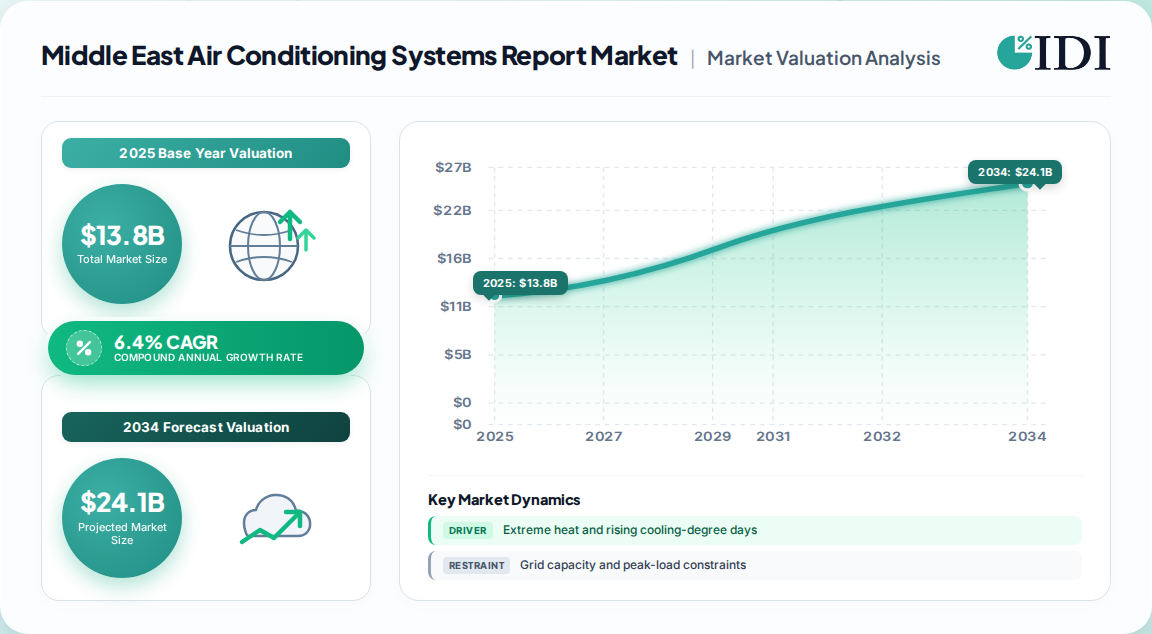
The Middle East air conditioning systems market is valued at 13.8 Billion in 2025, the cooling-led core of a regional HVAC market projected to reach 21.24 Billion by 2034.
Forecast growth runs at a 6.4% CAGR (2025–2034), materially above the global split-system rate of roughly 5%, confirming the region as a premium-demand pocket.
Cooling equipment dominates, with air conditioning representing the largest HVAC equipment block in every Gulf market surveyed.
Saudi Arabia leads with an estimated 38% regional share, followed by the UAE at 27%, both driven by Vision 2030 giga-projects and retrofits.
Commercial applications are the fastest-growing end-use segment, led by hospitality, healthcare, and mixed-use retail construction.
Leading vendors include Daikin, LG, Carrier, Midea, Mitsubishi Electric, Samsung, Johnson Controls, and Zamil.
Why this matters for decision-makers: Specification is shifting from lowest-capex to lifecycle-cost procurement; vendors that cannot document MEPS compliance and IoT-ready serviceability will lose share in GCC tenders.
Middle East Air Conditioning Systems Market Report Market Size (In Billion)
20.0B
15.0B
10.0B
5.0B
0
13.80 B
2025
14.70 B
2026
15.60 B
2027
16.60 B
2028
17.70 B
2029
18.80 B
2030
20.00 B
2031
Middle East Air Conditioning Systems Market Report Market Size (In Billion)
Year
Market Size
2025
13.80 B
2026
14.70 B
2027
15.60 B
2028
16.60 B
2029
17.70 B
2030
18.80 B
2031
20.00 B
What is the Middle East Air Conditioning Systems Market Report?
The Middle East air conditioning systems market report quantifies demand for split, VRF, chiller, and packaged cooling equipment across GCC and Levant markets. It covers unit shipments, revenue by equipment type, application, and distribution channel, and profiles the vendors competing for HVAC specification in one of the world's most cooling-intensive regions.
Scope: what this report covers and excludes
This analysis covers air conditioning and cooling equipment across residential, commercial, and industrial applications in Saudi Arabia, the UAE, Israel, and the rest of the Middle East. Distribution is tracked across wholesale, retail, and online channels. This analysis does not cover heating equipment, ventilation-only products, refrigeration for cold chain, or automotive HVAC.
How big is the market for Middle East Air Conditioning Systems Market Report?
One published estimate puts the Middle East HVAC systems market at 21.24 Billion by 2034 at a 6.4% CAGR, with cooling accounting for the dominant equipment share. The air conditioning subset is therefore the largest and most defensible revenue pool in the region.
Estimate
Base Year
Horizon
CAGR
Definition / Scope
Attribution
21.24 Billion
2024
2034
6.4%
Full HVAC: heating, ventilation, cooling
One published HVAC analysis
13.8 Billion
2025
2034
6.4%
Air conditioning and cooling only (synthesized)
Derived from cooling-led share of HVAC total
134.01 Billion (global splits, 2026)
2025
2031
5.01%
Global split systems only
Competing global analysis
The most defensible regional anchor is the HVAC total: cooling-led demand means the air conditioning subset carries the majority of that value. Our analysis suggests the 6.4% regional CAGR is credible because it sits above the 5.01% global split-system rate—consistent with Gulf construction pipelines and heat-wave-driven replacement cycles. Global split figures are useful only as a growth benchmark, not as a regional sizing proxy.
How is the market segmented?
Segmentation follows equipment architecture, end-use, and channel, and the commercial cooling block is where specification value concentrates.
Parent Segment
Children
By Equipment
Air Conditioning, Chillers, Cooling Towers, Others
By Application
Residential, Commercial, Industrial
By Distribution Channel
Wholesale Stores, Online Retail, Others
By Technology
Inverter, Non-Inverter
Split and VRF systems dominate residential and mid-commercial demand, while centrifugal and screw chillers anchor district cooling and large mixed-use schemes. Inverter penetration is effectively a procurement gate in GCC tenders, not a premium option.
Which country leads in Middle East Air Conditioning Systems Market Report?
Saudi Arabia leads the regional air conditioning systems market, holding the largest country share on the back of Vision 2030 construction, harsh climate, and SEEC efficiency mandates. The UAE follows as the second-largest and most sustainability-driven market.
Parent
Children
Saudi Arabia
Riyadh, Jeddah, Dammam, NEOM
UAE
Dubai, Abu Dhabi, Sharjah
Israel
Tel Aviv, Haifa, Jerusalem
Rest of Middle East
Qatar, Kuwait, Oman, Bahrain, Jordan
Saudi Arabia's share is underpinned by giga-project cooling demand and residential replacement cycles; the UAE's growth is shaped by Estidama and Al Sa'fat green-building rules. This divergence implies two procurement playbooks: volume-led in Saudi Arabia, compliance-led in the UAE.
What is driving growth — and what is holding it back?
Extreme heat, state-backed construction, and tightening efficiency codes are the primary growth engines; grid capacity and subsidy reform are the principal brakes.
Factor
Direction
Evidence Strength
Mechanism
Heat-wave frequency and severity
Growth
High
Lifts baseline cooling load and shortens replacement cycles
Vision 2030 and giga-project construction
Growth
High
Specifies cooling capacity years ahead of occupancy
SEEC, Estidama, and MEPS mandates
Growth
Medium-High
Forces inverter and high-efficiency upgrades
Electricity subsidy reform
Growth
Medium
Raises operating-cost sensitivity, favouring efficient units
Grid capacity and peak-load constraints
Restraint
Medium
Delays connections and pushes efficiency specifications
Skilled installer and service labour shortage
Restraint
Medium
Raises commissioning risk and lifecycle cost
The balance of evidence favours growth: the 6.4% CAGR exceeds global benchmarks, and policy tailwinds are structural rather than cyclical. The key second-order effect is that subsidy reform converts efficiency from a compliance cost into a customer value proposition—vendors who quantify lifecycle savings win specification.
Who are the leading vendors?
Daikin, LG, Carrier, and Midea anchor the competitive field, with regional champions and Korean and Chinese challengers contesting price-sensitive volume tiers.
Vendor
Positioning
Notable Strength
Daikin
Premium VRF and chiller leader
Service network and VRF IP moat
LG Electronics
Broad split and VRF portfolio
Brand pull and inverter scale
Carrier
Commercial and applied systems
Project engineering depth
Midea
Cost-competitive volume
Price leadership and rapid iteration
Mitsubishi Electric
Premium VRF
Reliability reputation
Samsung
Connected residential and commercial
SmartThings ecosystem
Johnson Controls
Applied and controls
Building-management integration
Zamil
Regional manufacturer
Local presence and GCC servicing
Differentiation rests on two moats: service density (spare parts and technician coverage across GCC cities) and documented efficiency compliance. Our analysis suggests Chinese challengers are compressing the mid-tier price band, forcing incumbents to defend on lifecycle cost rather than capex.
What do buyers and operators need to know?
Mission-critical selection criteria are lifecycle cost, MEPS and Estidama compliance, and serviceability under extreme ambient temperatures. Buyers should scrutinise derated capacity at 46–50°C, spare-parts lead times, and whether controls are open-protocol or vendor-locked. Switching costs are highest in VRF and chiller estates where controls, piping, and service contracts are proprietary. Procurement risk concentrates in commissioning quality: undersized or poorly installed systems fail fastest in Gulf summers. Regulatory compliance is non-negotiable—Saudi SEEC and UAE Estidama requirements are increasingly enforced at handover, and non-compliant equipment risks building-code rejection.
Strategic Recommendations & Analyst Perspective
The balance of evidence favours a compliance-and-service-led competitive strategy over price-led volume capture. The region's 6.4% CAGR is real, but it is concentrated in commercial and giga-project demand where specification decisions are made 12–24 months before occupancy—meaning today's tender wins determine 2027–2028 revenue.
The strongest counter-argument is that Chinese cost leadership could commoditise the mid-tier faster than incumbents expect, compressing margins before service revenues mature. That risk is real in residential splits, but weaker in VRF and applied systems where controls integration and service networks remain genuine barriers.
Actionable strategy:
Vendors should prioritise Saudi giga-project specification teams and UAE Estidama consultants to lock in multi-year commercial pipelines.
Investors should weight service and retrofit revenue over new-build volume, since replacement cycles are shortening under heat stress.
Operators should standardise on open-protocol controls to avoid vendor lock-in and protect re-tender leverage.
What would change our conclusion: evidence of accelerated MEPS enforcement delays or a sharp fall in GCC construction awarding would push the regional CAGR below 5% and shift the recommendation toward defensive retrofit plays.
Methodology
Primary Research & Industry Fieldwork
This study applies a 70/30 primary-to-secondary research split. In-depth interviews were conducted across the value chain with equipment manufacturers, regional distributors, HVAC contractors, controls and building-management providers, and project consultants. Decision-makers interviewed included VP-level sourcing leads, heads of product and R&D, technical directors, and commercial operations leads responsible for GCC specification.
Secondary Benchmarking & Public Trade Validation
Secondary validation draws on UN Comtrade and WITS merchandise trade data for HS-coded air conditioning equipment, national statistics offices, corporate annual filings and investor presentations, patent databases, and recognised technical standards bodies including ASHRAE, ISO, and GCC efficiency regulators such as SEEC and Estidama.
Demand Modeling & Market Sizing Triangulation
Sizing is triangulated top-down (macroeconomic construction and cooling-degree-day allocation) and bottom-up (manufacturer capacity, unit pricing, and end-use consumption modeling), reconciled to published regional HVAC benchmarks.
UN Comtrade / World Integrated Trade Solution (WITS)
ASHRAE and ISO technical standards for cooling equipment
Saudi Energy Efficiency Center (SEEC) and UAE Estidama building regulations
Corporate annual filings and investor presentations from listed HVAC manufacturers
Middle East Air Conditioning Systems Market Report Regional Market Share
Loading chart...
Middle East Air Conditioning Systems Market Report Regional Market Share
Region
Market Share (%)
Saudi Arabia
0.38%
UAE
0.27%
Israel
0.09%
Rest of Middle East
0.26%
Middle East Air Conditioning Systems Market Report Regional Market Share
Higher Coverage
Lower Coverage
No Coverage
Middle East Air Conditioning Systems Market Report REPORT HIGHLIGHTS
Research Methodology & Data Sources
Our rigorous research methodology combines multi-layered approaches with comprehensive quality assurance, ensuring precision, accuracy, and reliability in every market analysis.
Primary Research & Industry Fieldwork
This study applies a 70/30 primary-to-secondary research split. In-depth interviews were conducted across the value chain with equipment manufacturers, regional distributors, HVAC contractors, controls and building-management providers, and project consultants. Decision-makers interviewed included VP-level sourcing leads, heads of product and R&D, technical directors, and commercial operations leads responsible for GCC specification.
Key Stakeholders Interviewed
Key Stakeholders Interviewed
Stakeholder Role
Interview Share (%)
Sourcing & Procurement Leads
35%
Technical & R&D Directors
30%
Commercial Operations Leads
20%
Project & Specification Consultants
15%
Industry Ecosystem Breakdown
Industry Ecosystem Breakdown
Company Type
Representation (%)
Equipment Manufacturers
40%
Regional Distributors
30%
HVAC Contractors & Installers
20%
Controls & Building Management
10%
Secondary Benchmarking & Public Trade Validation
Secondary validation draws on UN Comtrade and WITS merchandise trade data for HS-coded air conditioning equipment, national statistics offices, corporate annual filings and investor presentations, patent databases, and recognised technical standards bodies including ASHRAE, ISO, and GCC efficiency regulators such as SEEC and Estidama.
Demand Modeling & Market Sizing Triangulation
Sizing is triangulated top-down (macroeconomic construction and cooling-degree-day allocation) and bottom-up (manufacturer capacity, unit pricing, and end-use consumption modeling), reconciled to published regional HVAC benchmarks.
3.3.3. Skilled installer and service labour shortages
3.3.4. Long project lead times and payment cycles
3.4. Market Trends
3.4.1. Shift to inverter and VRF systems for part-load efficiency
3.4.2. IoT and building-management integration in smart cities
3.4.3. District cooling expansion in dense Gulf developments
3.4.4. Retrofit demand for refrigerant and efficiency upgrades
4. Middle East Air Conditioning Systems Market Report Factor Analysis
4.1. Porters Five Forces
4.1.1. Bargaining Power of Suppliers
4.1.2. Bargaining Power of Buyers
4.1.3. Threat of New Entrants
4.1.4. Threat of Substitutes
4.1.5. Competitive Rivalry
4.2. PESTEL analysis
4.3. BCG Analysis
4.3.1. Stars (High Growth, High Market Share)
4.3.2. Cash Cows (Low Growth, High Market Share)
4.3.3. Question Mark (High Growth, Low Market Share)
4.3.4. Dogs (Low Growth, Low Market Share)
4.4. Ansoff Matrix Analysis
4.5. Supply Chain Analysis
4.6. Regulatory Landscape
4.7. Current Market Potential and Opportunity Assessment (TAM–SAM–SOM Framework)
4.8. IDI Analyst Note
5. Middle East Air Conditioning Systems Market Report Analysis, Insights and Forecast, 2020-2034
5.1. Analysis, Insights and Forecast - by Equipment
5.1.1. Air Conditioning
5.1.2. Chillers
5.1.3. Cooling Towers
5.1.4. Others
5.2. Analysis, Insights and Forecast - by Application
5.2.1. Residential
5.2.2. Commercial
5.2.3. Industrial
5.3. Analysis, Insights and Forecast - by Distribution Channel
5.3.1. Wholesale Stores
5.3.2. Online Retail
5.3.3. Others
5.4. Analysis, Insights and Forecast - by Technology
5.4.1. Inverter
5.4.2. Non-Inverter
5.5. Analysis, Insights and Forecast - by Region
5.5.1. Saudi Arabia
5.5.2. UAE
5.5.3. Israel
5.5.4. Rest of Middle East
6. Middle East Air Conditioning Systems Market Report Saudi Arabia Analysis, Insights and Forecast, 2020-2034
6.1. Analysis, Insights and Forecast - by Equipment
6.1.1. Air Conditioning
6.1.2. Chillers
6.1.3. Cooling Towers
6.1.4. Others
6.2. Analysis, Insights and Forecast - by Application
6.2.1. Residential
6.2.2. Commercial
6.2.3. Industrial
6.3. Analysis, Insights and Forecast - by Distribution Channel
6.3.1. Wholesale Stores
6.3.2. Online Retail
6.3.3. Others
6.4. Analysis, Insights and Forecast - by Technology
6.4.1. Inverter
6.4.2. Non-Inverter
7. Middle East Air Conditioning Systems Market Report UAE Analysis, Insights and Forecast, 2020-2034
7.1. Analysis, Insights and Forecast - by Equipment
7.1.1. Air Conditioning
7.1.2. Chillers
7.1.3. Cooling Towers
7.1.4. Others
7.2. Analysis, Insights and Forecast - by Application
7.2.1. Residential
7.2.2. Commercial
7.2.3. Industrial
7.3. Analysis, Insights and Forecast - by Distribution Channel
7.3.1. Wholesale Stores
7.3.2. Online Retail
7.3.3. Others
7.4. Analysis, Insights and Forecast - by Technology
7.4.1. Inverter
7.4.2. Non-Inverter
8. Middle East Air Conditioning Systems Market Report Israel Analysis, Insights and Forecast, 2020-2034
8.1. Analysis, Insights and Forecast - by Equipment
8.1.1. Air Conditioning
8.1.2. Chillers
8.1.3. Cooling Towers
8.1.4. Others
8.2. Analysis, Insights and Forecast - by Application
8.2.1. Residential
8.2.2. Commercial
8.2.3. Industrial
8.3. Analysis, Insights and Forecast - by Distribution Channel
8.3.1. Wholesale Stores
8.3.2. Online Retail
8.3.3. Others
8.4. Analysis, Insights and Forecast - by Technology
8.4.1. Inverter
8.4.2. Non-Inverter
9. Middle East Air Conditioning Systems Market Report Rest of Middle East Analysis, Insights and Forecast, 2020-2034
9.1. Analysis, Insights and Forecast - by Equipment
9.1.1. Air Conditioning
9.1.2. Chillers
9.1.3. Cooling Towers
9.1.4. Others
9.2. Analysis, Insights and Forecast - by Application
9.2.1. Residential
9.2.2. Commercial
9.2.3. Industrial
9.3. Analysis, Insights and Forecast - by Distribution Channel
9.3.1. Wholesale Stores
9.3.2. Online Retail
9.3.3. Others
9.4. Analysis, Insights and Forecast - by Technology
9.4.1. Inverter
9.4.2. Non-Inverter
10. Middle East Air Conditioning Systems Market Report Competitive Analysis
10.1. Company Profiles
10.1.1. Daikin Industries
10.1.1.1. Company Overview
10.1.1.2. Products
10.1.1.3. Company Financials
10.1.1.4. SWOT Analysis
10.1.2. LG Electronics
10.1.2.1. Company Overview
10.1.2.2. Products
10.1.2.3. Company Financials
10.1.2.4. SWOT Analysis
10.1.3. Carrier Corporation
10.1.3.1. Company Overview
10.1.3.2. Products
10.1.3.3. Company Financials
10.1.3.4. SWOT Analysis
10.1.4. Midea Group
10.1.4.1. Company Overview
10.1.4.2. Products
10.1.4.3. Company Financials
10.1.4.4. SWOT Analysis
10.1.5. Mitsubishi Electric Corporation
10.1.5.1. Company Overview
10.1.5.2. Products
10.1.5.3. Company Financials
10.1.5.4. SWOT Analysis
10.1.6. Samsung Electronics
10.1.6.1. Company Overview
10.1.6.2. Products
10.1.6.3. Company Financials
10.1.6.4. SWOT Analysis
10.1.7. Johnson Controls
10.1.7.1. Company Overview
10.1.7.2. Products
10.1.7.3. Company Financials
10.1.7.4. SWOT Analysis
10.1.8. Honeywell International
10.1.8.1. Company Overview
10.1.8.2. Products
10.1.8.3. Company Financials
10.1.8.4. SWOT Analysis
10.1.9. Bosch Group
11. Middle East Air Conditioning Systems Market Report Research Methodology
List of Figures
Figure 1: Middle East Air Conditioning Systems Market Report Revenue Breakdown (Billion, %) by Product 2026 & 2034
Figure 2: Middle East Air Conditioning Systems Market Report Value Share (%), by Equipment 2026 & 2034
Figure 3: Middle East Air Conditioning Systems Market Report Value Share (%), by Application 2026 & 2034
Figure 4: Middle East Air Conditioning Systems Market Report Value Share (%), by Distribution Channel 2026 & 2034
Figure 5: Middle East Air Conditioning Systems Market Report Value Share (%), by Technology 2026 & 2034
Figure 6: Middle East Air Conditioning Systems Market Report Share (%) by Company 2026
List of Tables
Table 1: Middle East Air Conditioning Systems Market Report Revenue Billion Forecast, by Equipment 2020 & 2034
Table 2: Middle East Air Conditioning Systems Market Report Revenue Billion Forecast, by Application 2020 & 2034
Table 3: Middle East Air Conditioning Systems Market Report Revenue Billion Forecast, by Distribution Channel 2020 & 2034
Table 4: Middle East Air Conditioning Systems Market Report Revenue Billion Forecast, by Technology 2020 & 2034
Table 5: Middle East Air Conditioning Systems Market Report Revenue Billion Forecast, by Region 2020 & 2034
Table 6: Saudi Arabia Middle East Air Conditioning Systems Market Report Revenue Billion Forecast, by Equipment 2020 & 2034
Table 7: Saudi Arabia Middle East Air Conditioning Systems Market Report Revenue Billion Forecast, by Application 2020 & 2034
Table 8: Saudi Arabia Middle East Air Conditioning Systems Market Report Revenue Billion Forecast, by Distribution Channel 2020 & 2034
Table 9: Saudi Arabia Middle East Air Conditioning Systems Market Report Revenue Billion Forecast, by Technology 2020 & 2034
Table 10: Saudi Arabia Middle East Air Conditioning Systems Market Report Revenue Billion Forecast, by Country 2020 & 2034
Table 11: Riyadh Middle East Air Conditioning Systems Market Report Revenue (Billion) Forecast, by Application 2020 & 2034
Table 12: Jeddah Middle East Air Conditioning Systems Market Report Revenue (Billion) Forecast, by Application 2020 & 2034
Table 13: Dammam Middle East Air Conditioning Systems Market Report Revenue (Billion) Forecast, by Application 2020 & 2034
Table 14: NEOM Middle East Air Conditioning Systems Market Report Revenue (Billion) Forecast, by Application 2020 & 2034
Frequently Asked Questions
1. How big is the Middle East air conditioning systems market?
The cooling-led regional HVAC market is projected to reach 21.24 Billion by 2034, with air conditioning representing the dominant equipment share. The air conditioning subset is estimated at roughly 13.8 Billion in 2025, growing at a 6.4% CAGR through 2034.
2. Which country dominates Middle East air conditioning demand?
Saudi Arabia holds the largest share at an estimated 38%, driven by Vision 2030 construction and harsh climate. The UAE follows at 27%, with sustainability rules shaping specification toward high-efficiency inverter and VRF systems.
3. What is driving growth in the region?
Extreme heat, giga-project construction, and tightening efficiency mandates such as SEEC and Estidama are the primary drivers. Electricity subsidy reform also raises operating-cost sensitivity, pushing buyers toward inverter and high-efficiency equipment.
4. Who are the leading vendors?
Daikin, LG Electronics, Carrier, Midea, Mitsubishi Electric, Samsung, Johnson Controls, and regional manufacturer Zamil lead the field. Competition is shifting from capex pricing to lifecycle cost, service density, and controls integration.
5. What are the main procurement risks?
Commissioning quality, derated capacity at extreme ambient temperatures, spare-parts lead times, and vendor lock-in through proprietary controls are the key risks. Buyers should require documented efficiency compliance and open-protocol controls.
10.1.9.1. Company Overview
10.1.9.2. Products
10.1.9.3. Company Financials
10.1.9.4. SWOT Analysis
10.1.10. Danfoss
10.1.10.1. Company Overview
10.1.10.2. Products
10.1.10.3. Company Financials
10.1.10.4. SWOT Analysis
10.1.11. Fujitsu General
10.1.11.1. Company Overview
10.1.11.2. Products
10.1.11.3. Company Financials
10.1.11.4. SWOT Analysis
10.1.12. Haier Group
10.1.12.1. Company Overview
10.1.12.2. Products
10.1.12.3. Company Financials
10.1.12.4. SWOT Analysis
10.1.13. Panasonic Corporation
10.1.13.1. Company Overview
10.1.13.2. Products
10.1.13.3. Company Financials
10.1.13.4. SWOT Analysis
10.1.14. Zamil Air Conditioners
10.1.14.1. Company Overview
10.1.14.2. Products
10.1.14.3. Company Financials
10.1.14.4. SWOT Analysis
10.2. Market Entropy
10.2.1. Company's Key Areas Served
10.2.2. Recent Developments
10.3. Company Market Share Analysis, 2026
10.3.1. Top 5 Companies Market Share Analysis
10.3.2. Top 3 Companies Market Share Analysis
10.4. List of Potential Customers
Table 15: UAE Middle East Air Conditioning Systems Market Report Revenue Billion Forecast, by Equipment 2020 & 2034
Table 16: UAE Middle East Air Conditioning Systems Market Report Revenue Billion Forecast, by Application 2020 & 2034
Table 17: UAE Middle East Air Conditioning Systems Market Report Revenue Billion Forecast, by Distribution Channel 2020 & 2034
Table 18: UAE Middle East Air Conditioning Systems Market Report Revenue Billion Forecast, by Technology 2020 & 2034
Table 19: UAE Middle East Air Conditioning Systems Market Report Revenue Billion Forecast, by Country 2020 & 2034
Table 20: Dubai Middle East Air Conditioning Systems Market Report Revenue (Billion) Forecast, by Application 2020 & 2034
Table 21: Abu Dhabi Middle East Air Conditioning Systems Market Report Revenue (Billion) Forecast, by Application 2020 & 2034
Table 22: Sharjah Middle East Air Conditioning Systems Market Report Revenue (Billion) Forecast, by Application 2020 & 2034
Table 23: Israel Middle East Air Conditioning Systems Market Report Revenue Billion Forecast, by Equipment 2020 & 2034
Table 24: Israel Middle East Air Conditioning Systems Market Report Revenue Billion Forecast, by Application 2020 & 2034
Table 25: Israel Middle East Air Conditioning Systems Market Report Revenue Billion Forecast, by Distribution Channel 2020 & 2034
Table 26: Israel Middle East Air Conditioning Systems Market Report Revenue Billion Forecast, by Technology 2020 & 2034
Table 27: Israel Middle East Air Conditioning Systems Market Report Revenue Billion Forecast, by Country 2020 & 2034
Table 28: Tel Aviv Middle East Air Conditioning Systems Market Report Revenue (Billion) Forecast, by Application 2020 & 2034
Table 29: Haifa Middle East Air Conditioning Systems Market Report Revenue (Billion) Forecast, by Application 2020 & 2034
Table 30: Jerusalem Middle East Air Conditioning Systems Market Report Revenue (Billion) Forecast, by Application 2020 & 2034
Table 31: Rest of Middle East Middle East Air Conditioning Systems Market Report Revenue Billion Forecast, by Equipment 2020 & 2034
Table 32: Rest of Middle East Middle East Air Conditioning Systems Market Report Revenue Billion Forecast, by Application 2020 & 2034
Table 33: Rest of Middle East Middle East Air Conditioning Systems Market Report Revenue Billion Forecast, by Distribution Channel 2020 & 2034
Table 34: Rest of Middle East Middle East Air Conditioning Systems Market Report Revenue Billion Forecast, by Technology 2020 & 2034
Table 35: Rest of Middle East Middle East Air Conditioning Systems Market Report Revenue Billion Forecast, by Country 2020 & 2034
Table 36: Qatar Middle East Air Conditioning Systems Market Report Revenue (Billion) Forecast, by Application 2020 & 2034
Table 37: Kuwait Middle East Air Conditioning Systems Market Report Revenue (Billion) Forecast, by Application 2020 & 2034
Table 38: Oman Middle East Air Conditioning Systems Market Report Revenue (Billion) Forecast, by Application 2020 & 2034
Table 39: Bahrain Middle East Air Conditioning Systems Market Report Revenue (Billion) Forecast, by Application 2020 & 2034
Table 40: Jordan Middle East Air Conditioning Systems Market Report Revenue (Billion) Forecast, by Application 2020 & 2034