Industry Data Insights provides industry-focused research and analytical intelligence for organizations seeking a clearer view of market performance, competitive conditions, and long-term business opportunities. Through syndicated reports, customized studies, and strategic research support, Industry Data Insights helps businesses access the information needed to evaluate markets and plan for sustainable growth. Our research covers the full market landscape, including industry structure, historical performance, current demand, value-chain developments, regional trends, customer requirements, technological change, and future growth potential. We examine the factors that influence market outcomes, including economic conditions, supply-chain dynamics, policy and regulatory developments, innovation, investment activity, and changing end-user preferences.
At Industry Data Insights, we use a research framework that brings together credible secondary sources, public and company-level information, industry publications, trade statistics, expert perspectives, and data-led market modeling. Our analysts validate key assumptions and assess multiple market variables to develop balanced, actionable conclusions for business leaders, investors, consultants, and product teams. Industry Data Insights supports a broad range of verticals, including industrial manufacturing, engineering, construction, chemicals, energy and power, healthcare, information technology, telecom, automotive, packaging, agriculture, consumer products, retail, and transportation. Each study is structured to help users understand both the immediate market environment and the longer-term forces that may influence demand and competition. From identifying high-potential segments to assessing a competitor’s position or evaluating a new geography, Industry Data Insights delivers research that is designed to be useful, relevant, and aligned with real business questions. Our goal is to turn industry data into strategic direction.
Cheese Powder Market Size, Share & Forecast to 2030
Cheese Powder Market by Product (Cheddar, Mozzarella, Parmesan, Blue Cheese, Swiss, Other Blends), by Application (Snacks, Bakery & Confectionery, Soups Sauces & Condiments, Ready Meals, Food Processing, HoReCa/Foodservice), by Channel (Commercial, Household), by North America (USA, Canada, Mexico), by Europe (Germany, UK, France, Italy), by Asia Pacific (China, Japan, India, South Korea), by South America (Brazil, Argentina), by Middle East & Africa (Saudi Arabia, UAE, South Africa) Forecast 2026-2034
Cheese Powder Market Size, Share & Forecast to 2030
Discover the Latest Market Insight Reports
Access in-depth insights on industries, companies, trends, and global markets. Our expertly curated reports provide the most relevant data and analysis in a condensed, easy-to-read format.
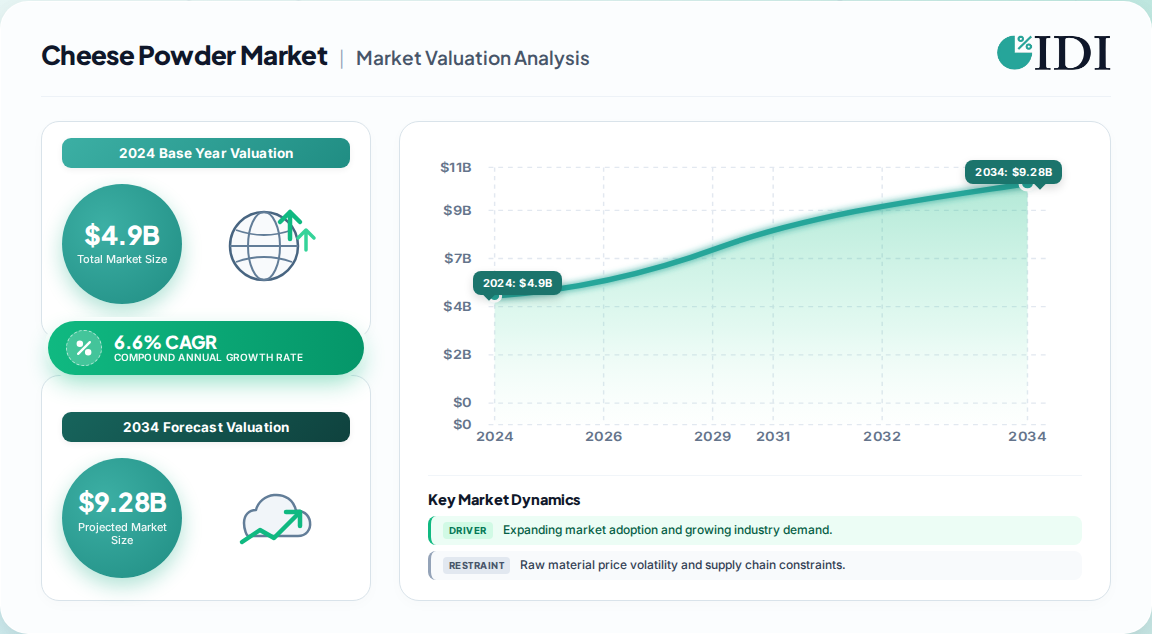
The global cheese powder market was valued at 4.9 Billion in 2024 and is projected to reach 7.1 Billion by 2030, growing at a 6.6% CAGR.
North America leads with 35.2% revenue share in 2024, while Asia-Pacific is the fastest-growing region at a projected 9.6% CAGR through 2030.
Cheddar cheese powder dominates product demand with a 39.98% share of global revenue, driven by snack seasoning and ready-meal applications.
Snacks account for 25.93% of application revenue, but HoReCa/Foodservice captures an estimated 56.3% of total market revenue when channel consumption is included.
Leading vendors include Kerry Group, Land O'Lakes, Glanbia, Archer Daniels Midland, and DairiConcepts, competing on spray-drying technology and clean-label formulations.
Why this matters for decision-makers: Vendors must pivot toward clean-label, naturally colored cheese powders and invest in electrostatic spray-drying to avoid margin compression as raw milk price volatility and plant-based alternatives squeeze traditional formulations.
Cheese Powder Market Market Size (In Billion)
7.5B
6.0B
4.5B
3.0B
1.5B
0
4.900 B
2024
5.200 B
2025
5.500 B
2026
5.900 B
2027
6.300 B
2028
6.700 B
2029
7.100 B
2030
Cheese Powder Market Market Size (In Billion)
Year
Market Size
2024
4.900 B
2025
5.200 B
2026
5.500 B
2027
5.900 B
2028
6.300 B
2029
6.700 B
2030
7.100 B
What is the Cheese Powder Market?
The cheese powder market covers dehydrated cheese products manufactured via spray-drying or drum-drying, used as shelf-stable flavor ingredients in snacks, sauces, ready meals, bakery, and foodservice. It serves as a convenient, long-life substitute for hard cheese, offering consistent flavor profiles and reduced logistics costs across the food processing value chain.
Scope: what this report covers and excludes
This report covers global cheese powder production, trade, and consumption across all major product types (cheddar, mozzarella, parmesan, blue cheese, Swiss, and other blends) and applications (snacks, bakery, soups and sauces, ready meals, food processing, and HoReCa/foodservice). This analysis does not cover adjacent markets such as natural hard cheese, processed cheese slices, cheese flavorings derived from synthetic compounds, or plant-based cheese alternatives except where referenced as competitive substitutes.
How big is the market for Cheese Powder Market?
The most defensible base-year valuation is 4.9 Billion in 2024, reflecting the broadest product and application coverage including foodservice channel consumption. A competing estimate of 1.63 Billion in 2025 likely excludes HoReCa and foodservice revenue, focusing only on packaged industrial ingredient sales.
Estimate
Base Year
Horizon
CAGR
Definition / Scope
Attribution
4.9 Billion
2024
2030
6.6%
Total cheese powder including foodservice and industrial
Commercial and household segments, narrower channel coverage
Another published estimate
Our analysis suggests the 4.9 Billion figure is most defensible for strategic planning because it captures the full HoReCa channel, which represents an estimated 56% of total consumption. The lower estimates likely reflect only packaged ingredient sales to food manufacturers, omitting the large foodservice seasoning and sauce base market where cheese powder is a critical input.
How is the market segmented?
Segmentation follows product type and application, with cheddar dominating product demand and snacks leading application revenue. Foodservice channel consumption is the largest end-use block when fully captured.
Parent Segment
Children
By Product
Cheddar, Mozzarella, Parmesan, Blue Cheese, Swiss, Other Blends
North America leads with an estimated 35–39% revenue share in 2024, anchored by US snack-seasoning demand and a robust export position. Europe follows at approximately 27.5%, while Asia-Pacific is the fastest-growing region at a 9.6% CAGR.
Cheese Powder Market Regional Market Share
Loading chart...
Cheese Powder Market Regional Market Share
Region
Market Share (%)
North America
0.36%
Europe
0.27%
Asia-Pacific
0.24%
South America
0.07%
Middle East & Africa
0.06%
Region
Share Estimate
North America
36%
Europe
27%
Asia-Pacific
24%
South America
7%
Middle East & Africa
6%
What is driving growth — and what is holding it back?
Convenience food demand and QSR expansion are the primary growth engines, while raw milk price volatility and plant-based substitution represent the most significant restraints.
Factor
Direction
Evidence Strength
Mechanism
QSR chain expansion in emerging markets
Driver
High
+1.4% CAGR impact; menu localization drives cheese-flavored items
Spray-drying technology advancement
Driver
High
+1.1% CAGR; preserves volatile flavors, reduces energy costs
Clean-label reformulation
Driver
Medium
+0.9% CAGR; EU Farm-to-Fork and FDA natural flavor guidance
Raw milk price volatility
Restraint
High
-0.7% CAGR; milk solids are majority of production cost
-0.4% CAGR; limits cross-border trade in South America and MEA
The balance of evidence suggests drivers outpace restraints by a factor of nearly 3:1 in CAGR impact, but the volatility of raw milk prices introduces short-term margin risk that can overwhelm operational efficiency gains. Our analysis indicates that manufacturers with long-term fixed-price supply contracts are most exposed to dairy commodity swings, while those with flexible pricing clauses and diversified dairy sourcing will sustain margins through 2030.
Who are the leading vendors?
The competitive landscape is moderately concentrated, with Kerry Group, Land O'Lakes, and Glanbia leading through scale, spray-drying capacity, and clean-label formulation expertise.
Company
Headquarters
Core Strength
Strategic Focus
Kerry Group
Ireland
Taste and nutrition portfolio
Clean-label enzyme-modified cheese powders
Land O'Lakes
USA
Dairy supply chain integration
Foodservice and industrial cheese powders
Glanbia
Ireland
Nutritional ingredients
High-protein and functional cheese powders
Archer Daniels Midland
USA
Global ingredient distribution
Private-label and formulation services
DairiConcepts
USA
Specialty dairy ingredients
Custom cheese powder blends for snacks
Lactosan
Denmark
Specialty cheese powders
Premium aged-cheese powder formats
Differentiation hinges on flavor authenticity retention through advanced drying techniques and the ability to offer clean-label, naturally colored products that comply with evolving FDA and EU regulations. Smaller players compete on specialty aged-cheese formats commanding 2.5–3× the price of standard cheddar powder.
What do buyers and operators need to know?
Procurement decisions should prioritize flavor consistency across batches, shelf-life stability, and regulatory compliance with clean-label mandates. Switching costs are moderate to high due to reformulation requirements and sensory validation cycles, so buyers should negotiate multi-year contracts with quality-linked pricing. The most significant procurement risk is raw milk price volatility, which can erode margins on fixed-price agreements; operators should include commodity-indexed pricing clauses. Regulatory compliance is mission-critical: the EU Farm-to-Fork Strategy targets a 50% reduction in artificial additives by 2030, and the FDA's updated natural flavor guidance finalized in Q3 2024 has already pushed major CPG companies to reformulate with annatto-colored cheese powders, avoiding titanium dioxide and artificial yellow dyes. Buyers who lock in supply of compliant, naturally colored cheese powder early will avoid the premium pricing that will likely emerge as demand outpaces supply of clean-label compliant ingredients.
Strategic Recommendations & Analyst Perspective
The balance of evidence favors a bullish medium-term outlook for cheese powder, with the 6.6% CAGR to 2030 representing a conservative baseline given the 9.6% growth projected for Asia-Pacific and the structural shift toward shelf-stable ingredients in foodservice. The strongest counter-argument is that plant-based alternatives could erode household demand faster than expected in North America and Europe, but our analysis suggests this is a long-tail risk rather than a near-term disruption, because plant-based cheese powders still struggle to match the flavor authenticity and cost profile of dairy-based powders in industrial applications.
For investors: Prioritize exposure to companies with electrostatic spray-drying capabilities and established clean-label portfolios, as these will capture premium pricing as regulatory deadlines tighten.
For operators: Secure multi-year supply agreements with commodity-indexed pricing to hedge raw milk volatility, and validate alternative suppliers in Asia-Pacific to reduce single-region concentration risk.
For vendors: Invest in private-label expansion in emerging retail markets, where organized retail growth is outpacing branded penetration and cheese-flavored snacks are gaining share.
The evidence that would change our conclusion is a faster-than-expected decline in dairy consumption in North America or Europe driven by regulatory or consumer shifts, or a breakthrough in plant-based cheese powder technology that achieves cost and flavor parity with dairy. Absent these, the market trajectory remains firmly positive through 2030.
Cheese Powder Market Regional Market Share
Higher Coverage
Lower Coverage
No Coverage
Cheese Powder Market REPORT HIGHLIGHTS
Research Methodology & Data Sources
Our rigorous research methodology combines multi-layered approaches with comprehensive quality assurance, ensuring precision, accuracy, and reliability in every market analysis.
Primary Research & Industry Fieldwork
Our research methodology is built on a 70/30 primary-to-secondary research split, ensuring that market estimates are grounded in direct industry validation. We conducted in-depth interviews with stakeholders across the value chain, including raw material suppliers, specialized cheese powder producers, contract formulators and blenders, global distributors, and foodservice operators. Interviews were conducted with decision-makers holding titles such as VP of Sourcing, Heads of R&D, Technical Directors, and Commercial Operations Leads. This fieldwork captured granular insights into capacity utilization, pricing dynamics, formulation trends, and procurement criteria that are not available through public sources.
Key Stakeholders Interviewed
Key Stakeholders Interviewed
Stakeholder Role
Interview Share (%)
VP of Sourcing & Procurement Directors
35%
Heads of R&D & Technical Directors
30%
Commercial Operations Leads
20%
Regulatory Affairs Managers
15%
Industry Ecosystem Breakdown
Industry Ecosystem Breakdown
Company Type
Representation (%)
Raw Material & Dairy Suppliers
45%
Specialized Cheese Powder Producers
30%
Contract Formulators & Blenders
15%
Global Distributors & Traders
10%
Secondary Benchmarking & Public Trade Validation
We triangulated primary findings against official multilateral trade databases including UN Comtrade, WTO tariff schedules, US ITC trade data, and Eurostat dairy trade statistics. Corporate annual filings, SEC 10-K reports, and investor presentations provided capacity and revenue validation. Patent databases were analyzed for spray-drying and clean-label innovation trends, while industry associations and technical standards bodies provided regulatory and quality benchmarks.
Demand Modeling & Market Sizing Triangulation
Our market sizing employs simultaneous top-down and bottom-up triangulation. The top-down approach allocates macroeconomic food processing and foodservice output to cheese powder consumption by segment. The bottom-up approach models manufacturer capacity, product pricing, and end-use consumption across industrial, foodservice, and household channels. Divergences between the two methods are reconciled through weighted regression analysis.
UK Cheese Powder Market Revenue (Billion) Forecast, by Application 2020 & 2034
Frequently Asked Questions
1. What is the current size of the cheese powder market?
The global cheese powder market was valued at 4.9 Billion in 2024 and is projected to reach 7.1 Billion by 2030, growing at a 6.6% CAGR, according to the broadest estimate covering both industrial and foodservice channels.
2. Which region dominates the cheese powder market?
North America leads with approximately 35.2% revenue share in 2024, anchored by US snack-seasoning demand. Europe follows at 27.5%, while Asia-Pacific is the fastest-growing region at a 9.6% CAGR.
3. What is the most popular cheese powder product type?
Cheddar cheese powder dominates with a 39.98% share of global revenue in 2024, driven by snack seasonings, sauces, and ready-meal applications. Mozzarella is forecast to grow fastest through 2030.
4. What are the main drivers of cheese powder market growth?
Convenience food demand, QSR chain expansion in emerging markets, spray-drying technology advancement, and clean-label reformulation are the primary growth drivers, collectively adding over 3% to CAGR.
5. Who are the leading companies in the cheese powder market?
Kerry Group, Land O'Lakes, Glanbia, Archer Daniels Midland, DairiConcepts, and Lactosan are the leading vendors, competing on spray-drying technology, clean-label formulations, and specialty aged-cheese formats.
Figure 18: Asia Pacific Cheese Powder Market Revenue (Billion), by Product 2026 & 2034
Figure 19: Asia Pacific Cheese Powder Market Revenue Share (%), by Product 2026 & 2034
Figure 20: Asia Pacific Cheese Powder Market Revenue (Billion), by Application 2026 & 2034
Figure 21: Asia Pacific Cheese Powder Market Revenue Share (%), by Application 2026 & 2034
Figure 22: Asia Pacific Cheese Powder Market Revenue (Billion), by Channel 2026 & 2034
Figure 23: Asia Pacific Cheese Powder Market Revenue Share (%), by Channel 2026 & 2034
Figure 24: Asia Pacific Cheese Powder Market Revenue (Billion), by Country 2026 & 2034
Figure 25: Asia Pacific Cheese Powder Market Revenue Share (%), by Country 2026 & 2034
Figure 26: South America Cheese Powder Market Revenue (Billion), by Product 2026 & 2034
Figure 27: South America Cheese Powder Market Revenue Share (%), by Product 2026 & 2034
Figure 28: South America Cheese Powder Market Revenue (Billion), by Application 2026 & 2034
Figure 29: South America Cheese Powder Market Revenue Share (%), by Application 2026 & 2034
Figure 30: South America Cheese Powder Market Revenue (Billion), by Channel 2026 & 2034
Figure 31: South America Cheese Powder Market Revenue Share (%), by Channel 2026 & 2034
Figure 32: South America Cheese Powder Market Revenue (Billion), by Country 2026 & 2034
Figure 33: South America Cheese Powder Market Revenue Share (%), by Country 2026 & 2034
Figure 34: Middle East & Africa Cheese Powder Market Revenue (Billion), by Product 2026 & 2034
Figure 35: Middle East & Africa Cheese Powder Market Revenue Share (%), by Product 2026 & 2034
Figure 36: Middle East & Africa Cheese Powder Market Revenue (Billion), by Application 2026 & 2034
Figure 37: Middle East & Africa Cheese Powder Market Revenue Share (%), by Application 2026 & 2034
Figure 38: Middle East & Africa Cheese Powder Market Revenue (Billion), by Channel 2026 & 2034
Figure 39: Middle East & Africa Cheese Powder Market Revenue Share (%), by Channel 2026 & 2034
Figure 40: Middle East & Africa Cheese Powder Market Revenue (Billion), by Country 2026 & 2034
Figure 41: Middle East & Africa Cheese Powder Market Revenue Share (%), by Country 2026 & 2034
Table 17:
Table 18: France Cheese Powder Market Revenue (Billion) Forecast, by Application 2020 & 2034