Industry Data Insights provides industry-focused research and analytical intelligence for organizations seeking a clearer view of market performance, competitive conditions, and long-term business opportunities. Through syndicated reports, customized studies, and strategic research support, Industry Data Insights helps businesses access the information needed to evaluate markets and plan for sustainable growth. Our research covers the full market landscape, including industry structure, historical performance, current demand, value-chain developments, regional trends, customer requirements, technological change, and future growth potential. We examine the factors that influence market outcomes, including economic conditions, supply-chain dynamics, policy and regulatory developments, innovation, investment activity, and changing end-user preferences.
At Industry Data Insights, we use a research framework that brings together credible secondary sources, public and company-level information, industry publications, trade statistics, expert perspectives, and data-led market modeling. Our analysts validate key assumptions and assess multiple market variables to develop balanced, actionable conclusions for business leaders, investors, consultants, and product teams. Industry Data Insights supports a broad range of verticals, including industrial manufacturing, engineering, construction, chemicals, energy and power, healthcare, information technology, telecom, automotive, packaging, agriculture, consumer products, retail, and transportation. Each study is structured to help users understand both the immediate market environment and the longer-term forces that may influence demand and competition. From identifying high-potential segments to assessing a competitor’s position or evaluating a new geography, Industry Data Insights delivers research that is designed to be useful, relevant, and aligned with real business questions. Our goal is to turn industry data into strategic direction.
Europe Home Fragrance Diffuser Market Report by Type (Reed Diffusers, Heat Diffusers, Ultrasonic Diffusers, Nebulizing Diffusers, Evaporative Diffusers, Others), by Distribution Channel (Specialty Retail Stores, Hypermarkets & Supermarkets, Online/E-commerce, Others), by Europe (Germany, UK, France, Italy, Spain, Russia, Rest of Europe) Forecast 2026-2034
Europe Home Fragrance Diffuser Market Report 2025
Discover the Latest Market Insight Reports
Access in-depth insights on industries, companies, trends, and global markets. Our expertly curated reports provide the most relevant data and analysis in a condensed, easy-to-read format.
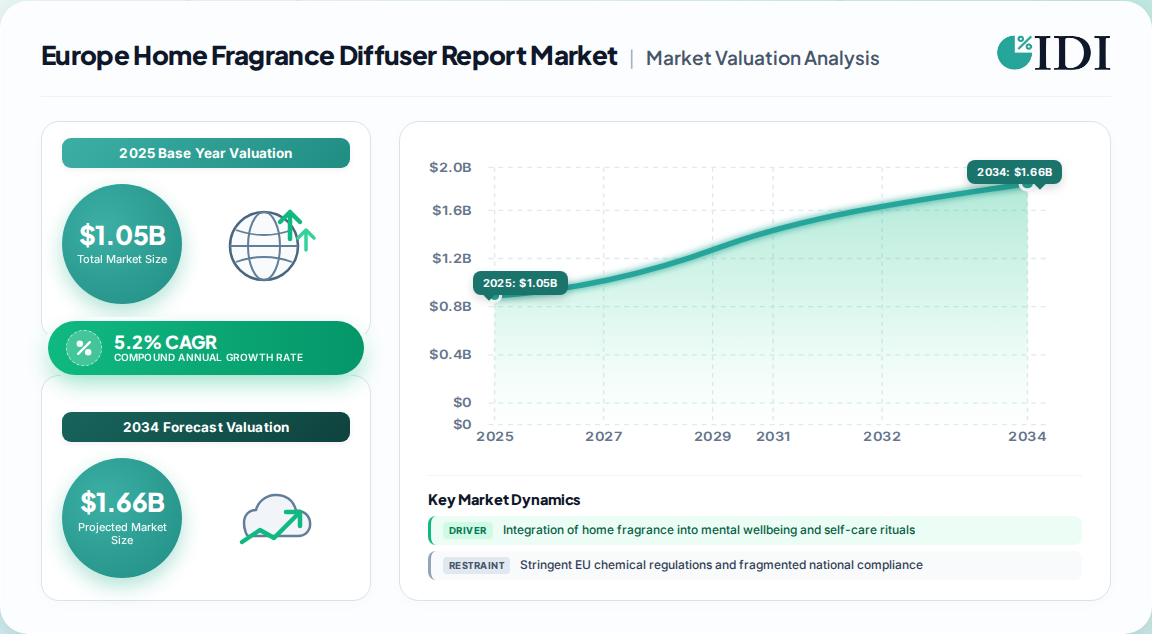
The Europe home fragrance diffuser market is estimated at 1.05 Billion in 2025, on track to reach 1.52 Billion by 2030 at a 5.2% CAGR (2025–2030).
Growth is anchored by Germany, which held the largest country share in 2022 and is projected to reach a market value of 244 Million by 2029.
France is the fastest-accelerating major country, posting a 6% CAGR, while the UK registers a more modest 4.3% CAGR over the same horizon.
Reed diffusers remain the volume backbone, but ultrasonic and nebulizing formats are the fastest-growing type segments, propelled by smart-home integration.
Sustainability is now a purchase gatekeeper: refillable, recyclable, and essential-oil-based propositions command premium shelf space across Nordic and Western Europe.
The competitive field blends luxury houses (Diptyque, Jo Malone London), lifestyle brands (NEST, Bath & Body Works), and niche specialists (Paddywax, Agraria).
Why this matters for decision-makers: Vendors that do not embed refill ecosystems and clean-label certification into their 2026–2028 roadmaps risk margin compression as private-label and mass retailers close the quality gap.
Europe Home Fragrance Diffuser Market Report Market Size (In Billion)
1.5B
1.0B
500.0M
0
1.050 B
2025
1.100 B
2026
1.160 B
2027
1.220 B
2028
1.280 B
2029
1.350 B
2030
Europe Home Fragrance Diffuser Market Report Market Size (In Billion)
Year
Market Size
2025
1.050 B
2026
1.100 B
2027
1.160 B
2028
1.220 B
2029
1.280 B
2030
1.350 B
What is the Europe Home Fragrance Diffuser Market Report?
The Europe Home Fragrance Diffuser Market Report is an executive-level analysis of the products, channels, and country dynamics that shape scent-diffusion demand across Europe. It quantifies market size, forecasts growth to 2030, segments by type and distribution channel, and profiles the vendors competing for share across Germany, the UK, France, Italy, Spain, and Russia.
Scope: what this report covers and excludes
This report covers the Europe home fragrance diffuser market across five product types (reed, heat, ultrasonic, nebulizing, evaporative, plus others) and four distribution channels (specialty retail, hypermarkets/supermarkets, online/e-commerce, others). Country coverage spans Germany, UK, France, Russia, Spain, Italy, and Rest of Europe. The analysis does not cover home fragrance candles, room sprays, incense, or automotive air fresheners except where they inform category context; nor does it address commercial/institutional scenting beyond its spillover effect on consumer demand.
How big is the market for Europe Home Fragrance Diffuser Market Report?
The most defensible base-year estimate is 1.05 Billion (2025), derived from the published 5.2% CAGR trajectory and Germany's 244 Million 2029 benchmark. Two independent published estimates bracket the opportunity, and their divergence is definitional rather than contradictory.
Estimate
Base year
Horizon
CAGR
Definition / scope
Attribution
1.05 Billion
2025
2030
5.2%
Europe diffusers only (reed, heat, ultrasonic, nebulizing, evaporative)
One published estimate
8.97 Billion
2026
2034
5.81%
Europe home fragrance including candles, sprays, diffusers
A competing analysis
3.8 Billion
2030
2030
5.6%
Global home fragrance diffusers
One published estimate
Our analysis suggests the diffuser-only figure is the correct planning base for category specialists. The wider 8.97 Billion home-fragrance number is directionally useful for sizing wallet share, but it inflates the addressable diffuser pool by roughly 8x because candles dominate format share (34.2% per the broader dataset). Buyers should anchor budgets to the diffuser-only series and treat the broader figure as a ceiling for category-adjacent expansion.
How is the market segmented?
Segmentation follows two non-geographic parents — product type and distribution channel — with type capturing the innovation premium and channel capturing the shift to digital discovery.
Reed diffusers benefit from low price points and zero-power operation, making them the default entry product. Ultrasonic and nebulizing units, however, carry higher ticket prices and attach naturally to smart-home ecosystems, which is where premiumization is concentrated. Online/e-commerce is the channel to watch: the broader home-fragrance dataset puts online at 41.7% of 2025 revenue, and diffuser SKUs are disproportionately suited to subscription and refill replenishment models.
Which countries lead in Europe Home Fragrance Diffuser Market Report?
Germany leads the European diffuser market, with the UK and France forming the next tier and France growing fastest among the majors. The geography tree below mirrors the report's country structure; exact diffuser-only country shares are not published, so the tree is the primary planning artifact.
Europe
Germany — largest country market; 244 Million projected by 2029
UK — mature, high-frequency purchase base; 4.3% CAGR
France — fastest major grower; 6% CAGR
Italy — artisanal and designer-led demand
Spain — wellness-led adoption
Russia — price-sensitive, volume-oriented
Rest of Europe — Nordics, Benelux, and CEE as emerging pockets
Germany's leadership rests on three reinforcing factors: strict eco-certification demand that rewards compliant premium brands, a wellness-driven consumer base, and the largest absolute spend on homecare perfumes in the region. France's 6% CAGR is the standout signal — its perfumery heritage gives diffusers cultural permission to premiumize faster than in price-led markets. This divergence implies that a single pan-European pricing architecture will under-monetize France and over-price Russia.
What is driving growth — and what is holding it back?
Growth is balanced but not uniform: demand-side wellness and technology drivers are strong, while regulatory and raw-material restraints are structural rather than cyclical.
Factor
Direction
Evidence strength
Mechanism
Wellness and self-care ritualization
Driver
Strong
Diffusers reframed as stress/sleep tools, driving replenishment
Middle/upper-class expansion and spa/hospitality influence
EU chemical regulation and national fragmentation
Restraint
Strong
Compliance cost and reformulation cycles slow launches
Indoor air quality sensitivity
Restraint
Moderate
Consumer scrutiny of VOCs and phthalates
Natural raw material volatility
Restraint
Moderate
Essential-oil price swings pressure margins
Private-label competition
Restraint
Strong
Mass retailers compress premium price umbrella
Our analysis suggests the driver-restraint balance favors growth through 2027, but the composition of growth shifts from volume to value. The regulatory restraint is the most under-priced risk in most vendor plans: ECHA Candidate List updates can force reformulation with 12–18 month lead times, and fragmented national compliance multiplies SKU complexity across seven-plus markets.
Who are the leading vendors?
The vendor field is stratified into luxury heritage houses, lifestyle and specialty brands, and digital-native challengers — each with a distinct moat.
Company
Positioning
Primary moat
Diptyque SAS (Manzanita Capital)
Luxury heritage
Brand equity and perfumery credibility
Jo Malone London (Estée Lauder)
Premium lifestyle
Gifting architecture and retail experience
NEST Fragrances (North Castle Partners)
Premium specialty
Scent design and department-store distribution
CURiO Brands (Capri Blue)
Accessible premium
Signature scent recognition and gifting
Bath & Body Works
Mass-premium
Scale, promotions, and channel reach
Paddywax (Designworks Investments)
Design-led
Artisanal aesthetic and price-value balance
Aromatique Inc.
Specialty
Botanical, decorative positioning
Agraria San Francisco
Luxury niche
Heritage packaging and home decor adjacency
The Yankee Candle Company (Newell Brands)
Mass
Distribution breadth and brand recall
Scentsy, Inc.
Direct sales
Consultant network and recurring revenue
Differentiation is shifting from scent alone to system-level propositions: refill availability, device connectivity, and certification. Luxury houses defend with brand and perfumery authority; mass players defend with shelf access and price. The vulnerable middle is unbranded mid-premium — squeezed by both ends and most exposed to private-label substitution.
What do buyers and operators need to know?
Procurement decisions in this category hinge on four mission-critical criteria: regulatory conformity, refill compatibility, channel fit, and scent-format durability. EU chemical compliance is not a checkbox — it is a continuous obligation, and vendors that cannot evidence ECHA-aligned formulations create downstream liability for retailers and distributors. Switching costs are moderate for reed and evaporative formats but rise sharply for ultrasonic and nebulizing devices, where device-refill lock-in and app ecosystems create multi-year customer relationships. Operators should also stress-test supply: natural raw material volatility can move unit economics within a single season, so dual-sourcing of fragrance concentrates is prudent. Finally, channel economics differ materially — online favors subscription and refill bundles, while specialty retail favors discovery and gifting. Buyers who model a single blended channel margin will misallocate assortment and promotional spend.
Strategic Recommendations & Analyst Perspective
The balance of evidence favors a value-over-volume strategy: the Europe diffuser market will grow at 5.2% through 2030, but the profit pool is migrating toward refill ecosystems, certified clean-label formulations, and connected devices. The strongest counter-argument is that price-led mass adoption could outrun premiumization in Russia and parts of Southern Europe — and that is a real risk. But Germany's regulatory bar and France's 6% CAGR suggest the premium tier expands faster than the discount tier in the markets that set category standards.
Our judgment: vendors should treat sustainability certification not as marketing but as market access. The refillable-diffuser model simultaneously answers regulatory pressure, consumer clean-label demand, and margin defense against private label — a rare triple alignment. The weakest strategic position is a mid-premium brand without certification or refill capability; that is the segment most likely to be disintermediated by 2028.
Actionable strategy for operators and investors:
Prioritize refill-compatible product architectures and subscription-ready online bundles to capture recurring revenue and defend against private label.
Localize pricing and assortment by country tier — premiumize France and Germany, value-engineer Russia and Rest of Europe — rather than running one pan-European architecture.
Build ECHA-aligned reformulation capability in-house or via contract formulators to shorten compliance cycles and protect launch calendars.
What would change our conclusion: if mass retailers successfully launch certified, refillable private-label lines at parity quality, the premiumization thesis weakens materially; conversely, if ultrasonic/nebulizing smart devices cross 25% of type share before 2028, growth could exceed the 5.2% base case. The full report contains the sub-segment forecasts and country-level compliance maps needed to stress-test these scenarios.
Europe Home Fragrance Diffuser Market Report Regional Market Share
Loading chart...
Europe Home Fragrance Diffuser Market Report Regional Market Share
Region
Market Share (%)
Germany
0.27%
UK
0.21%
France
0.24%
Italy
0.11%
Spain
0.08%
Russia
0.04%
Rest of Europe
0.05%
Europe Home Fragrance Diffuser Market Report Regional Market Share
Higher Coverage
Lower Coverage
No Coverage
Europe Home Fragrance Diffuser Market Report REPORT HIGHLIGHTS
Research Methodology & Data Sources
Our rigorous research methodology combines multi-layered approaches with comprehensive quality assurance, ensuring precision, accuracy, and reliability in every market analysis.
Primary Research & Industry Fieldwork
This study applies a 70/30 primary-to-secondary research split. In-depth interviews were conducted with stakeholders across the value chain, including essential-oil and fragrance concentrate suppliers, specialized diffuser manufacturers, contract formulators and fillers, and pan-European distributors. Decision-maker designations interviewed included VP-level Sourcing leads, Heads of R&D, Technical Directors, and Commercial Operations Leads, ensuring both formulation and go-to-market perspectives are captured.
Key Stakeholders Interviewed
Key Stakeholders Interviewed
Stakeholder Role
Interview Share (%)
Sourcing & Procurement Leads
35%
R&D & Technical Directors
30%
Commercial & Channel Operations
20%
Regulatory & Quality Managers
15%
Industry Ecosystem Breakdown
Industry Ecosystem Breakdown
Company Type
Representation (%)
Fragrance & Essential Oil Suppliers
40%
Diffuser Manufacturers & Formulators
35%
Distributors & Retail Buyers
25%
Secondary Benchmarking & Public Trade Validation
Secondary validation draws on official multilateral trade databases (UN Comtrade, Eurostat), corporate annual filings and investor presentations (10-K, SEC filings), patent databases, and recognized non-profit technical standards and industry associations. These sources anchor import/export flow estimates and cross-border pricing benchmarks, ensuring the sizing is grounded in observable trade and disclosure rather than survey sentiment alone.
Demand Modeling & Market Sizing Triangulation
Market sizing combines simultaneous Top-Down allocation (macroeconomic homecare spend, category share, and channel allocation) with Bottom-Up modeling (manufacturer capacity, product pricing, and end-use consumption by country). Triangulating both directions reduces single-source bias and produces a defensible base-year value and compound forecast.
Eurostat — intra-EU trade and household consumption statistics
UN Comtrade — fragrance and homecare product trade flows
European Chemicals Agency (ECHA) — Candidate List and REACH compliance data
Cosmetics Europe / national fragrance associations — category standards and labeling guidance
Aspects
Details
Study Period
2020-2034
Base Year
2025
Estimated Year
2026
Forecast Period
2026-2034
Historical Period
2020-2025
Growth Rate
CAGR of 5.2% from 2020-2034
Segmentation
By Type
Reed Diffusers
Heat Diffusers
Ultrasonic Diffusers
Nebulizing Diffusers
Evaporative Diffusers
Others
By Distribution Channel
Specialty Retail Stores
Hypermarkets & Supermarkets
Online/E-commerce
Others
By Geography
Europe
Germany
UK
France
Italy
Spain
Russia
Rest of Europe
Table of Contents
1. Europe Home Fragrance Diffuser Market Report Introduction
1.1. Research Scope
1.2. Market Segmentation
1.3. Research Objective
1.4. Definitions and Assumptions
2. Europe Home Fragrance Diffuser Market Report Executive Summary
2.1. Market Snapshot
3. Europe Home Fragrance Diffuser Market Report Dynamics
3.1. Introduction
3.2. Market Drivers
3.2.1. Integration of home fragrance into mental wellbeing and self-care rituals
3.2.2. Expansion of sustainable and clean-label consumer expectations
3.2.3. Rising per-capita spending on homecare and fragrance products
3.2.4. Smart diffuser technology and connected ecosystem adoption
3.2.5. Premiumization of home ambiance and gifting culture
3.3. Market Restrains
3.3.1. Stringent EU chemical regulations and fragmented national compliance
3.3.2. Growing consumer sensitivity and indoor air quality concerns
3.3.3. Volatility in natural raw material supply and ethical sourcing pressure
3.3.4. Intensifying competition from private labels and mass retailers
3.4. Market Trends
3.4.1. Smart diffusers with app control and scent personalization
3.4.2. Refillable and recyclable eco-conscious product systems
3.4.3. Floral and botanical scent preference rooted in European perfumery heritage
3.4.4. Online DTC subscription and replenishment models
3.4.5. Multi-sensory integration with interior design and smart home ecosystems
4. Europe Home Fragrance Diffuser Market Report Factor Analysis
4.1. Porters Five Forces
4.1.1. Bargaining Power of Suppliers
4.1.2. Bargaining Power of Buyers
4.1.3. Threat of New Entrants
4.1.4. Threat of Substitutes
4.1.5. Competitive Rivalry
4.2. PESTEL analysis
4.3. BCG Analysis
4.3.1. Stars (High Growth, High Market Share)
4.3.2. Cash Cows (Low Growth, High Market Share)
4.3.3. Question Mark (High Growth, Low Market Share)
4.3.4. Dogs (Low Growth, Low Market Share)
4.4. Ansoff Matrix Analysis
4.5. Supply Chain Analysis
4.6. Regulatory Landscape
4.7. Current Market Potential and Opportunity Assessment (TAM–SAM–SOM Framework)
4.8. IDI Analyst Note
5. Europe Home Fragrance Diffuser Market Report Analysis, Insights and Forecast, 2020-2034
5.1. Analysis, Insights and Forecast - by Type
5.1.1. Reed Diffusers
5.1.2. Heat Diffusers
5.1.3. Ultrasonic Diffusers
5.1.4. Nebulizing Diffusers
5.1.5. Evaporative Diffusers
5.1.6. Others
5.2. Analysis, Insights and Forecast - by Distribution Channel
5.2.1. Specialty Retail Stores
5.2.2. Hypermarkets & Supermarkets
5.2.3. Online/E-commerce
5.2.4. Others
5.3. Analysis, Insights and Forecast - by Region
5.3.1. Europe
6. Europe Home Fragrance Diffuser Market Report Competitive Analysis
6.1. Company Profiles
6.1.1. Diptyque SAS (Manzanita Capital UK LLP)
6.1.1.1. Company Overview
6.1.1.2. Products
6.1.1.3. Company Financials
6.1.1.4. SWOT Analysis
6.1.2. Jo Malone London (The Estee Lauder Companies Inc.)
6.1.2.1. Company Overview
6.1.2.2. Products
6.1.2.3. Company Financials
6.1.2.4. SWOT Analysis
6.1.3. NEST Fragrances (North Castle Partners LLC)
6.1.3.1. Company Overview
6.1.3.2. Products
6.1.3.3. Company Financials
6.1.3.4. SWOT Analysis
6.1.4. CURiO Brands (Capri Blue LLC)
6.1.4.1. Company Overview
6.1.4.2. Products
6.1.4.3. Company Financials
6.1.4.4. SWOT Analysis
6.1.5. Bath & Body Works Inc.
6.1.5.1. Company Overview
6.1.5.2. Products
6.1.5.3. Company Financials
6.1.5.4. SWOT Analysis
6.1.6. Paddywax LLC (Designworks Investments)
6.1.6.1. Company Overview
6.1.6.2. Products
6.1.6.3. Company Financials
6.1.6.4. SWOT Analysis
6.1.7. Aromatique Inc.
6.1.7.1. Company Overview
6.1.7.2. Products
6.1.7.3. Company Financials
6.1.7.4. SWOT Analysis
6.1.8. Agraria San Francisco Inc.
6.1.8.1. Company Overview
6.1.8.2. Products
6.1.8.3. Company Financials
6.1.8.4. SWOT Analysis
6.1.9. The Yankee Candle Company (Newell Brands Inc.)
7. Europe Home Fragrance Diffuser Market Report Research Methodology
List of Figures
Figure 1: Europe Home Fragrance Diffuser Market Report Revenue Breakdown (Billion, %) by Product 2026 & 2034
Figure 2: Europe Home Fragrance Diffuser Market Report Value Share (%), by Type 2026 & 2034
Figure 3: Europe Home Fragrance Diffuser Market Report Value Share (%), by Distribution Channel 2026 & 2034
Figure 4: Europe Home Fragrance Diffuser Market Report Share (%) by Company 2026
List of Tables
Table 1: Europe Home Fragrance Diffuser Market Report Revenue Billion Forecast, by Type 2020 & 2034
Table 2: Europe Home Fragrance Diffuser Market Report Revenue Billion Forecast, by Distribution Channel 2020 & 2034
Table 3: Europe Home Fragrance Diffuser Market Report Revenue Billion Forecast, by Region 2020 & 2034
Table 4: Europe Europe Home Fragrance Diffuser Market Report Revenue Billion Forecast, by Type 2020 & 2034
Table 5: Europe Europe Home Fragrance Diffuser Market Report Revenue Billion Forecast, by Distribution Channel 2020 & 2034
Table 6: Europe Europe Home Fragrance Diffuser Market Report Revenue Billion Forecast, by Country 2020 & 2034
Table 7: Germany Europe Home Fragrance Diffuser Market Report Revenue (Billion) Forecast, by Application 2020 & 2034
Table 8: UK Europe Home Fragrance Diffuser Market Report Revenue (Billion) Forecast, by Application 2020 & 2034
Table 9: France Europe Home Fragrance Diffuser Market Report Revenue (Billion) Forecast, by Application 2020 & 2034
Table 10: Italy Europe Home Fragrance Diffuser Market Report Revenue (Billion) Forecast, by Application 2020 & 2034
Table 11: Spain Europe Home Fragrance Diffuser Market Report Revenue (Billion) Forecast, by Application 2020 & 2034
Table 12: Russia Europe Home Fragrance Diffuser Market Report Revenue (Billion) Forecast, by Application 2020 & 2034
Table 13: Rest of Europe Europe Home Fragrance Diffuser Market Report Revenue (Billion) Forecast, by Application 2020 & 2034
Frequently Asked Questions
1. How big is the Europe home fragrance diffuser market?
The Europe home fragrance diffuser market is estimated at 1.05 Billion in 2025 and is projected to reach 1.52 Billion by 2030, growing at a 5.2% CAGR. The estimate reflects diffuser-only products and excludes candles and room sprays.
2. Which country leads the European diffuser market?
Germany leads the European diffuser market and is projected to reach a market value of 244 Million by 2029. The UK and France follow, with France growing fastest among the major markets at a 6% CAGR.
3. What is the fastest-growing diffuser type in Europe?
Ultrasonic and nebulizing diffusers are the fastest-growing types, driven by smart-home integration and scent personalization. Reed diffusers remain the largest volume segment due to low price points and zero-power operation.
4. What is driving growth in the Europe diffuser market?
Growth is driven by wellness and self-care ritualization, smart diffuser technology, sustainability and clean-label demand, and rising per-capita homecare spending. Regulatory pressure and raw material volatility are the main restraints.
5. Who are the leading companies in the Europe home fragrance diffuser market?
Leading companies include Diptyque, Jo Malone London, NEST Fragrances, CURiO Brands, Bath & Body Works, Paddywax, Agraria, The Yankee Candle Company, and Scentsy. The field blends luxury heritage houses with lifestyle and mass-premium brands.