Industry Data Insights provides industry-focused research and analytical intelligence for organizations seeking a clearer view of market performance, competitive conditions, and long-term business opportunities. Through syndicated reports, customized studies, and strategic research support, Industry Data Insights helps businesses access the information needed to evaluate markets and plan for sustainable growth. Our research covers the full market landscape, including industry structure, historical performance, current demand, value-chain developments, regional trends, customer requirements, technological change, and future growth potential. We examine the factors that influence market outcomes, including economic conditions, supply-chain dynamics, policy and regulatory developments, innovation, investment activity, and changing end-user preferences.
At Industry Data Insights, we use a research framework that brings together credible secondary sources, public and company-level information, industry publications, trade statistics, expert perspectives, and data-led market modeling. Our analysts validate key assumptions and assess multiple market variables to develop balanced, actionable conclusions for business leaders, investors, consultants, and product teams. Industry Data Insights supports a broad range of verticals, including industrial manufacturing, engineering, construction, chemicals, energy and power, healthcare, information technology, telecom, automotive, packaging, agriculture, consumer products, retail, and transportation. Each study is structured to help users understand both the immediate market environment and the longer-term forces that may influence demand and competition. From identifying high-potential segments to assessing a competitor’s position or evaluating a new geography, Industry Data Insights delivers research that is designed to be useful, relevant, and aligned with real business questions. Our goal is to turn industry data into strategic direction.
France Sun Care Cosmetics Market Report by Product (Tinted Moisturizers, SPF Foundation, SPF BB Creams, SPF Primers, SPF Sunscreen, Others), by Type (Conventional, Organic), by Distribution Channel (Hypermarkets & Supermarkets, Specialty Stores, E-Commerce, Others), by France (Île-de-France, Auvergne-Rhône-Alpes, Provence-Alpes-Côte dAzur, Nouvelle-Aquitaine, Occitanie, Hauts-de-France, Grand Est, Other Regions) Forecast 2026-2034
France Sun Care Cosmetics Market Report 2025
Discover the Latest Market Insight Reports
Access in-depth insights on industries, companies, trends, and global markets. Our expertly curated reports provide the most relevant data and analysis in a condensed, easy-to-read format.
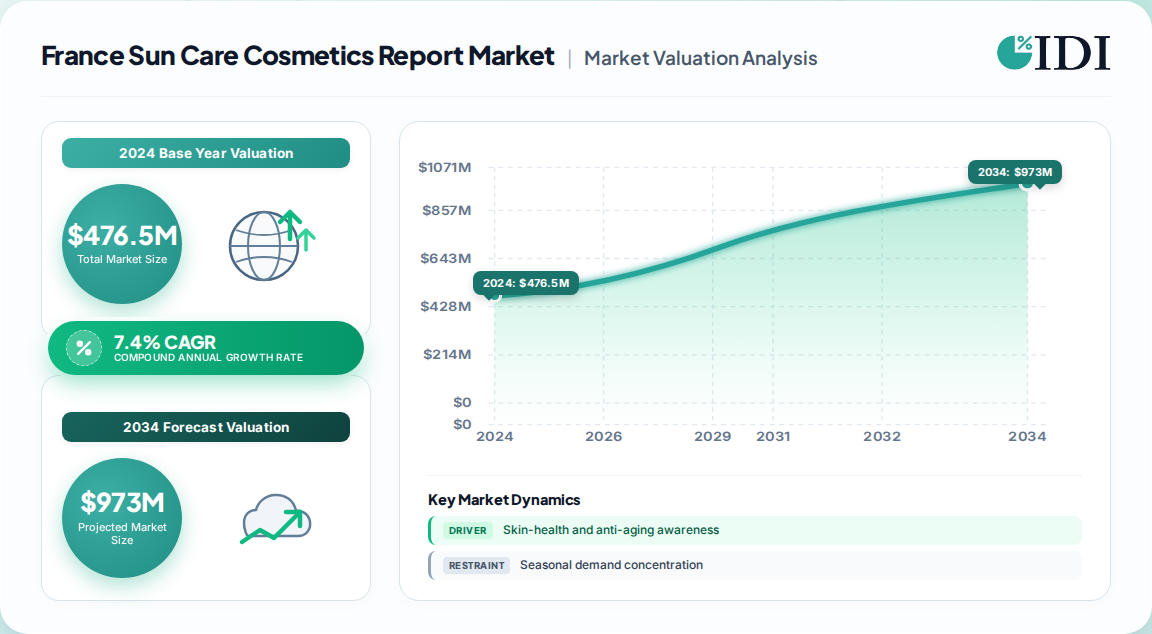
The France sun care cosmetics market was estimated at USD 476.5 million in 2024, with our base-case projection of USD 511.8 million for 2025.
Forecast CAGR of 7.4% from 2025 to 2033, reaching roughly USD 976 million by 2033 under the stated base.
SPF sunscreen is the largest product segment at 31.6% revenue share in 2024; tinted moisturizers grow fastest at 8.0% CAGR.
Conventional formulations hold 82.1% share; organic is the fastest-growing type at 7.9% CAGR.
Hypermarkets and supermarkets lead distribution at 37.1% share; e-commerce grows fastest at 8.2% CAGR.
Leading vendors include L'Oréal, Pierre Fabre, Beiersdorf, NAOS, Clarins, LVMH, Groupe Rocher and Sisley.
Why this matters for decision-makers: The French market rewards hybrid SPF-skincare positioning and pharmacy-grade trust; vendors without a credible dermo-cosmetic or clean-label story face margin compression as mass channels commoditize basic sunscreen.
France Sun Care Cosmetics Market Report Market Size (In Million)
750.0M
600.0M
450.0M
300.0M
150.0M
0
477.0 M
2024
512.0 M
2025
550.0 M
2026
590.0 M
2027
634.0 M
2028
681.0 M
2029
732.0 M
2030
France Sun Care Cosmetics Market Report Market Size (In Million)
Year
Market Size
2024
477.0 M
2025
512.0 M
2026
550.0 M
2027
590.0 M
2028
634.0 M
2029
681.0 M
2030
732.0 M
What is the France Sun Care Cosmetics Market Report?
The France sun care cosmetics market report quantifies revenue, segmentation and competitive dynamics for SPF-bearing cosmetic and skincare products sold in France, covering tinted moisturizers, SPF foundations, BB creams, primers and sunscreens across conventional and organic types, through mass, specialty, pharmacy and e-commerce channels.
Scope: what this report covers and excludes
This analysis covers consumer-facing sun care cosmetics sold in metropolitan France, including SPF-infused color cosmetics and daily facial sunscreens, across conventional and organic types and the major retail channels. This analysis does not cover professional/clinic-only sun protection, after-sun body care without SPF, self-tanning products, or industrial UV filters sold as raw materials.
How big is the market for France Sun Care Cosmetics Market Report?
The most defensible base-year figure is USD 476.5 million for 2024, but a competing regional analysis implies a materially faster French trajectory; reconciling the two is essential before committing capital.
Estimate
Base year
Horizon
CAGR
Definition / scope
Attribution
USD 476.5 million
2024
2025–2033
7.4%
Sun care cosmetics: SPF cosmetics + facial sunscreen, retail value
One published estimate
France CAGR 9.9% (Europe report)
2024
2025–2032
9.9%
Broader European sun care cosmetics including SPF lotions and sprays
A competing analysis
Europe CAGR 6.9%
2024
2025–2032
6.9%
Europe aggregate, all sun care cosmetics
A competing analysis
Global CAGR 7.54%
2024
2025–2035
7.54%
Global sun care cosmetics
A competing analysis
Our analysis suggests the 7.4% figure is the most defensible for France specifically, because it is anchored to a disclosed country base and a stated product and channel taxonomy. The 9.9% France CAGR sits inside a broader European report whose French scope appears to include SPF lotions and sprays, which mechanically inflates growth. The divergence implies that buyers should stress-test forecasts at 6.5%–8.5% rather than at the high end.
How is the market segmented?
The market segments cleanly along three axes — product form, formulation type and distribution channel — with hybrid SPF cosmetics the fastest-moving product cluster.
Which French region leads in France Sun Care Cosmetics Market Report?
Île-de-France leads on revenue concentration, reflecting pharmacy density, premium specialty retail and the highest per-capita spend on facial SPF, followed by Auvergne-Rhône-Alpes and Provence-Alpes-Côte d'Azur.
France Sun Care Cosmetics Market Report Regional Market Share
Loading chart...
France Sun Care Cosmetics Market Report Regional Market Share
Region
Market Share (%)
Île-de-France
0.31%
Auvergne-Rhône-Alpes
0.16%
Provence-Alpes-Côte d'Azur
0.13%
Nouvelle-Aquitaine
0.11%
Occitanie
0.09%
Hauts-de-France
0.08%
Grand Est
0.07%
Other Regions
0.05%
France
Île-de-France
Auvergne-Rhône-Alpes
Provence-Alpes-Côte d'Azur
Nouvelle-Aquitaine
Occitanie
Hauts-de-France
Grand Est
Other Regions
Region
Estimated share
Rationale
Île-de-France
31%
Highest income, pharmacy and specialty density, premium SPF demand
Auvergne-Rhône-Alpes
16%
Strong dermo-cosmetic cluster and outdoor leisure base
Provence-Alpes-Côte d'Azur
13%
Tourism-driven seasonal peaks and sun-intensity exposure
Nouvelle-Aquitaine
11%
Coastal tourism and growing clean-beauty retail
Occitanie
9%
Sun-belt exposure and outdoor lifestyle
Hauts-de-France
8%
Mass-channel volume, lower premium mix
Grand Est
7%
Cross-border and mass-market demand
Other Regions
5%
Residual regional demand
Our analysis suggests the Mediterranean south over-indexes on seasonal volume while Île-de-France drives year-round premium and hybrid SPF demand — a split that matters for channel and assortment planning.
What is driving growth — and what is holding it back?
Growth is driven by dermatologist-endorsed daily SPF habits, hybrid product innovation and clean-label reformulation; the main brakes are seasonal concentration, price sensitivity in mass channels and regulatory reformulation cost.
Factor
Direction
Evidence strength
Mechanism
Skin-health and anti-aging awareness
Driver
High
Dermatological recommendation and public campaigns normalize daily SPF
Hybrid SPF-skincare and SPF-makeup
Driver
High
Multi-functional formats expand use occasions and price points
Clean, mineral and reef-safe demand
Driver
Medium-High
Organic certification (COSMOS, Ecocert) builds trust and premium
Tourism and outdoor leisure
Driver
Medium
Seasonal volume peaks in coastal and southern regions
Texture and finish innovation
Driver
Medium
Lightweight, non-greasy, invisible films drive repeat purchase
Seasonal concentration
Restraint
High
Revenue skews to Q2–Q3, pressuring working capital
Price sensitivity in mass channel
Restraint
Medium
Private label and promotions compress branded margins
Reformulation and compliance cost
Restraint
Medium
UV-filter and labeling rules raise R&D and testing spend
According to a YouGov survey published in October 2024, about 34% of French consumers use sunscreen regularly in their skincare routine — the single most important demand anchor. Our analysis suggests the balance clearly favors growth, but the seasonal skew means operators should model working capital and promotional intensity carefully.
Who are the leading vendors?
L'Oréal leads on scale and UV-filter IP, Pierre Fabre and NAOS on pharmacy-grade dermo-cosmetics, and Clarins, LVMH and Sisley on premium and clean-label positioning.
Vendor
Core strength
Primary channel
Positioning
L'Oréal S.A.
Netlock microencapsulation, Anthelios franchise
Mass, pharmacy, e-commerce
Mass-premium breadth
Pierre Fabre
Dermo-cosmetic credibility
Pharmacy
Clinical trust
Beiersdorf AG
Mass sunscreen scale
Mass, pharmacy
Value-plus protection
NAOS (Bioderma)
Dermatology-led formulations
Pharmacy
Sensitive-skin authority
Clarins
Premium botanical positioning
Specialty, pharmacy
Premium clean
LVMH
Luxury brand equity
Specialty, travel retail
Prestige
Groupe Rocher
Natural-brand authenticity
Mass, specialty
Accessible clean
Sisley
Ultra-premium skincare
Specialty
Luxury SPF skincare
Competitive moats rest on UV-filter know-how, pharmacy relationships and certification credibility rather than on price. Our analysis suggests pharmacy-anchored dermo-cosmetic brands hold the strongest defensible position, while mass brands compete on texture and promotion.
What do buyers and operators need to know?
Buyers should prioritize formulation efficacy evidence, UV-filter compliance and certification status over headline SPF claims, because French consumers and pharmacists scrutinize texture, broad-spectrum coverage and ingredient transparency. Procurement risk concentrates in seasonal stock commitments and in reformulation cycles triggered by UV-filter regulatory changes, which raise switching costs and testing timelines. Channel choice matters more than price: pharmacy and specialty placements build trust and premium, while mass and e-commerce demand promotional agility. Operators should secure certified organic supply early, validate reef-safe and mineral claims against COSMOS and Ecocert standards, and model dual assortments for year-round hybrid SPF versus seasonal sunscreen volume.
Strategic Recommendations & Analyst Perspective
The balance of evidence favors a hybrid, pharmacy-credible growth strategy for France. The disclosed base of USD 476.5 million with 7.4% CAGR is the most defensible anchor, and the fastest-growing cells — tinted moisturizers, organic formulations and e-commerce — all point to consumers treating SPF as a daily skincare step rather than a seasonal purchase. Vendors that build year-round hybrid SPF assortments and secure pharmacy or dermo-cosmetic endorsement are best placed to capture share.
The strongest counter-argument is that seasonal concentration and mass-channel price competition will cap realized margins, and that the 9.9% France CAGR from the broader European dataset signals upside the base case understates. We treat that as a scenario, not a central case, because its scope includes SPF lotions and sprays outside the core cosmetics definition. The evidence that would change our conclusion is a sustained shift in daily SPF usage above 40% of consumers or a regulatory change to UV-filter approvals that resets formulation economics.
Prioritize hybrid SPF-cosmetic formats in tinted moisturizers and SPF foundations to capture 8%+ growth and higher price points.
Invest in organic certification and clean-label supply now, as organic grows at 7.9% and certification is a durable trust moat.
Build e-commerce and pharmacy dual-channel capability to balance premium trust with 8.2% online growth.
France Sun Care Cosmetics Market Report Regional Market Share
Higher Coverage
Lower Coverage
No Coverage
France Sun Care Cosmetics Market Report REPORT HIGHLIGHTS
Research Methodology & Data Sources
Our rigorous research methodology combines multi-layered approaches with comprehensive quality assurance, ensuring precision, accuracy, and reliability in every market analysis.
Primary Research & Industry Fieldwork
Our research program applies a 70/30 primary-to-secondary split. In-depth interviews were conducted across the value chain with raw material and UV-filter suppliers, specialized sun care producers, contract formulators, and national distributors and pharmacy buying groups. Within these organizations we engaged decision-makers including VP Sourcing, Heads of R&D, Technical and Formulation Directors, and Commercial Operations Leads to validate volumes, pricing architecture and channel economics.
Key Stakeholders Interviewed
Key Stakeholders Interviewed
Stakeholder Role
Interview Share (%)
R&D & Formulation Heads
35%
Procurement & Sourcing Leads
30%
Commercial Operations Leads
20%
Regulatory & Quality Directors
15%
Industry Ecosystem Breakdown
Industry Ecosystem Breakdown
Company Type
Representation (%)
UV-Filter & Raw Material Suppliers
30%
Specialized Sun Care Producers
35%
Contract Formulators & Fillers
20%
National Distributors & Pharmacy Groups
15%
Secondary Benchmarking & Public Trade Validation
We benchmark findings against official multilateral trade and standards databases — UN Comtrade, WTO, Eurostat and US ITC — alongside corporate annual filings (10-K and investor presentations), patent databases covering UV-filter and encapsulation technologies, and recognized non-profit technical standards and industry associations. This triangulates revenue, trade flow and formulation trends without reliance on any single commercial source.
Demand Modeling & Market Sizing Triangulation
We run simultaneous top-down allocation from macroeconomic and beauty-industry aggregates and bottom-up modeling from manufacturer capacity, product pricing and end-use consumption. The two approaches are reconciled to a single base-year value and projected with regression and demand-elasticity analysis.
UN Comtrade (bilateral trade flows for cosmetics and UV-filter products)
COSMOS and Ecocert (organic and natural cosmetics certification standards)
French national cosmetics and dermatology industry associations and pharmacopoeia standards
Aspects
Details
Study Period
2020-2034
Base Year
2025
Estimated Year
2026
Forecast Period
2026-2034
Historical Period
2020-2025
Growth Rate
CAGR of 7.4% from 2020-2034
Segmentation
By Product
Tinted Moisturizers
SPF Foundation
SPF BB Creams
SPF Primers
SPF Sunscreen
Others
By Type
Conventional
Organic
By Distribution Channel
Hypermarkets & Supermarkets
Specialty Stores
E-Commerce
Others
By Geography
France
Île-de-France
Auvergne-Rhône-Alpes
Provence-Alpes-Côte dAzur
Nouvelle-Aquitaine
Occitanie
Hauts-de-France
Grand Est
Other Regions
Table of Contents
1. France Sun Care Cosmetics Market Report Introduction
1.1. Research Scope
1.2. Market Segmentation
1.3. Research Objective
1.4. Definitions and Assumptions
2. France Sun Care Cosmetics Market Report Executive Summary
2.1. Market Snapshot
3. France Sun Care Cosmetics Market Report Dynamics
3.1. Introduction
3.2. Market Drivers
3.2.1. Skin-health and anti-aging awareness
3.2.2. Dermatological recommendation and public campaigns
3.2.3. Growing tourism and outdoor leisure, Texture and finish innovation, Social media beauty routines
3.3. Market Restrains
3.3.1. Seasonal demand concentration
3.3.2. Price sensitivity in mass channels
3.3.3. Reformulation and UV-filter compliance cost
3.4. Market Trends
3.4.1. Hybrid SPF-skincare and SPF-makeup formats
3.4.2. Mineral and reef-safe formulations, Clean, natural and organic certification, Lightweight, invisible textures
3.4.3. Daily facial SPF routine adoption
4. France Sun Care Cosmetics Market Report Factor Analysis
4.1. Porters Five Forces
4.1.1. Bargaining Power of Suppliers
4.1.2. Bargaining Power of Buyers
4.1.3. Threat of New Entrants
4.1.4. Threat of Substitutes
4.1.5. Competitive Rivalry
4.2. PESTEL analysis
4.3. BCG Analysis
4.3.1. Stars (High Growth, High Market Share)
4.3.2. Cash Cows (Low Growth, High Market Share)
4.3.3. Question Mark (High Growth, Low Market Share)
4.3.4. Dogs (Low Growth, Low Market Share)
4.4. Ansoff Matrix Analysis
4.5. Supply Chain Analysis
4.6. Regulatory Landscape
4.7. Current Market Potential and Opportunity Assessment (TAM–SAM–SOM Framework)
4.8. IDI Analyst Note
5. France Sun Care Cosmetics Market Report Analysis, Insights and Forecast, 2020-2034
5.1. Analysis, Insights and Forecast - by Product
5.1.1. Tinted Moisturizers
5.1.2. SPF Foundation
5.1.3. SPF BB Creams
5.1.4. SPF Primers
5.1.5. SPF Sunscreen
5.1.6. Others
5.2. Analysis, Insights and Forecast - by Type
5.2.1. Conventional
5.2.2. Organic
5.3. Analysis, Insights and Forecast - by Distribution Channel
5.3.1. Hypermarkets & Supermarkets
5.3.2. Specialty Stores
5.3.3. E-Commerce
5.3.4. Others
5.4. Analysis, Insights and Forecast - by Region
5.4.1. France
6. France Sun Care Cosmetics Market Report Competitive Analysis
6.1. Company Profiles
6.1.1. L'Oréal S.A.
6.1.1.1. Company Overview
6.1.1.2. Products
6.1.1.3. Company Financials
6.1.1.4. SWOT Analysis
6.1.2. Pierre Fabre
6.1.2.1. Company Overview
6.1.2.2. Products
6.1.2.3. Company Financials
6.1.2.4. SWOT Analysis
6.1.3. Beiersdorf AG
6.1.3.1. Company Overview
6.1.3.2. Products
6.1.3.3. Company Financials
6.1.3.4. SWOT Analysis
6.1.4. NAOS
6.1.4.1. Company Overview
6.1.4.2. Products
6.1.4.3. Company Financials
6.1.4.4. SWOT Analysis
6.1.5. Clarins
6.1.5.1. Company Overview
6.1.5.2. Products
6.1.5.3. Company Financials
6.1.5.4. SWOT Analysis
6.1.6. LVMH
6.1.6.1. Company Overview
6.1.6.2. Products
6.1.6.3. Company Financials
6.1.6.4. SWOT Analysis
6.1.7. Groupe Rocher
6.1.7.1. Company Overview
6.1.7.2. Products
6.1.7.3. Company Financials
6.1.7.4. SWOT Analysis
6.1.8. Sisley
6.1.8.1. Company Overview
6.1.8.2. Products
6.1.8.3. Company Financials
6.1.8.4. SWOT Analysis
6.2. Market Entropy
6.2.1. Company's Key Areas Served
6.2.2. Recent Developments
7. France Sun Care Cosmetics Market Report Research Methodology
List of Figures
Figure 1: France Sun Care Cosmetics Market Report Revenue Breakdown (Million, %) by Product 2026 & 2034
Figure 2: France Sun Care Cosmetics Market Report Value Share (%), by Product 2026 & 2034
Figure 3: France Sun Care Cosmetics Market Report Value Share (%), by Type 2026 & 2034
Figure 4: France Sun Care Cosmetics Market Report Value Share (%), by Distribution Channel 2026 & 2034
Figure 5: France Sun Care Cosmetics Market Report Share (%) by Company 2026
List of Tables
Table 1: France Sun Care Cosmetics Market Report Revenue Million Forecast, by Product 2020 & 2034
Table 2: France Sun Care Cosmetics Market Report Revenue Million Forecast, by Type 2020 & 2034
Table 3: France Sun Care Cosmetics Market Report Revenue Million Forecast, by Distribution Channel 2020 & 2034
Table 4: France Sun Care Cosmetics Market Report Revenue Million Forecast, by Region 2020 & 2034
Table 5: France France Sun Care Cosmetics Market Report Revenue Million Forecast, by Product 2020 & 2034
Table 6: France France Sun Care Cosmetics Market Report Revenue Million Forecast, by Type 2020 & 2034
Table 7: France France Sun Care Cosmetics Market Report Revenue Million Forecast, by Distribution Channel 2020 & 2034
Table 8: France France Sun Care Cosmetics Market Report Revenue Million Forecast, by Country 2020 & 2034
Table 9: Île-de-France France Sun Care Cosmetics Market Report Revenue (Million) Forecast, by Application 2020 & 2034
Table 10: Auvergne-Rhône-Alpes France Sun Care Cosmetics Market Report Revenue (Million) Forecast, by Application 2020 & 2034
Table 11: Provence-Alpes-Côte dAzur France Sun Care Cosmetics Market Report Revenue (Million) Forecast, by Application 2020 & 2034
Table 12: Nouvelle-Aquitaine France Sun Care Cosmetics Market Report Revenue (Million) Forecast, by Application 2020 & 2034
Table 13: Occitanie France Sun Care Cosmetics Market Report Revenue (Million) Forecast, by Application 2020 & 2034
Table 14: Hauts-de-France France Sun Care Cosmetics Market Report Revenue (Million) Forecast, by Application 2020 & 2034
Table 15: Grand Est France Sun Care Cosmetics Market Report Revenue (Million) Forecast, by Application 2020 & 2034
Frequently Asked Questions
1. How big is the France sun care cosmetics market?
The France sun care cosmetics market was estimated at USD 476.5 million in 2024 and is projected to reach roughly USD 976 million by 2033, growing at a 7.4% CAGR over the forecast period.
2. Which product segment leads the French market?
SPF sunscreen held the largest share at about 31.6% in 2024, driven by dermatologist recommendations and daily-use habits. Tinted moisturizers are the fastest-growing product segment at an 8.0% CAGR.
3. Is organic sun care growing in France?
Yes. Organic sun care is the fastest-growing type at a 7.9% CAGR, supported by clean-label demand and French certifications such as COSMOS and Ecocert that build consumer confidence.
4. Which distribution channel dominates in France?
Hypermarkets and supermarkets led with about 37.1% revenue share in 2024. E-commerce is the fastest-growing channel at an 8.2% CAGR, driven by convenience and targeted digital marketing.
5. Who are the leading vendors in France?
Leading vendors include L'Oréal, Pierre Fabre, Beiersdorf, NAOS, Clarins, LVMH, Groupe Rocher and Sisley, competing on UV-filter technology, pharmacy credibility and clean-label positioning.
6.3. Company Market Share Analysis, 2026
6.3.1. Top 5 Companies Market Share Analysis
6.3.2. Top 3 Companies Market Share Analysis
6.4. List of Potential Customers
Table 16: Other Regions France Sun Care Cosmetics Market Report Revenue (Million) Forecast, by Application 2020 & 2034