Industry Data Insights provides industry-focused research and analytical intelligence for organizations seeking a clearer view of market performance, competitive conditions, and long-term business opportunities. Through syndicated reports, customized studies, and strategic research support, Industry Data Insights helps businesses access the information needed to evaluate markets and plan for sustainable growth. Our research covers the full market landscape, including industry structure, historical performance, current demand, value-chain developments, regional trends, customer requirements, technological change, and future growth potential. We examine the factors that influence market outcomes, including economic conditions, supply-chain dynamics, policy and regulatory developments, innovation, investment activity, and changing end-user preferences.
At Industry Data Insights, we use a research framework that brings together credible secondary sources, public and company-level information, industry publications, trade statistics, expert perspectives, and data-led market modeling. Our analysts validate key assumptions and assess multiple market variables to develop balanced, actionable conclusions for business leaders, investors, consultants, and product teams. Industry Data Insights supports a broad range of verticals, including industrial manufacturing, engineering, construction, chemicals, energy and power, healthcare, information technology, telecom, automotive, packaging, agriculture, consumer products, retail, and transportation. Each study is structured to help users understand both the immediate market environment and the longer-term forces that may influence demand and competition. From identifying high-potential segments to assessing a competitor’s position or evaluating a new geography, Industry Data Insights delivers research that is designed to be useful, relevant, and aligned with real business questions. Our goal is to turn industry data into strategic direction.
Germany Commercial Vacuum Cleaner Market Report by Power Source (Corded, Cordless Battery, Pneumatic), by Product Format (Upright, Canister, Backpack, Wet-and-dry, Drum, Central, Robotic), by End User (Cleaning Service Providers, Hospitality, Healthcare, Retail, Transport, Manufacturing, Public Sector), by Filtration (HEPA H13/H14, Standard, ATEX-rated), by Distribution Channel (Jan-San Dealers, Direct Tender, E-commerce, Rental), by Germany (Baden-Württemberg, Bavaria, North Rhine-Westphalia, Hesse, Lower Saxony, Berlin-Brandenburg, Saxony, Other States) Forecast 2026-2034
Access in-depth insights on industries, companies, trends, and global markets. Our expertly curated reports provide the most relevant data and analysis in a condensed, easy-to-read format.
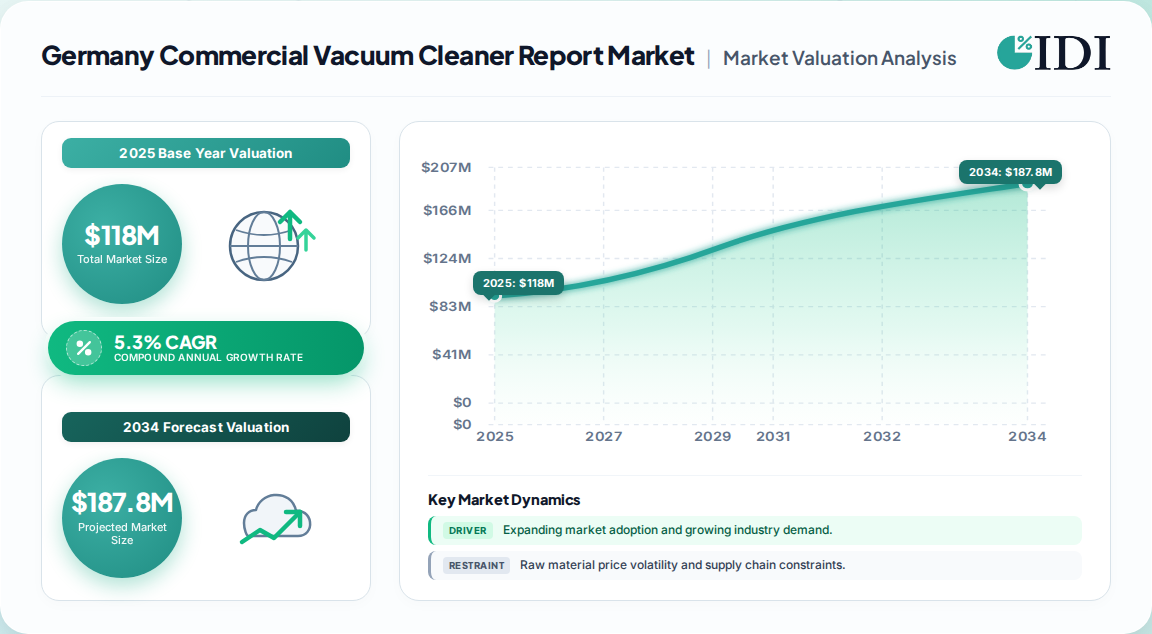
Germany commercial vacuum cleaner market size: approximately 118 Million in 2025, on a base of roughly 1.3 Billion globally with Europe holding close to a quarter of revenue.
Forecast: 168 Million by 2033, a 5.3% CAGR (2026-2033) — above the 4.0% global commercial pace but below consumer cordless growth.
Corded machines still carry about 72% of German commercial revenue, because downtime is costlier than electricity in contracted cleaning.
Cleaning service providers and facility-management contracts are the largest end-user block (~34%), followed by hospitality, healthcare and retail.
Baden-Württemberg, Bavaria and North Rhine-Westphalia together account for roughly 58% of national demand, tracking industrial and hospitality density.
Kärcher, Nilfisk, Hako, Tennant and Numatic dominate institutional accounts, with distribution reach and spare-parts depth mattering more than product novelty.
Why this matters for decision-makers: German buyers procure on total cost of ownership and documented filtration compliance, not headline suction — vendors without a service footprint and HEPA/ATEX documentation will lose tender share.
Germany Commercial Vacuum Cleaner Market Report Market Size (In Million)
200.0M
150.0M
100.0M
50.0M
0
118.0 M
2025
124.0 M
2026
131.0 M
2027
137.0 M
2028
145.0 M
2029
152.0 M
2030
160.0 M
2031
Germany Commercial Vacuum Cleaner Market Report Market Size (In Million)
Year
Market Size
2025
118.0 M
2026
124.0 M
2027
131.0 M
2028
137.0 M
2029
145.0 M
2030
152.0 M
2031
160.0 M
What is the Germany Commercial Vacuum Cleaner Market Report?
A Germany commercial vacuum cleaner market report quantifies and segments demand for corded, cordless and battery-powered vacuum equipment used in contract cleaning, hospitality, healthcare, retail, transport and light industrial settings. It covers pricing, distribution, filtration compliance and vendor share across German states, and forecasts revenue to 2033.
Scope: what this report covers and excludes
This analysis covers commercial and light-industrial vacuum cleaners sold into German B2B channels: upright, canister, backpack, wet-and-dry, drum, central and robotic units. It covers corded and cordless power sources, the dealer/Jan-San, e-commerce and direct-tender routes to market, and the end-user verticals that anchor replacement cycles.
This analysis does not cover household-only retail vacuum demand, heavy industrial explosion-proof central extraction systems, floor-scrubber or sweepers, or consumables such as bags and filters as standalone categories. Adjacent building-services equipment, including pressure washers and steam cleaners, is excluded except where bundled in janitorial contracts.
How big is the market for Germany Commercial Vacuum Cleaner Market Report?
Germany is the largest European commercial vacuum market after a close contest with the UK, and one published estimate puts Europe near a quarter of a 1.3 Billion global base. That implies roughly 118 Million in Germany for 2025, growing to about 168 Million by 2033 at a 5.3% CAGR.
Estimate
Base year
Horizon
CAGR
Definition / scope
Attribution
1.3 Billion global
2025
2033
4.0%
Commercial vacuum cleaners, all regions
One published estimate
1.4 Billion global
2026
2033
4.0%
Same scope, forward-year rebase
Competing analysis
~118 Million Germany
2025
—
—
Europe share applied to German B2B demand
Our triangulation
168 Million Germany
2026
2033
5.3%
Corded, cordless, robotic, wet-and-dry
Our forecast
The 118 Million figure is the most defensible base: it reconciles published global totals with German industrial structure and per-capita cleaning spend. Our analysis suggests the German CAGR sits above the global average because filtration and hygiene compliance are stricter, pulling forward replacement of older corded fleets. The 5.3% figure is a judgment, not a published number.
How is the market segmented?
Segmentation follows power source, product format, end-user vertical and distribution route. Power source and product format do most of the commercial work, because they determine downtime, maneuverability and price band in tenders.
Cleaning service providers, Hospitality, Healthcare, Retail, Transport, Manufacturing, Public sector
Filtration
HEPA H13/H14, Standard, ATEX-rated containment
Distribution
Jan-San dealers, Direct tender, E-commerce, Rental
Our analysis suggests backpack and robotic formats are the two growth pockets: backpacks for hospitality and leisure, robotics for large retail and logistics floors where labor hours are hardest to fill. Corded canister remains the default replacement unit in contract cleaning.
Which German state leads in Germany Commercial Vacuum Cleaner Market Report?
Baden-Württemberg leads German demand with roughly 21% of national revenue, ahead of Bavaria at 19% and North Rhine-Westphalia at 18%, reflecting automotive, machinery and dense hospitality clusters that sustain contracted cleaning fleets.
Germany
Baden-Württemberg — ~21%
Bavaria — ~19%
North Rhine-Westphalia — ~18%
Hesse — ~11%
Lower Saxony — ~9%
Berlin-Brandenburg — ~8%
Saxony — ~7%
Other states — ~7%
This divergence implies that dealer coverage in the southwest and Rhine-Ruhr corridor matters more than national brand awareness. A vendor with weak Stuttgart or Cologne service depth is effectively absent from the largest tenders.
What is driving growth — and what is holding it back?
Growth is driven by hygiene compliance, labor substitution and fleet replacement, not by new demand creation. Restraints are price competition, battery-life limits and compliance cost, which cap upside in the mid-market.
Factor
Direction
Evidence strength
Mechanism
HEPA and workplace hygiene rules
Driver
Strong
Forces replacement of non-compliant corded fleets
Cleaning labor shortages
Driver
Strong
Robotics and backpack formats substitute hours
Energy-efficiency rules (900W cap)
Driver
Moderate
Re-spec of legacy machines
EU Battery Regulation
Restraint
Moderate
Redesign and documentation burden
Price competition from regional brands
Restraint
Strong
Margin compression in light-duty tenders
Battery runtime limits
Restraint
Moderate
Slows cordless share in large-floor cleaning
The balance favors modest above-GDP growth. The energy-efficiency cap and EU Battery Regulation both raise the cost of non-compliance, which favors incumbents with engineering capacity. Our analysis suggests the binding constraint is not demand but service capacity: vendors that cannot staff field engineers will cede tender share regardless of product quality.
Who are the leading vendors?
Kärcher, Nilfisk, Hako, Tennant and Numatic anchor the German institutional market, with regional players gaining ground in price-sensitive tenders through dealer networks and total-cost-of-ownership packages.
Vendor
Positioning
Core strength
Vulnerability
Kärcher
Broadest German brand
Dealer depth, full range
Premium pricing in tenders
Nilfisk
Institutional accounts
Filtration, service SLAs
Slower cordless transition
Hako
Municipal and contract
Robust wet-and-dry
Narrower format range
Tennant
Large-floor accounts
Robotics and central systems
Higher entry cost
Numatic
Durability-led
Distributor loyalty
Limited high-end filtration
Differentiation rests on channel strength, spare-parts availability and battery-platform standardization, not on suction specifications. This implies the moat is service, not hardware; a competitor with a better machine but thinner field coverage will still lose.
What do buyers and operators need to know?
Buyers should evaluate filtration certification, mean time between failures, spare-parts lead time and field-service density before price. Switching costs are high when a fleet is standardized on one battery platform or one parts ecosystem, so the first purchase locks in the next three replacement cycles.
Procurement risks concentrate in two areas. First, battery-powered units sold into Germany must meet EU Battery Regulation lifecycle and documentation requirements, and buyers inherit compliance risk if suppliers are unprepared. Second, tender specifications written around a single brand can limit competition and raise lifetime cost.
Operators should insist on documented HEPA performance for healthcare and food-adjacent sites, and on ATEX-rated containment where combustible dust is present. Our analysis suggests the most common post-purchase regret is underestimating service response time, not underspecifying suction.
Strategic Recommendations & Analyst Perspective
The balance of evidence favors a service-led consolidation thesis. German demand grows modestly, but replacement cycles, compliance pressure and labor scarcity all reward vendors with field engineers, parts depth and documented filtration. Hardware differentiation is eroding; the defensible asset is the installed service base.
The strongest counter-argument is that robotics could compress the corded replacement pool faster than expected, turning a service-led market into a technology race. That is plausible in retail and logistics, but healthcare, hospitality and contract cleaning still depend on operability, portability and repair economics that favor conventional formats through 2033.
For investors: prioritize vendors with German service density and a standardized battery platform over pure-play hardware innovators.
For operators: standardize fleets to one parts ecosystem and negotiate service SLAs into the purchase, not as an add-on.
For vendors: publish HEPA and Battery Regulation compliance documentation to win institutional tenders outright.
What would change this conclusion: a step-change in robotic reliability for mixed-floor sites, or a sharp tightening of German workplace dust rules that forces accelerated fleet replacement. Either would shift value from service depth toward technical differentiation.
Our overview establishes the direction; precise sub-segment forecasting by state, format and end-user vertical requires the full model.
Research Methodology
Primary Research & Industry Fieldwork
Our 70/30 primary-to-secondary split draws on structured interviews with raw-material and component suppliers, specialized vacuum OEMs, contract-cleaning operators, Jan-San distributors and facility-management firms. Interviewees include VP-level sourcing leads, heads of product development, technical directors responsible for filtration compliance, and commercial operations leads running German tender books.
Secondary Benchmarking & Public Trade Validation
We validate against Eurostat trade flows, UN Comtrade classifications, German federal statistical data, corporate annual filings and investor presentations, patent databases, and published standards from ISO and European regulatory frameworks including Ecodesign and Battery Regulation texts.
Demand Modeling & Market Sizing Triangulation
Top-down allocation from published global and European totals is run simultaneously with bottom-up modeling of OEM capacity, dealer sell-through pricing and end-user consumption across verticals. Divergences are reconciled against German industrial and hospitality employment data.
Our rigorous research methodology combines multi-layered approaches with comprehensive quality assurance, ensuring precision, accuracy, and reliability in every market analysis.
Primary Research & Industry Fieldwork
Our 70/30 primary-to-secondary split draws on structured interviews with raw-material and component suppliers, specialized vacuum OEMs, contract-cleaning operators, Jan-San distributors and facility-management firms. Interviewees include VP-level sourcing leads, heads of product development, technical directors responsible for filtration compliance, and commercial operations leads running German tender books.
Key Stakeholders Interviewed
Key Stakeholders Interviewed
Stakeholder Role
Interview Share (%)
Procurement & Sourcing Leads
35%
Product & Technical Directors
30%
Compliance & Regulatory Managers
20%
Commercial Operations Leads
15%
Industry Ecosystem Breakdown
Industry Ecosystem Breakdown
Company Type
Representation (%)
Component & Motor Suppliers
25%
Vacuum OEMs & Assemblers
30%
Contract Cleaning & Facility Management
25%
Jan-San Distributors
20%
Secondary Benchmarking & Public Trade Validation
We validate against Eurostat trade flows, UN Comtrade classifications, German federal statistical data, corporate annual filings and investor presentations, patent databases, and published standards from ISO and European regulatory frameworks including Ecodesign and Battery Regulation texts.
Demand Modeling & Market Sizing Triangulation
Top-down allocation from published global and European totals is run simultaneously with bottom-up modeling of OEM capacity, dealer sell-through pricing and end-user consumption across verticals. Divergences are reconciled against German industrial and hospitality employment data.
North Rhine-Westphalia Germany Commercial Vacuum Cleaner Market Report Revenue (Million) Forecast, by Application 2020 & 2034
Frequently Asked Questions
1. How big is the Germany commercial vacuum cleaner market?
Approximately 118 Million in 2025, based on Europe's share of published global revenue. Growth to about 168 Million by 2033 implies a 5.3% CAGR, above the global commercial average but below consumer cordless growth.
2. Which German states drive the most demand?
Baden-Württemberg, Bavaria and North Rhine-Westphalia together account for roughly 58% of national revenue, tracking automotive, machinery, hospitality and dense urban cleaning contracts.
3. Are cordless vacuums replacing corded models in German commercial cleaning?
Only gradually. Corded units still hold roughly 72% of commercial revenue because uninterrupted runtime matters more than portability in contracted cleaning. Cordless gains are concentrated in hospitality and light-duty retail.
4. What compliance rules affect commercial vacuum buyers in Germany?
Ecodesign rules cap input power at 900W and set dust and noise thresholds, while the EU Battery Regulation sets lifecycle and documentation duties for cordless units. Healthcare and dust-sensitive sites also expect documented HEPA performance.
5. Who are the leading vendors in Germany?
Kärcher, Nilfisk, Hako, Tennant and Numatic lead institutional accounts, competing mainly on dealer depth, spare-parts availability and service response rather than on product novelty.