Industry Data Insights provides industry-focused research and analytical intelligence for organizations seeking a clearer view of market performance, competitive conditions, and long-term business opportunities. Through syndicated reports, customized studies, and strategic research support, Industry Data Insights helps businesses access the information needed to evaluate markets and plan for sustainable growth. Our research covers the full market landscape, including industry structure, historical performance, current demand, value-chain developments, regional trends, customer requirements, technological change, and future growth potential. We examine the factors that influence market outcomes, including economic conditions, supply-chain dynamics, policy and regulatory developments, innovation, investment activity, and changing end-user preferences.
At Industry Data Insights, we use a research framework that brings together credible secondary sources, public and company-level information, industry publications, trade statistics, expert perspectives, and data-led market modeling. Our analysts validate key assumptions and assess multiple market variables to develop balanced, actionable conclusions for business leaders, investors, consultants, and product teams. Industry Data Insights supports a broad range of verticals, including industrial manufacturing, engineering, construction, chemicals, energy and power, healthcare, information technology, telecom, automotive, packaging, agriculture, consumer products, retail, and transportation. Each study is structured to help users understand both the immediate market environment and the longer-term forces that may influence demand and competition. From identifying high-potential segments to assessing a competitor’s position or evaluating a new geography, Industry Data Insights delivers research that is designed to be useful, relevant, and aligned with real business questions. Our goal is to turn industry data into strategic direction.
Heated Towel Rail Market by Product Type (Electric Heated Towel Rails, Hydronic Heated Towel Rails, Dual Fuel Heated Towel Rails), by Application (Residential, Commercial), by Distribution Channel (Offline, Online), by Europe (Germany, UK, France, Italy, Netherlands, Switzerland, Belgium, Russia, Spain, Turkey), by North America (USA, Canada, Mexico), by Asia Pacific (China, Japan, India, South Korea, Singapore, Malaysia, Australia, Thailand, Indonesia, Philippines), by Middle East & Africa (Saudi Arabia, UAE, South Africa, Egypt, Israel), by South America (Brazil, Argentina) Forecast 2026-2034
Access in-depth insights on industries, companies, trends, and global markets. Our expertly curated reports provide the most relevant data and analysis in a condensed, easy-to-read format.
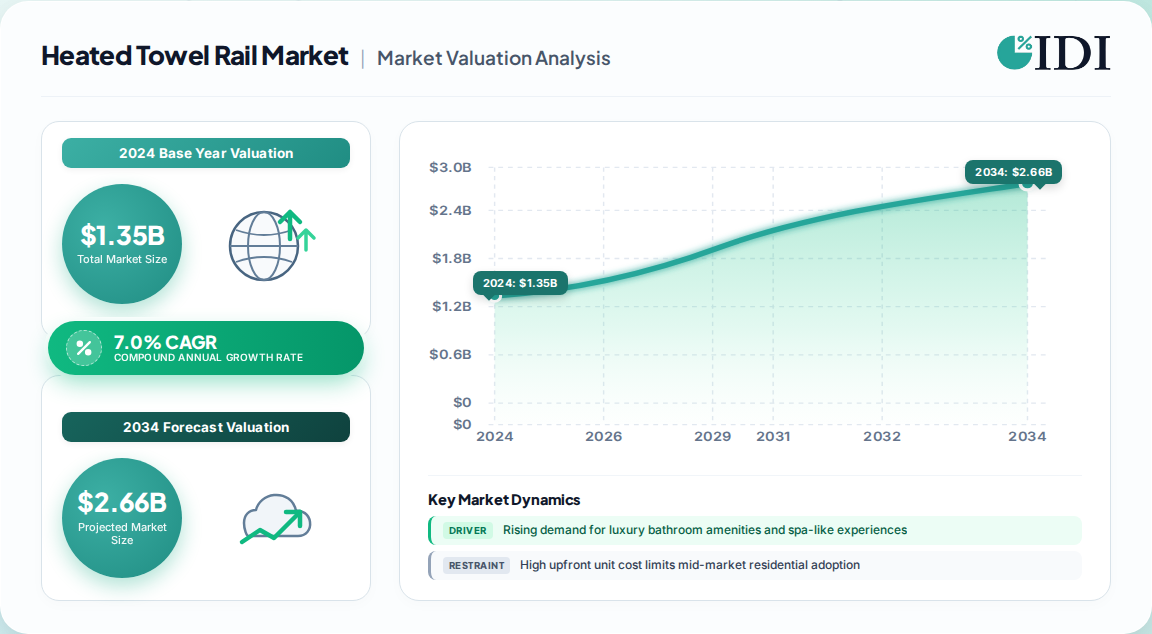
The global heated towel rail market is valued at USD 1.35 Billion in 2024, with forecasts reaching USD 2.32 Billion by 2032 at a 7.0% CAGR, though competing analyses project up to USD 4.1 Billion.
Electric heated towel rails dominate with 65% revenue share, favored for lower installation friction and rapid heating versus hydronic systems.
Europe leads with 42.5% revenue share in 2024, underpinned by cold-climate adoption, luxury bathroom norms, and established manufacturer density.
Asia-Pacific is the fastest-growing region, driven by urbanization, disposable income growth, and hospitality construction in China, India, and Japan.
Leading vendors include Zehnder Group, PORCELANOSA, Amba Products, Vogue UK, and Bathroom Butler, with fragmentation and premiumization defining competition.
Why this matters for decision-makers: The divergence between conservative (7%) and aggressive (11.3%) forecasts signals unresolved demand assumptions around smart-home penetration and commercial retrofit cycles. Buyers should pressure-test vendor forecasts against local construction starts before committing capital.
Heated Towel Rail Market Market Size (In Billion)
2.5B
2.0B
1.5B
1.0B
500.0M
0
1.350 B
2024
1.440 B
2025
1.550 B
2026
1.650 B
2027
1.770 B
2028
1.890 B
2029
2.030 B
2030
Heated Towel Rail Market Market Size (In Billion)
Year
Market Size
2024
1.350 B
2025
1.440 B
2026
1.550 B
2027
1.650 B
2028
1.770 B
2029
1.890 B
2030
2.030 B
What is the Heated Towel Rail Market?
The heated towel rail market comprises manufacturers, distributors, and retailers of bathroom fixtures that warm and dry towels using electric, hydronic, or dual-fuel heating. It serves residential, commercial, and hospitality sectors, with value driven by premiumization, energy efficiency, and bathroom renovation cycles.
Scope: what this report covers and excludes
This analysis covers electric, hydronic, and dual-fuel heated towel rails across residential and commercial applications, distributed through offline and online channels. It addresses value sizing, segmentation, regional dynamics, vendor positioning, and procurement considerations.
This analysis does not cover conventional bathroom radiators, underfloor heating systems, standalone towel warmers without rail configurations, or broader HVAC equipment categories. Adjacent smart-home control platforms are referenced only where they integrate with towel rail functionality.
How big is the market for Heated Towel Rail Market?
The global heated towel rail market is valued at USD 1.35 Billion in 2024 and is projected to reach USD 2.32 Billion by 2032, reflecting a 7.0% CAGR, though competing estimates diverge materially on both base-year value and growth trajectory.
Our analysis suggests the middle-path 7.0% CAGR is most defensible for near-term planning because it aligns with actual construction spending growth and bathroom renovation cycle data. The higher estimates likely embed aggressive smart-home attach rates and commercial hospitality expansion that remain sensitive to interest-rate and capex cycles. Buyers should model scenarios across the 7–11% band.
How is the market segmented?
The heated towel rail market is segmented by product type, application, and distribution channel, with electric systems dominating value and commercial applications leading volume in hospitality and healthcare.
Electric rails hold approximately 48.6–65% share depending on definitional scope, reflecting installation ease and retrofit suitability. Hydronic systems retain strong share in European new-build where central heating is standard, while dual-fuel is gaining traction as a bridge technology.
Which region leads in Heated Towel Rail Market?
Europe leads the global heated towel rail market with 42.5% revenue share in 2024, driven by cold-climate adoption, luxury bathroom norms, and manufacturer concentration; Asia-Pacific is the fastest-growing region at a materially higher growth rate.
Heated Towel Rail Market Regional Market Share
Loading chart...
Heated Towel Rail Market Regional Market Share
Region
Market Share (%)
Europe
0.43%
North America
0.27%
Asia-Pacific
0.22%
South America
0.05%
Middle East & Africa
0.05%
Europe — Germany, UK, France, Italy, Netherlands, Switzerland, Belgium, Russia, Spain, Turkey, Rest of Europe
North America — USA, Canada, Mexico
Asia-Pacific — China, Japan, India, South Korea, Singapore, Malaysia, Australia, Thailand, Indonesia, Philippines, Rest of Asia-Pacific
Middle East & Africa — Saudi Arabia, UAE, South Africa, Egypt, Israel, Rest of MEA
South America — Brazil, Argentina, Rest of South America
Europe's lead is structural rather than cyclical: central heating penetration, cultural emphasis on bathroom aesthetics, and the presence of Zehnder, Vogue UK, Kudox, and Stelrad create a reinforcing ecosystem. Asia-Pacific growth, by contrast, is velocity-driven—urbanization and hospitality construction in China and India are pulling demand faster than local supply chains can premiumize, which compressing near-term average selling prices.
What is driving growth — and what is holding it back?
Growth is being driven by luxury bathroom renovation, smart-home integration, and hygiene awareness in commercial settings, while high unit costs, installation complexity, and energy-price volatility are the primary restraints.
Factor
Direction
Evidence Strength
Mechanism
Luxury bathroom renovation cycles
Driver
High
Premium fixtures attach to remodel spend; 71% of experts report homeowner willingness to invest
Smart-home & IoT integration
Driver
Medium-High
Programmable timers, Wi-Fi controls, voice assistant compatibility raise perceived value
Hospitality & healthcare hygiene demand
Driver
High
Commercial buyers prioritize drying and mold inhibition; 57.3% commercial share
Energy efficiency regulation
Driver
Medium
Eco-design and efficiency standards favor low-temperature and carbon-fiber elements
High upfront unit cost
Restraint
High
Premium rails price out mid-market residential buyers, especially in emerging regions
Installation & plumbing complexity
Restraint
Medium
Hydronic and dual-fuel require trade labor, slowing retrofit adoption
Our analysis suggests the driver-restraint balance tilts positive through 2032, but the growth rate is more likely to track the conservative 7% path than the aggressive 11% path. The key swing factor is commercial retrofit activity—if hospitality capex holds, upside surprise is plausible; if rate-sensitive construction slows, the lower bound dominates.
Who are the leading vendors?
The heated towel rail market is moderately fragmented, with European specialists, global bathroom brands, and regional challengers competing on design, energy efficiency, and channel access.
Company
HQ
Positioning
Notable Strength
Zehnder Group AG
Switzerland
Global premium HVAC & radiators
Engineering heritage, specification influence
PORCELANOSA Grupo
Spain
Bathroom & surfaces conglomerate
Design integration, retail reach
Amba Products
USA
Electric towel warmers
North America distribution
WarmlyYours.com
USA
Electric radiant & towel rails
Direct-to-consumer e-commerce
Vogue UK
UK
Designer heated rails
Eco-friendly materials, brand equity
Kudox
UK
Value-engineered radiators & rails
Trade channel strength
Bathroom Butler
South Africa
Premium heated rails
Hospitality specification
Stelrad
UK
Mass-market radiators
Volume and installer network
Margaroli Srl
Italy
Designer hydronic rails
European design credibility
Runtal North America
USA
Architectural radiators
Commercial specification
Differentiation is shifting from pure heat output to design language, smart controls, and sustainability credentials. Our analysis suggests vendors with integrated smart-home protocols and recycled-material narratives will command premium pricing, while undifferentiated value players face margin compression from Asian imports.
What do buyers and operators need to know?
Procurement decisions hinge on heating type, installation infrastructure, energy efficiency certification, and after-sales support. Electric rails offer lower installation friction but require dedicated circuits; hydronic systems demand plumbing integration but benefit from central heating efficiency.
Buyers should scrutinize: (1) IP ratings and safety certifications for bathroom zones; (2) warranty terms on heating elements, which vary widely; (3) compatibility with existing smart-home ecosystems; and (4) total cost of ownership including energy consumption over a 7–10 year horizon. Switching costs are moderate—fixtures are wall-mounted and replaceable—but commercial buyers face downtime risk during replacement, making reliability and spare-part availability critical.
Regulatory compliance varies by market: EU ecodesign and energy labeling requirements apply, while North American buyers should verify UL/ETL listing. Our analysis suggests certification gaps are the most common procurement failure point in cross-border sourcing.
Strategic Recommendations & Analyst Perspective
The balance of evidence favors a conservative-to-moderate growth outlook: the 7.0% CAGR path is more defensible than the 11.3% projection, because it aligns with construction-cycle reality and avoids over-embedding smart-home attach rates that remain unproven at scale. The strongest counter-argument is that commercial hospitality retrofit could accelerate faster than expected, particularly in the Middle East and Asia-Pacific, which would validate the higher forecast—but this remains a scenario, not a base case.
For investors, the attractive sub-segments are electric rails in North America (retrofit-friendly) and dual-fuel systems in Europe (bridge technology for renovation). For operators, the priority is channel strategy: offline still dominates at 64.5%, but online is growing faster and rewards brands with strong content and review management.
Actionable Strategy:
Vendors should prioritize smart-control integration and recycled-material certification to defend premium pricing against Asian value entrants.
Investors should underwrite to the 7% base case and treat commercial hospitality pipeline as upside optionality, not baseline.
Operators should build dual-channel capabilities—trade-counter relationships for specification and DTC e-commerce for replacement demand—to capture both purchase occasions.
Evidence that would change our conclusion: sustained commercial construction starts above trend for four or more quarters, or regulatory mandates requiring heated drying in hospitality hygiene standards, would justify upgrading to the higher-growth scenario.
Heated Towel Rail Market Regional Market Share
Higher Coverage
Lower Coverage
No Coverage
Heated Towel Rail Market REPORT HIGHLIGHTS
Research Methodology & Data Sources
Our rigorous research methodology combines multi-layered approaches with comprehensive quality assurance, ensuring precision, accuracy, and reliability in every market analysis.
Research Methodology
Key Stakeholders Interviewed
Key Stakeholders Interviewed
Stakeholder Role
Interview Share (%)
VP Sourcing & Procurement
30%
Heads of Product R&D
30%
Technical Directors
25%
Commercial Operations Leads
15%
Industry Ecosystem Breakdown
Industry Ecosystem Breakdown
Company Type
Representation (%)
Heating Element & Metal Suppliers
30%
Specialized Rail Manufacturers
40%
OEM / Contract Assemblers
15%
Global Distributors & Retailers
15%
Primary Research & Industry Fieldwork
This study employs a 70/30 primary-to-secondary research split. In-depth interviews were conducted with stakeholders across the heated towel rail value chain: metal and heating-element suppliers, specialized rail manufacturers, OEM/contract assemblers, and global distributors. Decision-makers interviewed include VP-level Sourcing leads, Heads of Product R&D, Technical Directors, and Commercial Operations Leads across Europe, North America, and Asia-Pacific.
Secondary Benchmarking & Public Trade Validation
Secondary validation draws on official multilateral trade databases (UN Comtrade, Eurostat, US ITC), corporate annual filings (10-K, SEC disclosures, investor presentations), patent databases for heating-element and control technologies, and recognized technical standards bodies including IEC and national building-code authorities. No third-party market research publisher data is cited in this methodology.
Demand Modeling & Market Sizing Triangulation
Sizing uses simultaneous top-down (macroeconomic construction spend and segment allocation) and bottom-up (manufacturer capacity, unit pricing, end-use consumption) triangulation. Divergences between the two approaches are reconciled against trade-flow data and installer survey inputs.
Table 16: Russia Heated Towel Rail Market Revenue (Billion) Forecast, by Application 2020 & 2034
Frequently Asked Questions
1. What is the current market size of the global heated towel rail market?
The global heated towel rail market is valued at USD 1.35 Billion in 2024, with projections reaching USD 2.32 Billion by 2032 at a 7.0% CAGR. Competing estimates range higher, up to USD 4.1 Billion by 2034, reflecting differing assumptions on smart-home penetration.
2. What is the expected growth rate of the global heated towel rail market?
Published forecasts range from 7.0% to 11.3% CAGR depending on scope and horizon. Our analysis favors the 7.0% path as most defensible for near-term planning, with higher estimates treated as upside scenarios tied to commercial retrofit acceleration.
3. Who are the top players in the heated towel rail market?
Leading players include Zehnder Group, PORCELANOSA Grupo, Amba Products, WarmlyYours.com, Vogue UK, Kudox, Bathroom Butler, Stelrad, Margaroli Srl, and Runtal North America, alongside regional challengers in China and Italy.
4. Which region dominates the heated towel rail market?
Europe leads with 42.5% revenue share in 2024, supported by cold-climate adoption, luxury bathroom norms, and manufacturer concentration. Asia-Pacific is the fastest-growing region, driven by urbanization and hospitality construction.
5. What segments are covered in the heated towel rail market report?
The market is segmented by product type (electric, hydronic, dual-fuel), application (residential, commercial), and distribution channel (offline, online), with regional breakdowns across Europe, North America, Asia-Pacific, Middle East & Africa, and South America.