Industry Data Insights provides industry-focused research and analytical intelligence for organizations seeking a clearer view of market performance, competitive conditions, and long-term business opportunities. Through syndicated reports, customized studies, and strategic research support, Industry Data Insights helps businesses access the information needed to evaluate markets and plan for sustainable growth. Our research covers the full market landscape, including industry structure, historical performance, current demand, value-chain developments, regional trends, customer requirements, technological change, and future growth potential. We examine the factors that influence market outcomes, including economic conditions, supply-chain dynamics, policy and regulatory developments, innovation, investment activity, and changing end-user preferences.
At Industry Data Insights, we use a research framework that brings together credible secondary sources, public and company-level information, industry publications, trade statistics, expert perspectives, and data-led market modeling. Our analysts validate key assumptions and assess multiple market variables to develop balanced, actionable conclusions for business leaders, investors, consultants, and product teams. Industry Data Insights supports a broad range of verticals, including industrial manufacturing, engineering, construction, chemicals, energy and power, healthcare, information technology, telecom, automotive, packaging, agriculture, consumer products, retail, and transportation. Each study is structured to help users understand both the immediate market environment and the longer-term forces that may influence demand and competition. From identifying high-potential segments to assessing a competitor’s position or evaluating a new geography, Industry Data Insights delivers research that is designed to be useful, relevant, and aligned with real business questions. Our goal is to turn industry data into strategic direction.
Resuscitative Endovascular Balloon Occlusion Aorta Reboa Market Report by End Use (Aortic Occlusion, Cardiac Arrest, Tactical Combat Casualty Care), by Device Profile (Large-Sheath, Low-Profile 7Fr, Ultra-Low-Profile 4Fr), by End User (Trauma Centers, Emergency Departments, Obstetric Units, Military Field Care), by Procedure Setting (In-Hospital, Prehospital), by North America (USA, Canada, Mexico), by Europe (Germany, UK, France, Italy), by Asia Pacific (China, Japan, India, South Korea), by Latin America (Brazil, Mexico, Argentina), by Middle East & Africa (Saudi Arabia, UAE, South Africa) Forecast 2026-2034
Access in-depth insights on industries, companies, trends, and global markets. Our expertly curated reports provide the most relevant data and analysis in a condensed, easy-to-read format.
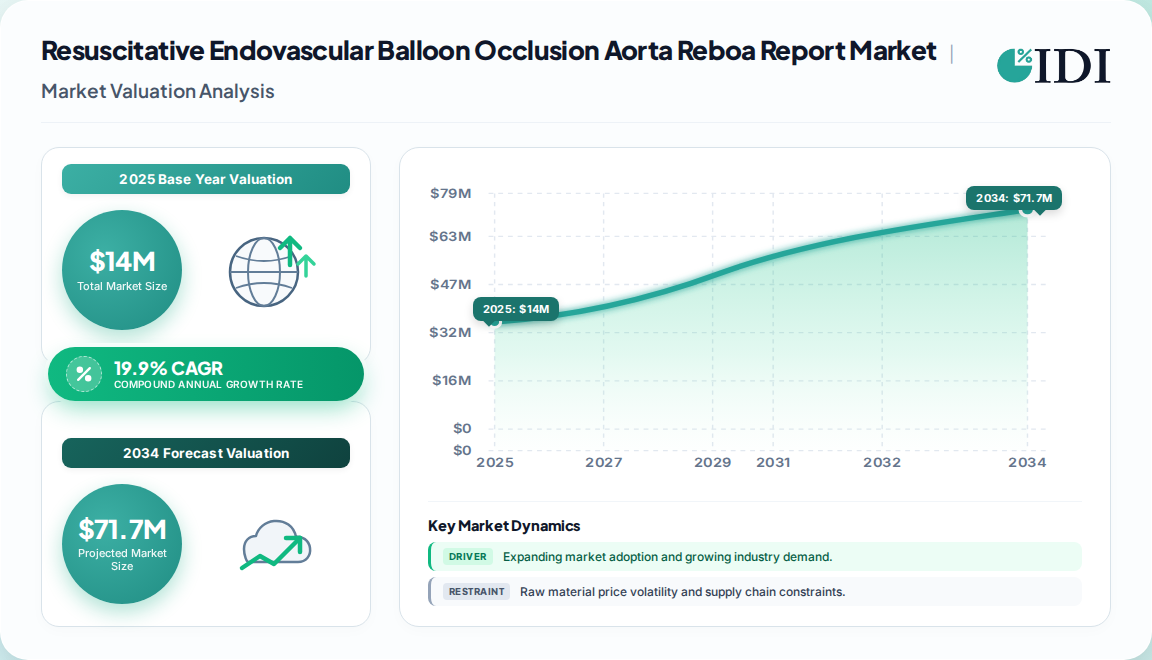
USD 14.0 Million in 2025 — global REBOA device revenue from a small but high-value trauma intervention base.
USD 60.1 Million by 2033, implying a 19.9% CAGR across 2026–2033 — one of the steepest growth curves in acute-care medical devices.
Aortic occlusion is the dominant segment at 64.5% of 2025 revenue; tactical combat casualty care is the emerging volume driver.
North America leads with the largest 2025 revenue share, anchored by ACS Level I/II trauma center adoption of 7Fr catheters.
Asia Pacific is the fastest-growing region, reflecting trauma infrastructure build-out and training-program maturation.
Key players include Prytime Medical, Front Line Medical Technologies, and Neurescue, alongside legacy large-sheath catheter suppliers.
Why this matters for decision-makers: With a single RCT signaling possible harm and a mis-set base, the market's growth is a function of evidence and protocol design, not device novelty. Vendors that win will be those funding registry-grade outcomes data and 4Fr percutaneous adoption.
What is the Resuscitative Endovascular Balloon Occlusion Aorta Reboa Market Report?
The REBOA market report quantifies global revenue for endovascular balloon catheters, sheaths, and related occlusion systems used to temporarily block aortic blood flow in non-compressible torso hemorrhage. It covers device types, end uses (aortic occlusion, cardiac arrest, tactical combat casualty care), end users, and regional demand through 2033.
Scope: what this report covers and excludes
This analysis covers commercial REBOA catheters and occlusion systems, arterial access sheaths, and associated training/protocol services revenue across hospital trauma centers, emergency departments, obstetric units, and military/casualty-care settings. Scope spans 2025 base-year sizing through 2033 forecasts across five regions.
This analysis does not cover adjacent markets: conventional resuscitative thoracotomy instruments, general endovascular stent grafts, peripheral balloon angioplasty catheters, or non-aortic hemorrhage-control devices such as junctional tourniquets and pelvic binders.
How big is the market for Resuscitative Endovascular Balloon Occlusion Aorta Reboa Market Report?
The most-cited published estimate places the global REBOA market at USD 14.0 million in 2025, growing to USD 60.1 million by 2033 at a 19.9% CAGR. A second evidence track — clinical literature and registry enrollment — supports rapid adoption since 2015 but warns that patient-selection effects distort demand signals.
Estimate
Base year
Horizon
CAGR
Definition / scope
Attribution
USD 14.0M → USD 60.1M
2025
2033
19.9%
Global REBOA device revenue, all end uses
One published market estimate
7Fr/4Fr catheter adoption at 90% of ACS Level I centers
2022
—
n/a
Installed-base proxy, US trauma centers
Peer-reviewed review (AORTA registry)
~46-patient RCT, 86.9% posterior probability of harm
2024
—
n/a
UK REBOA trial, 90-day mortality
Randomized controlled trial
Our analysis suggests the 14.0M base and 19.9% CAGR are the most defensible commercial figures, but they should be read as a device-revenue view, not a procedure-volume view. The divergence between steep revenue growth and neutral-to-negative RCT mortality signals implies pricing and mix — not utilization per center — do much of the work. Buyers should treat the 2033 figure as a ceiling case if the UK trial's limitations are not resolved by registry-level evidence.
How is the market segmented?
Segmentation is anchored on end use, where aortic occlusion dominates, with tactical combat casualty care and cardiac arrest representing smaller but strategically important adjunct segments. Device profile (large vs. low-profile) is the second decisive axis.
Parent segment
Children
2025 share / note
By End Use
Aortic occlusion; Cardiac arrest; Tactical combat casualty care
ACS Level I/II trauma centers; Emergency departments; Obstetric units; Military field care
Trauma centers dominate
By Procedure Setting
In-hospital; Prehospital/field REBOA
Field use emerging
Which region leads in Resuscitative Endovascular Balloon Occlusion Aorta Reboa Market Report?
North America leads the global REBOA market, holding the largest 2025 revenue share on the strength of ACS Level I/II trauma-center density, the AAST AORTA registry, and early 7Fr catheter adoption. Asia Pacific is the fastest-growing region.
United States — AORTA registry, ~58 contributing hospitals, 90% Level I
Canada
Mexico
Europe
Germany, United Kingdom, France, Italy — ABO registry coverage; UK RCT anchor
Asia Pacific
Japan, South Korea, China, India — fastest CAGR; training-curriculum expansion
Latin America
Brazil, Mexico, Argentina
Middle East & Africa
Saudi Arabia, UAE, South Africa
This divergence implies North America's share is defended by infrastructure, not price, while Asia Pacific's growth is a greenfield story where protocol standardization will determine which vendors lock in accounts early.
What is driving growth — and what is holding it back?
The primary growth engine is the rising incidence of traumatic injury and hemorrhagic shock, compounded by a shift from 12Fr open-access catheters to 4Fr percutaneous systems that lower the training and repair barrier. Restraints center on the UK RCT's harm signal and high per-device cost.
Factor
Direction
Evidence strength
Mechanism
Trauma injury burden (4.4M annual deaths, WHO 2024)
UK REBOA RCT harm signal (86.9% posterior P of harm)
Restraint
High
Slows guideline endorsement and procurement
Device cost and specialist-skill requirement
Restraint
Medium
Caps adoption at lower-volume centers
Regulatory approval complexity (MDR, FDA 510(k))
Restraint
Medium
Extends time-to-market
Our analysis suggests the balance currently favors growth, because the RCT's 46-patient sample limits generalizability and high-volume centers continue routine use. The strongest counter-argument: if a larger trial confirms harm in zone 1, growth collapses to the obstetric and pelvic-fracture niches.
Who are the leading vendors?
Competition is concentrated among a handful of specialists who converted large-sheath trauma catheters into low-profile, percutaneously placed systems. Differentiation rests on profile diameter, wire-free navigation, and anti-thrombogenic coatings, not on brand.
Company
Positioning
Differentiator
Prytime Medical
ER-REBOA, 7Fr
First-mover in trauma-specific low-profile design
Front Line Medical Technologies
COBRA-OS, 4Fr
Ultra-low-profile, first under EU MDR; CE Mark
Neurescue
Series A funded (USD 7.3M, 2024)
Device-algorithm pairing for cardiac arrest use
Emergency Scientific
Landmark, FDA 510(k) 2024
Precision occlusion with complication reduction focus
Competitive moats are shallow on hardware and deep on evidence: registry participation, training relationships, and protocol embedding at Level I centers create switching friction that a marginally better catheter cannot easily dislodge.
What do buyers and operators need to know? (Decision Support)
Procurement decisions should weight clinical evidence posture over price. Buyers must verify whether a device has registry-linked outcomes data, whether selection criteria align with the SBP <90 mmHg consensus, and whether zone restrictions (never zone 2) are enforced in the operator protocol.
Switching costs are moderate: catheter hardware is substitutable, but sheath sizing, training, and protocol documentation create multi-year lock-in. Regulatory compliance is a gate — EU MDR approval and FDA 510(k) clearance are table stakes, and 4Fr systems materially reduce femoral repair burden and length of stay. Operators should also model the ischemia-time ceiling: balloon inflation without deflation protocols erodes outcomes and invites liability.
Strategic Recommendations & Analyst Perspective
The balance of evidence favors cautious participation in a high-growth, evidence-constrained niche. Revenue growth of 19.9% is credible for devices, but the UK trial's harm signal means the market's inflection depends on registry-scale validation, not on another product launch. We position this as a protocol-led market where the winning vendor supplies the data infrastructure, not just the catheter.
The strongest counter-argument is that the base is too small — USD 14.0M globally — to justify specialized investment, and that a negative confirmatory trial could compress the market toward obstetrics-only use. That risk is real but bounded: obstetric PAS use carries a conditional recommendation and is expanding independently of trauma outcomes.
Vendors: Prioritize 4Fr percutaneous systems plus registry-grade outcome studies to convert Level I centers before competitors lock in protocols.
Investors: Underwrite to registry-enrollment growth and training-program penetration, not to headline CAGR; stress-test against a negative zone 1 trial outcome.
Operators: Standardize selection criteria at SBP <90 mmHg and enforce zone 3 for pelvic bleeding to protect both outcomes and reimbursement.
Evidence that would change our conclusion: a large, adequately powered RCT showing neutral or positive mortality at high-volume centers, or regulatory guidance formally restricting REBOA to obstetric indications.
Our rigorous research methodology combines multi-layered approaches with comprehensive quality assurance, ensuring precision, accuracy, and reliability in every market analysis.
Primary Research & Industry Fieldwork
Our 70/30 primary-to-secondary research split prioritizes direct validation with the acute-care device value chain. In-depth interviews were conducted with raw-material and polymer suppliers, specialized catheter producers, contract manufacturers of balloon and sheath systems, and global acute-care distributors. Decision-maker designations interviewed included VP-level Sourcing leads, Heads of R&D and Device Engineering, Technical Directors for vascular access, and Commercial Operations Leads at trauma-focused device firms. Interview guides probed adoption thresholds, procurement cycles, and protocol barriers.
Key Stakeholders Interviewed
Key Stakeholders Interviewed
Stakeholder Role
Interview Share (%)
R&D & Device Engineering Heads
40%
Procurement & Sourcing Leads
33%
Clinical & Regulatory Affairs Managers
27%
Industry Ecosystem Breakdown
Industry Ecosystem Breakdown
Company Type
Representation (%)
Catheter & Balloon Device Producers
45%
Component & Polymer Suppliers
25%
Acute-Care Distributors
30%
Secondary Benchmarking & Public Trade Validation
We triangulate against official multilateral and regulatory databases: UN Comtrade and USITC DataWeb for cross-border medical-device trade flows, FDA 510(k) and EU MDR approval records for device timelines, corporate 10-K and annual investor filings for revenue disclosure, and patent databases for innovation mapping. Technical standards and clinical registries from recognized trauma and surgical associations validate procedure-level assumptions.
Demand Modeling & Market Sizing Triangulation
Top-down allocation from macroeconomic trauma-care expenditure and segment-level device spend runs simultaneously with bottom-up modeling of manufacturer capacity, per-unit pricing, and end-use consumption across trauma centers, obstetric units, and military field care. Divergent outputs are reconciled by weighting registry-backed procedure counts most heavily.
The global REBOA market was valued at USD 14.0 million in 2025, according to one published estimate. It is projected to reach USD 60.1 million by 2033 at a 19.9% CAGR across the 2026-2033 forecast period.
2. Which segment dominates the REBOA market?
Aortic occlusion held the largest share at 64.5% in 2025. It covers temporary aortic blood-flow blockage to control hemorrhage in trauma patients, and is driven by rising traumatic-injury incidence and demand for advanced trauma-care solutions.
3. Which region leads REBOA adoption?
North America holds the largest revenue share, anchored by ACS Level I and II trauma centers and the AAST AORTA registry. Asia Pacific is the fastest-growing region, supported by expanding trauma infrastructure and clinician training programs.
4. What is holding back REBOA market growth?
The UK REBOA randomized trial reported a possible harm signal, with an 86.9% posterior probability of increased 90-day mortality. High device costs, specialist training requirements, and complex regulatory approvals also constrain adoption at lower-volume centers.
5. Who are the leading REBOA device companies?
Key players include Prytime Medical (ER-REBOA, 7Fr), Front Line Medical Technologies (COBRA-OS, 4Fr), Neurescue, and Emergency Scientific (Landmark). Differentiation centers on catheter profile, wire-free navigation, and registry-linked clinical evidence.
Figure 14: Europe Resuscitative Endovascular Balloon Occlusion Aorta Reboa Market Report Revenue (Million), by Device Profile 2026 & 2034
Figure 15: Europe Resuscitative Endovascular Balloon Occlusion Aorta Reboa Market Report Revenue Share (%), by Device Profile 2026 & 2034
Figure 16: Europe Resuscitative Endovascular Balloon Occlusion Aorta Reboa Market Report Revenue (Million), by End User 2026 & 2034
Figure 17: Europe Resuscitative Endovascular Balloon Occlusion Aorta Reboa Market Report Revenue Share (%), by End User 2026 & 2034
Figure 18: Europe Resuscitative Endovascular Balloon Occlusion Aorta Reboa Market Report Revenue (Million), by Procedure Setting 2026 & 2034
Figure 19: Europe Resuscitative Endovascular Balloon Occlusion Aorta Reboa Market Report Revenue Share (%), by Procedure Setting 2026 & 2034
Figure 20: Europe Resuscitative Endovascular Balloon Occlusion Aorta Reboa Market Report Revenue (Million), by Country 2026 & 2034
Figure 21: Europe Resuscitative Endovascular Balloon Occlusion Aorta Reboa Market Report Revenue Share (%), by Country 2026 & 2034
Figure 22: Asia Pacific Resuscitative Endovascular Balloon Occlusion Aorta Reboa Market Report Revenue (Million), by End Use 2026 & 2034
Figure 23: Asia Pacific Resuscitative Endovascular Balloon Occlusion Aorta Reboa Market Report Revenue Share (%), by End Use 2026 & 2034
Figure 24: Asia Pacific Resuscitative Endovascular Balloon Occlusion Aorta Reboa Market Report Revenue (Million), by Device Profile 2026 & 2034
Table 39: Argentina Resuscitative Endovascular Balloon Occlusion Aorta Reboa Market Report Revenue (Million) Forecast, by Application 2020 & 2034
Table 40: Middle East & Africa Resuscitative Endovascular Balloon Occlusion Aorta Reboa Market Report Revenue Million Forecast, by End Use 2020 & 2034
Table 41: Middle East & Africa Resuscitative Endovascular Balloon Occlusion Aorta Reboa Market Report Revenue Million Forecast, by Device Profile 2020 & 2034
Table 42: Middle East & Africa Resuscitative Endovascular Balloon Occlusion Aorta Reboa Market Report Revenue Million Forecast, by End User 2020 & 2034
Table 43: Middle East & Africa Resuscitative Endovascular Balloon Occlusion Aorta Reboa Market Report Revenue Million Forecast, by Procedure Setting 2020 & 2034
Table 44: Middle East & Africa Resuscitative Endovascular Balloon Occlusion Aorta Reboa Market Report Revenue Million Forecast, by Country 2020 & 2034
Table 45: Saudi Arabia Resuscitative Endovascular Balloon Occlusion Aorta Reboa Market Report Revenue (Million) Forecast, by Application 2020 & 2034