Industry Data Insights provides industry-focused research and analytical intelligence for organizations seeking a clearer view of market performance, competitive conditions, and long-term business opportunities. Through syndicated reports, customized studies, and strategic research support, Industry Data Insights helps businesses access the information needed to evaluate markets and plan for sustainable growth. Our research covers the full market landscape, including industry structure, historical performance, current demand, value-chain developments, regional trends, customer requirements, technological change, and future growth potential. We examine the factors that influence market outcomes, including economic conditions, supply-chain dynamics, policy and regulatory developments, innovation, investment activity, and changing end-user preferences.
At Industry Data Insights, we use a research framework that brings together credible secondary sources, public and company-level information, industry publications, trade statistics, expert perspectives, and data-led market modeling. Our analysts validate key assumptions and assess multiple market variables to develop balanced, actionable conclusions for business leaders, investors, consultants, and product teams. Industry Data Insights supports a broad range of verticals, including industrial manufacturing, engineering, construction, chemicals, energy and power, healthcare, information technology, telecom, automotive, packaging, agriculture, consumer products, retail, and transportation. Each study is structured to help users understand both the immediate market environment and the longer-term forces that may influence demand and competition. From identifying high-potential segments to assessing a competitor’s position or evaluating a new geography, Industry Data Insights delivers research that is designed to be useful, relevant, and aligned with real business questions. Our goal is to turn industry data into strategic direction.
Thoracic Catheters Market Report: 2026 Growth Outlook
Thoracic Catheters Market Report
Updated On
Nov 23 2026
Total Pages
274
Vijayashree Ugale
Research Analyst
Thoracic Catheters Market Report: 2026 Growth Outlook
Thoracic Catheters Market Report by Product (Thoracostomy Tubes, Pleural Drainage Catheters, Trocar Catheters, Others), by Material (Silicone, PVC, Polyurethane, Others), by Application (Pneumothorax, Pleural Effusion, Hemothorax, Cardiothoracic Surgery, Trauma Surgery, Others), by End Use (Hospitals, Specialty Clinics, Ambulatory Surgical Centers, Home Care, Others), by North America (USA, Canada, Mexico), by Europe (Germany, UK, France, Italy, Spain), by Asia Pacific (China, Japan, India, South Korea, Australia), by Latin America (Brazil, Mexico, Argentina), by Middle East & Africa (Saudi Arabia, UAE, South Africa) Forecast 2026-2034
Thoracic Catheters Market Report: 2026 Growth Outlook
Discover the Latest Market Insight Reports
Access in-depth insights on industries, companies, trends, and global markets. Our expertly curated reports provide the most relevant data and analysis in a condensed, easy-to-read format.
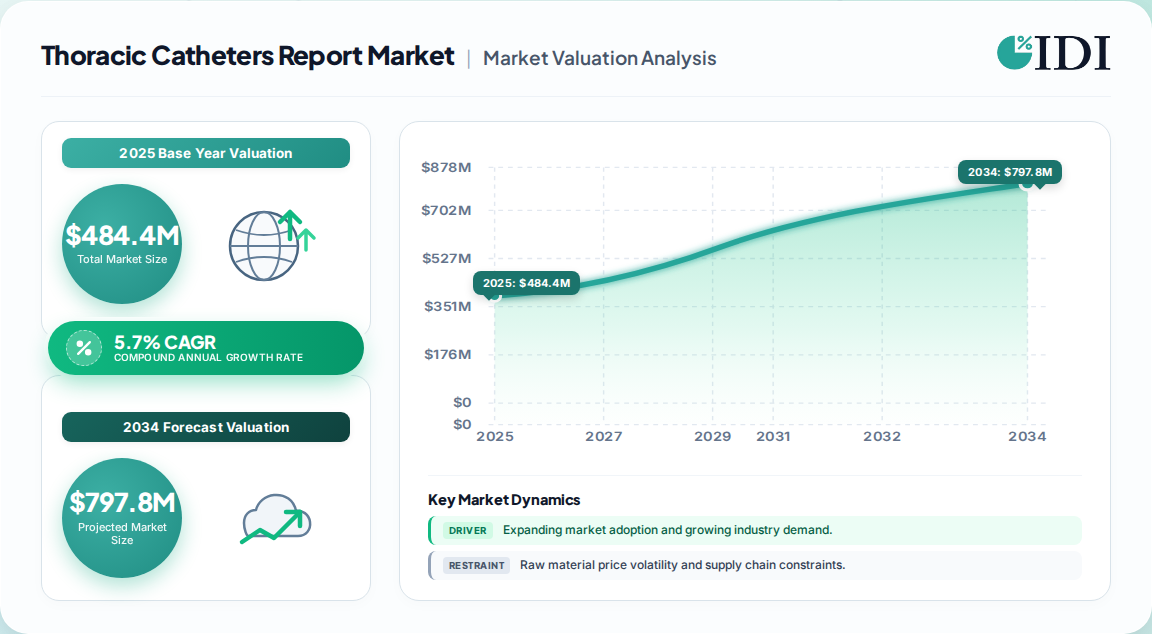
USD 484.4 million was the global thoracic catheters market size in 2025, with North America holding roughly 42% of global revenue.
Forecast to USD 748.9 million by 2033 at a 5.7% CAGR (2026–2033), implying about USD 264 million of incremental annual revenue.
Pleural drainage catheters lead product revenue, while pneumothorax leads applications and silicone leads materials; hospitals hold roughly 54.5% of end-use revenue.
Asia Pacific is the fastest-growing region, with the U.S. remaining the single largest country market.
Digital drainage, small-bore catheters and tunneled indwelling devices are the three innovation vectors reshaping purchasing.
Why this matters for decision-makers: vendors that cannot document shorter length-of-stay and lower total cost of care will face margin compression as GPO-led commoditization intensifies in North America.
Thoracic Catheters Market Report Market Size (In Million)
750.0M
600.0M
450.0M
300.0M
150.0M
0
484.0 M
2025
508.0 M
2026
537.0 M
2027
568.0 M
2028
600.0 M
2029
635.0 M
2030
671.0 M
2031
Thoracic Catheters Market Report Market Size (In Million)
Year
Market Size
2025
484.0 M
2026
508.0 M
2027
537.0 M
2028
568.0 M
2029
600.0 M
2030
635.0 M
2031
671.0 M
What is the Thoracic Catheters Market Report?
The thoracic catheters market report covers flexible tubes inserted into the pleural or mediastinal cavity to drain air, blood or fluid in pneumothorax, pleural effusion, hemothorax, trauma and post-surgical recovery. It sizes products (thoracostomy tubes, pleural drainage catheters), materials (silicone, PVC, polyurethane), applications, end users and regions.
Scope: what this report covers and excludes
This analysis covers the global thoracic catheter market across product, material, application and end-use segments, with country-level breakdowns for North America, Europe, Asia Pacific, Latin America and the Middle East & Africa. It addresses thoracostomy tubes, pleural drainage catheters, trocar catheters and related kits used in acute and ambulatory chest drainage. This analysis does not cover chest drainage canisters and suction units sold as standalone capital equipment, extracorporeal membrane oxygenation circuits, bronchoscopes, or indwelling pleural catheter reimbursement policy design.
How big is the market for Thoracic Catheters Market Report?
The most defensible base is USD 484.4 million for 2025, growing to USD 508.3 million in 2026 and USD 748.9 million by 2033 at 5.7% CAGR — the only estimate anchored to a disclosed 2025 actual and a matching forecast horizon.
Estimate
Base year
Horizon
CAGR
Definition / scope
Attribution
USD 484.4M
2025
2033
5.7%
Global thoracic catheters, product/material/application/end-use
One published estimate
USD 424.2M
2025
2034
5.46%
Global thoracic catheters, narrower product set
A competing analysis
USD 1.10B
2026
2032
8.08%
Broader chest drainage definition likely including disposables
A competing analysis
USD 1.19B
2027
2032
8.08%
Same publisher, later base year
A competing analysis
Our analysis favours the 5.7% trajectory. The USD 1.1–1.19 billion figures are 2.3–2.5x higher and almost certainly embed drainage canisters, consumable kits and digital monitoring hardware that a strict thoracic-catheter definition excludes. Buyers should treat the higher figures as a category-level view, not a catheter-only view.
How is the market segmented?
Segmentation follows four axes — product, material, application and end use — with product and application carrying the strongest purchasing implications because they map directly to procedure type and reimbursement pathway.
Hospitals, Specialty Clinics, Ambulatory Surgical Centers, Home Care, Others
Pleural drainage catheters and silicone hold the revenue lead, but polyurethane and small-bore Seldinger placement are the growth vectors. This divergence implies procurement teams should re-tender on a 24–36 month cycle rather than locking long-term PVC-heavy contracts.
Which region leads in Thoracic Catheters Market Report?
North America leads with roughly 39–42.5% of global revenue in 2025, driven by high cardiothoracic surgery volumes, premium digital drainage adoption and concentrated GPO purchasing; Asia Pacific is the fastest-growing region.
Asia Pacific (China, Japan, India, South Korea, Australia)
Latin America (Brazil, Mexico, Argentina)
Middle East & Africa (Saudi Arabia, UAE, South Africa)
The regional spread matters because the buying logic differs sharply. North America rewards documented length-of-stay reduction; Europe rewards sterile single-use consistency and CE-driven traceability; Asia Pacific rewards price-competitive small-bore kits as surgical volumes scale.
What is driving growth — and what is holding it back?
The dominant driver is clinical burden: rising pleural effusion, pneumothorax and empyema prevalence, compounded by expanding thoracic and cardiothoracic surgery volumes performed through minimally invasive routes.
Factor
Direction
Evidence strength
Mechanism
Pleural effusion & pneumothorax burden
Driver
High
~252 cases per 100,000 non-malignant effusion incidence; chronic drainage demand
Cardiothoracic surgery volumes
Driver
High
Japan 94,961 thoracic procedures in 2024, 2.2x the 2000 level
Minimally invasive small-bore shift
Driver
Medium-high
86.6% clinical improvement in 134 ultrasound-guided pigtail procedures
Digital drainage & ERAS workflows
Driver
Medium
Shorter stays, mean 1 day reduction across five RCTs
Home-based and palliative drainage
Driver
Medium
Outpatient tunneled catheter models expand care setting reach
Blockage, infection, malposition
Restraint
Medium
Clot and debris obstruction reduces drainage efficacy
GPO commoditization and pricing pressure
Restraint
High
North America standard-tube price erosion
Supply chain and polymer availability
Restraint
Medium
~0.5 percentage point potential CAGR drag in disruption scenarios
The balance favours growth. Our analysis suggests the restraints are concentrated in mature acute-care standard tubes, while the drivers concentrate in premium and ambulatory products — a margin-mix shift that will separate winners from volume-only players.
Who are the leading vendors?
The vendor landscape is moderately concentrated, with large diversified medtech players competing against specialist chest-drainage and catheter manufacturers across acute and ambulatory channels.
Player type
Representative participants
Strategic position
Diversified medtech
Medtronic, Teleflex, BD, ICU Medical
Broad portfolios, GPO contracts, digital drainage integration
Chest-drainage specialists
Atrium Medical (Getinge), Medela, Redax, Rocket Medical
Category depth, proprietary drainage systems
Catheter and access specialists
Vygon, Grena, Cook Medical, B. Braun
Small-bore and tunneled catheter engineering
Differentiation is shifting from tube construction to system-level outcomes — antimicrobial coatings, anti-clog valves, and digital drainage integration. Our analysis suggests specialist vendors retain defensible niches in tunneled indwelling catheters and pediatric sizing, while diversified players dominate through bundle economics.
What do buyers and operators need to know?
Selection hinges on four criteria: catheter patency under thick or clotted fluid, insertional trauma profile, imaging compatibility, and the vendor's ability to document length-of-stay or readmission impact. For acute standard tubes, price and sterility assurance dominate; for tunneled and ambulatory products, training, home-care support and reimbursement documentation dominate.
Procurement risk is concentrated in supply continuity. Medical-grade silicone and polyurethane depend on a narrow supplier base, and sterilization capacity constraints can create 4–12 week allocation gaps during demand shocks. Switching costs rise sharply once a facility standardizes digital drainage consoles, because consumables become proprietary. Buyers should therefore negotiate consumable pricing floors at the point of capital placement.
Regulatory compliance is non-trivial. Catheters sit under Class II frameworks in the U.S. and EU MDR in Europe, requiring biocompatibility, sterility and shelf-life validation; post-market surveillance obligations are tightening. Operators should verify notified-body certificates remain valid through contract term.
Strategic Recommendations & Analyst Perspective
The balance of evidence favours the 5.7% consensus trajectory over the more aggressive 8%+ estimates, because catheter-only revenue is structurally smaller than chest-drainage category revenue. Investors should anchor valuation on the narrower definition and treat the higher figures as an upside case contingent on digital-system attachment.
The strongest counter-argument is that digital drainage could pull consumable spend into a higher-growth system model, effectively expanding the addressable catheter market beyond the 5.7% path. That case is credible but unproven at scale; the RCT evidence on length-of-stay is directionally positive yet statistically significant in only two of five trials.
Prioritize tunneled and small-bore portfolios in North America and Western Europe, where outpatient and palliative drainage economics are most mature.
Build outcomes evidence, not feature lists — vendors that can show day-level length-of-stay reduction will defend premium pricing against GPO pressure.
Secure silicone and polyurethane supply with dual sourcing and pre-qualified sterilization capacity to avoid 0.5-point growth drag.
What would change this conclusion: a multi-center trial demonstrating statistically significant cost savings from digital drainage attached to proprietary catheters, or Asian reimbursement expansion for tunneled catheters, would justify upgrading to the higher-growth case.
Methodology
Primary Research & Industry Fieldwork
This study follows a 70/30 primary-to-secondary research split. We conducted in-depth interviews with raw material suppliers, specialized catheter producers, contract sterilization and packaging formulators, and global medical-device distributors across five regions.
Secondary Benchmarking & Public Trade Validation
Benchmarks were validated against UN Comtrade, US ITC, Eurostat and WTO trade records, corporate 10-K and annual investor filings, patent databases, and recognized technical standards bodies.
Demand Modeling & Market Sizing Triangulation
We triangulate a top-down allocation from macroeconomic and surgical-volume data against a bottom-up model of manufacturer capacity, product pricing and end-use consumption.
Our rigorous research methodology combines multi-layered approaches with comprehensive quality assurance, ensuring precision, accuracy, and reliability in every market analysis.
Primary Research & Industry Fieldwork
This study follows a 70/30 primary-to-secondary research split. We conducted in-depth interviews with raw material suppliers, specialized catheter producers, contract sterilization and packaging formulators, and global medical-device distributors across five regions. Decision-maker designations interviewed included VP of Sourcing, Heads of R&D, Technical Directors and Commercial Operations Leads, ensuring coverage of both clinical and procurement perspectives.
Key Stakeholders Interviewed
Key Stakeholders Interviewed
Stakeholder Role
Interview Share (%)
VP of Sourcing & Procurement Leads
30%
Heads of R&D
30%
Technical Directors
25%
Commercial Operations Leads
15%
Industry Ecosystem Breakdown
Industry Ecosystem Breakdown
Company Type
Representation (%)
Raw Material & Polymer Suppliers
25%
Specialized Catheter Producers
40%
Sterilization & Packaging Formulators
15%
Global Medical Device Distributors
20%
Secondary Benchmarking & Public Trade Validation
Benchmarks were validated against UN Comtrade, US ITC, Eurostat and WTO trade records, corporate 10-K and annual investor filings, patent databases, and recognized technical standards bodies such as ISO. These sources provided independent checks on trade flow direction, surgical procedure volumes and material input cost trajectories.
Demand Modeling & Market Sizing Triangulation
We triangulate a top-down allocation from macroeconomic and surgical-volume data against a bottom-up model of manufacturer capacity, product pricing and end-use consumption. Divergences between the two approaches are reconciled through demand elasticity testing across price bands.
Table 14: Europe Thoracic Catheters Market Report Revenue Million Forecast, by Product 2020 & 2034
Table 15: Europe Thoracic Catheters Market Report Revenue Million Forecast, by Material 2020 & 2034
Europe Thoracic Catheters Market Report Revenue Million Forecast, by Application 2020 & 2034
Frequently Asked Questions
1. What is the thoracic catheters market size?
USD 484.4 million in 2025, forecast to reach USD 748.9 million by 2033 at a 5.7% CAGR. North America accounts for roughly 42% of global revenue.
2. Which segment leads the thoracic catheters market?
Pleural drainage catheters lead product revenue, pneumothorax leads applications, silicone leads materials, and hospitals lead end use with about 54.5% share in 2025.
3. Which region is the fastest-growing?
Asia Pacific is the fastest-growing region, driven by expanding thoracic surgery volumes, rising cancer burden and cost-competitive small-bore catheter adoption.
4. Who are the key players?
Medtronic, Teleflex, BD, ICU Medical, Getinge (Atrium), Medela, Redax, Rocket Medical, Vygon, Grena, Cook Medical and B. Braun.
5. What is the biggest restraint?
Catheter blockage, infection and dislodgement risks, coupled with GPO-led commoditization and premium pricing pressure in North America, limit per-unit revenue growth.
Figure 17: Europe Thoracic Catheters Market Report Revenue Share (%), by Application 2026 & 2034
Figure 18: Europe Thoracic Catheters Market Report Revenue (Million), by End Use 2026 & 2034
Figure 19: Europe Thoracic Catheters Market Report Revenue Share (%), by End Use 2026 & 2034
Figure 20: Europe Thoracic Catheters Market Report Revenue (Million), by Country 2026 & 2034
Figure 21: Europe Thoracic Catheters Market Report Revenue Share (%), by Country 2026 & 2034
Figure 22: Asia Pacific Thoracic Catheters Market Report Revenue (Million), by Product 2026 & 2034
Figure 23: Asia Pacific Thoracic Catheters Market Report Revenue Share (%), by Product 2026 & 2034
Figure 24: Asia Pacific Thoracic Catheters Market Report Revenue (Million), by Material 2026 & 2034
Figure 25: Asia Pacific Thoracic Catheters Market Report Revenue Share (%), by Material 2026 & 2034
Figure 26: Asia Pacific Thoracic Catheters Market Report Revenue (Million), by Application 2026 & 2034
Figure 27: Asia Pacific Thoracic Catheters Market Report Revenue Share (%), by Application 2026 & 2034
Figure 28: Asia Pacific Thoracic Catheters Market Report Revenue (Million), by End Use 2026 & 2034
Figure 29: Asia Pacific Thoracic Catheters Market Report Revenue Share (%), by End Use 2026 & 2034
Figure 30: Asia Pacific Thoracic Catheters Market Report Revenue (Million), by Country 2026 & 2034
Figure 31: Asia Pacific Thoracic Catheters Market Report Revenue Share (%), by Country 2026 & 2034
Figure 32: Latin America Thoracic Catheters Market Report Revenue (Million), by Product 2026 & 2034
Figure 33: Latin America Thoracic Catheters Market Report Revenue Share (%), by Product 2026 & 2034
Figure 34: Latin America Thoracic Catheters Market Report Revenue (Million), by Material 2026 & 2034
Figure 35: Latin America Thoracic Catheters Market Report Revenue Share (%), by Material 2026 & 2034
Figure 36: Latin America Thoracic Catheters Market Report Revenue (Million), by Application 2026 & 2034
Figure 37: Latin America Thoracic Catheters Market Report Revenue Share (%), by Application 2026 & 2034
Figure 38: Latin America Thoracic Catheters Market Report Revenue (Million), by End Use 2026 & 2034
Figure 39: Latin America Thoracic Catheters Market Report Revenue Share (%), by End Use 2026 & 2034
Figure 40: Latin America Thoracic Catheters Market Report Revenue (Million), by Country 2026 & 2034
Figure 41: Latin America Thoracic Catheters Market Report Revenue Share (%), by Country 2026 & 2034
Figure 42: Middle East & Africa Thoracic Catheters Market Report Revenue (Million), by Product 2026 & 2034
Figure 43: Middle East & Africa Thoracic Catheters Market Report Revenue Share (%), by Product 2026 & 2034
Figure 44: Middle East & Africa Thoracic Catheters Market Report Revenue (Million), by Material 2026 & 2034
Figure 45: Middle East & Africa Thoracic Catheters Market Report Revenue Share (%), by Material 2026 & 2034
Figure 46: Middle East & Africa Thoracic Catheters Market Report Revenue (Million), by Application 2026 & 2034
Figure 47: Middle East & Africa Thoracic Catheters Market Report Revenue Share (%), by Application 2026 & 2034
Figure 48: Middle East & Africa Thoracic Catheters Market Report Revenue (Million), by End Use 2026 & 2034
Figure 49: Middle East & Africa Thoracic Catheters Market Report Revenue Share (%), by End Use 2026 & 2034
Figure 50: Middle East & Africa Thoracic Catheters Market Report Revenue (Million), by Country 2026 & 2034
Figure 51: Middle East & Africa Thoracic Catheters Market Report Revenue Share (%), by Country 2026 & 2034
Table 16:
Table 17: Europe Thoracic Catheters Market Report Revenue Million Forecast, by End Use 2020 & 2034
Table 18: Europe Thoracic Catheters Market Report Revenue Million Forecast, by Country 2020 & 2034