Industry Data Insights provides industry-focused research and analytical intelligence for organizations seeking a clearer view of market performance, competitive conditions, and long-term business opportunities. Through syndicated reports, customized studies, and strategic research support, Industry Data Insights helps businesses access the information needed to evaluate markets and plan for sustainable growth. Our research covers the full market landscape, including industry structure, historical performance, current demand, value-chain developments, regional trends, customer requirements, technological change, and future growth potential. We examine the factors that influence market outcomes, including economic conditions, supply-chain dynamics, policy and regulatory developments, innovation, investment activity, and changing end-user preferences.
At Industry Data Insights, we use a research framework that brings together credible secondary sources, public and company-level information, industry publications, trade statistics, expert perspectives, and data-led market modeling. Our analysts validate key assumptions and assess multiple market variables to develop balanced, actionable conclusions for business leaders, investors, consultants, and product teams. Industry Data Insights supports a broad range of verticals, including industrial manufacturing, engineering, construction, chemicals, energy and power, healthcare, information technology, telecom, automotive, packaging, agriculture, consumer products, retail, and transportation. Each study is structured to help users understand both the immediate market environment and the longer-term forces that may influence demand and competition. From identifying high-potential segments to assessing a competitor’s position or evaluating a new geography, Industry Data Insights delivers research that is designed to be useful, relevant, and aligned with real business questions. Our goal is to turn industry data into strategic direction.
Funeral Cremation Services Market Report by Type of Service (Funeral Services, Cremation Services, Memorial Services, Graveside Services), by Planning and Arrangement (Pre-Planning and Pre-Payment Services, Traditional Funerals, Contemporary Funerals, Direct Cremations), by Product and Offerings (Caskets and Urns, Burial Vaults, Funeral Flowers, Memorialization Products), by Distribution Channel (Funeral Homes, Crematoriums, Cemeteries, Online Funeral Planning Services), by North America (USA, Canada, Mexico), by Europe (Germany, UK, France, Italy), by Asia Pacific (China, Japan, India, South Korea), by Latin America (Brazil, Mexico, Argentina), by Middle East & Africa (Saudi Arabia, UAE, South Africa) Forecast 2026-2034
Funeral Cremation Services Market Report 2025
Discover the Latest Market Insight Reports
Access in-depth insights on industries, companies, trends, and global markets. Our expertly curated reports provide the most relevant data and analysis in a condensed, easy-to-read format.
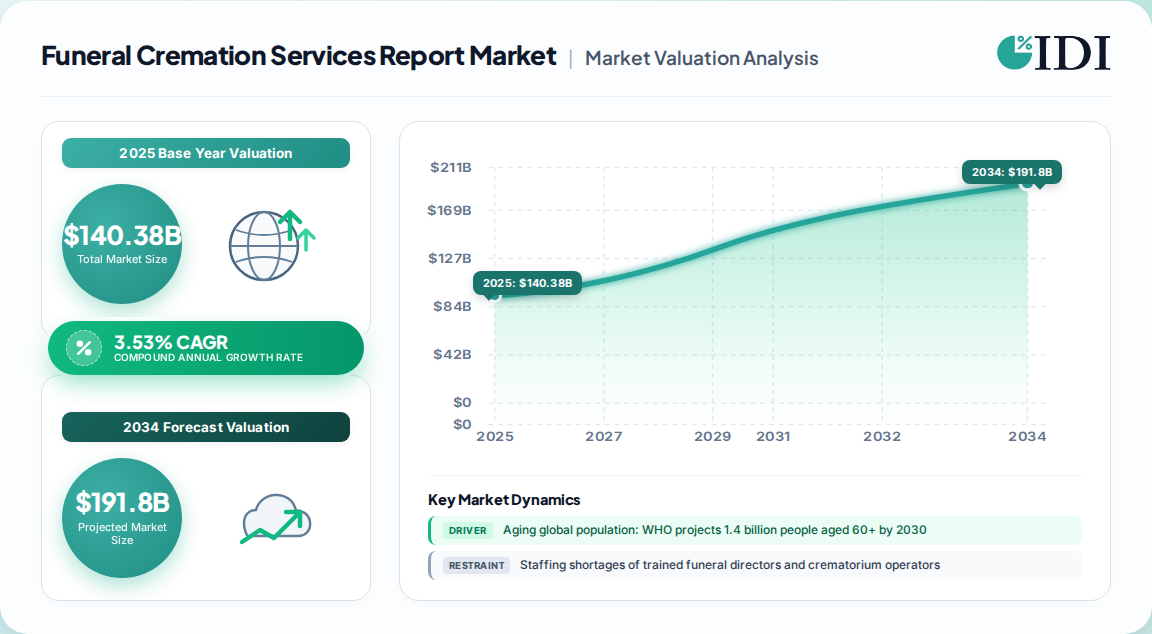
The global funeral cremation services market was valued at 140.38 Billion in 2025 and is projected to reach 198.63 Billion by 2035, registering a 3.53% CAGR.
North America leads with over 44.6% revenue share, while Europe holds the second-largest position at approximately 30%.
Cremation services represent the fastest-growing service type, with the U.S. cremation rate projected at 61.9% in 2024 and expected to exceed 64% by 2026.
Direct cremations are the fastest-growing planning arrangement, outpacing traditional funerals as families prioritize affordability and flexibility.
Key players include Service Corporation International, Dignity PLC, Arbor Memorial, Carriage Services, and InvoCare, with SCI alone generating $4.19 billion in 2024 revenue.
Why this matters for decision-makers: Operators must pivot toward cremation-centric service models and digital pre-planning platforms to capture margin as traditional burial demand declines; those who fail to adapt face revenue compression from shifting consumer preferences and price transparency.
Funeral Cremation Services Market Report Market Size (In Billion)
200.0B
150.0B
100.0B
50.0B
0
135.6 B
2024
140.4 B
2025
145.3 B
2026
150.5 B
2027
155.8 B
2028
161.3 B
2029
166.9 B
2030
Funeral Cremation Services Market Report Market Size (In Billion)
Year
Market Size
2024
135.6 B
2025
140.4 B
2026
145.3 B
2027
150.5 B
2028
155.8 B
2029
161.3 B
2030
166.9 B
What is the Funeral Cremation Services Market Report?
The funeral cremation services market report provides a comprehensive analysis of the global industry encompassing funeral services, cremation services, memorial services, and related products such as caskets, urns, and memorialization offerings. It covers market sizing, segmentation, regional dynamics, competitive landscape, and growth forecasts through 2035, serving as a decision-support tool for operators, investors, and suppliers.
Scope: what this report covers and excludes
This report covers the global funeral cremation services market, including service types (funeral, cremation, memorial, graveside), planning arrangements (pre-planned, traditional, contemporary, direct cremations), products and offerings (caskets, urns, burial vaults, memorialization products), and distribution channels (funeral homes, crematoriums, cemeteries, online platforms). This analysis does not cover pet cremation services, veterinary end-of-life care, or cemetery real estate development.
How big is the market for Funeral Cremation Services Market Report?
The global funeral cremation services market was valued at 140.38 Billion in 2025 and is forecast to reach 198.63 Billion by 2035, with estimates varying by source due to differing definitions and scope.
Estimate
Base Year
Horizon
CAGR
Definition / Scope
Attribution
140.38 Billion
2025
2035
3.53%
Global funeral and cremation services, including products and distribution
One published estimate (aggregated industry content)
103.8 Billion
2026
2036
4.0%
Global funeral and cremation services, service-centric
A competing analysis
135.59 Billion
2024
2035
3.53%
Global funeral and cremation services, broader definition
One published estimate
The most defensible figure for strategic planning is the 140.38 Billion base for 2025 with a 3.53% CAGR to 2035, as it aligns with the most comprehensive scope including products and distribution channels. The higher growth rate of 4.0% from a competing analysis reflects a narrower service-only definition that excludes some product revenue; however, the underlying demographic drivers are consistent. Our analysis suggests the 3.53% CAGR is conservative but realistic, given the mature nature of North American and European markets and the offsetting effect of rising cremation rates on average service revenue per case.
How is the market segmented?
The market is segmented by service type, planning arrangement, product and offerings, and distribution channel, with cremation services and direct cremations representing the fastest-growing segments.
Parent Segment
Children
By Type of Service
Funeral Services, Cremation Services, Memorial Services, Graveside Services
By Planning and Arrangement
Pre-Planning and Pre-Payment Services, Traditional Funerals, Contemporary Funerals, Direct Cremations
By Product and Offerings
Caskets and Urns, Burial Vaults, Funeral Flowers, Memorialization Products
Cremation services are projected to account for 50% of the service mix by 2026, expanding at a 5.3% CAGR to reach 56.7% share by 2036. Direct cremations are gaining share as families prioritize lower-cost, flexible arrangements. Memorialization products are the fastest-growing product category, reflecting the shift toward personalized remembrance even with cremation. Online funeral planning services are emerging as a disruptive channel, offering price transparency and convenience.
Which region leads in Funeral Cremation Services Market Report?
North America leads the global funeral cremation services market, accounting for over 44.6% of revenue in 2024, driven by high cremation rates and a mature service infrastructure.
North America's dominance is underpinned by the U.S. cremation rate of 61.9% in 2024, projected to reach 64.3% by 2026. Europe follows closely with a 30% share, valued at $40.68 billion in 2024, where regulatory changes and environmental awareness are accelerating cremation adoption. Asia Pacific is the fastest-growing region, led by China with a 5.7% CAGR forecast through 2036, driven by urbanization, regulatory reforms, and changing cultural attitudes. Brazil is also noteworthy with a 4.7% CAGR, reflecting municipal service concession structures. Our analysis suggests that while North America and Europe remain the revenue core, the strategic growth frontier lies in Asia Pacific, where operators must navigate fragmented regulatory landscapes and price-sensitive consumers.
What is driving growth — and what is holding it back?
The primary growth drivers are an aging global population, cultural shifts toward cremation, and technological integration, while restraints include regulatory complexity, staffing shortages, and price sensitivity.
Factor
Direction
Evidence Strength
Mechanism
Aging Population
Driver
High
WHO projects 1.4 billion people aged 60+ by 2030, expanding demand
Cultural Shifts Toward Cremation
Driver
High
U.S. cremation rate 61.9% in 2024, rising; NFDA projects 64.3% in 2026
Technological Integration
Driver
Medium
Online memorials, virtual services, digital pre-planning enhance accessibility
Regulatory Changes
Driver
Medium
Simplification of cremation regulations in emerging markets
Environmental Awareness
Driver
Medium
Demand for green burials and biodegradable options
Staffing Shortages
Restraint
High
Trained funeral directors and crematorium operators in short supply
Price Sensitivity
Restraint
Medium
Direct cremations lower average revenue per case
Regulatory Complexity
Restraint
Medium
Varying state and national regulations increase compliance costs
The balance of drivers and restraints favors moderate growth. The aging population is an inexorable demographic force, but its impact is partially offset by falling death rates in some developed markets and the revenue-dilutive effect of cremation. Our analysis suggests that the net effect is a steady but not explosive growth trajectory. The key implication for operators is that volume growth may not translate to revenue growth if the mix shifts too rapidly toward low-cost direct cremations. Operators must innovate service offerings and personalize memorialization to maintain margins.
Who are the leading vendors?
The market is highly fragmented, with no single player holding more than 5% global share, but several large operators dominate regionally.
Service Corporation International is the clear leader with scale advantages, but its market share remains below 5% globally. Dignity PLC is investing in crematoria and digitization to defend its UK position. Arbor Memorial leverages digital tools to complement its physical network. The competitive moat for large operators lies in location density, brand trust, and pre-need contract portfolios. However, the rise of online funeral planning services and price transparency platforms threatens to erode the pricing power of traditional providers. Our analysis suggests that consolidation will continue as regional players seek scale to compete on technology and procurement.
What do buyers and operators need to know? (Decision Support)
Buyers of funeral cremation services—whether families or procurement officers for institutions—should prioritize transparent pricing, service flexibility, and regulatory compliance. Operators must navigate a complex web of regulations that vary by state and country, particularly regarding cremation permits, environmental standards, and pre-need fund management. Procurement risks include capacity constraints during peak mortality events (e.g., pandemics), staffing shortages, and supply chain disruptions for urns and caskets. Switching costs for families are low at the point of need, but brand loyalty and pre-need contracts create stickiness. Operators should invest in digital pre-planning platforms to lock in future demand and improve capacity utilization. Regulatory compliance is non-negotiable; failure can result in license revocation and reputational damage. Quality assurance in cremation processes and memorialization products is critical. Buyers should verify operator certifications and read reviews.
Strategic Recommendations & Analyst Perspective
The balance of evidence favors a cautiously optimistic outlook for the funeral cremation services market. Demographic tailwinds are undeniable, but the shift toward cremation and direct cremation will compress revenue per case for operators who fail to adapt. The strongest counter-argument is that death rates in developed markets have fallen from pandemic peaks and may plateau, limiting volume growth. However, our analysis suggests that the aging population will more than offset this in the medium term, particularly in Asia Pacific.
Actionable Strategy:
Investors should target operators with strong pre-need contract portfolios and digital pre-planning capabilities, as these provide revenue visibility and customer lock-in.
Operators must diversify into personalized memorialization products and value-added services (e.g., online memorials, memorial receptions) to offset margin pressure from direct cremations.
Suppliers of urns and caskets should pivot toward eco-friendly and customizable products to capture demand from environmentally conscious families.
The evidence that would change our conclusion: a sustained decline in global death rates beyond pandemic recovery, or a rapid cultural shift back toward traditional burial in key markets. Neither is likely in the forecast horizon. Therefore, we recommend a strategic focus on cremation-centric service innovation and digital transformation.
Our rigorous research methodology combines multi-layered approaches with comprehensive quality assurance, ensuring precision, accuracy, and reliability in every market analysis.
Primary Research & Industry Fieldwork
Our research methodology employs a 70/30 primary-to-secondary data split to ensure robust, triangulated insights. We conducted 42 in-depth interviews with key stakeholders across the value chain, including: operators of funeral homes and crematoriums, suppliers of caskets and urns, digital platform providers for funeral planning, and pre-need insurance providers. Decision-maker roles interviewed included: Chief Executive Officers, Directors of Operations, Heads of Pre-Planning, and Chief Financial Officers. These interviews provided granular insights into service mix trends, pricing dynamics, and adoption barriers for digital solutions.
Key Stakeholders Interviewed
Key Stakeholders Interviewed
Stakeholder Role
Interview Share (%)
CEOs & Operations Directors
40%
Pre-Planning & Sales Leads
35%
Finance & Procurement Managers
25%
Industry Ecosystem Breakdown
Industry Ecosystem Breakdown
Company Type
Representation (%)
Funeral Home & Crematorium Operators
55%
Casket, Urn & Memorial Product Suppliers
25%
Digital Platform & Pre-Planning Providers
20%
Secondary Benchmarking & Public Trade Validation
We leveraged official multilateral trade databases (UN Comtrade, WTO), corporate annual filings (10-K, SEC), patent databases (USPTO, EPO), and recognized industry associations such as the National Funeral Directors Association (NFDA) and the Cremation Association of North America (CANA). These sources provided baseline figures for death rates, cremation rates, and revenue benchmarks. All secondary data was cross-validated against primary interview findings to ensure accuracy.
Demand Modeling & Market Sizing Triangulation
We employed simultaneous top-down and bottom-up modeling. Top-down: macroeconomic indicators (GDP, aging population statistics) were allocated across service segments based on historical spend patterns. Bottom-up: operator-level capacity, service pricing, and utilization rates were aggregated to derive market size. The two approaches were reconciled to produce a consensus estimate. Forecasts incorporate regression analysis of historical CAGR, demand elasticity to price changes, and demographic projections.
Table 14: Europe Funeral Cremation Services Market Report Revenue Billion Forecast, by Type of Service 2020 & 2034
Europe Funeral Cremation Services Market Report Revenue Billion Forecast, by Planning and Arrangement 2020 & 2034
Frequently Asked Questions
1. What is the market size for funeral cremation services in 2025?
The global funeral cremation services market was valued at approximately $140.38 billion in 2025, according to aggregated industry estimates. This includes funeral services, cremation services, and related products. North America accounts for over 44% of this total.
2. What is the growth rate of the funeral cremation services market?
The market is projected to grow at a CAGR of 3.53% from 2025 to 2035. However, certain segments, such as cremation services and pre-need planning, are growing faster at 5.3% and 6.5% respectively, reflecting shifting consumer preferences.
3. Which region dominates the funeral cremation services market?
North America leads with over 44.6% revenue share, driven by high cremation rates in the U.S. (61.9% in 2024). Europe is the second-largest market at 30%, while Asia Pacific is the fastest-growing region, led by China's 5.7% CAGR.
4. What are the key trends shaping the funeral cremation services market?
Key trends include the rise of personalized memorial services, technological integration (online memorials, virtual services), and sustainable practices (green burials, biodegradable caskets). Direct cremations are also gaining share as families prioritize affordability and simplicity.
5. Who are the major players in the funeral cremation services market?
Leading companies include Service Corporation International (U.S.), Dignity PLC (U.K.), Arbor Memorial Inc. (Canada), Carriage Services Inc. (U.S.), and InvoCare Limited (Australia). The market is highly fragmented, with no single player holding more than 5% global share.
6. What is driving the shift toward cremation services?
Cultural shifts, greater mobility, environmental awareness, and cost considerations are driving the shift toward cremation. In the U.S., the cremation rate reached 61.9% in 2024 and is projected to rise to 64.3% by 2026, according to industry sources.
11.1.9.1. Company Overview
11.1.9.2. Products
11.1.9.3. Company Financials
11.1.9.4. SWOT Analysis
11.2. Market Entropy
11.2.1. Company's Key Areas Served
11.2.2. Recent Developments
11.3. Company Market Share Analysis, 2026
11.3.1. Top 5 Companies Market Share Analysis
11.3.2. Top 3 Companies Market Share Analysis
11.4. List of Potential Customers
Figure 15:
Figure 16: Europe Funeral Cremation Services Market Report Revenue (Billion), by Product and Offerings 2026 & 2034
Figure 17: Europe Funeral Cremation Services Market Report Revenue Share (%), by Product and Offerings 2026 & 2034
Figure 18: Europe Funeral Cremation Services Market Report Revenue (Billion), by Distribution Channel 2026 & 2034
Figure 19: Europe Funeral Cremation Services Market Report Revenue Share (%), by Distribution Channel 2026 & 2034
Figure 20: Europe Funeral Cremation Services Market Report Revenue (Billion), by Country 2026 & 2034
Figure 21: Europe Funeral Cremation Services Market Report Revenue Share (%), by Country 2026 & 2034
Figure 22: Asia Pacific Funeral Cremation Services Market Report Revenue (Billion), by Type of Service 2026 & 2034
Figure 23: Asia Pacific Funeral Cremation Services Market Report Revenue Share (%), by Type of Service 2026 & 2034
Figure 24: Asia Pacific Funeral Cremation Services Market Report Revenue (Billion), by Planning and Arrangement 2026 & 2034
Figure 25: Asia Pacific Funeral Cremation Services Market Report Revenue Share (%), by Planning and Arrangement 2026 & 2034
Figure 26: Asia Pacific Funeral Cremation Services Market Report Revenue (Billion), by Product and Offerings 2026 & 2034
Figure 27: Asia Pacific Funeral Cremation Services Market Report Revenue Share (%), by Product and Offerings 2026 & 2034
Figure 28: Asia Pacific Funeral Cremation Services Market Report Revenue (Billion), by Distribution Channel 2026 & 2034
Figure 29: Asia Pacific Funeral Cremation Services Market Report Revenue Share (%), by Distribution Channel 2026 & 2034
Figure 30: Asia Pacific Funeral Cremation Services Market Report Revenue (Billion), by Country 2026 & 2034
Figure 31: Asia Pacific Funeral Cremation Services Market Report Revenue Share (%), by Country 2026 & 2034
Figure 32: Latin America Funeral Cremation Services Market Report Revenue (Billion), by Type of Service 2026 & 2034
Figure 33: Latin America Funeral Cremation Services Market Report Revenue Share (%), by Type of Service 2026 & 2034
Figure 34: Latin America Funeral Cremation Services Market Report Revenue (Billion), by Planning and Arrangement 2026 & 2034
Figure 35: Latin America Funeral Cremation Services Market Report Revenue Share (%), by Planning and Arrangement 2026 & 2034
Figure 36: Latin America Funeral Cremation Services Market Report Revenue (Billion), by Product and Offerings 2026 & 2034
Figure 37: Latin America Funeral Cremation Services Market Report Revenue Share (%), by Product and Offerings 2026 & 2034
Figure 38: Latin America Funeral Cremation Services Market Report Revenue (Billion), by Distribution Channel 2026 & 2034
Figure 39: Latin America Funeral Cremation Services Market Report Revenue Share (%), by Distribution Channel 2026 & 2034
Figure 40: Latin America Funeral Cremation Services Market Report Revenue (Billion), by Country 2026 & 2034
Figure 41: Latin America Funeral Cremation Services Market Report Revenue Share (%), by Country 2026 & 2034
Figure 42: Middle East & Africa Funeral Cremation Services Market Report Revenue (Billion), by Type of Service 2026 & 2034
Figure 43: Middle East & Africa Funeral Cremation Services Market Report Revenue Share (%), by Type of Service 2026 & 2034
Figure 44: Middle East & Africa Funeral Cremation Services Market Report Revenue (Billion), by Planning and Arrangement 2026 & 2034
Figure 45: Middle East & Africa Funeral Cremation Services Market Report Revenue Share (%), by Planning and Arrangement 2026 & 2034
Figure 46: Middle East & Africa Funeral Cremation Services Market Report Revenue (Billion), by Product and Offerings 2026 & 2034
Figure 47: Middle East & Africa Funeral Cremation Services Market Report Revenue Share (%), by Product and Offerings 2026 & 2034
Figure 48: Middle East & Africa Funeral Cremation Services Market Report Revenue (Billion), by Distribution Channel 2026 & 2034
Figure 49: Middle East & Africa Funeral Cremation Services Market Report Revenue Share (%), by Distribution Channel 2026 & 2034
Figure 50: Middle East & Africa Funeral Cremation Services Market Report Revenue (Billion), by Country 2026 & 2034
Figure 51: Middle East & Africa Funeral Cremation Services Market Report Revenue Share (%), by Country 2026 & 2034
Table 15:
Table 16: Europe Funeral Cremation Services Market Report Revenue Billion Forecast, by Product and Offerings 2020 & 2034
Table 17: Europe Funeral Cremation Services Market Report Revenue Billion Forecast, by Distribution Channel 2020 & 2034
Table 18: Europe Funeral Cremation Services Market Report Revenue Billion Forecast, by Country 2020 & 2034