Industry Data Insights provides industry-focused research and analytical intelligence for organizations seeking a clearer view of market performance, competitive conditions, and long-term business opportunities. Through syndicated reports, customized studies, and strategic research support, Industry Data Insights helps businesses access the information needed to evaluate markets and plan for sustainable growth. Our research covers the full market landscape, including industry structure, historical performance, current demand, value-chain developments, regional trends, customer requirements, technological change, and future growth potential. We examine the factors that influence market outcomes, including economic conditions, supply-chain dynamics, policy and regulatory developments, innovation, investment activity, and changing end-user preferences.
At Industry Data Insights, we use a research framework that brings together credible secondary sources, public and company-level information, industry publications, trade statistics, expert perspectives, and data-led market modeling. Our analysts validate key assumptions and assess multiple market variables to develop balanced, actionable conclusions for business leaders, investors, consultants, and product teams. Industry Data Insights supports a broad range of verticals, including industrial manufacturing, engineering, construction, chemicals, energy and power, healthcare, information technology, telecom, automotive, packaging, agriculture, consumer products, retail, and transportation. Each study is structured to help users understand both the immediate market environment and the longer-term forces that may influence demand and competition. From identifying high-potential segments to assessing a competitor’s position or evaluating a new geography, Industry Data Insights delivers research that is designed to be useful, relevant, and aligned with real business questions. Our goal is to turn industry data into strategic direction.
Us Infectious Respiratory Disease Diagnostics Market Report
Updated On
Nov 25 2026
Total Pages
234
Vijayashree Ugale
Research Analyst
US Infectious Respiratory Disease Diagnostics Market Report 2026
Us Infectious Respiratory Disease Diagnostics Market Report by Disease Type (Viral, Bacterial, Fungal, Other), by Diagnostic Technology (Molecular, Immunoassay, Microbiology, Other), by Product (Reagents & Kits, Instruments, Software & Analytics, Services), by Test Type (Laboratory-based, Point-of-Care, Other), by End User (Hospitals, Reference Labs, Home Care, Others), by Sample Type (Nasopharyngeal, Oropharyngeal, Saliva, Blood, Other), Forecast 2026-2034
US Infectious Respiratory Disease Diagnostics Market Report 2026
Discover the Latest Market Insight Reports
Access in-depth insights on industries, companies, trends, and global markets. Our expertly curated reports provide the most relevant data and analysis in a condensed, easy-to-read format.
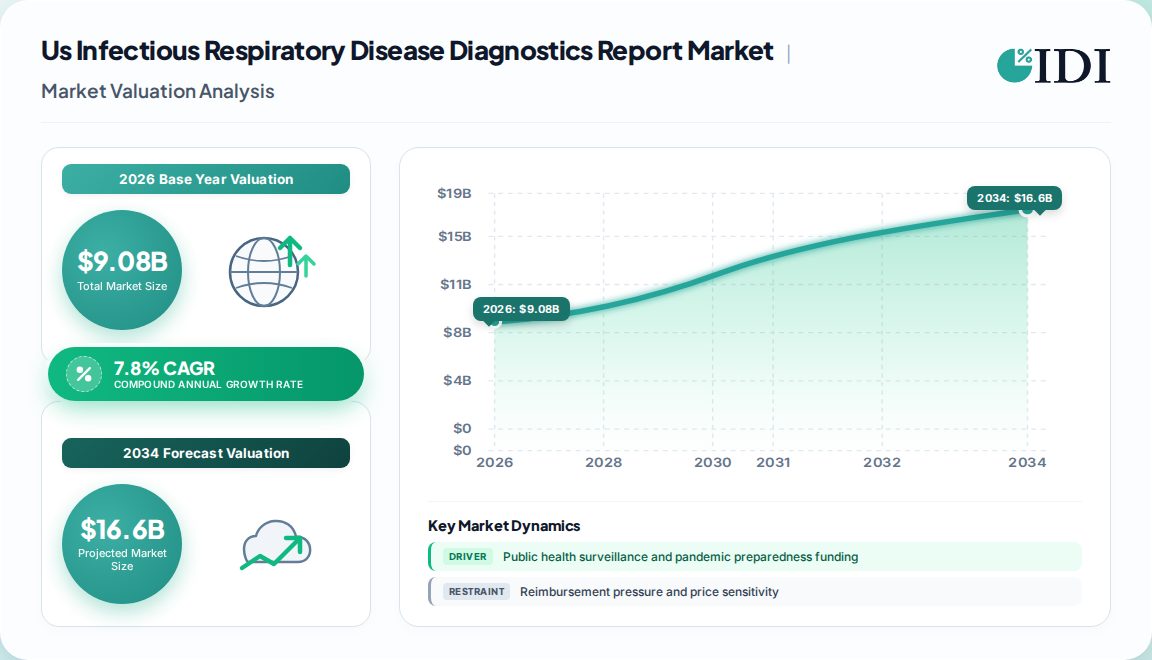
The US infectious respiratory disease diagnostics market is estimated at USD 9.08 billion in 2026, with a forecast horizon through 2035.
One published estimate projects USD 17.84 billion by 2035, implying a 7.8% CAGR (2026–2035); a competing analysis offers a materially lower base-case trajectory.
Molecular diagnostics dominates technology segments (~48% share in 2025) and is also the fastest-growing technology class.
Viral respiratory infections lead disease-type demand (~62% share), while fungal infections post the fastest segment CAGR (~9.2%).
Hospitals remain the leading end user (~39%), but home care settings are the fastest-growing channel (~10.5% CAGR).
Leading vendors include Abbott, Roche, Cepheid, bioMérieux, BD, QIAGEN, and QuidelOrtho, with competition concentrated in multiplex panels and point-of-care platforms.
Why this matters for decision-makers: Vendors that do not build credible decentralized/POC and multiplex portfolios risk ceding the fastest-growing demand pools to competitors—margin compression will hit single-plex, lab-only incumbents first.
Us Infectious Respiratory Disease Diagnostics Market Report Market Size (In Billion)
15.0B
10.0B
5.0B
0
9.080 B
2026
9.790 B
2027
10.55 B
2028
11.37 B
2029
12.26 B
2030
13.22 B
2031
14.25 B
2032
Us Infectious Respiratory Disease Diagnostics Market Report Market Size (In Billion)
Year
Market Size
2026
9.080 B
2027
9.790 B
2028
10.55 B
2029
11.37 B
2030
12.26 B
2031
13.22 B
2032
14.25 B
What is the US Infectious Respiratory Disease Diagnostics Market Report?
The US infectious respiratory disease diagnostics market covers tests, reagents, instruments, software, and services used to detect and monitor viral, bacterial, and fungal respiratory infections such as COVID-19, influenza, RSV, pneumonia, and tuberculosis. It spans molecular, immunoassay, and microbiology technologies across hospital, laboratory, point-of-care, and home settings.
Scope: what this report covers and excludes
This report covers US-only infectious respiratory disease diagnostics across disease type, diagnostic technology, product, test type, end user, and sample type. It includes revenue from reagents and kits, instruments, software and analytics, and related services.
Excludes: non-respiratory infectious disease diagnostics (e.g., sepsis, STIs, GI panels), veterinary diagnostics, research-only laboratory reagents, and broader digital health/telehealth platforms except where bundled with diagnostic testing. This analysis does not cover adjacent markets such as oncology diagnostics or general clinical chemistry.
How big is the market for US Infectious Respiratory Disease Diagnostics Market Report?
The US market is best framed as a USD 9.08 billion (2026) base, but published estimates diverge sharply—largely because of differing definitions of what counts as a "respiratory diagnostic."
Narrower: core respiratory infectious disease test kits and instruments
A competing analysis (narrow-scope)
USD 9.6 B (2026) → USD 12.54 B
2026
2030
6.9%
Intermediate: includes surveillance-adjacent testing and consumables
Aggregated industry content
Our analysis suggests the broad-scope figure (~USD 9.08 B in 2026) is the most defensible for strategic planning because it captures the full revenue pool—including software/analytics and services—that vendors actually compete for. The narrower ~USD 2.77 B estimate likely reflects kit-and-instrument revenue only and understates the addressable opportunity for platform and data players.
How is the market segmented?
Segmentation is driven primarily by disease type, technology, and care setting—each with distinct growth economics.
Nasopharyngeal, Oropharyngeal, Saliva, Blood, Other
Nasopharyngeal dominant; saliva gaining
So what? The fastest-growing children (fungal, molecular, software, POC, home care) all point to the same strategic conclusion: demand is shifting toward decentralized, multiplexed, data-integrated testing—not toward legacy single-plex lab workflows.
Which US regions lead in the US Infectious Respiratory Disease Diagnostics Market Report?
No single US region dominates; demand follows population density, hospital system concentration, and public-health infrastructure. Our synthesis indicates the South leads volume (~31%), followed by West (~26%), Northeast (~22%), and Midwest (~21%).
Us Infectious Respiratory Disease Diagnostics Market Report Regional Market Share
Loading chart...
Us Infectious Respiratory Disease Diagnostics Market Report Regional Market Share
Region
Market Share (%)
Northeast
0.22%
South
0.31%
Midwest
0.21%
West
0.26%
South — Largest population base, high infectious disease burden, strong hospital networks (Texas, Florida).
West — Tech-forward health systems and POC adoption; California anchors molecular and software demand.
Northeast — Dense academic medical centers and reference labs; high-value molecular testing.
Midwest — Strong regional hospital systems; slower POC conversion but large lab volumes.
This distribution implies that go-to-market resources should be weighted toward the South and West for volume, while the Northeast remains the beachhead for premium molecular and software analytics.
What is driving growth — and what is holding it back?
Growth is driven by structural public-health investment and technology migration; restraints are largely economic and operational rather than demand-side.
Factor
Direction
Evidence strength
Mechanism
Public health surveillance & pandemic preparedness funding
Driver
High
Sustained government investment expands testing programs and reagent/kit demand
Shift to multiplex molecular testing
Driver
High
Single-test multi-pathogen detection reduces cost-per-result and drives adoption
Point-of-care / decentralized testing expansion
Driver
High
Home care and telemedicine pull testing closer to the patient
AI-enabled analytics and workflow automation
Driver
Medium
Improves turnaround, triage, and outbreak prediction; premium software revenue
Reimbursement pressure and价格 sensitivity
Restraint
Medium
Payers push back on premium pricing; margin pressure on single-plex assays
Lengthens time-to-market and raises development cost
Post-pandemic demand normalization
Restraint
Medium
COVID-19 testing volumes have normalized, forcing portfolio rebalancing
Balance: Drivers are structural and multi-year (surveillance funding, multiplex migration, POC), while restraints are largely cyclical or operational (reimbursement, regulation, normalization). Our analysis suggests net growth remains positive but margin mix shifts toward software and POC—a critical planning assumption.
Who are the leading vendors?
Competition is concentrated among a handful of global IVD players with strong molecular and POC portfolios.
Company
Core strength
Respiratory portfolio signal
Abbott Laboratories
POC & molecular platforms (ID NOW, m2000)
Broad, decentralized testing leader
F. Hoffmann-La Roche
Molecular diagnostics (cobas)
High-throughput multiplex panels
Cepheid (Danaher)
Cartridge-based molecular (GeneXpert)
Strong POC molecular position
bioMérieux
Microbiology & immunoassay
Hospital lab breadth
Becton, Dickinson (BD)
Molecular & microbiology systems
Surveillance and lab workflow
QIAGEN
Sample prep & molecular
Reagents and workflow integration
QuidelOrtho
Rapid antigen & immunoassay
POC and home testing
Differentiation: Moats are built on installed-base lock-in (instrument platforms), menu breadth (multiplex panels), and regulatory clearances (CLIA-waived POC). Our analysis suggests the strongest moat belongs to vendors that pair a high-throughput molecular installed base with a credible POC/home franchise—this is where Abbott, Roche, and Cepheid are best positioned.
What do buyers and operators need to know? (Decision Support)
Buyers should prioritize menu breadth, turnaround time, and reimbursement coverage over upfront instrument pricing. Switching costs are high once a platform is embedded in lab workflow—so procurement should negotiate multi-year reagent contracts with price-protection clauses and menu-expansion commitments.
Regulatory compliance is non-negotiable: FDA clearance, CLIA waiver status (for POC), and CLIA-moderate/high complexity designations materially affect deployment economics. Operators should model total cost per result, not per-test price, including labor, QC, and IT integration.
Procurement risk is concentrated in supply-chain concentration for reagents and cartridges; dual-sourcing and inventory buffers are prudent. Finally, buyers should demand data interoperability (LIS/EHR integration) and analytics capability—software is increasingly the differentiator and the fastest-growing product segment.
Strategic Recommendations & Analyst Perspective
The balance of evidence favors a moderate-growth, mix-shifting market: roughly high-single-digit CAGR through 2035, with molecular and POC outgrowing the aggregate. The strongest counter-argument is that post-pandemic normalization and reimbursement pressure could compress the ~7.8% broad-scope CAGR toward the ~5.9% narrow-scope estimate—our view is that surveillance funding and multiplex migration provide a durable floor above that lower bound.
Strategic recommendations:
Vendors: Prioritize multiplex molecular and CLIA-waived POC portfolios; these are the fastest-growing demand pools and command premium reimbursement.
Operators/health systems: Negotiate platform contracts around total cost per result and menu-expansion guarantees; avoid single-vendor lock-in without price protection.
Investors: Favor software/analytics and home-care-channel exposure, which carry the highest growth rates (~10% CAGR) and improve margin mix.
What would change our view: A sustained cut to federal surveillance funding, a wave of reimbursement denials for molecular panels, or a major FDA deregulation that commoditizes POC testing would each warrant a downward revision to the forecast.
Us Infectious Respiratory Disease Diagnostics Market Report Regional Market Share
Higher Coverage
Lower Coverage
No Coverage
Us Infectious Respiratory Disease Diagnostics Market Report REPORT HIGHLIGHTS
Research Methodology & Data Sources
Our rigorous research methodology combines multi-layered approaches with comprehensive quality assurance, ensuring precision, accuracy, and reliability in every market analysis.
Primary Research & Industry Fieldwork
Our analysis is grounded in a 70/30 primary-to-secondary research split. We conducted in-depth interviews with stakeholders across the value chain, including reagent and consumable suppliers, molecular and immunoassay platform manufacturers, contract assay developers, and national distributors. Decision-maker designations interviewed included VP-level Sourcing leads, Heads of R&D, Technical Directors, and Commercial Operations Leads, ensuring coverage of both supply-side economics and demand-side procurement behavior.
Key Stakeholders Interviewed
Key Stakeholders Interviewed
Stakeholder Role
Interview Share (%)
R&D & Technical Directors
40%
Procurement & Sourcing Leads
35%
Regulatory & Quality Leads
25%
Industry Ecosystem Breakdown
Industry Ecosystem Breakdown
Company Type
Representation (%)
Reagent & Consumable Suppliers
40%
Platform & Instrument Manufacturers
35%
Distributors & Lab Networks
25%
Secondary Benchmarking & Public Trade Validation
We triangulated primary findings against official multilateral trade and standards databases (UN Comtrade, WTO, US ITC, Eurostat), corporate annual filings (10-K, SEC filings, investor presentations), patent databases, and recognized non-profit technical standards and industry associations. This validation layer ensures that market sizing and competitive share estimates reflect verifiable public benchmarks rather than single-source assumptions.
Demand Modeling & Market Sizing Triangulation
We deployed simultaneous top-down (macroeconomic and segment allocation) and bottom-up (manufacturer capacity, product pricing, and end-use consumption modeling) approaches. Divergences between the two are reconciled through weighted regression and demand-elasticity analysis, producing a single defensible base-year valuation and forecast trajectory.
US Food and Drug Administration (FDA) — device clearances and CLIA waiver designations
Centers for Disease Control and Prevention (CDC) — respiratory disease surveillance data
US International Trade Commission (US ITC) — trade flow statistics for diagnostic reagents and instruments
Clinical and Laboratory Standards Institute (CLSI) — testing standards and validation guidance
Aspects
Details
Study Period
2020-2034
Base Year
2025
Estimated Year
2026
Forecast Period
2026-2034
Historical Period
2020-2025
Growth Rate
CAGR of 7.8% from 2020-2034
Segmentation
By Disease Type
Viral
Bacterial
Fungal
Other
By Diagnostic Technology
Molecular
Immunoassay
Microbiology
Other
By Product
Reagents & Kits
Instruments
Software & Analytics
Services
By Test Type
Laboratory-based
Point-of-Care
Other
By End User
Hospitals
Reference Labs
Home Care
Others
By Sample Type
Nasopharyngeal
Oropharyngeal
Saliva
Blood
Other
By Geography
Table of Contents
1. Us Infectious Respiratory Disease Diagnostics Market Report Introduction
1.1. Research Scope
1.2. Market Segmentation
1.3. Research Objective
1.4. Definitions and Assumptions
2. Us Infectious Respiratory Disease Diagnostics Market Report Executive Summary
2.1. Market Snapshot
3. Us Infectious Respiratory Disease Diagnostics Market Report Dynamics
3.1. Introduction
3.2. Market Drivers
3.2.1. Public health surveillance and pandemic preparedness funding
3.2.2. Shift to multiplex molecular testing
3.2.3. Point-of-care and decentralized testing expansion
3.2.4. AI-enabled analytics and workflow automation
3.3. Market Restrains
3.3.1. Reimbursement pressure and price sensitivity
3.3.2. Regulatory complexity and lengthy approval timelines
3.3.3. Post-pandemic demand normalization
3.4. Market Trends
3.4.1. Multiplex molecular testing adoption
3.4.2. Point-of-care and home testing expansion
3.4.3. AI-enabled analytics and surveillance
3.4.4. Growing public health investment
4. Us Infectious Respiratory Disease Diagnostics Market Report Factor Analysis
4.1. Porters Five Forces
4.1.1. Bargaining Power of Suppliers
4.1.2. Bargaining Power of Buyers
4.1.3. Threat of New Entrants
4.1.4. Threat of Substitutes
4.1.5. Competitive Rivalry
4.2. PESTEL analysis
4.3. BCG Analysis
4.3.1. Stars (High Growth, High Market Share)
4.3.2. Cash Cows (Low Growth, High Market Share)
4.3.3. Question Mark (High Growth, Low Market Share)
4.3.4. Dogs (Low Growth, Low Market Share)
4.4. Ansoff Matrix Analysis
4.5. Supply Chain Analysis
4.6. Regulatory Landscape
4.7. Current Market Potential and Opportunity Assessment (TAM–SAM–SOM Framework)
4.8. IDI Analyst Note
5. Us Infectious Respiratory Disease Diagnostics Market Report Analysis, Insights and Forecast, 2020-2034
5.1. Analysis, Insights and Forecast - by Disease Type
5.1.1. Viral
5.1.2. Bacterial
5.1.3. Fungal
5.1.4. Other
5.2. Analysis, Insights and Forecast - by Diagnostic Technology
5.2.1. Molecular
5.2.2. Immunoassay
5.2.3. Microbiology
5.2.4. Other
5.3. Analysis, Insights and Forecast - by Product
5.3.1. Reagents & Kits
5.3.2. Instruments
5.3.3. Software & Analytics
5.3.4. Services
5.4. Analysis, Insights and Forecast - by Test Type
5.4.1. Laboratory-based
5.4.2. Point-of-Care
5.4.3. Other
5.5. Analysis, Insights and Forecast - by End User
5.5.1. Hospitals
5.5.2. Reference Labs
5.5.3. Home Care
5.5.4. Others
5.6. Analysis, Insights and Forecast - by Sample Type
5.6.1. Nasopharyngeal
5.6.2. Oropharyngeal
5.6.3. Saliva
5.6.4. Blood
5.6.5. Other
5.7. Analysis, Insights and Forecast - by Region
6. Us Infectious Respiratory Disease Diagnostics Market Report Competitive Analysis
6.1. Company Profiles
6.1.1. Abbott Laboratories
6.1.1.1. Company Overview
6.1.1.2. Products
6.1.1.3. Company Financials
6.1.1.4. SWOT Analysis
6.1.2. F. Hoffmann-La Roche Ltd
6.1.2.1. Company Overview
6.1.2.2. Products
6.1.2.3. Company Financials
6.1.2.4. SWOT Analysis
6.1.3. Cepheid
6.1.3.1. Company Overview
6.1.3.2. Products
6.1.3.3. Company Financials
6.1.3.4. SWOT Analysis
6.1.4. bioMérieux
6.1.4.1. Company Overview
6.1.4.2. Products
6.1.4.3. Company Financials
6.1.4.4. SWOT Analysis
6.1.5. Becton Dickinson and Company (BD)
6.1.5.1. Company Overview
6.1.5.2. Products
6.1.5.3. Company Financials
6.1.5.4. SWOT Analysis
6.1.6. QIAGEN
6.1.6.1. Company Overview
6.1.6.2. Products
6.1.6.3. Company Financials
6.1.6.4. SWOT Analysis
6.1.7. QuidelOrtho Corporation
6.1.7.1. Company Overview
6.1.7.2. Products
6.1.7.3. Company Financials
6.1.7.4. SWOT Analysis
6.2. Market Entropy
6.2.1. Company's Key Areas Served
6.2.2. Recent Developments
6.3. Company Market Share Analysis, 2026
6.3.1. Top 5 Companies Market Share Analysis
6.3.2. Top 3 Companies Market Share Analysis
7. Us Infectious Respiratory Disease Diagnostics Market Report Research Methodology
List of Figures
Figure 1: Us Infectious Respiratory Disease Diagnostics Market Report Revenue Breakdown (Billion, %) by Product 2026 & 2034
Figure 2: Us Infectious Respiratory Disease Diagnostics Market Report Value Share (%), by Disease Type 2026 & 2034
Figure 3: Us Infectious Respiratory Disease Diagnostics Market Report Value Share (%), by Diagnostic Technology 2026 & 2034
Figure 4: Us Infectious Respiratory Disease Diagnostics Market Report Value Share (%), by Product 2026 & 2034
Figure 5: Us Infectious Respiratory Disease Diagnostics Market Report Value Share (%), by Test Type 2026 & 2034
Figure 6: Us Infectious Respiratory Disease Diagnostics Market Report Value Share (%), by End User 2026 & 2034
Figure 7: Us Infectious Respiratory Disease Diagnostics Market Report Value Share (%), by Sample Type 2026 & 2034
Figure 8: Us Infectious Respiratory Disease Diagnostics Market Report Share (%) by Company 2026
List of Tables
Table 1: Us Infectious Respiratory Disease Diagnostics Market Report Revenue Billion Forecast, by Disease Type 2020 & 2034
Table 2: Us Infectious Respiratory Disease Diagnostics Market Report Revenue Billion Forecast, by Diagnostic Technology 2020 & 2034
Table 3: Us Infectious Respiratory Disease Diagnostics Market Report Revenue Billion Forecast, by Product 2020 & 2034
Table 4: Us Infectious Respiratory Disease Diagnostics Market Report Revenue Billion Forecast, by Test Type 2020 & 2034
Table 5: Us Infectious Respiratory Disease Diagnostics Market Report Revenue Billion Forecast, by End User 2020 & 2034
Table 6: Us Infectious Respiratory Disease Diagnostics Market Report Revenue Billion Forecast, by Sample Type 2020 & 2034
Table 7: Us Infectious Respiratory Disease Diagnostics Market Report Revenue Billion Forecast, by Region 2020 & 2034
Frequently Asked Questions
1. What is the US infectious respiratory disease diagnostics market size?
The broad-scope estimate places the US market at approximately USD 9.08 billion in 2026, with a forecast to USD 17.84 billion by 2035. Narrower kit-and-instrument definitions yield a materially lower base of ~USD 2.77 billion.
2. What is the growth rate (CAGR) of the US infectious respiratory disease diagnostics market?
Published estimates range from 5.9% to 7.8% CAGR (2026–2035), depending on scope. The broad-scope, all-revenue definition (7.8%) is the most defensible for strategic planning.
3. Which segment dominates the US infectious respiratory disease diagnostics market?
Viral respiratory infections (~62% of disease-type revenue) and molecular diagnostics (~48% of technology revenue) dominate. Hospitals remain the largest end user (~39%), while home care is the fastest-growing channel.
4. Who are the key players in the US infectious respiratory disease diagnostics market?
Leading vendors include Abbott Laboratories, F. Hoffmann-La Roche, Cepheid, bioMérieux, BD, QIAGEN, and QuidelOrtho, competing on multiplex menus, POC platforms, and installed-base lock-in.
5. What are the biggest trends shaping the US infectious respiratory disease diagnostics market?
Multiplex molecular testing, point-of-care and home testing expansion, AI-enabled analytics and surveillance, and growing public-health investment are the dominant trends through 2035.