Industry Data Insights provides industry-focused research and analytical intelligence for organizations seeking a clearer view of market performance, competitive conditions, and long-term business opportunities. Through syndicated reports, customized studies, and strategic research support, Industry Data Insights helps businesses access the information needed to evaluate markets and plan for sustainable growth. Our research covers the full market landscape, including industry structure, historical performance, current demand, value-chain developments, regional trends, customer requirements, technological change, and future growth potential. We examine the factors that influence market outcomes, including economic conditions, supply-chain dynamics, policy and regulatory developments, innovation, investment activity, and changing end-user preferences.
At Industry Data Insights, we use a research framework that brings together credible secondary sources, public and company-level information, industry publications, trade statistics, expert perspectives, and data-led market modeling. Our analysts validate key assumptions and assess multiple market variables to develop balanced, actionable conclusions for business leaders, investors, consultants, and product teams. Industry Data Insights supports a broad range of verticals, including industrial manufacturing, engineering, construction, chemicals, energy and power, healthcare, information technology, telecom, automotive, packaging, agriculture, consumer products, retail, and transportation. Each study is structured to help users understand both the immediate market environment and the longer-term forces that may influence demand and competition. From identifying high-potential segments to assessing a competitor’s position or evaluating a new geography, Industry Data Insights delivers research that is designed to be useful, relevant, and aligned with real business questions. Our goal is to turn industry data into strategic direction.
Middle East Artificial Intelligence Healthcare Market Report 2026
Middle East Artificial Intelligence Healthcare Market Report
Updated On
Nov 23 2026
Total Pages
274
Shweta Thorat
Research Associate
Middle East Artificial Intelligence Healthcare Market Report 2026
Middle East Artificial Intelligence Healthcare Market Report by Component (Software Solutions, Hardware, Services), by Technology (Machine Learning, Deep Learning, Natural Language Processing, Computer Vision, Context-Aware Computing), by Application (Medical Imaging & Diagnostics, Robot-Assisted Surgery, Virtual Assistance & Telehealth, Drug Discovery, Precision Medicine, Fraud Detection & Cybersecurity, Revenue Cycle Management), by End Use (Hospitals & Health Systems, Diagnostic Labs, Pharmaceutical & Biotech, Payers, Patients & Consumer Platforms, Virtual Assistance Providers), by GCC (Saudi Arabia, UAE, Qatar, Kuwait, Bahrain, Oman), by Levant & Egypt (Israel, Jordan, Egypt, Lebanon), by Rest of Middle East (Iraq, Others) Forecast 2026-2034
Middle East Artificial Intelligence Healthcare Market Report 2026
Discover the Latest Market Insight Reports
Access in-depth insights on industries, companies, trends, and global markets. Our expertly curated reports provide the most relevant data and analysis in a condensed, easy-to-read format.
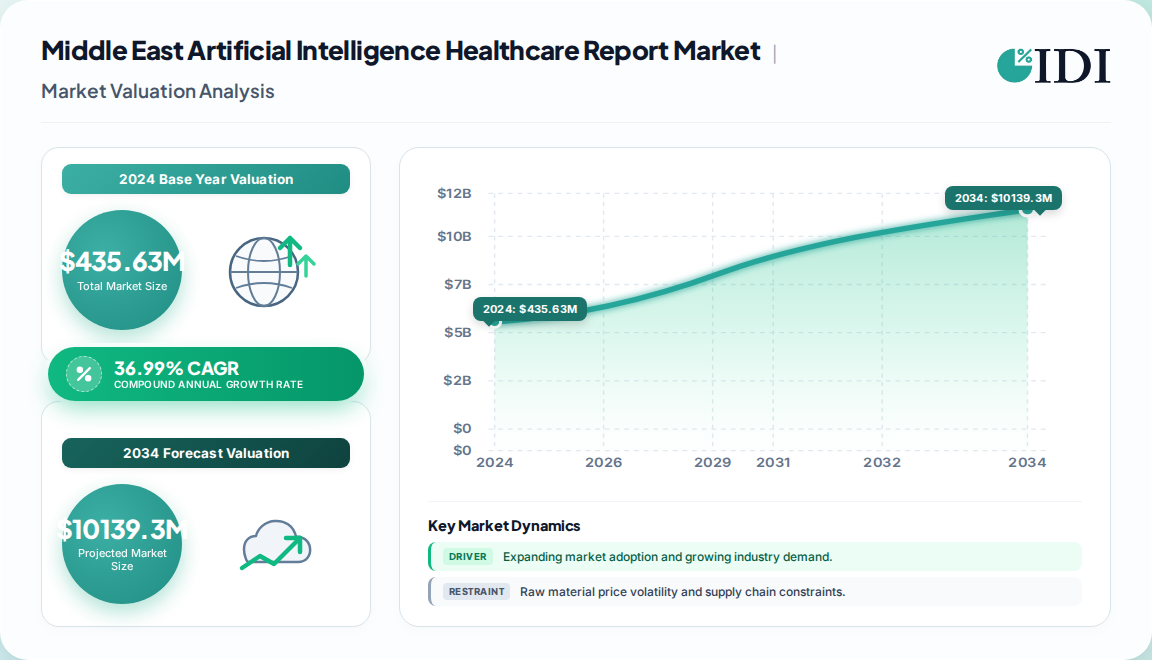
The Middle East AI in healthcare market was valued at USD 435.63 million in 2024 and is projected to reach USD 8,390.91 million by 2033, a 36.99% CAGR—one of the fastest regional AI adoption curves globally.
Software solutions dominate with 58.31% revenue share (2024) and grow fastest, as providers prioritize workflow-embedded AI over hardware refresh cycles.
Saudi Arabia and the UAE lead national adoption, anchored by Vision 2030 and the UAE National AI Strategy 2031; together they represent the majority of regional AI health spend.
Machine learning is the leading technology layer, while generative-AI patient agents (e.g., Hippocratic AI–Burjeel) are the fastest-emerging commercial segment.
Regulatory maturation is accelerating: SFDA (Saudi) and MOHAP (UAE) now provide clearer device-approval pathways, reducing deployment uncertainty for vendors.
Key players include Lunit, Hippocratic AI, Siemens Healthineers, GE HealthCare, NVIDIA and regional integrators; the market remains moderately fragmented with high partnership intensity.
Why this matters for decision-makers: The window to secure AI-health positions in the Gulf is 2025–2027—vendors that lock in health-system partnerships and SFDA/MOHAP clearances now will define the reference-installation landscape before consolidation.
Middle East Artificial Intelligence Healthcare Market Report Market Size (In Million)
3.0B
2.0B
1.0B
0
436.0 M
2024
597.0 M
2025
818.0 M
2026
1.120 B
2027
1.530 B
2028
2.100 B
2029
2.880 B
2030
Middle East Artificial Intelligence Healthcare Market Report Market Size (In Million)
Year
Market Size
2024
436.0 M
2025
597.0 M
2026
818.0 M
2027
1.120 B
2028
1.530 B
2029
2.100 B
2030
2.880 B
What is the Middle East Artificial Intelligence Healthcare Market Report?
The Middle East Artificial Intelligence Healthcare Market Report is a decision-grade analysis of AI software, hardware and services deployed across Gulf and Levant healthcare systems—covering diagnostics, telemedicine, precision medicine and administrative AI—quantifying market size, segmentation, country dynamics, vendor positioning and procurement risk through 2033.
Scope: what this report covers and excludes
This report covers AI in healthcare across the Middle East, defined as the GCC (Saudi Arabia, UAE, Qatar, Kuwait, Bahrain, Oman), Israel, Jordan, Egypt and Lebanon. It includes AI software solutions, hardware (inference infrastructure, imaging AI appliances), and services (integration, training, managed AI). It spans applications from medical imaging and diagnostics to virtual care, precision medicine and revenue-cycle AI. This analysis does not cover traditional (non-AI) health IT, general hospital EMR middleware, or non-healthcare AI verticals.
How big is the market for Middle East Artificial Intelligence Healthcare Market Report?
The market is estimated at USD 435.63 million in 2024, rising to USD 8.39 billion by 2033 at a 36.99% CAGR—a trajectory implying roughly 19x growth in under a decade, driven by digital health infrastructure build-out, national AI strategies and telehealth scale-up.
Estimate
Base Year
Horizon
CAGR
Definition / scope
Attribution
USD 435.63M → USD 8,390.91M
2024
2033
36.99%
Middle East AI in healthcare, all components
One published estimate
Global AI in healthcare USD 40.14B (2025) → USD 251.36B (2031)
2025
2031
36.21%
Global all-component AI healthcare
A competing analysis
Global AI in healthcare USD 28.07B (2025) → USD 543.83B (2035)
2025
2035
34.5%
Global AI healthcare incl. pharma
A second published estimate
Middle East AI in healthcare (implicit share of global)
2025
2031
~37%
Regional sub-set of global
Our analysis of published benchmarks
Our analysis suggests the 36.99% regional CAGR is the most defensible planning figure: the Middle East is starting from a small base (roughly 1–1.5% of global AI health spend) but compounding faster than global averages due to greenfield digital infrastructure and sovereign funding. The higher-end global forecasts (USD 543.83B by 2035) rest on broader definitions including pharma R&D AI; for buyer planning, the narrower regional 36.99% figure is the safer anchor.
How is the market segmented?
Segmentation follows four axes—component, technology, application and end use—with software solutions and machine learning dominant today, while services and generative-AI copilots are the fastest-growing layers through 2033.
Parent Segment
Children
By Component
Software Solutions, Hardware, Services
By Technology
Machine Learning, Deep Learning, Natural Language Processing, Computer Vision, Context-Aware Computing
Software's 58.31% share reflects buyer preference for incremental AI overlays on existing EMR/PACS estates rather than rip-and-replace hardware. Services will grow fastest as hospitals discover that model accuracy without workflow redesign yields minimal ROI—a pattern our analysis expects to mirror global experience.
Which countries lead in Middle East Artificial Intelligence Healthcare Market Report?
Saudi Arabia and the UAE lead, together accounting for roughly 65% of regional AI health spend, followed by Israel (a strong medtech AI export hub), Qatar, Kuwait and the wider GCC. National AI strategies and centralized health-data exchanges are the primary differentiators.
Parent
Children
GCC
Saudi Arabia, UAE, Qatar, Kuwait, Bahrain, Oman
Levant & Egypt
Israel, Jordan, Egypt, Lebanon
Rest of Middle East
Iraq, Others
Country / Cluster
Estimated Share
Saudi Arabia
38%
UAE
27%
Israel
15%
Qatar
8%
Kuwait
5%
Rest of Middle East
7%
Saudi Arabia's lead stems from Vision 2030 health-sector transformation and SEHA-style virtual care at scale; the UAE's Malaffi health information exchange provides the data substrate AI algorithms require. Our analysis suggests the UAE is the faster per-capita adopter, while Saudi Arabia offers the larger absolute prize—a distinction crucial for vendor resource allocation.
What is driving growth — and what is holding it back?
Growth is driven by national AI strategies, digital health infrastructure, telehealth scale-up and precision-medicine investment, while restraints center on data privacy regulation, capital intensity and fragmented clinical validation standards across markets.
Factor
Direction
Evidence strength
Mechanism
National AI strategies (Vision 2030, UAE AI 2031)
Driver
High
Sovereign funding and mandates
Digital health exchanges (Malaffi, SEHA)
Driver
High
Data availability for AI training
Telehealth & remote monitoring adoption
Driver
High
Generates AI-use demand
Precision medicine / genomics investment
Driver
Medium-High
AI-driven drug discovery demand
Data privacy and localization rules
Restraint
High
Compliance cost and deployment delay
High initial infrastructure investment
Restraint
Medium
Limits mid-tier provider adoption
Fragmented regulatory pathways
Restraint
Medium
Slower multi-country rollout
The balance of evidence favors the drivers: sovereign-level funding is largely insulated from commercial cycle risk, and regulatory maturation (SFDA, MOHAP) is converting restraints into predictable compliance costs. The key second-order effect our analysis identifies: AI adoption will concentrate in health systems capable of data-sharing at scale, widening the gap between Gulf leaders and smaller regional markets.
Who are the leading vendors?
The landscape combines global AI-health platforms (Siemens Healthineers, GE HealthCare, NVIDIA), specialized medical-AI firms (Lunit, Hippocratic AI) and regional integrators, with partnership intensity high and pure-play regional leaders still emerging.
Vendor
Positioning
Regional Strength
Moat
Lunit
Chest X-ray / mammography AI
Saudi (Dr. Sulaiman Al Habib contracts)
Clinical validation + reference installs
Hippocratic AI
Generative-AI patient agents
UAE/Oman (Burjeel)
GenAI agent design + local partnerships
Siemens Healthineers
Imaging + AI platform
GCC-wide
Installed base + integrated stack
GE HealthCare
Imaging AI + edge inference
GCC-wide
Hardware-software bundling
NVIDIA
Inference infrastructure
Regional cloud/hospital
Compute ecosystem
Regional integrators
Deployment & localization
Country-level
Regulatory and relationship access
Differentiation hinges on validated clinical evidence and reference installations—hospitals in the region buy proven outcomes, not model benchmarks. Our analysis suggests vendors with SFDA/MOHAP-cleared products and sovereign-partnership track records hold durable moats, while undifferentiated AI-app vendors face margin compression as larger platforms bundle capabilities.
What do buyers and operators need to know? (Decision Support)
Procurement success in this region depends less on model accuracy than on regulatory clearance, data-integration capability and local partnership depth. Buyers should prioritize vendors with SFDA or MOHAP approvals and demonstrable interoperability with Malaffi or SEHA-class exchanges—without these, pilots rarely convert to production.
Switching costs are rising as AI embeds into clinical workflows; multi-year enterprise agreements with retraining clauses are becoming standard. Key procurement risks include:
Data residency and privacy compliance varying by country—build country-specific data-handling addenda.
Clinical validation gaps—require local or regionally representative validation data, not just FDA/CE evidence.
Vendor concentration risk—assess the vendor's local support footprint and continuity plans.
Workflow-change management—budget for training and process redesign, which typically exceeds software cost in year one.
Our analysis also flags a timeline risk: sovereign-funded programs may prioritize national champions, so international vendors should structure partnerships (JV, reseller, or co-development) early rather than pursue direct-only entry.
Strategic Recommendations & Analyst Perspective
The balance of evidence favors early, partnership-led market entry concentrated in Saudi Arabia and the UAE, where sovereign funding, data infrastructure and regulatory clarity converge. The 36.99% CAGR is credible but base-effect-driven; absolute revenue remains modest through 2026, meaning early entrants compete for reference installations rather than immediate volume.
The strongest counter-argument is that aggressive global forecasts mask definitional inflation, and regional AI spend could lag if energy-market volatility (as flagged by the OECD's March 2026 interim outlook) constrains sovereign budgets. We weight this risk as moderate—health and AI are explicitly protected priorities in Vision 2030 and UAE AI 2031—but it argues for staged investment with contractual exit points.
Actionable strategy:
Vendors: Prioritize SFDA/MOHAP clearance and one flagship health-system partnership per country to lock reference installations before 2027.
Investors: Focus on services and integration layers, where local moats are strongest and global platform commoditization is slowest.
Operators: Budget 1.5–2x software cost for workflow redesign and data integration; treat AI as a clinical-transformation program, not an IT purchase.
Our conclusion would change if regulatory pathways fragment (raising multi-country rollout costs materially) or if sovereign AI-health budgets are reallocated amid sustained energy-price disruption. While this overview quantifies the headline trajectory, precise country-level and sub-segment forecasting—critical for capital allocation—requires the full report's bottom-up models and vendor benchmark data.
Middle East Artificial Intelligence Healthcare Market Report Regional Market Share
Loading chart...
Middle East Artificial Intelligence Healthcare Market Report Regional Market Share
Region
Market Share (%)
Saudi Arabia
0.38%
UAE
0.27%
Israel
0.15%
Qatar
0.08%
Kuwait
0.05%
Rest of Middle East
0.07%
Middle East Artificial Intelligence Healthcare Market Report Regional Market Share
Higher Coverage
Lower Coverage
No Coverage
Middle East Artificial Intelligence Healthcare Market Report REPORT HIGHLIGHTS
Research Methodology & Data Sources
Our rigorous research methodology combines multi-layered approaches with comprehensive quality assurance, ensuring precision, accuracy, and reliability in every market analysis.
Primary Research & Industry Fieldwork
Our research process follows a 70/30 primary-to-secondary split. Primary fieldwork includes in-depth interviews with stakeholders across the AI-healthcare value chain: health-system CIOs, medical-imaging AI vendors, health-information-exchange operators, national regulatory advisors and regional distribution/integration partners. Interviews are conducted with decision-makers holding titles such as Chief Digital Officer, Head of Clinical Informatics, Procurement Director and Regulatory Affairs Lead. Structured questionnaires capture deployment timelines, budget authority, vendor shortlists and validation requirements, with responses weighted by institution size and country.
Key Stakeholders Interviewed
Key Stakeholders Interviewed
Stakeholder Role
Interview Share (%)
Chief Digital & Clinical Informatics Officers
40%
Procurement & Sourcing Directors
30%
Regulatory & Compliance Leads
20%
Clinical Department Heads
10%
Industry Ecosystem Breakdown
Industry Ecosystem Breakdown
Company Type
Representation (%)
Health Systems & Providers
35%
AI Software & Platform Vendors
30%
Medical Device & Imaging OEMs
20%
Regulators & Integration Partners
15%
Secondary Benchmarking & Public Trade Validation
We triangulate primary inputs against official multilateral and standards databases—UN Comtrade, WTO trade statistics, US ITC, Eurostat and national health-ministry publications—plus corporate annual filings (10-K, SEC filings, investor presentations), patent databases and recognized technical standards bodies (ISO, IEEE, HL7/FHIR interoperability standards). Regulatory sources include SFDA (Saudi Arabia), MOHAP (UAE) and FDA device-clearance databases for cross-validation of AI-medical-device approvals.
Demand Modeling & Market Sizing Triangulation
We run simultaneous Top-Down and Bottom-Up models: Top-Down allocates regional healthcare IT spend to AI using segment-level penetration assumptions; Bottom-Up aggregates vendor revenue, installed-base capacity and end-use consumption by country. Divergences are reconciled through sensitivity analysis and expert review before consensus sizing.
1. Middle East Artificial Intelligence Healthcare Market Report Introduction
1.1. Research Scope
1.2. Market Segmentation
1.3. Research Objective
1.4. Definitions and Assumptions
2. Middle East Artificial Intelligence Healthcare Market Report Executive Summary
2.1. Market Snapshot
3. Middle East Artificial Intelligence Healthcare Market Report Dynamics
3.1. Introduction
3.2. Market Drivers
3.3. Market Restrains
3.4. Market Trends
4. Middle East Artificial Intelligence Healthcare Market Report Factor Analysis
4.1. Porters Five Forces
4.1.1. Bargaining Power of Suppliers
4.1.2. Bargaining Power of Buyers
4.1.3. Threat of New Entrants
4.1.4. Threat of Substitutes
4.1.5. Competitive Rivalry
4.2. PESTEL analysis
4.3. BCG Analysis
4.3.1. Stars (High Growth, High Market Share)
4.3.2. Cash Cows (Low Growth, High Market Share)
4.3.3. Question Mark (High Growth, Low Market Share)
4.3.4. Dogs (Low Growth, Low Market Share)
4.4. Ansoff Matrix Analysis
4.5. Supply Chain Analysis
4.6. Regulatory Landscape
4.7. Current Market Potential and Opportunity Assessment (TAM–SAM–SOM Framework)
4.8. IDI Analyst Note
5. Middle East Artificial Intelligence Healthcare Market Report Analysis, Insights and Forecast, 2020-2034
5.1. Analysis, Insights and Forecast - by Component
5.1.1. Software Solutions
5.1.2. Hardware
5.1.3. Services
5.2. Analysis, Insights and Forecast - by Technology
5.2.1. Machine Learning
5.2.2. Deep Learning
5.2.3. Natural Language Processing
5.2.4. Computer Vision
5.2.5. Context-Aware Computing
5.3. Analysis, Insights and Forecast - by Application
5.3.1. Medical Imaging & Diagnostics
5.3.2. Robot-Assisted Surgery
5.3.3. Virtual Assistance & Telehealth
5.3.4. Drug Discovery
5.3.5. Precision Medicine
5.3.6. Fraud Detection & Cybersecurity
5.3.7. Revenue Cycle Management
5.4. Analysis, Insights and Forecast - by End Use
5.4.1. Hospitals & Health Systems
5.4.2. Diagnostic Labs
5.4.3. Pharmaceutical & Biotech
5.4.4. Payers
5.4.5. Patients & Consumer Platforms
5.4.6. Virtual Assistance Providers
5.5. Analysis, Insights and Forecast - by Region
5.5.1. GCC
5.5.2. Levant & Egypt
5.5.3. Rest of Middle East
6. Middle East Artificial Intelligence Healthcare Market Report GCC Analysis, Insights and Forecast, 2020-2034
6.1. Analysis, Insights and Forecast - by Component
6.1.1. Software Solutions
6.1.2. Hardware
6.1.3. Services
6.2. Analysis, Insights and Forecast - by Technology
6.2.1. Machine Learning
6.2.2. Deep Learning
6.2.3. Natural Language Processing
6.2.4. Computer Vision
6.2.5. Context-Aware Computing
6.3. Analysis, Insights and Forecast - by Application
6.3.1. Medical Imaging & Diagnostics
6.3.2. Robot-Assisted Surgery
6.3.3. Virtual Assistance & Telehealth
6.3.4. Drug Discovery
6.3.5. Precision Medicine
6.3.6. Fraud Detection & Cybersecurity
6.3.7. Revenue Cycle Management
6.4. Analysis, Insights and Forecast - by End Use
6.4.1. Hospitals & Health Systems
6.4.2. Diagnostic Labs
6.4.3. Pharmaceutical & Biotech
6.4.4. Payers
6.4.5. Patients & Consumer Platforms
6.4.6. Virtual Assistance Providers
7. Middle East Artificial Intelligence Healthcare Market Report Levant & Egypt Analysis, Insights and Forecast, 2020-2034
7.1. Analysis, Insights and Forecast - by Component
7.1.1. Software Solutions
7.1.2. Hardware
7.1.3. Services
7.2. Analysis, Insights and Forecast - by Technology
7.2.1. Machine Learning
7.2.2. Deep Learning
7.2.3. Natural Language Processing
7.2.4. Computer Vision
7.2.5. Context-Aware Computing
7.3. Analysis, Insights and Forecast - by Application
7.3.1. Medical Imaging & Diagnostics
7.3.2. Robot-Assisted Surgery
7.3.3. Virtual Assistance & Telehealth
7.3.4. Drug Discovery
7.3.5. Precision Medicine
7.3.6. Fraud Detection & Cybersecurity
7.3.7. Revenue Cycle Management
7.4. Analysis, Insights and Forecast - by End Use
7.4.1. Hospitals & Health Systems
7.4.2. Diagnostic Labs
7.4.3. Pharmaceutical & Biotech
7.4.4. Payers
7.4.5. Patients & Consumer Platforms
7.4.6. Virtual Assistance Providers
8. Middle East Artificial Intelligence Healthcare Market Report Rest of Middle East Analysis, Insights and Forecast, 2020-2034
8.1. Analysis, Insights and Forecast - by Component
8.1.1. Software Solutions
8.1.2. Hardware
8.1.3. Services
8.2. Analysis, Insights and Forecast - by Technology
8.2.1. Machine Learning
8.2.2. Deep Learning
8.2.3. Natural Language Processing
8.2.4. Computer Vision
8.2.5. Context-Aware Computing
8.3. Analysis, Insights and Forecast - by Application
8.3.1. Medical Imaging & Diagnostics
8.3.2. Robot-Assisted Surgery
8.3.3. Virtual Assistance & Telehealth
8.3.4. Drug Discovery
8.3.5. Precision Medicine
8.3.6. Fraud Detection & Cybersecurity
8.3.7. Revenue Cycle Management
8.4. Analysis, Insights and Forecast - by End Use
8.4.1. Hospitals & Health Systems
8.4.2. Diagnostic Labs
8.4.3. Pharmaceutical & Biotech
8.4.4. Payers
8.4.5. Patients & Consumer Platforms
8.4.6. Virtual Assistance Providers
9. Middle East Artificial Intelligence Healthcare Market Report Competitive Analysis
9.1. Company Profiles
9.2. Market Entropy
9.2.1. Company's Key Areas Served
9.2.2. Recent Developments
9.3. Company Market Share Analysis, 2026
9.3.1. Top 5 Companies Market Share Analysis
9.3.2. Top 3 Companies Market Share Analysis
9.4. List of Potential Customers
10. Middle East Artificial Intelligence Healthcare Market Report Research Methodology
List of Figures
Figure 1: Middle East Artificial Intelligence Healthcare Market Report Revenue Breakdown (Million, %) by Product 2026 & 2034
Figure 2: Middle East Artificial Intelligence Healthcare Market Report Value Share (%), by Component 2026 & 2034
Figure 3: Middle East Artificial Intelligence Healthcare Market Report Value Share (%), by Technology 2026 & 2034
Figure 4: Middle East Artificial Intelligence Healthcare Market Report Value Share (%), by Application 2026 & 2034
Figure 5: Middle East Artificial Intelligence Healthcare Market Report Value Share (%), by End Use 2026 & 2034
Figure 6: Middle East Artificial Intelligence Healthcare Market Report Share (%) by Company 2026
List of Tables
Table 1: Middle East Artificial Intelligence Healthcare Market Report Revenue Million Forecast, by Component 2020 & 2034
Table 2: Middle East Artificial Intelligence Healthcare Market Report Revenue Million Forecast, by Technology 2020 & 2034
Table 3: Middle East Artificial Intelligence Healthcare Market Report Revenue Million Forecast, by Application 2020 & 2034
Table 4: Middle East Artificial Intelligence Healthcare Market Report Revenue Million Forecast, by End Use 2020 & 2034
Table 5: Middle East Artificial Intelligence Healthcare Market Report Revenue Million Forecast, by Region 2020 & 2034
Table 6: GCC Middle East Artificial Intelligence Healthcare Market Report Revenue Million Forecast, by Component 2020 & 2034
Table 7: GCC Middle East Artificial Intelligence Healthcare Market Report Revenue Million Forecast, by Technology 2020 & 2034
Table 8: GCC Middle East Artificial Intelligence Healthcare Market Report Revenue Million Forecast, by Application 2020 & 2034
Table 9: GCC Middle East Artificial Intelligence Healthcare Market Report Revenue Million Forecast, by End Use 2020 & 2034
Table 10: GCC Middle East Artificial Intelligence Healthcare Market Report Revenue Million Forecast, by Country 2020 & 2034
Table 11: Saudi Arabia Middle East Artificial Intelligence Healthcare Market Report Revenue (Million) Forecast, by Application 2020 & 2034
Table 12: UAE Middle East Artificial Intelligence Healthcare Market Report Revenue (Million) Forecast, by Application 2020 & 2034
Table 13: Qatar Middle East Artificial Intelligence Healthcare Market Report Revenue (Million) Forecast, by Application 2020 & 2034
Table 14: Kuwait Middle East Artificial Intelligence Healthcare Market Report Revenue (Million) Forecast, by Application 2020 & 2034
Frequently Asked Questions
1. How big is the Middle East AI in healthcare market?
The market was valued at USD 435.63 million in 2024 and is projected to reach USD 8,390.91 million by 2033, growing at a 36.99% CAGR. Software solutions account for the largest component share at over 58%.
2. Which countries lead AI healthcare adoption in the Middle East?
Saudi Arabia and the UAE lead, together representing roughly 65% of regional AI health spend. Vision 2030, the UAE National AI Strategy 2031 and centralized data exchanges like Malaffi drive their advantage.
3. What is the fastest-growing segment in this market?
Services and generative-AI patient-facing agents are growing fastest. Software holds the largest revenue share today, but integration, retraining and managed-AI services are expanding quickest as hospitals operationalize AI.
4. What are the main barriers to AI adoption in Middle East healthcare?
Data privacy and localization rules, high initial infrastructure investment, and fragmented regulatory pathways across countries are the primary restraints. Regulatory maturation via SFDA and MOHAP is gradually reducing these barriers.
5. Who are the leading vendors in the Middle East AI healthcare market?
Key players include Lunit, Hippocratic AI, Siemens Healthineers, GE HealthCare and NVIDIA, alongside regional integrators. Partnership intensity is high, with vendors competing on clinical validation and sovereign-level reference installations.
Table 15: Bahrain Middle East Artificial Intelligence Healthcare Market Report Revenue (Million) Forecast, by Application 2020 & 2034
Table 16: Oman Middle East Artificial Intelligence Healthcare Market Report Revenue (Million) Forecast, by Application 2020 & 2034
Table 17: Levant & Egypt Middle East Artificial Intelligence Healthcare Market Report Revenue Million Forecast, by Component 2020 & 2034
Table 18: Levant & Egypt Middle East Artificial Intelligence Healthcare Market Report Revenue Million Forecast, by Technology 2020 & 2034
Table 19: Levant & Egypt Middle East Artificial Intelligence Healthcare Market Report Revenue Million Forecast, by Application 2020 & 2034
Table 20: Levant & Egypt Middle East Artificial Intelligence Healthcare Market Report Revenue Million Forecast, by End Use 2020 & 2034
Table 21: Levant & Egypt Middle East Artificial Intelligence Healthcare Market Report Revenue Million Forecast, by Country 2020 & 2034
Table 22: Israel Middle East Artificial Intelligence Healthcare Market Report Revenue (Million) Forecast, by Application 2020 & 2034
Table 23: Jordan Middle East Artificial Intelligence Healthcare Market Report Revenue (Million) Forecast, by Application 2020 & 2034
Table 24: Egypt Middle East Artificial Intelligence Healthcare Market Report Revenue (Million) Forecast, by Application 2020 & 2034
Table 25: Lebanon Middle East Artificial Intelligence Healthcare Market Report Revenue (Million) Forecast, by Application 2020 & 2034
Table 26: Rest of Middle East Middle East Artificial Intelligence Healthcare Market Report Revenue Million Forecast, by Component 2020 & 2034
Table 27: Rest of Middle East Middle East Artificial Intelligence Healthcare Market Report Revenue Million Forecast, by Technology 2020 & 2034
Table 28: Rest of Middle East Middle East Artificial Intelligence Healthcare Market Report Revenue Million Forecast, by Application 2020 & 2034
Table 29: Rest of Middle East Middle East Artificial Intelligence Healthcare Market Report Revenue Million Forecast, by End Use 2020 & 2034
Table 30: Rest of Middle East Middle East Artificial Intelligence Healthcare Market Report Revenue Million Forecast, by Country 2020 & 2034
Table 31: Iraq Middle East Artificial Intelligence Healthcare Market Report Revenue (Million) Forecast, by Application 2020 & 2034
Table 32: Others Middle East Artificial Intelligence Healthcare Market Report Revenue (Million) Forecast, by Application 2020 & 2034