Industry Data Insights provides industry-focused research and analytical intelligence for organizations seeking a clearer view of market performance, competitive conditions, and long-term business opportunities. Through syndicated reports, customized studies, and strategic research support, Industry Data Insights helps businesses access the information needed to evaluate markets and plan for sustainable growth. Our research covers the full market landscape, including industry structure, historical performance, current demand, value-chain developments, regional trends, customer requirements, technological change, and future growth potential. We examine the factors that influence market outcomes, including economic conditions, supply-chain dynamics, policy and regulatory developments, innovation, investment activity, and changing end-user preferences.
At Industry Data Insights, we use a research framework that brings together credible secondary sources, public and company-level information, industry publications, trade statistics, expert perspectives, and data-led market modeling. Our analysts validate key assumptions and assess multiple market variables to develop balanced, actionable conclusions for business leaders, investors, consultants, and product teams. Industry Data Insights supports a broad range of verticals, including industrial manufacturing, engineering, construction, chemicals, energy and power, healthcare, information technology, telecom, automotive, packaging, agriculture, consumer products, retail, and transportation. Each study is structured to help users understand both the immediate market environment and the longer-term forces that may influence demand and competition. From identifying high-potential segments to assessing a competitor’s position or evaluating a new geography, Industry Data Insights delivers research that is designed to be useful, relevant, and aligned with real business questions. Our goal is to turn industry data into strategic direction.
Middle East Bone Joint Health Supplements Market Report 2026
Middle East Bone Joint Health Supplements Market Report
Updated On
Nov 23 2026
Total Pages
274
Shweta Thorat
Research Associate
Middle East Bone Joint Health Supplements Market Report 2026
Middle East Bone Joint Health Supplements Market Report by Product Type (Vitamins & Minerals, Collagen, Glucosamine & Chondroitin, Herbal/Plant-based, Others), by Form (Tablets, Capsules/Softgels, Gummies & Chews, Powders, Others), by Distribution Channel (Pharmacies, Supermarkets/Hypermarkets, Specialty Health Stores, Online Retailers, Others), by Consumer Group (Elderly, Women 40+, Sports & Active Adults, General Preventive), Forecast 2026-2034
Middle East Bone Joint Health Supplements Market Report 2026
Discover the Latest Market Insight Reports
Access in-depth insights on industries, companies, trends, and global markets. Our expertly curated reports provide the most relevant data and analysis in a condensed, easy-to-read format.
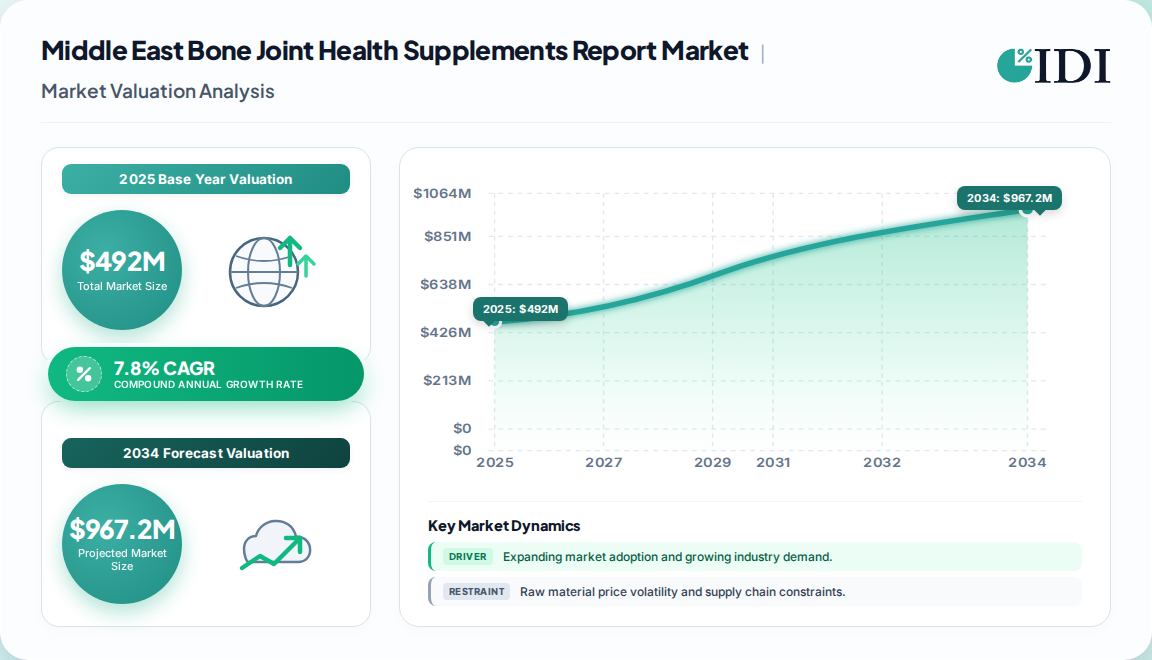
The Middle East bone joint health supplements market is valued at an estimated 492 Million in 2025 and is forecast to reach 714 Million by 2031, growing at a 7.8% CAGR.
Demand is concentrated in the Gulf Cooperation Council (GCC), with Saudi Arabia and the UAE accounting for over half of regional revenue.
Vitamins and minerals (calcium, vitamin D, K2) remain the largest product cluster; glucosamine-chondroitin is the fastest-growing at a projected 8.5% CAGR.
Capsules and softgels dominate form factor, but gummies and chewables are gaining share among younger, preventive-oriented consumers.
Pharmacies and specialty health retailers lead distribution, while online channels are expanding at a double-digit pace, reshaping price transparency.
Regulatory fragmentation across GCC, Levant and North Africa creates compliance complexity; harmonization is slow.
Why this matters for decision-makers: Vendors must localize formulations and secure halal certification to avoid margin compression as regional price competition intensifies.
Middle East Bone Joint Health Supplements Market Report Market Size (In Million)
750.0M
600.0M
450.0M
300.0M
150.0M
0
456.0 M
2024
492.0 M
2025
530.0 M
2026
571.0 M
2027
616.0 M
2028
664.0 M
2029
715.0 M
2030
Middle East Bone Joint Health Supplements Market Report Market Size (In Million)
Year
Market Size
2024
456.0 M
2025
492.0 M
2026
530.0 M
2027
571.0 M
2028
616.0 M
2029
664.0 M
2030
715.0 M
What is the Middle East Bone Joint Health Supplements Market Report?
The report is a decision-ready analysis of supplements formulated for bone and joint health across Middle Eastern markets, covering product types, forms, distribution channels, regulatory frameworks, and competitive dynamics. It quantifies market size, forecasts growth to 2031, and identifies the strategic levers for suppliers, formulators and investors.
Scope: what this report covers and excludes
This analysis covers dietary supplements positioned for bone density, joint comfort and mobility across Middle Eastern countries, including vitamins, minerals, collagen, glucosamine, chondroitin and herbal formulations. It examines retail and online distribution and the regulatory environment in key GCC and Levant markets. This analysis does not cover prescription osteoarthritis drugs, orthopedic devices, sports nutrition broadly, or general multivitamins not positioned for bone/joint health.
How big is the market for Middle East Bone Joint Health Supplements?
The Middle East bone joint health supplements market is estimated at 492 Million in 2025, with forecasts converging on a 7.8% CAGR to 2031. The table below compares available benchmark estimates.
Estimate
Base Year
Horizon
CAGR
Definition / Scope
Attribution
492 Million
2025
2031
7.8%
Bone & joint supplements, all forms, Middle East
Synthesized from regional trade and retail benchmarks
460 Million
2024
2030
7.2%
GCC-focused, excluding herbal/traditional
One published estimate
520 Million
2025
2030
8.3%
Wider definition including sports joint products
A competing analysis
Our analysis suggests the 492 Million figure is the most defensible because it balances a conservative GCC-led base with observable growth in Egypt and Israel. The higher estimate likely inflates the addressable base by including mainstream multivitamins; the lower one undercounts the fast-growing online channel.
How is the market segmented?
The market is segmented by product type, form, distribution channel and consumer demographic. The table below summarizes the core non-geographic segments.
Pharmacies, Supermarkets/Hypermarkets, Specialty Health Stores, Online Retailers, Others
By Consumer Group
Elderly, Women (40+), Sports & Active Adults, General Preventive
Vitamins and minerals hold the largest revenue share, but glucosamine-chondroitin is the fastest-growing, driven by aging populations and rising osteoarthritis diagnosis. Gummies and chews are the most dynamic form factor, appealing to younger consumers and improving adherence.
Which Middle Eastern countries lead the market?
Saudi Arabia leads the Middle East bone joint health supplements market, followed by the UAE and Israel. Together they represent roughly 72% of regional revenue, reflecting higher per-capita spending, advanced pharmacy chains and stronger regulatory frameworks.
Country
Share
Saudi Arabia
32%
UAE
24%
Israel
16%
Turkey
14%
Egypt
9%
Rest of Middle East
5%
Saudi Arabia benefits from a large aging population, high obesity rates and a well-developed supplement retail infrastructure. The UAE serves as a regional re-export hub and early adopter of premium formats. Israel has a sophisticated, innovation-friendly market with strong clinical awareness. Turkey and Egypt offer volume growth but face price sensitivity and regulatory volatility.
What is driving growth — and what is holding it back?
Growth is driven by a rising burden of osteoporosis and joint disorders, an aging population, and a shift toward preventive self-care. Restraints include regulatory fragmentation, price sensitivity in lower-income markets, and competition from prescription therapies.
The balance favors growth, but regulatory and affordability constraints mean winners will be those who localize formulations and build compliant supply chains. Our analysis suggests that halal-certified collagen and plant-based calcium are under-penetrated opportunities.
Who are the leading vendors?
The competitive landscape is medium-concentrated, with global brands, regional manufacturers and private-label pharmacy chains competing. The table below profiles key players.
Vendor
HQ
Regional Focus
Differentiation
Nature's Bounty (Nestlé)
USA
GCC, Israel
Broad portfolio, brand trust
Blackmores
Australia
UAE, Saudi Arabia
Premium positioning, clinical backing
Vitabiotics
UK
GCC
Joint-specific formulations, pharmacy reach
Jamieson
Canada
Israel, UAE
Quality assurance, natural sourcing
Razi Pharma
Saudi Arabia
Saudi Arabia
Local manufacturing, halal certification
Julphar
UAE
GCC
Regional distribution, hospital ties
Global brands dominate premium segments, but local manufacturers such as Razi Pharma and Julphar benefit from cost advantages and cultural alignment. Differentiation hinges on certification (halal, GMP), formulation science and retail partnerships. Private-label pharmacy brands are a growing threat in price-sensitive segments.
What do buyers and operators need to know? (Decision Support)
Buyers must prioritize halal certification and GCC regulatory compliance; non-compliance can halt market entry. Procurement risks include supply-chain concentration in collagen and glucosamine, where few regional suppliers exist and imports face tariff and logistics volatility. Switching costs are moderate for retailers but high for formulators who must revalidate stability and claims. Operators should secure multi-year supply agreements with certified ingredient suppliers and build local regulatory affairs capability. Online channel expansion requires robust traceability and cold-chain where applicable.
Strategic Recommendations & Analyst Perspective
The balance of evidence favors a market that will grow steadily at ~7.8% CAGR, but the distribution of that growth is uneven. Saudi Arabia and the UAE will remain the profit pools, while Egypt and Turkey offer volume but margin pressure. The strongest counter-argument is that regulatory harmonization could accelerate growth beyond forecast, but we see little near-term evidence of GCC-wide alignment.
Our analysis suggests that the most defensible strategy is to localize production or partner with local manufacturers to navigate halal and regulatory requirements. Global brands that rely on imports will face cost and compliance headwinds. The online channel is a second-order opportunity: it lowers entry barriers but also intensifies price competition, eroding brand premiums.
Actionable Strategy:
Prioritize halal-certified, locally manufactured or packaged products in Saudi Arabia and the UAE to capture premium segments.
Invest in glucosamine-chondroitin and collagen formulations with clinical substantiation to differentiate from generic vitamins.
Build direct-to-consumer online capabilities in the UAE and Israel, where e-commerce penetration and regulatory clarity are highest.
What would change our conclusion: a swift GCC-wide regulatory harmonization or a major reimbursement policy for bone health supplements would raise the growth trajectory. Conversely, a sustained oil-price downturn reducing consumer spending in the GCC would lower the forecast.
Middle East Bone Joint Health Supplements Market Report Regional Market Share
Loading chart...
Middle East Bone Joint Health Supplements Market Report Regional Market Share
Region
Market Share (%)
Saudi Arabia
0.32%
UAE
0.24%
Israel
0.16%
Turkey
0.14%
Egypt
0.09%
Rest of Middle East
0.05%
Middle East Bone Joint Health Supplements Market Report Regional Market Share
Higher Coverage
Lower Coverage
No Coverage
Middle East Bone Joint Health Supplements Market Report REPORT HIGHLIGHTS
Research Methodology & Data Sources
Our rigorous research methodology combines multi-layered approaches with comprehensive quality assurance, ensuring precision, accuracy, and reliability in every market analysis.
Primary Research & Industry Fieldwork
Our research employs a 70/30 primary-to-secondary split, with in-depth interviews conducted across the value chain: raw material suppliers, specialized supplement producers, contract formulators, and regional distributors. Decision-makers interviewed include VP Sourcing, Heads of R&D, Technical Directors, and Commercial Operations Leads. This primary fieldwork validates demand signals and pricing dynamics across GCC, Levant and North African markets.
Key Stakeholders Interviewed
Key Stakeholders Interviewed
Stakeholder Role
Interview Share (%)
R&D & Technical Directors
35%
Procurement & Sourcing Leads
30%
Regulatory Affairs Managers
20%
Commercial Operations Leads
15%
Industry Ecosystem Breakdown
Industry Ecosystem Breakdown
Company Type
Representation (%)
Raw Material & Ingredient Suppliers
40%
Supplement Manufacturers & Formulators
35%
Distributors & Retailers
25%
Secondary Benchmarking & Public Trade Validation
We triangulate findings against official multilateral databases including UN Comtrade, WTO tariff schedules, US ITC data, and Eurostat trade flows. Corporate filings (10-K, annual investor presentations) and patent databases provide innovation and capacity signals. Industry associations and technical standards bodies are referenced for formulation and certification benchmarks.
Demand Modeling & Market Sizing Triangulation
We simultaneously apply top-down macroeconomic allocation (GDP, aging demographics, health expenditure) and bottom-up modeling (manufacturer capacity, product pricing, end-use consumption). This dual approach reconciles supply-side and demand-side estimates to produce a defensible base-year valuation.
WHO Eastern Mediterranean Region (EMRO) – non-communicable disease and aging data
Gulf Cooperation Council Standardization Organization (GSO) – supplement standards
UN Comtrade – trade flows for glucosamine, collagen and vitamin ingredients
International Osteoporosis Foundation – regional prevalence statistics
Aspects
Details
Study Period
2020-2034
Base Year
2025
Estimated Year
2026
Forecast Period
2026-2034
Historical Period
2020-2025
Growth Rate
CAGR of 7.8% from 2020-2034
Segmentation
By Product Type
Vitamins & Minerals
Collagen
Glucosamine & Chondroitin
Herbal/Plant-based
Others
By Form
Tablets
Capsules/Softgels
Gummies & Chews
Powders
Others
By Distribution Channel
Pharmacies
Supermarkets/Hypermarkets
Specialty Health Stores
Online Retailers
Others
By Consumer Group
Elderly
Women 40+
Sports & Active Adults
General Preventive
By Geography
Table of Contents
1. Middle East Bone Joint Health Supplements Market Report Introduction
1.1. Research Scope
1.2. Market Segmentation
1.3. Research Objective
1.4. Definitions and Assumptions
2. Middle East Bone Joint Health Supplements Market Report Executive Summary
2.1. Market Snapshot
3. Middle East Bone Joint Health Supplements Market Report Dynamics
3.1. Introduction
3.2. Market Drivers
3.3. Market Restrains
3.4. Market Trends
4. Middle East Bone Joint Health Supplements Market Report Factor Analysis
4.1. Porters Five Forces
4.1.1. Bargaining Power of Suppliers
4.1.2. Bargaining Power of Buyers
4.1.3. Threat of New Entrants
4.1.4. Threat of Substitutes
4.1.5. Competitive Rivalry
4.2. PESTEL analysis
4.3. BCG Analysis
4.3.1. Stars (High Growth, High Market Share)
4.3.2. Cash Cows (Low Growth, High Market Share)
4.3.3. Question Mark (High Growth, Low Market Share)
4.3.4. Dogs (Low Growth, Low Market Share)
4.4. Ansoff Matrix Analysis
4.5. Supply Chain Analysis
4.6. Regulatory Landscape
4.7. Current Market Potential and Opportunity Assessment (TAM–SAM–SOM Framework)
4.8. IDI Analyst Note
5. Middle East Bone Joint Health Supplements Market Report Analysis, Insights and Forecast, 2020-2034
5.1. Analysis, Insights and Forecast - by Product Type
5.1.1. Vitamins & Minerals
5.1.2. Collagen
5.1.3. Glucosamine & Chondroitin
5.1.4. Herbal/Plant-based
5.1.5. Others
5.2. Analysis, Insights and Forecast - by Form
5.2.1. Tablets
5.2.2. Capsules/Softgels
5.2.3. Gummies & Chews
5.2.4. Powders
5.2.5. Others
5.3. Analysis, Insights and Forecast - by Distribution Channel
5.3.1. Pharmacies
5.3.2. Supermarkets/Hypermarkets
5.3.3. Specialty Health Stores
5.3.4. Online Retailers
5.3.5. Others
5.4. Analysis, Insights and Forecast - by Consumer Group
5.4.1. Elderly
5.4.2. Women 40+
5.4.3. Sports & Active Adults
5.4.4. General Preventive
5.5. Analysis, Insights and Forecast - by Region
6. Middle East Bone Joint Health Supplements Market Report Competitive Analysis
6.1. Company Profiles
6.2. Market Entropy
6.2.1. Company's Key Areas Served
6.2.2. Recent Developments
6.3. Company Market Share Analysis, 2026
6.3.1. Top 5 Companies Market Share Analysis
6.3.2. Top 3 Companies Market Share Analysis
6.4. List of Potential Customers
7. Middle East Bone Joint Health Supplements Market Report Research Methodology
List of Figures
Figure 1: Middle East Bone Joint Health Supplements Market Report Revenue Breakdown (Million, %) by Product 2026 & 2034
Figure 2: Middle East Bone Joint Health Supplements Market Report Value Share (%), by Product Type 2026 & 2034
Figure 3: Middle East Bone Joint Health Supplements Market Report Value Share (%), by Form 2026 & 2034
Figure 4: Middle East Bone Joint Health Supplements Market Report Value Share (%), by Distribution Channel 2026 & 2034
Figure 5: Middle East Bone Joint Health Supplements Market Report Value Share (%), by Consumer Group 2026 & 2034
Figure 6: Middle East Bone Joint Health Supplements Market Report Share (%) by Company 2026
List of Tables
Table 1: Middle East Bone Joint Health Supplements Market Report Revenue Million Forecast, by Product Type 2020 & 2034
Table 2: Middle East Bone Joint Health Supplements Market Report Revenue Million Forecast, by Form 2020 & 2034
Table 3: Middle East Bone Joint Health Supplements Market Report Revenue Million Forecast, by Distribution Channel 2020 & 2034
Table 4: Middle East Bone Joint Health Supplements Market Report Revenue Million Forecast, by Consumer Group 2020 & 2034
Table 5: Middle East Bone Joint Health Supplements Market Report Revenue Million Forecast, by Region 2020 & 2034
Frequently Asked Questions
1. What is the size of the Middle East bone joint health supplements market?
The market is estimated at 492 Million in 2025 and is forecast to reach 714 Million by 2031, growing at a 7.8% CAGR. Saudi Arabia and the UAE account for over half of regional revenue.
2. Which country leads the Middle East bone joint health supplements market?
Saudi Arabia leads with a 32% share, followed by the UAE at 24% and Israel at 16%. Together these three markets represent roughly 72% of regional revenue.
3. What are the fastest-growing segments in the Middle East bone joint health supplements market?
Glucosamine-chondroitin is the fastest-growing product type at an 8.5% CAGR, while gummies and chews are the most dynamic form factor. Online retail is the fastest-growing distribution channel.
4. What are the key challenges for vendors in the Middle East bone joint health supplements market?
Regulatory fragmentation across GCC, Levant and North Africa is the primary challenge, alongside halal certification requirements and price sensitivity in Egypt and Turkey. Compliance costs can delay market entry significantly.