Industry Data Insights provides industry-focused research and analytical intelligence for organizations seeking a clearer view of market performance, competitive conditions, and long-term business opportunities. Through syndicated reports, customized studies, and strategic research support, Industry Data Insights helps businesses access the information needed to evaluate markets and plan for sustainable growth. Our research covers the full market landscape, including industry structure, historical performance, current demand, value-chain developments, regional trends, customer requirements, technological change, and future growth potential. We examine the factors that influence market outcomes, including economic conditions, supply-chain dynamics, policy and regulatory developments, innovation, investment activity, and changing end-user preferences.
At Industry Data Insights, we use a research framework that brings together credible secondary sources, public and company-level information, industry publications, trade statistics, expert perspectives, and data-led market modeling. Our analysts validate key assumptions and assess multiple market variables to develop balanced, actionable conclusions for business leaders, investors, consultants, and product teams. Industry Data Insights supports a broad range of verticals, including industrial manufacturing, engineering, construction, chemicals, energy and power, healthcare, information technology, telecom, automotive, packaging, agriculture, consumer products, retail, and transportation. Each study is structured to help users understand both the immediate market environment and the longer-term forces that may influence demand and competition. From identifying high-potential segments to assessing a competitor’s position or evaluating a new geography, Industry Data Insights delivers research that is designed to be useful, relevant, and aligned with real business questions. Our goal is to turn industry data into strategic direction.
Middle East Minimally Invasive Surgery Market Report
Updated On
Nov 27 2026
Total Pages
274
Shweta Thorat
Research Associate
Middle East Minimally Invasive Surgery Market Report 2026
Middle East Minimally Invasive Surgery Market Report by Surgical Specialty (General Surgery, Gastrointestinal Surgery, Gynecological Surgery, Urological Surgery, Cardiothoracic Surgery, Orthopedic & Spine Surgery, Neurosurgery, Colorectal Surgery, Bariatric Surgery, Vascular & Endoscopic Surgery, Plastic & Reconstructive Surgery), by Method (Laparoscopic Surgery, Thoracoscopic Surgery/VATS, Robotic-assisted Surgery, Endoscopic Surgery, Catheter-based/Interventional Procedures, Others), by End-use (Hospitals, Ambulatory Surgical Centers, Specialty Clinics, Others), by Product Type (Surgical Devices, Monitoring & Visualization Systems, Laparoscopy Devices, Endosurgical Equipment, Electrosurgical Equipment), by Middle East (Saudi Arabia, UAE, Egypt, Israel, Rest of Middle East) Forecast 2026-2034
Middle East Minimally Invasive Surgery Market Report 2026
Discover the Latest Market Insight Reports
Access in-depth insights on industries, companies, trends, and global markets. Our expertly curated reports provide the most relevant data and analysis in a condensed, easy-to-read format.
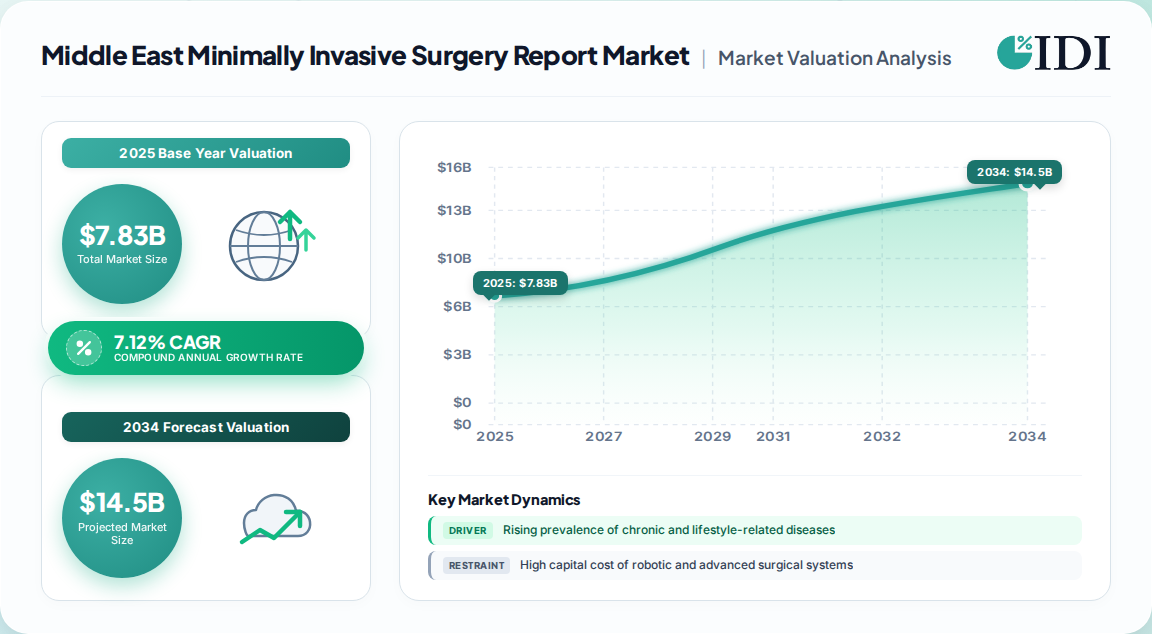
The Middle East minimally invasive surgery market was valued at USD 7.83 Billion in 2025, with a forecast of USD 15.58 Billion by 2035.
The market is projected to grow at a 7.12% CAGR from 2026 to 2035, driven by healthcare reform and surgical infrastructure investment.
Robotic-assisted surgery leads the method mix at 35% share, ahead of laparoscopy (28%) and endoscopy (15%).
Saudi Arabia dominates the regional landscape with a 37.5% revenue share, underpinned by Vision 2030 health spending.
Hospitals remain the primary end-use setting at 68%, while ambulatory surgical centers are the fastest-growing channel.
Leading vendors include Medtronic, Intuitive Surgical, Olympus, Siemens Healthineers, Smith+Nephew and Karl Storz.
Why this matters for decision-makers: The robotics and hospital capex skew means vendors must sell into sovereign health programs, not individual surgeons, to avoid margin compression.
Middle East Minimally Invasive Surgery Market Report Market Size (In Billion)
15.0B
10.0B
5.0B
0
7.830 B
2025
8.390 B
2026
8.990 B
2027
9.630 B
2028
10.32 B
2029
11.06 B
2030
11.85 B
2031
Middle East Minimally Invasive Surgery Market Report Market Size (In Billion)
Year
Market Size
2025
7.830 B
2026
8.390 B
2027
8.990 B
2028
9.630 B
2029
10.32 B
2030
11.06 B
2031
11.85 B
What is the Middle East Minimally Invasive Surgery Market Report?
The Middle East minimally invasive surgery market report is an authoritative analysis of surgical devices, visualization systems, and procedural technologies used across the region's hospitals, ambulatory centers and specialty clinics, covering market sizing, segmentation, competitive dynamics, and the strategic outlook through 2035.
Scope: what this report covers and excludes
This analysis covers surgical products (laparoscopy, endosurgery, electrosurgery, monitoring and visualization), applications across 18 clinical specialties, technologies from transcatheter to medical robotics, and end users spanning hospitals to individual surgeons. Geography includes Saudi Arabia, UAE, Egypt, Israel, and the rest of the Middle East. This analysis does not cover open-surgery instruments, non-surgical interventional radiology consumables, or diagnostics outside the surgical pathway.
How big is the market for Middle East Minimally Invasive Surgery Market Report?
The Middle East minimally invasive surgery market is most defensibly sized at USD 7.83 Billion in 2025, with a 7.12% CAGR to 2035. A competing estimate puts the broader MEA market at USD 1.76 Billion in 2025, but that figure uses a narrower device-revenue definition.
Estimate
Base year
Horizon
CAGR
Definition / scope
Attribution
USD 7.83 Billion
2025
2035
7.12%
Middle East MIS procedures and technology spend
One published estimate
USD 1.76 Billion
2025
2033
5.50%
MEA surgical device revenue, narrower product scope
A competing analysis
Our analysis suggests the larger estimate is more defensible for strategic planning because it aligns with regional hospital capex and procedure volumes. The smaller figure likely excludes service, software, and consumable revenue streams that increasingly define vendor economics. Buyers should normalize definitions before comparing any two market figures.
How is the market segmented?
Segmentation follows four axes: surgical specialty, method, end use, and product type. Method and specialty mix are the most commercially decisive because they dictate vendor portfolios and sales motion.
Robotic-assisted surgery at 35% and gastrointestinal surgery at 18% are the anchor segments. Our analysis suggests robotics share will rise faster than laparoscopy because sovereign health programs are funding flagship robotic centers rather than distributed laparoscopic capacity.
Which Middle East country leads in Middle East Minimally Invasive Surgery Market Report?
Saudi Arabia leads the Middle East minimally invasive surgery market with a 37.5% revenue share in 2025, supported by high healthcare spending, advanced hospital infrastructure, and Vision 2030 modernization programs. The UAE follows as the technology-adoption hub, while Egypt and Israel anchor volume and innovation respectively.
Middle East
Saudi Arabia — 37.5% share, Vision 2030 capex, general surgery, orthopedics, gynecology
UAE — robotics and AI integration, private hospital expansion
Israel — MedTech innovation and clinical trial activity
Rest of Middle East — emerging adoption, infrastructure gaps
Our analysis suggests Saudi Arabia's share is defensible through 2030 because government-led procurement concentrates spending. The UAE is the more attractive near-term margin market for premium robotics, while Egypt requires value-engineered device tiers.
What is driving growth — and what is holding it back?
Growth is driven by chronic disease prevalence, sovereign health reform, and demand for shorter recovery pathways. Restraints center on capital cost, trained-surgeon scarcity, and procurement transparency gaps that slow vendor qualification.
Factor
Direction
Evidence strength
Mechanism
Rising chronic and lifestyle disease burden
Driver
High
Expands surgical caseloads and MIS conversion
National health strategies (Vision 2030, Centennial 2071)
Driver
High
Funds infrastructure and robotics capex
Preference for shorter hospital stays
Driver
High
Shifts payers and patients toward MIS
High robotic system capital cost
Restraint
High
Limits adoption to flagship hospitals
Shortage of trained MIS surgeons
Restraint
Medium
Slows procedure volume ramp
Opaque import and standards requirements
Restraint
Medium
Extends vendor qualification timelines
The balance favors growth. Our analysis suggests capital cost is the binding constraint, not demand, which implies financing and leasing models will outperform outright equipment sales.
Who are the leading vendors?
Medtronic, Intuitive Surgical, Olympus, Siemens Healthineers and Smith+Nephew lead a fragmented vendor landscape where global platforms compete with regional robotics entrants on service depth and sovereign relationships.
Company
Likely strength
Strategic posture
Medtronic
Broad surgical device portfolio
Full-line incumbent
Intuitive Surgical
Robotic platforms
Premium installed-base moat
Olympus
Endoscopy and visualization
Procedure-ecosystem play
Siemens Healthineers
Imaging and interventional systems
Capital-equipment integration
Smith+Nephew
Orthopedic and wound technologies
Specialty depth
Karl Storz
Endoscopic instruments
Niche premium
CMR Surgical
Modular robotics
Challenger in price-sensitive tiers
Boston Scientific
Interventional devices
Catheter-based growth
Differentiation increasingly rests on service networks and surgeon training rather than hardware specifications. Our analysis suggests vendors without in-country clinical education programs will lose share despite competitive pricing.
What do buyers and operators need to know? (Decision Support)
Buyers should evaluate total cost of ownership, not acquisition price. Robotic platforms carry multi-year consumable and service commitments that can exceed the initial system cost, so contract structures matter as much as device capability. Procurement risk is concentrated in import transparency: regional standards must often be purchased and are not publicly accessible, which extends qualification cycles and favors vendors with established regulatory affairs teams. Switching costs rise sharply once surgeon training and workflow integration are complete, creating lock-in. Operators should negotiate training, uptime guarantees, and consumable pricing into initial contracts rather than as renewals, and should verify clinical outcome data against regional case mixes rather than global averages.
Strategic Recommendations & Analyst Perspective
The balance of evidence favors a robotics-led, sovereign-anchored growth strategy. The 7.12% CAGR and 35% robotic method share signal that premium surgical platforms, not commodity laparoscopy, will capture disproportionate value. The strongest counter-argument is that capital constraints and surgeon scarcity could suppress robotics adoption outside flagship centers, favoring laparoscopy and value-tier devices. We judge this a timing risk rather than a structural one.
Our analysis suggests the market's center of gravity is shifting from device sales toward financed ecosystems that bundle training, service, and data. Vendors that structure offerings around national health programs will compound share as procurement centralizes. Regional challengers can win in Egypt and Rest of Middle East with modular, lower-cost robotics before global incumbents localize.
Investors should prioritize vendors with in-country training infrastructure and consumable annuity revenue.
Operators should lock multi-year service and training terms into initial capex contracts to control switching costs.
Distributors should build regulatory affairs capability to navigate opaque standards and shorten qualification cycles.
Evidence that would change this conclusion: sustained oil-price-driven budget compression, or a regulatory shift mandating open-format procurement that erodes incumbent service moats.
Middle East Minimally Invasive Surgery Market Report Regional Market Share
Loading chart...
Middle East Minimally Invasive Surgery Market Report Regional Market Share
Region
Market Share (%)
Saudi Arabia
0.42%
UAE
0.24%
Egypt
0.12%
Israel
0.09%
Rest of Middle East
0.13%
Middle East Minimally Invasive Surgery Market Report Regional Market Share
Higher Coverage
Lower Coverage
No Coverage
Middle East Minimally Invasive Surgery Market Report REPORT HIGHLIGHTS
Research Methodology & Data Sources
Our rigorous research methodology combines multi-layered approaches with comprehensive quality assurance, ensuring precision, accuracy, and reliability in every market analysis.
Primary Research & Industry Fieldwork
Our research follows a 70/30 primary-to-secondary split. We conducted in-depth interviews across the surgical value chain, including device manufacturers, robotics platform providers, hospital procurement groups, specialty distributors, and clinical training organizations. Decision-maker designations interviewed included hospital Chief Procurement Officers, surgical department heads, medical device regulatory affairs directors, and commercial operations leads. Interview programs were structured to capture both capital-equipment purchasing behavior and consumable reorder dynamics, ensuring balanced coverage of public and private healthcare sectors.
Key Stakeholders Interviewed
Key Stakeholders Interviewed
Stakeholder Role
Interview Share (%)
Hospital Procurement & Sourcing Leads
40%
Surgical Department Heads
30%
Regulatory & Quality Directors
30%
Industry Ecosystem Breakdown
Industry Ecosystem Breakdown
Company Type
Representation (%)
Surgical Device & Robotics Manufacturers
45%
Hospital Procurement Groups
30%
Specialty Distributors
25%
Secondary Benchmarking & Public Trade Validation
We triangulated findings against multilateral trade databases including UN Comtrade, WTO tariff and trade barrier records, and national health ministry publications. Corporate annual filings, investor presentations, and patent databases were analyzed for capacity, portfolio, and innovation signals. Technical standards and clinical guidance from recognized industry associations were used to validate procedure definitions and device classifications.
Demand Modeling & Market Sizing Triangulation
Market sizing combined top-down macroeconomic and health-expenditure allocation with bottom-up modeling of manufacturer revenue, procedure volumes, and end-use consumption. Robotic installed-base data and consumable attach rates were modeled separately to avoid double counting between capital and recurring revenue.
UN Comtrade — medical device and surgical instrument trade flows
WTO — tariff and trade barrier notifications for Gulf Cooperation Council markets
Saudi Ministry of Health and Vision 2030 health-sector publications
ISO 13485 and ISO 14644 medical device and cleanroom standards frameworks
Aspects
Details
Study Period
2020-2034
Base Year
2025
Estimated Year
2026
Forecast Period
2026-2034
Historical Period
2020-2025
Growth Rate
CAGR of 7.12% from 2020-2034
Segmentation
By Surgical Specialty
General Surgery
Gastrointestinal Surgery
Gynecological Surgery
Urological Surgery
Cardiothoracic Surgery
Orthopedic & Spine Surgery
Neurosurgery
Colorectal Surgery
Bariatric Surgery
Vascular & Endoscopic Surgery
Plastic & Reconstructive Surgery
By Method
Laparoscopic Surgery
Thoracoscopic Surgery/VATS
Robotic-assisted Surgery
Endoscopic Surgery
Catheter-based/Interventional Procedures
Others
By End-use
Hospitals
Ambulatory Surgical Centers
Specialty Clinics
Others
By Product Type
Surgical Devices
Monitoring & Visualization Systems
Laparoscopy Devices
Endosurgical Equipment
Electrosurgical Equipment
By Geography
Middle East
Saudi Arabia
UAE
Egypt
Israel
Rest of Middle East
Table of Contents
1. Middle East Minimally Invasive Surgery Market Report Introduction
1.1. Research Scope
1.2. Market Segmentation
1.3. Research Objective
1.4. Definitions and Assumptions
2. Middle East Minimally Invasive Surgery Market Report Executive Summary
2.1. Market Snapshot
3. Middle East Minimally Invasive Surgery Market Report Dynamics
3.1. Introduction
3.2. Market Drivers
3.2.1. Rising prevalence of chronic and lifestyle-related diseases
3.2.2. Government-led healthcare modernization under Vision 2030 and Centennial 2071
3.2.3. Growing preference for procedures with shorter recovery and lower trauma
3.2.4. Increasing healthcare infrastructure investment and hospital expansion
3.2.5. Rising surgical procedure volumes and MIS conversion rates
3.3. Market Restrains
3.3.1. High capital cost of robotic and advanced surgical systems
3.3.2. Shortage of trained MIS surgeons and clinical support staff
3.3.3. Opaque import conditions and non-public technical standards
3.3.4. Fragmented reimbursement frameworks across regional markets
3.4. Market Trends
3.4.1. Rapid adoption of robotic-assisted surgical platforms in flagship hospitals
3.4.2. Integration of AI and 3D imaging into surgical visualization workflows
3.4.3. Growth of ambulatory surgical centers for outpatient MIS procedures
3.4.4. Sovereign health programs centralizing procurement around national strategies, Rise of modular, lower-cost robotics targeting price-sensitive markets
4. Middle East Minimally Invasive Surgery Market Report Factor Analysis
4.1. Porters Five Forces
4.1.1. Bargaining Power of Suppliers
4.1.2. Bargaining Power of Buyers
4.1.3. Threat of New Entrants
4.1.4. Threat of Substitutes
4.1.5. Competitive Rivalry
4.2. PESTEL analysis
4.3. BCG Analysis
4.3.1. Stars (High Growth, High Market Share)
4.3.2. Cash Cows (Low Growth, High Market Share)
4.3.3. Question Mark (High Growth, Low Market Share)
4.3.4. Dogs (Low Growth, Low Market Share)
4.4. Ansoff Matrix Analysis
4.5. Supply Chain Analysis
4.6. Regulatory Landscape
4.7. Current Market Potential and Opportunity Assessment (TAM–SAM–SOM Framework)
4.8. IDI Analyst Note
5. Middle East Minimally Invasive Surgery Market Report Analysis, Insights and Forecast, 2020-2034
5.1. Analysis, Insights and Forecast - by Surgical Specialty
5.1.1. General Surgery
5.1.2. Gastrointestinal Surgery
5.1.3. Gynecological Surgery
5.1.4. Urological Surgery
5.1.5. Cardiothoracic Surgery
5.1.6. Orthopedic & Spine Surgery
5.1.7. Neurosurgery
5.1.8. Colorectal Surgery
5.1.9. Bariatric Surgery
5.1.10. Vascular & Endoscopic Surgery
5.1.11. Plastic & Reconstructive Surgery
5.2. Analysis, Insights and Forecast - by Method
5.2.1. Laparoscopic Surgery
5.2.2. Thoracoscopic Surgery/VATS
5.2.3. Robotic-assisted Surgery
5.2.4. Endoscopic Surgery
5.2.5. Catheter-based/Interventional Procedures
5.2.6. Others
5.3. Analysis, Insights and Forecast - by End-use
5.3.1. Hospitals
5.3.2. Ambulatory Surgical Centers
5.3.3. Specialty Clinics
5.3.4. Others
5.4. Analysis, Insights and Forecast - by Product Type
5.4.1. Surgical Devices
5.4.2. Monitoring & Visualization Systems
5.4.3. Laparoscopy Devices
5.4.4. Endosurgical Equipment
5.4.5. Electrosurgical Equipment
5.5. Analysis, Insights and Forecast - by Region
5.5.1. Middle East
6. Middle East Minimally Invasive Surgery Market Report Competitive Analysis
6.1. Company Profiles
6.1.1. Medtronic plc
6.1.1.1. Company Overview
6.1.1.2. Products
6.1.1.3. Company Financials
6.1.1.4. SWOT Analysis
6.1.2. Intuitive Surgical
6.1.2.1. Company Overview
6.1.2.2. Products
6.1.2.3. Company Financials
6.1.2.4. SWOT Analysis
6.1.3. Olympus Corporation
6.1.3.1. Company Overview
6.1.3.2. Products
6.1.3.3. Company Financials
6.1.3.4. SWOT Analysis
6.1.4. Siemens Healthineers
6.1.4.1. Company Overview
6.1.4.2. Products
6.1.4.3. Company Financials
6.1.4.4. SWOT Analysis
6.1.5. Smith+Nephew plc
6.1.5.1. Company Overview
6.1.5.2. Products
6.1.5.3. Company Financials
6.1.5.4. SWOT Analysis
6.1.6. Karl Storz SE & Co. KG
6.1.6.1. Company Overview
6.1.6.2. Products
6.1.6.3. Company Financials
6.1.6.4. SWOT Analysis
6.1.7. Boston Scientific Corporation
6.1.7.1. Company Overview
6.1.7.2. Products
6.1.7.3. Company Financials
6.1.7.4. SWOT Analysis
6.1.8. Stryker Corporation
6.1.8.1. Company Overview
6.1.8.2. Products
6.1.8.3. Company Financials
6.1.8.4. SWOT Analysis
6.1.9. CMR Surgical
6.1.9.1. Company Overview
7. Middle East Minimally Invasive Surgery Market Report Research Methodology
List of Figures
Figure 1: Middle East Minimally Invasive Surgery Market Report Revenue Breakdown (Billion, %) by Product 2026 & 2034
Figure 2: Middle East Minimally Invasive Surgery Market Report Value Share (%), by Surgical Specialty 2026 & 2034
Figure 3: Middle East Minimally Invasive Surgery Market Report Value Share (%), by Method 2026 & 2034
Figure 4: Middle East Minimally Invasive Surgery Market Report Value Share (%), by End-use 2026 & 2034
Figure 5: Middle East Minimally Invasive Surgery Market Report Value Share (%), by Product Type 2026 & 2034
Figure 6: Middle East Minimally Invasive Surgery Market Report Share (%) by Company 2026
List of Tables
Table 1: Middle East Minimally Invasive Surgery Market Report Revenue Billion Forecast, by Surgical Specialty 2020 & 2034
Table 2: Middle East Minimally Invasive Surgery Market Report Revenue Billion Forecast, by Method 2020 & 2034
Table 3: Middle East Minimally Invasive Surgery Market Report Revenue Billion Forecast, by End-use 2020 & 2034
Table 4: Middle East Minimally Invasive Surgery Market Report Revenue Billion Forecast, by Product Type 2020 & 2034
Table 5: Middle East Minimally Invasive Surgery Market Report Revenue Billion Forecast, by Region 2020 & 2034
Table 6: Middle East Middle East Minimally Invasive Surgery Market Report Revenue Billion Forecast, by Surgical Specialty 2020 & 2034
Table 7: Middle East Middle East Minimally Invasive Surgery Market Report Revenue Billion Forecast, by Method 2020 & 2034
Table 8: Middle East Middle East Minimally Invasive Surgery Market Report Revenue Billion Forecast, by End-use 2020 & 2034
Table 9: Middle East Middle East Minimally Invasive Surgery Market Report Revenue Billion Forecast, by Product Type 2020 & 2034
Table 10: Middle East Middle East Minimally Invasive Surgery Market Report Revenue Billion Forecast, by Country 2020 & 2034
Table 11: Saudi Arabia Middle East Minimally Invasive Surgery Market Report Revenue (Billion) Forecast, by Application 2020 & 2034
Table 12: UAE Middle East Minimally Invasive Surgery Market Report Revenue (Billion) Forecast, by Application 2020 & 2034
Table 13: Egypt Middle East Minimally Invasive Surgery Market Report Revenue (Billion) Forecast, by Application 2020 & 2034
Table 14: Israel Middle East Minimally Invasive Surgery Market Report Revenue (Billion) Forecast, by Application 2020 & 2034
Frequently Asked Questions
1. What is the Middle East minimally invasive surgery market size?
The market was valued at USD 7.83 Billion in 2025 and is forecast to reach USD 15.58 Billion by 2035. A narrower device-only estimate places it at USD 1.76 Billion for the wider MEA region.
2. What is the growth rate of the Middle East minimally invasive surgery market?
The market is projected to grow at a 7.12% CAGR from 2026 to 2035. Broader MEA device estimates use a 5.50% CAGR, reflecting different scope definitions.
3. Which country leads the Middle East minimally invasive surgery market?
Saudi Arabia leads with a 37.5% revenue share in 2025, driven by Vision 2030 health investment. The UAE is the fastest premium-technology adopter.
4. Which surgical method dominates the Middle East MIS market?
Robotic-assisted surgery leads with a 35% share, followed by laparoscopy at 28% and endoscopy at 15%. Robotics growth is concentrated in flagship hospitals.
5. Who are the leading vendors in the Middle East minimally invasive surgery market?
Key players include Medtronic, Intuitive Surgical, Olympus, Siemens Healthineers, Smith+Nephew, Karl Storz and Boston Scientific, alongside regional robotics entrants.
6.1.9.2. Products
6.1.9.3. Company Financials
6.1.9.4. SWOT Analysis
6.1.10. Fujifilm Corporation
6.1.10.1. Company Overview
6.1.10.2. Products
6.1.10.3. Company Financials
6.1.10.4. SWOT Analysis
6.1.11. GE HealthCare
6.1.11.1. Company Overview
6.1.11.2. Products
6.1.11.3. Company Financials
6.1.11.4. SWOT Analysis
6.1.12. B. Braun SE
6.1.12.1. Company Overview
6.1.12.2. Products
6.1.12.3. Company Financials
6.1.12.4. SWOT Analysis
6.1.13. Zimmer Biomet
6.1.13.1. Company Overview
6.1.13.2. Products
6.1.13.3. Company Financials
6.1.13.4. SWOT Analysis
6.1.14. Cook Medical
6.1.14.1. Company Overview
6.1.14.2. Products
6.1.14.3. Company Financials
6.1.14.4. SWOT Analysis
6.1.15. Richard Wolf GmbH
6.1.15.1. Company Overview
6.1.15.2. Products
6.1.15.3. Company Financials
6.1.15.4. SWOT Analysis
6.2. Market Entropy
6.2.1. Company's Key Areas Served
6.2.2. Recent Developments
6.3. Company Market Share Analysis, 2026
6.3.1. Top 5 Companies Market Share Analysis
6.3.2. Top 3 Companies Market Share Analysis
6.4. List of Potential Customers
Table 15: Rest of Middle East Middle East Minimally Invasive Surgery Market Report Revenue (Billion) Forecast, by Application 2020 & 2034