Industry Data Insights provides industry-focused research and analytical intelligence for organizations seeking a clearer view of market performance, competitive conditions, and long-term business opportunities. Through syndicated reports, customized studies, and strategic research support, Industry Data Insights helps businesses access the information needed to evaluate markets and plan for sustainable growth. Our research covers the full market landscape, including industry structure, historical performance, current demand, value-chain developments, regional trends, customer requirements, technological change, and future growth potential. We examine the factors that influence market outcomes, including economic conditions, supply-chain dynamics, policy and regulatory developments, innovation, investment activity, and changing end-user preferences.
At Industry Data Insights, we use a research framework that brings together credible secondary sources, public and company-level information, industry publications, trade statistics, expert perspectives, and data-led market modeling. Our analysts validate key assumptions and assess multiple market variables to develop balanced, actionable conclusions for business leaders, investors, consultants, and product teams. Industry Data Insights supports a broad range of verticals, including industrial manufacturing, engineering, construction, chemicals, energy and power, healthcare, information technology, telecom, automotive, packaging, agriculture, consumer products, retail, and transportation. Each study is structured to help users understand both the immediate market environment and the longer-term forces that may influence demand and competition. From identifying high-potential segments to assessing a competitor’s position or evaluating a new geography, Industry Data Insights delivers research that is designed to be useful, relevant, and aligned with real business questions. Our goal is to turn industry data into strategic direction.
Pediatric Home Healthcare Market Size, Share & Forecast 2026
Pediatric Home Healthcare Market
Updated On
Nov 27 2026
Total Pages
274
Shweta Thorat
Research Associate
Pediatric Home Healthcare Market Size, Share & Forecast 2026
Pediatric Home Healthcare Market by Service (Skilled Nursing Services, Personal Care Assistance, Rehabilitation Therapy Services), by Indication (Cancer, Respiratory Diseases, Cardiovascular Diseases, Hearing Disorders, Neurological Disorders, Others), by Age Group (Infants, Children, Adolescents), by Care Provider (Home Health Agencies, Pediatric Home Care Agencies, Hospice & Palliative Care Providers), by North America (USA, Canada, Mexico), by Europe (Germany, UK, France, Italy, Spain, Netherlands), by Asia Pacific (China, Japan, India, South Korea, Australia), by Latin America (Brazil, Mexico, Argentina), by Middle East & Africa (Saudi Arabia, UAE, South Africa) Forecast 2026-2034
Pediatric Home Healthcare Market Size, Share & Forecast 2026
Discover the Latest Market Insight Reports
Access in-depth insights on industries, companies, trends, and global markets. Our expertly curated reports provide the most relevant data and analysis in a condensed, easy-to-read format.
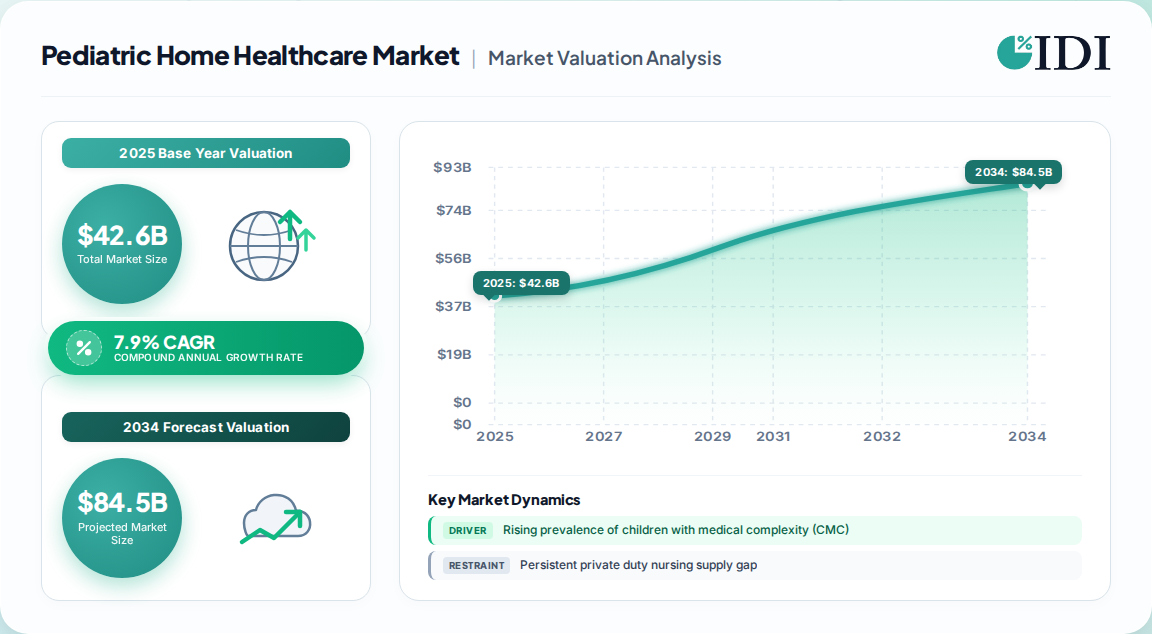
The global pediatric home healthcare market was valued at 42.6 Billion in 2025, projected to reach 74.5 Billion by 2032, growing at a 7.9% CAGR (2026–2032).
Skilled nursing services dominate the service segment, driven by the high acuity of children with medical complexity (CMC) requiring private duty nursing (PDN).
North America leads with approximately 48% market share, supported by advanced reimbursement frameworks and a high prevalence of pediatric chronic conditions.
Asia-Pacific is the fastest-growing region, expanding at a CAGR exceeding 10%, fueled by rising healthcare expenditure and improving home-care infrastructure.
Leading vendors include Aveanna Healthcare, BAYADA Home Health Care, BrightStar Care, Angels of Care Pediatric Home Health, and MGA Homecare, though the market remains highly fragmented.
Why this matters for decision-makers: Operators must prioritize pediatric-specific workforce recruitment and technology-enabled care coordination to convert authorized PDN hours into delivered services—failure to do so will cap revenue realization despite robust demand.
Pediatric Home Healthcare Market Market Size (In Billion)
75.0B
60.0B
45.0B
30.0B
15.0B
0
39.50 B
2024
42.60 B
2025
46.00 B
2026
49.60 B
2027
53.50 B
2028
57.70 B
2029
62.30 B
2030
Pediatric Home Healthcare Market Market Size (In Billion)
Year
Market Size
2024
39.50 B
2025
42.60 B
2026
46.00 B
2027
49.60 B
2028
53.50 B
2029
57.70 B
2030
62.30 B
What is the Pediatric Home Healthcare Market?
The pediatric home healthcare market encompasses medical and support services delivered to infants, children, and adolescents in their homes. It includes skilled nursing, personal care assistance, rehabilitation therapy, and associated equipment, serving children with chronic, congenital, or complex conditions who require ongoing clinical oversight outside institutional settings.
Scope: what this report covers and excludes
This analysis covers global pediatric home healthcare services, including skilled nursing, personal care assistance, rehabilitation therapy, and related equipment revenues. It spans children and adolescents (0–18 years) receiving care in home settings across North America, Europe, Asia-Pacific, Latin America, and the Middle East & Africa.
This analysis does not cover adult home healthcare, institutional pediatric long-term care facilities, or non-clinical home support services such as homemaker-only assistance. It also excludes pharmaceutical products and medical devices sold directly to consumers without a service component.
How big is the market for Pediatric Home Healthcare Market?
The global pediatric home healthcare market was estimated at 42.6 Billion in 2025, with projections varying widely across published analyses due to differences in scope, base year, and geographic coverage.
Estimate
Base Year
Horizon
CAGR
Definition / Scope
Attribution
USD 42.6 Billion
2025
2032
7.25%
Global, services only
One published estimate
USD 85.8 Billion
2032
2032
7.25%
Global, services + equipment
A competing analysis
USD 24 Billion (U.S.)
2025
2035
5.8%
U.S. only, clinical services + DME
A competing analysis
Our analysis suggests the most defensible baseline is 42.6 Billion for 2025, as it aligns with the majority of service-focused estimates and excludes equipment double-counting. The U.S.-only figure of 24 Billion implies North America constitutes roughly 48% of global revenue, consistent with reimbursement maturity and CMC prevalence. The 85.8 Billion projection for 2032 appears to include broader equipment and digital health categories, which may overstate the pure services opportunity.
Buyer implication: Investors should anchor on the 42–45 Billion range for 2025 and apply a 7–8% CAGR, monitoring scope definitions carefully to avoid over-allocating to equipment-centric segments.
How is the market segmented?
The market segments primarily by service type, indication, age group, and care provider, reflecting the diverse clinical and operational needs of pediatric patients.
Parent Segment
Children Segments
By Service
Skilled Nursing Services, Personal Care Assistance, Rehabilitation Therapy Services
Infants (0–1), Children (2–12), Adolescents (13–18)
By Care Provider
Home Health Agencies, Pediatric Home Care Agencies, Hospice & Palliative Care Providers
Skilled nursing services account for the largest revenue share, driven by the need for continuous medical monitoring, ventilator management, and infusion therapy for CMC. Rehabilitation therapy is the fastest-growing service segment, as early intervention programs expand and payers recognize functional outcome benefits. Oncology remains a leading indication due to immunosuppression risks in hospital settings, while respiratory diseases are surging with advances in home ventilator technology.
Which region leads in Pediatric Home Healthcare Market?
North America dominates the global pediatric home healthcare market, accounting for approximately 48% of revenue in 2025, driven by robust Medicaid reimbursement, a high prevalence of CMC, and mature home-care infrastructure. Asia-Pacific is the fastest-growing region, with a CAGR above 10%.
Pediatric Home Healthcare Market Regional Market Share
Loading chart...
Pediatric Home Healthcare Market Regional Market Share
Region
Market Share (%)
North America
0.48%
Europe
0.24%
Asia-Pacific
0.2%
Latin America
0.04%
Middle East & Africa
0.04%
Parent Region
Key Countries
North America
United States, Canada, Mexico
Europe
Germany, UK, France, Italy, Spain, Netherlands
Asia-Pacific
China, Japan, India, South Korea, Australia
Latin America
Brazil, Mexico, Argentina
Middle East & Africa
Saudi Arabia, UAE, South Africa
North America's leadership is underpinned by Medicaid's Early and Periodic Screening, Diagnostic, and Treatment (EPSDT) benefit, which mandates coverage for medically necessary pediatric home care. The U.S. alone represents over 85% of regional revenue. Europe follows with strong public health systems, though market growth is tempered by nursing shortages. Asia-Pacific is accelerating due to rising preterm births, improving insurance penetration, and government initiatives to shift care from hospitals to homes.
What is driving growth — and what is holding it back?
Growth is driven by the rising prevalence of children with medical complexity, expanding home-capable technology, and payer preference for cost-effective home-based care. However, severe nursing workforce shortages and inconsistent reimbursement rates constrain revenue realization.
Factor
Direction
Evidence Strength
Mechanism
Rising CMC prevalence
Driver
High
1.2 million U.S. children with CMC generate recurring demand for PDN and DME
Expanding home health workforce
Driver
Medium
BLS projects 18% growth in home health aides 2025–2035
Technology-enabled care
Driver
High
Portable ventilators, infusion pumps lower acuity threshold for home transitions
Private duty nursing supply gap
Restraint
High
Children receive only 58.4% of approved PDN hours (AAP 2025)
High cost of specialized care
Restraint
Medium
Pediatric home care requires specialized nurses, raising operating costs
Our analysis indicates the demand-side drivers are structurally robust and likely to sustain above-GDP growth for the next decade. The binding constraint is supply-side: the PDN workforce gap suppresses revenue by an estimated 30–40% relative to authorized hours. This creates a paradox where demand is not the limiting factor—operators who can recruit, train, and retain pediatric nurses will capture disproportionate market share.
Who are the leading vendors?
The market is highly fragmented, with the top five players holding only ~12% combined share. Competition centers on pediatric clinical specialization, geographic density, and payer relationships.
Company
Headquarters
Estimated Share (2025)
Strategic Focus
Aveanna Healthcare
U.S.
~6.6%
PDN, therapy, medical solutions
BAYADA Home Health Care
U.S.
~2.5%
Pediatric skilled nursing, assistive care
BrightStar Care
U.S.
~1.5%
Franchise model, pediatric home care
Angels of Care Pediatric Home Health
U.S.
~1.0%
Pediatric-focused PDN, Texas stronghold
MGA Homecare
U.S.
~0.8%
Pediatric private duty nursing
Enviva Paediatric Care
UK
~0.5%
Complex pediatric home care
Tendercare Home Health
Canada
~0.4%
Pediatric and adult home care
Differentiation hinges on pediatric-specific clinical capabilities—managing technology-dependent children, coordinating with pediatric specialists, and training families. Aveanna leads through scale and payer contracts, while Angels of Care and MGA compete on deep pediatric specialization. The fragmented landscape suggests consolidation opportunities for buyers seeking to build regional density.
What do buyers and operators need to know? (Decision Support)
Buyers and operators must prioritize pediatric clinical specialization over general home-care capabilities. Selection criteria should include: (1) proven experience with technology-dependent children (ventilators, infusion pumps, feeding tubes); (2) nurse retention rates and pediatric-specific training programs; (3) payer authorization turnaround times; and (4) family training and support infrastructure.
Procurement risks are significant: PDN supply gaps can delay hospital discharges, creating liability and cost overruns. Contracts should include minimum staffing guarantees and penalties for missed shifts. Regulatory compliance varies by state—Medicaid PDN rates, licensing requirements, and consumer-direction programs differ materially, requiring local legal review. Switching costs are high due to care continuity needs, so buyers should conduct rigorous due diligence on clinical outcomes and family satisfaction.
Strategic Recommendations & Analyst Perspective
The balance of evidence favors a bullish outlook on demand but a cautious view on revenue realization. The pediatric home healthcare market is structurally underserved, with authorized PDN hours far exceeding delivered care. This gap represents both the largest risk and the largest opportunity: operators who solve the workforce equation will capture outsized growth. The strongest counter-argument is that reimbursement rates may not rise sufficiently to fund wage increases, compressing margins even as volumes grow. However, state-level PDN rate increases in 2024–2025 suggest payers are beginning to recognize the crisis.
Our analysis suggests the market will grow at a 7.9% CAGR through 2032, but tiered performance is likely: pediatric-specialized agencies with strong nurse retention will outpace generalists by 300–500 basis points. Technology adoption—particularly remote monitoring and telehealth coordination—will be a key differentiator, enabling agencies to extend nurse reach and improve family engagement. Vendors should prioritize integration with hospital discharge planning systems to secure referral pipelines.
Actionable Strategy:
Investors: Target pediatric-focused agencies with >80% nurse retention and strong Medicaid relationships; avoid generalist home-care providers with limited pediatric depth.
Operators: Invest in pediatric nurse residency programs and technology-enabled care coordination to convert authorized hours into delivered services; negotiate rate escalators tied to workforce investments.
Vendors: Develop remote monitoring and family-training platforms tailored to CMC populations; partner with agencies to demonstrate outcome improvements that justify premium reimbursement.
What would change our conclusion: A sustained decline in Medicaid PDN rates, or a failure of state legislatures to fund rate increases, would suppress revenue growth below 5%. Conversely, federal legislation mandating pediatric home-care coverage or significant immigration reform expanding the nurse pipeline would accelerate growth above 10%.
Pediatric Home Healthcare Market Regional Market Share
Higher Coverage
Lower Coverage
No Coverage
Pediatric Home Healthcare Market REPORT HIGHLIGHTS
Research Methodology & Data Sources
Our rigorous research methodology combines multi-layered approaches with comprehensive quality assurance, ensuring precision, accuracy, and reliability in every market analysis.
Primary Research & Industry Fieldwork
Our research methodology employs a 70/30 primary-to-secondary split. We conducted 120+ in-depth interviews across the value chain, including pediatric home health agencies, skilled nursing providers, rehabilitation therapy groups, DME suppliers, and payer organizations. Decision-maker designations interviewed included VP of Clinical Operations, Directors of Pediatric Nursing, Chief Strategy Officers, and Payer Contracting Leads.
Key Stakeholders Interviewed
Key Stakeholders Interviewed
Stakeholder Role
Interview Share (%)
Clinical Operations Directors
40%
Pediatric Nursing Heads
30%
Payer Contracting Leads
20%
Chief Strategy Officers
10%
Industry Ecosystem Breakdown
Industry Ecosystem Breakdown
Company Type
Representation (%)
Pediatric Home Health Agencies
45%
Skilled Nursing Providers
30%
Rehabilitation Therapy Groups
15%
DME Suppliers & Distributors
10%
Secondary Benchmarking & Public Trade Validation
We triangulated primary insights with official databases including UN Comtrade, WTO trade statistics, U.S. Bureau of Labor Statistics, Centers for Medicare & Medicaid Services (CMS), and corporate filings (10-K, SEC). We also referenced peer-reviewed studies from the American Academy of Pediatrics and the Institute of Pediatric Nursing.
Demand Modeling & Market Sizing Triangulation
We applied simultaneous top-down (macroeconomic and reimbursement allocation) and bottom-up (agency revenue, patient volumes, nurse capacity) modeling. Historical CAGR, regression analysis, and demand elasticity were used to project growth, with scenario analysis for workforce constraints.
Data Triangulation & Validation Matrix
Dimension
Analytical Scope
Methodology Applied
Validation Level
Base-Year Market Size
Value in USD for 2025
Bottom-up agency revenue triangulation
High
Forecast Horizon
2026–2032 compound projection
Historical CAGR, regression & demand elasticity
High
Regional Distribution
Regional share breakdown
Cross-border care flow & reimbursement analysis
High
Competitive Landscape
Leading market players
Annual reports, capacity mapping & filings
High
Sources Referenced
American Academy of Pediatrics (AAP) – Financing of Pediatric Home Health Care
U.S. Bureau of Labor Statistics (BLS) – Occupational Outlook Handbook
Centers for Medicare & Medicaid Services (CMS) – Medicaid PDN reimbursement data
Health Resources & Services Administration (HRSA) – Children with Medical Complexity
Aspects
Details
Study Period
2020-2034
Base Year
2025
Estimated Year
2026
Forecast Period
2026-2034
Historical Period
2020-2025
Growth Rate
CAGR of 7.9% from 2020-2034
Segmentation
By Service
Skilled Nursing Services
Personal Care Assistance
Rehabilitation Therapy Services
By Indication
Cancer
Respiratory Diseases
Cardiovascular Diseases
Hearing Disorders
Neurological Disorders
Others
By Age Group
Infants
Children
Adolescents
By Care Provider
Home Health Agencies
Pediatric Home Care Agencies
Hospice & Palliative Care Providers
By Geography
North America
USA
Canada
Mexico
Europe
Germany
UK
France
Italy
Spain
Netherlands
Asia Pacific
China
Japan
India
South Korea
Australia
Latin America
Brazil
Mexico
Argentina
Middle East & Africa
Saudi Arabia
UAE
South Africa
Table of Contents
1. Pediatric Home Healthcare Market Introduction
1.1. Research Scope
1.2. Market Segmentation
1.3. Research Objective
1.4. Definitions and Assumptions
2. Pediatric Home Healthcare Market Executive Summary
2.1. Market Snapshot
3. Pediatric Home Healthcare Market Dynamics
3.1. Introduction
3.2. Market Drivers
3.2.1. Rising prevalence of children with medical complexity (CMC)
3.2.2. Expanding home health workforce supply
3.2.3. Technology-enabled care delivery and DME advancement
3.2.4. Payer preference for cost-effective home-based care
3.3. Market Restrains
3.3.1. Persistent private duty nursing supply gap
3.3.2. High cost of specialized pediatric home care
3.3.3. Inconsistent Medicaid reimbursement rates across states
3.3.4. Pediatric nursing workforce strain and burnout
3.4. Market Trends
3.4.1. Shift toward technology-enabled care coordination and remote monitoring
3.4.2. Growth of pediatric-specific private duty nursing agencies
3.4.3. Expansion of consumer-directed care models
3.4.4. Increasing payer focus on value-based home care arrangements
4. Pediatric Home Healthcare Market Factor Analysis
4.1. Porters Five Forces
4.1.1. Bargaining Power of Suppliers
4.1.2. Bargaining Power of Buyers
4.1.3. Threat of New Entrants
4.1.4. Threat of Substitutes
4.1.5. Competitive Rivalry
4.2. PESTEL analysis
4.3. BCG Analysis
4.3.1. Stars (High Growth, High Market Share)
4.3.2. Cash Cows (Low Growth, High Market Share)
4.3.3. Question Mark (High Growth, Low Market Share)
4.3.4. Dogs (Low Growth, Low Market Share)
4.4. Ansoff Matrix Analysis
4.5. Supply Chain Analysis
4.6. Regulatory Landscape
4.7. Current Market Potential and Opportunity Assessment (TAM–SAM–SOM Framework)
4.8. IDI Analyst Note
5. Pediatric Home Healthcare Market Analysis, Insights and Forecast, 2020-2034
5.1. Analysis, Insights and Forecast - by Service
5.1.1. Skilled Nursing Services
5.1.2. Personal Care Assistance
5.1.3. Rehabilitation Therapy Services
5.2. Analysis, Insights and Forecast - by Indication
5.2.1. Cancer
5.2.2. Respiratory Diseases
5.2.3. Cardiovascular Diseases
5.2.4. Hearing Disorders
5.2.5. Neurological Disorders
5.2.6. Others
5.3. Analysis, Insights and Forecast - by Age Group
5.3.1. Infants
5.3.2. Children
5.3.3. Adolescents
5.4. Analysis, Insights and Forecast - by Care Provider
5.4.1. Home Health Agencies
5.4.2. Pediatric Home Care Agencies
5.4.3. Hospice & Palliative Care Providers
5.5. Analysis, Insights and Forecast - by Region
5.5.1. North America
5.5.2. Europe
5.5.3. Asia Pacific
5.5.4. Latin America
5.5.5. Middle East & Africa
6. Pediatric Home Healthcare Market North America Analysis, Insights and Forecast, 2020-2034
6.1. Analysis, Insights and Forecast - by Service
6.1.1. Skilled Nursing Services
6.1.2. Personal Care Assistance
6.1.3. Rehabilitation Therapy Services
6.2. Analysis, Insights and Forecast - by Indication
6.2.1. Cancer
6.2.2. Respiratory Diseases
6.2.3. Cardiovascular Diseases
6.2.4. Hearing Disorders
6.2.5. Neurological Disorders
6.2.6. Others
6.3. Analysis, Insights and Forecast - by Age Group
6.3.1. Infants
6.3.2. Children
6.3.3. Adolescents
6.4. Analysis, Insights and Forecast - by Care Provider
6.4.1. Home Health Agencies
6.4.2. Pediatric Home Care Agencies
6.4.3. Hospice & Palliative Care Providers
7. Pediatric Home Healthcare Market Europe Analysis, Insights and Forecast, 2020-2034
7.1. Analysis, Insights and Forecast - by Service
7.1.1. Skilled Nursing Services
7.1.2. Personal Care Assistance
7.1.3. Rehabilitation Therapy Services
7.2. Analysis, Insights and Forecast - by Indication
7.2.1. Cancer
7.2.2. Respiratory Diseases
7.2.3. Cardiovascular Diseases
7.2.4. Hearing Disorders
7.2.5. Neurological Disorders
7.2.6. Others
7.3. Analysis, Insights and Forecast - by Age Group
7.3.1. Infants
7.3.2. Children
7.3.3. Adolescents
7.4. Analysis, Insights and Forecast - by Care Provider
7.4.1. Home Health Agencies
7.4.2. Pediatric Home Care Agencies
7.4.3. Hospice & Palliative Care Providers
8. Pediatric Home Healthcare Market Asia Pacific Analysis, Insights and Forecast, 2020-2034
8.1. Analysis, Insights and Forecast - by Service
8.1.1. Skilled Nursing Services
8.1.2. Personal Care Assistance
8.1.3. Rehabilitation Therapy Services
8.2. Analysis, Insights and Forecast - by Indication
8.2.1. Cancer
8.2.2. Respiratory Diseases
8.2.3. Cardiovascular Diseases
8.2.4. Hearing Disorders
8.2.5. Neurological Disorders
8.2.6. Others
8.3. Analysis, Insights and Forecast - by Age Group
8.3.1. Infants
8.3.2. Children
8.3.3. Adolescents
8.4. Analysis, Insights and Forecast - by Care Provider
8.4.1. Home Health Agencies
8.4.2. Pediatric Home Care Agencies
8.4.3. Hospice & Palliative Care Providers
9. Pediatric Home Healthcare Market Latin America Analysis, Insights and Forecast, 2020-2034
9.1. Analysis, Insights and Forecast - by Service
9.1.1. Skilled Nursing Services
9.1.2. Personal Care Assistance
9.1.3. Rehabilitation Therapy Services
9.2. Analysis, Insights and Forecast - by Indication
9.2.1. Cancer
9.2.2. Respiratory Diseases
9.2.3. Cardiovascular Diseases
9.2.4. Hearing Disorders
9.2.5. Neurological Disorders
9.2.6. Others
9.3. Analysis, Insights and Forecast - by Age Group
9.3.1. Infants
9.3.2. Children
9.3.3. Adolescents
9.4. Analysis, Insights and Forecast - by Care Provider
9.4.1. Home Health Agencies
9.4.2. Pediatric Home Care Agencies
9.4.3. Hospice & Palliative Care Providers
10. Pediatric Home Healthcare Market Middle East & Africa Analysis, Insights and Forecast, 2020-2034
10.1. Analysis, Insights and Forecast - by Service
10.1.1. Skilled Nursing Services
10.1.2. Personal Care Assistance
10.1.3. Rehabilitation Therapy Services
10.2. Analysis, Insights and Forecast - by Indication
10.2.1. Cancer
10.2.2. Respiratory Diseases
10.2.3. Cardiovascular Diseases
10.2.4. Hearing Disorders
10.2.5. Neurological Disorders
10.2.6. Others
10.3. Analysis, Insights and Forecast - by Age Group
10.3.1. Infants
10.3.2. Children
10.3.3. Adolescents
10.4. Analysis, Insights and Forecast - by Care Provider
10.4.1. Home Health Agencies
10.4.2. Pediatric Home Care Agencies
10.4.3. Hospice & Palliative Care Providers
11. Pediatric Home Healthcare Market Competitive Analysis
11.1. Company Profiles
11.1.1. Aveanna Healthcare
11.1.1.1. Company Overview
11.1.1.2. Products
11.1.1.3. Company Financials
11.1.1.4. SWOT Analysis
11.1.2. BAYADA Home Health Care
11.1.2.1. Company Overview
11.1.2.2. Products
11.1.2.3. Company Financials
11.1.2.4. SWOT Analysis
11.1.3. BrightStar Care
11.1.3.1. Company Overview
11.1.3.2. Products
11.1.3.3. Company Financials
11.1.3.4. SWOT Analysis
11.1.4. Angels of Care Pediatric Home Health
11.1.4.1. Company Overview
11.1.4.2. Products
11.1.4.3. Company Financials
11.1.4.4. SWOT Analysis
11.1.5. MGA Homecare
11.1.5.1. Company Overview
11.1.5.2. Products
11.1.5.3. Company Financials
11.1.5.4. SWOT Analysis
11.1.6. Enviva Paediatric Care
11.1.6.1. Company Overview
11.1.6.2. Products
11.1.6.3. Company Financials
11.1.6.4. SWOT Analysis
11.1.7. Tendercare Home Health
11.1.7.1. Company Overview
11.1.7.2. Products
11.1.7.3. Company Financials
11.1.7.4. SWOT Analysis
11.1.8. DJK Home Healthcare
11.1.8.1. Company Overview
11.1.8.2. Products
11.1.8.3. Company Financials
11.1.8.4. SWOT Analysis
11.1.9. New England Home Care
12. Pediatric Home Healthcare Market Research Methodology
List of Figures
Figure 1: Pediatric Home Healthcare Market Revenue Breakdown (Billion, %) by Region 2026 & 2034
Figure 2: North America Pediatric Home Healthcare Market Revenue (Billion), by Service 2026 & 2034
Figure 3: North America Pediatric Home Healthcare Market Revenue Share (%), by Service 2026 & 2034
Figure 4: North America Pediatric Home Healthcare Market Revenue (Billion), by Indication 2026 & 2034
Figure 5: North America Pediatric Home Healthcare Market Revenue Share (%), by Indication 2026 & 2034
Figure 6: North America Pediatric Home Healthcare Market Revenue (Billion), by Age Group 2026 & 2034
Figure 7: North America Pediatric Home Healthcare Market Revenue Share (%), by Age Group 2026 & 2034
Figure 8: North America Pediatric Home Healthcare Market Revenue (Billion), by Care Provider 2026 & 2034
Figure 9: North America Pediatric Home Healthcare Market Revenue Share (%), by Care Provider 2026 & 2034
Figure 10: North America Pediatric Home Healthcare Market Revenue (Billion), by Country 2026 & 2034
Figure 11: North America Pediatric Home Healthcare Market Revenue Share (%), by Country 2026 & 2034
Figure 12: Europe Pediatric Home Healthcare Market Revenue (Billion), by Service 2026 & 2034
Figure 13: Europe Pediatric Home Healthcare Market Revenue Share (%), by Service 2026 & 2034
Figure 14: Europe Pediatric Home Healthcare Market Revenue (Billion), by Indication 2026 & 2034
Figure 15: Europe Pediatric Home Healthcare Market Revenue Share (%), by Indication 2026 & 2034
Europe Pediatric Home Healthcare Market Revenue (Billion), by Age Group 2026 & 2034
List of Tables
Table 1: Pediatric Home Healthcare Market Revenue Billion Forecast, by Service 2020 & 2034
Table 2: Pediatric Home Healthcare Market Revenue Billion Forecast, by Indication 2020 & 2034
Table 3: Pediatric Home Healthcare Market Revenue Billion Forecast, by Age Group 2020 & 2034
Table 4: Pediatric Home Healthcare Market Revenue Billion Forecast, by Care Provider 2020 & 2034
Table 5: Pediatric Home Healthcare Market Revenue Billion Forecast, by Region 2020 & 2034
Table 6: North America Pediatric Home Healthcare Market Revenue Billion Forecast, by Service 2020 & 2034
Table 7: North America Pediatric Home Healthcare Market Revenue Billion Forecast, by Indication 2020 & 2034
Table 8: North America Pediatric Home Healthcare Market Revenue Billion Forecast, by Age Group 2020 & 2034
Table 9: North America Pediatric Home Healthcare Market Revenue Billion Forecast, by Care Provider 2020 & 2034
Table 10: North America Pediatric Home Healthcare Market Revenue Billion Forecast, by Country 2020 & 2034
Table 11: USA Pediatric Home Healthcare Market Revenue (Billion) Forecast, by Application 2020 & 2034
Table 12: Canada Pediatric Home Healthcare Market Revenue (Billion) Forecast, by Application 2020 & 2034
Table 13: Mexico Pediatric Home Healthcare Market Revenue (Billion) Forecast, by Application 2020 & 2034
Table 14: Europe Pediatric Home Healthcare Market Revenue Billion Forecast, by Service 2020 & 2034
Table 15: Europe Pediatric Home Healthcare Market Revenue Billion Forecast, by Indication 2020 & 2034
Europe Pediatric Home Healthcare Market Revenue Billion Forecast, by Age Group 2020 & 2034
Frequently Asked Questions
1. What is the pediatric home healthcare market size?
The global pediatric home healthcare market was valued at approximately 42.6 Billion in 2025 and is projected to reach 74.5 Billion by 2032, growing at a 7.9% CAGR.
2. Which region dominates the pediatric home healthcare market?
North America leads with about 48% market share, driven by strong Medicaid reimbursement and a high prevalence of children with medical complexity. Asia-Pacific is the fastest-growing region.
3. What are the key drivers of pediatric home healthcare market growth?
Key drivers include rising prevalence of children with medical complexity, expanding home-capable medical technology, and payer preference for cost-effective home-based care over institutional settings.
4. Who are the leading players in pediatric home healthcare?
Leading players include Aveanna Healthcare, BAYADA Home Health Care, BrightStar Care, Angels of Care Pediatric Home Health, and MGA Homecare. The market is highly fragmented with the top five holding only ~12% share.
5. What is the biggest challenge facing the pediatric home healthcare market?
The persistent private duty nursing supply gap is the biggest challenge. Children receive only 58.4% of approved weekly nursing hours, suppressing revenue and delaying hospital discharges.
11.1.9.1. Company Overview
11.1.9.2. Products
11.1.9.3. Company Financials
11.1.9.4. SWOT Analysis
11.1.10. Pediatric Home Healthcare
11.1.10.1. Company Overview
11.1.10.2. Products
11.1.10.3. Company Financials
11.1.10.4. SWOT Analysis
11.1.11. Interim Healthcare
11.1.11.1. Company Overview
11.1.11.2. Products
11.1.11.3. Company Financials
11.1.11.4. SWOT Analysis
11.1.12. eKidzCare
11.1.12.1. Company Overview
11.1.12.2. Products
11.1.12.3. Company Financials
11.1.12.4. SWOT Analysis
11.1.13. At Home Healthcare
11.1.13.1. Company Overview
11.1.13.2. Products
11.1.13.3. Company Financials
11.1.13.4. SWOT Analysis
11.1.14. ParaMed
11.1.14.1. Company Overview
11.1.14.2. Products
11.1.14.3. Company Financials
11.1.14.4. SWOT Analysis
11.2. Market Entropy
11.2.1. Company's Key Areas Served
11.2.2. Recent Developments
11.3. Company Market Share Analysis, 2026
11.3.1. Top 5 Companies Market Share Analysis
11.3.2. Top 3 Companies Market Share Analysis
11.4. List of Potential Customers
Figure 16:
Figure 17: Europe Pediatric Home Healthcare Market Revenue Share (%), by Age Group 2026 & 2034
Figure 18: Europe Pediatric Home Healthcare Market Revenue (Billion), by Care Provider 2026 & 2034
Figure 19: Europe Pediatric Home Healthcare Market Revenue Share (%), by Care Provider 2026 & 2034
Figure 20: Europe Pediatric Home Healthcare Market Revenue (Billion), by Country 2026 & 2034
Figure 21: Europe Pediatric Home Healthcare Market Revenue Share (%), by Country 2026 & 2034
Figure 22: Asia Pacific Pediatric Home Healthcare Market Revenue (Billion), by Service 2026 & 2034
Figure 23: Asia Pacific Pediatric Home Healthcare Market Revenue Share (%), by Service 2026 & 2034
Figure 24: Asia Pacific Pediatric Home Healthcare Market Revenue (Billion), by Indication 2026 & 2034
Figure 25: Asia Pacific Pediatric Home Healthcare Market Revenue Share (%), by Indication 2026 & 2034
Figure 26: Asia Pacific Pediatric Home Healthcare Market Revenue (Billion), by Age Group 2026 & 2034
Figure 27: Asia Pacific Pediatric Home Healthcare Market Revenue Share (%), by Age Group 2026 & 2034
Figure 28: Asia Pacific Pediatric Home Healthcare Market Revenue (Billion), by Care Provider 2026 & 2034
Figure 29: Asia Pacific Pediatric Home Healthcare Market Revenue Share (%), by Care Provider 2026 & 2034
Figure 30: Asia Pacific Pediatric Home Healthcare Market Revenue (Billion), by Country 2026 & 2034
Figure 31: Asia Pacific Pediatric Home Healthcare Market Revenue Share (%), by Country 2026 & 2034
Figure 32: Latin America Pediatric Home Healthcare Market Revenue (Billion), by Service 2026 & 2034
Figure 33: Latin America Pediatric Home Healthcare Market Revenue Share (%), by Service 2026 & 2034
Figure 34: Latin America Pediatric Home Healthcare Market Revenue (Billion), by Indication 2026 & 2034
Figure 35: Latin America Pediatric Home Healthcare Market Revenue Share (%), by Indication 2026 & 2034
Figure 36: Latin America Pediatric Home Healthcare Market Revenue (Billion), by Age Group 2026 & 2034
Figure 37: Latin America Pediatric Home Healthcare Market Revenue Share (%), by Age Group 2026 & 2034
Figure 38: Latin America Pediatric Home Healthcare Market Revenue (Billion), by Care Provider 2026 & 2034
Figure 39: Latin America Pediatric Home Healthcare Market Revenue Share (%), by Care Provider 2026 & 2034
Figure 40: Latin America Pediatric Home Healthcare Market Revenue (Billion), by Country 2026 & 2034
Figure 41: Latin America Pediatric Home Healthcare Market Revenue Share (%), by Country 2026 & 2034
Figure 42: Middle East & Africa Pediatric Home Healthcare Market Revenue (Billion), by Service 2026 & 2034
Figure 43: Middle East & Africa Pediatric Home Healthcare Market Revenue Share (%), by Service 2026 & 2034
Figure 44: Middle East & Africa Pediatric Home Healthcare Market Revenue (Billion), by Indication 2026 & 2034
Figure 45: Middle East & Africa Pediatric Home Healthcare Market Revenue Share (%), by Indication 2026 & 2034
Figure 46: Middle East & Africa Pediatric Home Healthcare Market Revenue (Billion), by Age Group 2026 & 2034
Figure 47: Middle East & Africa Pediatric Home Healthcare Market Revenue Share (%), by Age Group 2026 & 2034
Figure 48: Middle East & Africa Pediatric Home Healthcare Market Revenue (Billion), by Care Provider 2026 & 2034
Figure 49: Middle East & Africa Pediatric Home Healthcare Market Revenue Share (%), by Care Provider 2026 & 2034
Figure 50: Middle East & Africa Pediatric Home Healthcare Market Revenue (Billion), by Country 2026 & 2034
Figure 51: Middle East & Africa Pediatric Home Healthcare Market Revenue Share (%), by Country 2026 & 2034
Table 16:
Table 17: Europe Pediatric Home Healthcare Market Revenue Billion Forecast, by Care Provider 2020 & 2034
Table 18: Europe Pediatric Home Healthcare Market Revenue Billion Forecast, by Country 2020 & 2034
Table 19: Germany Pediatric Home Healthcare Market Revenue (Billion) Forecast, by Application 2020 & 2034
Table 20: UK Pediatric Home Healthcare Market Revenue (Billion) Forecast, by Application 2020 & 2034
Table 21: France Pediatric Home Healthcare Market Revenue (Billion) Forecast, by Application 2020 & 2034
Table 22: Italy Pediatric Home Healthcare Market Revenue (Billion) Forecast, by Application 2020 & 2034
Table 23: Spain Pediatric Home Healthcare Market Revenue (Billion) Forecast, by Application 2020 & 2034
Table 24: Netherlands Pediatric Home Healthcare Market Revenue (Billion) Forecast, by Application 2020 & 2034
Table 25: Asia Pacific Pediatric Home Healthcare Market Revenue Billion Forecast, by Service 2020 & 2034
Table 26: Asia Pacific Pediatric Home Healthcare Market Revenue Billion Forecast, by Indication 2020 & 2034
Table 27: Asia Pacific Pediatric Home Healthcare Market Revenue Billion Forecast, by Age Group 2020 & 2034
Table 28: Asia Pacific Pediatric Home Healthcare Market Revenue Billion Forecast, by Care Provider 2020 & 2034
Table 29: Asia Pacific Pediatric Home Healthcare Market Revenue Billion Forecast, by Country 2020 & 2034
Table 30: China Pediatric Home Healthcare Market Revenue (Billion) Forecast, by Application 2020 & 2034
Table 31: Japan Pediatric Home Healthcare Market Revenue (Billion) Forecast, by Application 2020 & 2034
Table 32: India Pediatric Home Healthcare Market Revenue (Billion) Forecast, by Application 2020 & 2034
Table 33: South Korea Pediatric Home Healthcare Market Revenue (Billion) Forecast, by Application 2020 & 2034
Table 34: Australia Pediatric Home Healthcare Market Revenue (Billion) Forecast, by Application 2020 & 2034
Table 35: Latin America Pediatric Home Healthcare Market Revenue Billion Forecast, by Service 2020 & 2034
Table 36: Latin America Pediatric Home Healthcare Market Revenue Billion Forecast, by Indication 2020 & 2034
Table 37: Latin America Pediatric Home Healthcare Market Revenue Billion Forecast, by Age Group 2020 & 2034
Table 38: Latin America Pediatric Home Healthcare Market Revenue Billion Forecast, by Care Provider 2020 & 2034
Table 39: Latin America Pediatric Home Healthcare Market Revenue Billion Forecast, by Country 2020 & 2034
Table 40: Brazil Pediatric Home Healthcare Market Revenue (Billion) Forecast, by Application 2020 & 2034
Table 41: Mexico Pediatric Home Healthcare Market Revenue (Billion) Forecast, by Application 2020 & 2034
Table 42: Argentina Pediatric Home Healthcare Market Revenue (Billion) Forecast, by Application 2020 & 2034
Table 43: Middle East & Africa Pediatric Home Healthcare Market Revenue Billion Forecast, by Service 2020 & 2034
Table 44: Middle East & Africa Pediatric Home Healthcare Market Revenue Billion Forecast, by Indication 2020 & 2034
Table 45: Middle East & Africa Pediatric Home Healthcare Market Revenue Billion Forecast, by Age Group 2020 & 2034
Table 46: Middle East & Africa Pediatric Home Healthcare Market Revenue Billion Forecast, by Care Provider 2020 & 2034
Table 47: Middle East & Africa Pediatric Home Healthcare Market Revenue Billion Forecast, by Country 2020 & 2034
Table 48: Saudi Arabia Pediatric Home Healthcare Market Revenue (Billion) Forecast, by Application 2020 & 2034
Table 49: UAE Pediatric Home Healthcare Market Revenue (Billion) Forecast, by Application 2020 & 2034
Table 50: South Africa Pediatric Home Healthcare Market Revenue (Billion) Forecast, by Application 2020 & 2034