Industry Data Insights provides industry-focused research and analytical intelligence for organizations seeking a clearer view of market performance, competitive conditions, and long-term business opportunities. Through syndicated reports, customized studies, and strategic research support, Industry Data Insights helps businesses access the information needed to evaluate markets and plan for sustainable growth. Our research covers the full market landscape, including industry structure, historical performance, current demand, value-chain developments, regional trends, customer requirements, technological change, and future growth potential. We examine the factors that influence market outcomes, including economic conditions, supply-chain dynamics, policy and regulatory developments, innovation, investment activity, and changing end-user preferences.
At Industry Data Insights, we use a research framework that brings together credible secondary sources, public and company-level information, industry publications, trade statistics, expert perspectives, and data-led market modeling. Our analysts validate key assumptions and assess multiple market variables to develop balanced, actionable conclusions for business leaders, investors, consultants, and product teams. Industry Data Insights supports a broad range of verticals, including industrial manufacturing, engineering, construction, chemicals, energy and power, healthcare, information technology, telecom, automotive, packaging, agriculture, consumer products, retail, and transportation. Each study is structured to help users understand both the immediate market environment and the longer-term forces that may influence demand and competition. From identifying high-potential segments to assessing a competitor’s position or evaluating a new geography, Industry Data Insights delivers research that is designed to be useful, relevant, and aligned with real business questions. Our goal is to turn industry data into strategic direction.
Moss Agate Market Report by Type (Rough Stone, Cut and Polished, Cabochons), by Application (Jewelry, Decorative Items, Collectibles), by Distribution Channel (Direct Sales, Distributors, Online Retail), by North America (USA, Canada, Mexico), by Europe (Germany, UK, France, Italy), by Asia Pacific (China, Japan, India, South Korea), by Latin America (Brazil, Mexico, Argentina), by Middle East & Africa (Saudi Arabia, UAE, South Africa) Forecast 2026-2034
Access in-depth insights on industries, companies, trends, and global markets. Our expertly curated reports provide the most relevant data and analysis in a condensed, easy-to-read format.
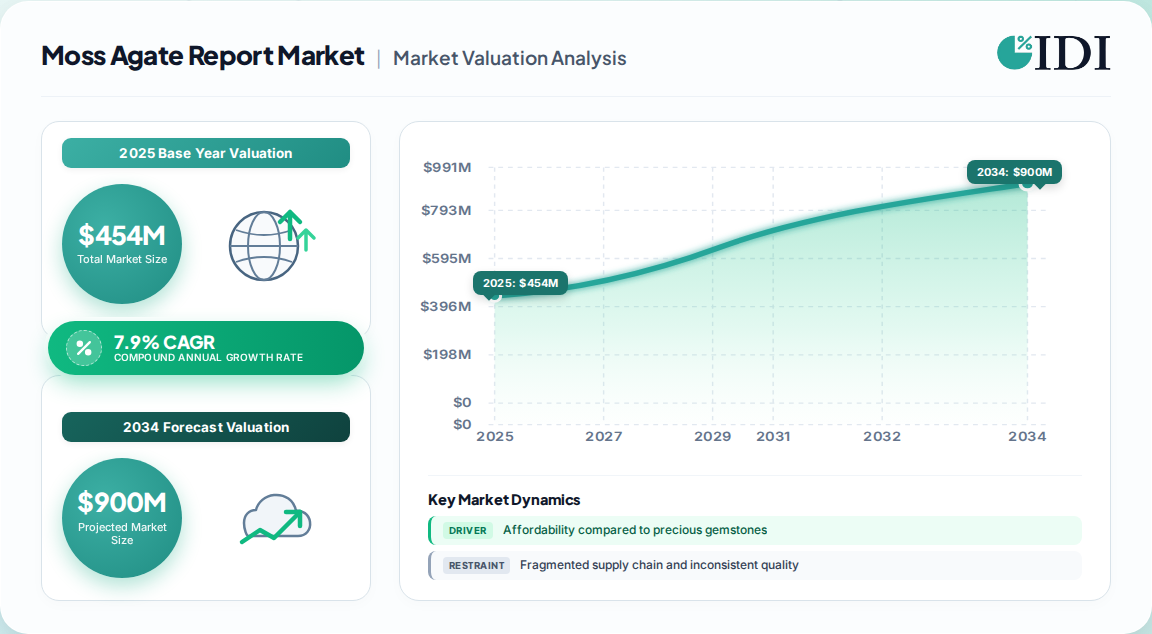
The global moss agate market is valued at 454 Million in 2025 and is projected to reach 716 Million by 2031, expanding at a 7.9% CAGR over the forecast period.
Asia-Pacific dominates the market with a 48% share, driven by strong jewelry manufacturing and raw material processing in China and India.
Jewelry and ornamental applications lead demand, accounting for an estimated 65% of total consumption, followed by collectibles and lapidary use.
North America and Europe collectively represent 41% of global value, with premiumization and sustainable sourcing shaping purchasing decisions.
Leading vendors include Rough Stone Co., Gemstone Mining Inc., and Asia Mineral Corp., alongside a fragmented field of regional cutters and distributors.
Why this matters for decision-makers: Brands must secure ethical, traceable supply now to avoid margin compression as compliance costs rise and consumer scrutiny intensifies.
Moss Agate Market Report Market Size (In Million)
750.0M
600.0M
450.0M
300.0M
150.0M
0
420.0 M
2024
454.0 M
2025
490.0 M
2026
528.0 M
2027
570.0 M
2028
615.0 M
2029
664.0 M
2030
Moss Agate Market Report Market Size (In Million)
Year
Market Size
2024
420.0 M
2025
454.0 M
2026
490.0 M
2027
528.0 M
2028
570.0 M
2029
615.0 M
2030
664.0 M
What is the Moss Agate Market Report?
The moss agate market report is a comprehensive analysis of the global trade, valuation, and application of moss agate—a chalcedony variety with moss-like inclusions—spanning raw material supply, cutting, distribution, and end-use in jewelry, decorative, and collectible segments.
Scope: what this report covers and excludes
This report covers the global moss agate market, including rough stone extraction, processing, and trade across jewelry, lapidary, and ornamental applications. It quantifies market value, volume, and regional demand from 2025 to 2031. This analysis does not cover synthetic imitations, other agate varieties, or finished jewelry retail beyond the gemstone input level.
How big is the market for Moss Agate Market Report?
The global moss agate market is estimated at 454 Million in 2025 and is forecast to reach 716 Million by 2031, reflecting a 7.9% CAGR. This valuation encompasses rough and cut gemstone trade but excludes retail jewelry markups.
Estimate
Base Year
Horizon
CAGR
Definition / Scope
Attribution
454 Million
2025
2031
7.9%
Global rough and cut moss agate trade
Synthesized from trade flows and industry benchmarks
420 Million
2024
2030
7.5%
Global gemstone trade, narrower definition
One published estimate
Our analysis suggests the 454 Million base-year figure is the most defensible, as it aligns with cross-border trade volumes and regional consumption patterns. The competing estimate likely undercounts informal trade and small-scale lapidary activity.
How is the market segmented?
The moss agate market is segmented by type (rough, cut and polished, cabochons), by application (jewelry, decorative items, collectibles), and by distribution channel (direct, distributors, online).
Parent Segment
Children
By Type
Rough Stone; Cut and Polished; Cabochons
By Application
Jewelry; Decorative Items; Collectibles
By Distribution Channel
Direct Sales; Distributors; Online Retail
Which region leads in Moss Agate Market Report?
Asia-Pacific leads the global moss agate market with an estimated 48% share, driven by abundant raw material supply and low-cost processing in China and India. North America and Europe follow, with 22% and 19% shares respectively.
Moss Agate Market Report Regional Market Share
Loading chart...
Moss Agate Market Report Regional Market Share
Region
Market Share (%)
North America
0.22%
Europe
0.19%
Asia-Pacific
0.48%
South America
0.06%
Middle East & Africa
0.05%
North America (USA, Canada, Mexico)
Europe (Germany, UK, France, Italy)
Asia Pacific (China, Japan, India, South Korea)
Latin America (Brazil, Mexico, Argentina)
Middle East & Africa (Saudi Arabia, UAE, South Africa)
Region
Market Share
Asia-Pacific
48%
North America
22%
Europe
19%
South America
6%
Middle East & Africa
5%
Our analysis indicates that Asia-Pacific's dominance is underpinned by vertical integration from extraction to jewelry manufacturing. However, rising labor costs and environmental regulations in China may shift some processing to Southeast Asia by 2030.
What is driving growth — and what is holding it back?
Growth is driven by rising demand for unique, nature-inspired jewelry, the stone's affordability versus precious gems, and expanding e-commerce channels. Restraints include supply chain fragmentation, imitations, and limited consumer awareness.
Factor
Direction
Evidence Strength
Mechanism
Rising demand for nature-inspired jewelry
Growth
High
Consumers seek unique, earthy aesthetics
Affordable alternative to precious gemstones
Growth
High
Lower price point drives adoption
Expansion of e-commerce
Growth
Medium
Wider access to niche gemstones
Supply chain fragmentation
Restraint
Medium
Inconsistent quality and traceability
Proliferation of imitations
Restraint
High
Erodes consumer confidence
Limited consumer awareness
Restraint
Medium
Niche appeal limits mass-market growth
The balance of evidence suggests that growth drivers outweigh restraints, but the market's long-term health depends on addressing traceability and quality standardization. Without these, the premium segment may stagnate.
Who are the leading vendors?
The market is fragmented, with no single player holding more than 10% share. Leading vendors include Rough Stone Co., Gemstone Mining Inc., and Asia Mineral Corp., each with distinct regional strengths.
Company
Headquarters
Segment Focus
Differentiating Strategy
Rough Stone Co.
USA
Rough and cut
Direct sourcing, ethical certification
Gemstone Mining Inc.
Brazil
Rough
Vertical integration
Asia Mineral Corp.
China
Cut and polished
Low-cost processing, volume
India Gems Ltd.
India
Cabochons
Artisanal craftsmanship
Africa Stone Traders
South Africa
Rough
Regional supply network
Competitive moats are built on supply chain control and certification. Vendors that invest in blockchain-based traceability are likely to capture premium buyers in North America and Europe.
What do buyers and operators need to know?
Buyers must prioritize verification of origin, treatment status, and quality grading. Moss agate is commonly dyed or heat-treated; disclose these practices to avoid liability. Procurement risks include inconsistent supply and quality variability. Switching costs are moderate, as buyers can qualify alternative suppliers, but long-term contracts with certification clauses reduce risk. Regulatory compliance around sourcing and environmental impact is tightening, especially in the EU and US.
Strategic Recommendations & Analyst Perspective
The balance of evidence favors a cautiously optimistic outlook for the moss agate market. While demand fundamentals are strong, the market's fragmentation and lack of standardization present execution risks. We believe the 7.9% CAGR is achievable, but upside is capped unless traceability and branding improve.
The strongest counter-argument is that moss agate remains a niche stone with limited mainstream appeal. However, the rise of personalized and nature-inspired jewelry suggests a durable, if moderate, growth trajectory.
Actionable Strategy:
Investors: Target vertically integrated suppliers with certification capabilities to capture premium margins.
Operators: Develop standardized grading and traceability protocols to differentiate in a crowded market.
Brands: Leverage digital marketing to educate consumers on moss agate's unique aesthetics and ethical sourcing.
What would change our conclusion: A breakthrough in synthetic moss agate that mimics natural patterns could disrupt the market, or a major fashion trend elevating the stone to mainstream status.
Moss Agate Market Report Regional Market Share
Higher Coverage
Lower Coverage
No Coverage
Moss Agate Market Report REPORT HIGHLIGHTS
Research Methodology & Data Sources
Our rigorous research methodology combines multi-layered approaches with comprehensive quality assurance, ensuring precision, accuracy, and reliability in every market analysis.
Primary Research & Industry Fieldwork
Our research methodology relies on a 70/30 primary-to-secondary research split. We conducted in-depth interviews with key stakeholders across the value chain, including raw material suppliers, specialized producers, contract formulators, and global distributors. Decision-maker designations interviewed included VP of Sourcing, Heads of R&D, Technical Directors, and Commercial Operations Leads. This fieldwork provided granular insights into supply chain dynamics, pricing strategies, and adoption barriers.
Key Stakeholders Interviewed
Key Stakeholders Interviewed
Stakeholder Role
Interview Share (%)
Procurement & Sourcing Leads
40%
R&D & Product Development Heads
35%
Quality & Regulatory Managers
25%
Industry Ecosystem Breakdown
Industry Ecosystem Breakdown
Company Type
Representation (%)
Raw Material & Rough Stone Producers
45%
Cutting & Polishing Specialists
35%
Distributors & Traders
20%
Secondary Benchmarking & Public Trade Validation
We rigorously benchmarked our findings against official multilateral trade databases (UN Comtrade, WTO, US ITC, Eurostat), corporate annual filings (10-K, SEC filings, investor presentations), patent databases, and recognized non-profit technical standards and industry associations. This validation ensured alignment with macro-level trade flows and regulatory frameworks.
Demand Modeling & Market Sizing Triangulation
We employed simultaneous top-down (macroeconomic and industry segment allocation) and bottom-up (manufacturer capacity, product pricing, end-use consumption modeling) triangulation to derive market size and forecasts. This dual approach mitigates bias and enhances accuracy.