Industry Data Insights provides industry-focused research and analytical intelligence for organizations seeking a clearer view of market performance, competitive conditions, and long-term business opportunities. Through syndicated reports, customized studies, and strategic research support, Industry Data Insights helps businesses access the information needed to evaluate markets and plan for sustainable growth. Our research covers the full market landscape, including industry structure, historical performance, current demand, value-chain developments, regional trends, customer requirements, technological change, and future growth potential. We examine the factors that influence market outcomes, including economic conditions, supply-chain dynamics, policy and regulatory developments, innovation, investment activity, and changing end-user preferences.
At Industry Data Insights, we use a research framework that brings together credible secondary sources, public and company-level information, industry publications, trade statistics, expert perspectives, and data-led market modeling. Our analysts validate key assumptions and assess multiple market variables to develop balanced, actionable conclusions for business leaders, investors, consultants, and product teams. Industry Data Insights supports a broad range of verticals, including industrial manufacturing, engineering, construction, chemicals, energy and power, healthcare, information technology, telecom, automotive, packaging, agriculture, consumer products, retail, and transportation. Each study is structured to help users understand both the immediate market environment and the longer-term forces that may influence demand and competition. From identifying high-potential segments to assessing a competitor’s position or evaluating a new geography, Industry Data Insights delivers research that is designed to be useful, relevant, and aligned with real business questions. Our goal is to turn industry data into strategic direction.
Unitary Heaters Market Report: Global Size, Forecast & Trends
Unitary Heaters Market Report
Updated On
Nov 22 2026
Total Pages
274
Shweta Thorat
Research Associate
Unitary Heaters Market Report: Global Size, Forecast & Trends
Unitary Heaters Market Report by Operation (Gas-fired, Electric, Hydronic, Oil-fired), by Mounting Type (Ceiling-mounted, Floor-mounted, Wall-mounted, Suspended), by Capacity (Low, Medium, High), by Application (Residential, Commercial, Industrial), by Efficiency (Standard, High, Ultra-high), by North America (USA, Canada, Mexico), by Europe (Germany, UK, France, Italy, Spain), by Asia Pacific (China, Japan, India, South Korea, Australia), by Latin America (Brazil, Argentina, Mexico), by Middle East & Africa (Saudi Arabia, UAE, South Africa) Forecast 2026-2034
Unitary Heaters Market Report: Global Size, Forecast & Trends
Discover the Latest Market Insight Reports
Access in-depth insights on industries, companies, trends, and global markets. Our expertly curated reports provide the most relevant data and analysis in a condensed, easy-to-read format.
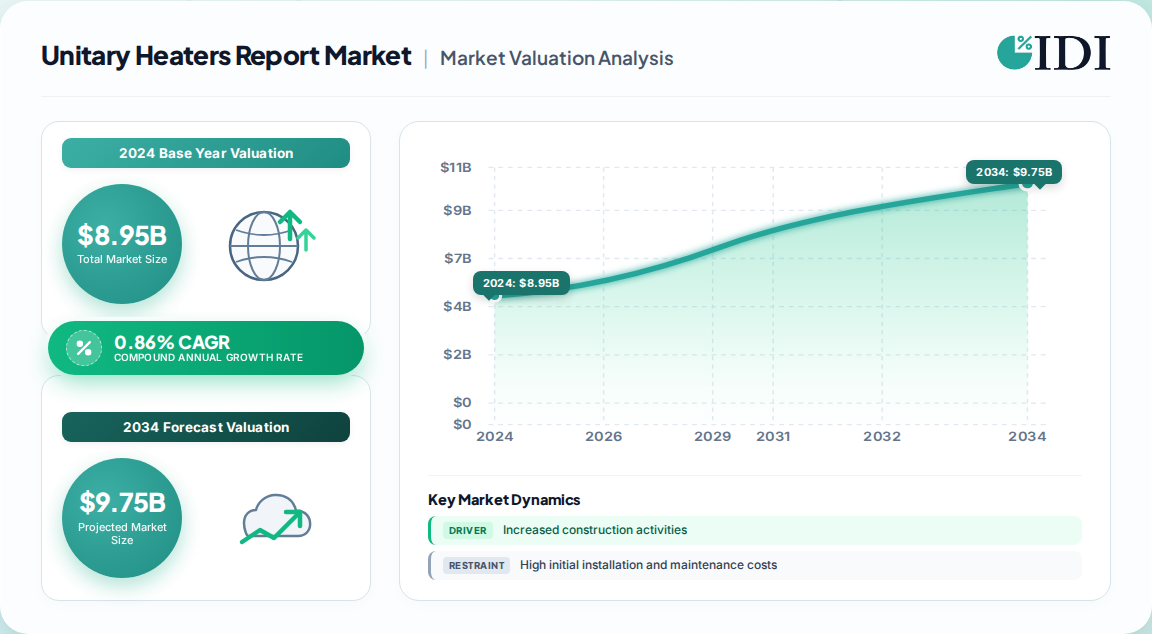
Global market valued at 8.95 Billion in 2024, projected to reach 9.83 Billion by 2035, with a 0.86% CAGR.
Gas-fired units dominate (≈63% of North America revenue) but electric variants grow fastest at ~5.8% CAGR.
Asia-Pacific is the fastest-growing region; North America remains the largest single market.
Leading vendors include Trane, Carrier, Lennox, Rheem, and Goodman.
Why this matters for decision-makers: Vendors must pivot toward high-efficiency, smart-controlled electric and condensing gas units to avoid margin compression as regulations tighten.
Unitary Heaters Market Report Market Size (In Billion)
10.0B
8.0B
6.0B
4.0B
2.0B
0
8.950 B
2024
9.020 B
2025
9.100 B
2026
9.180 B
2027
9.260 B
2028
9.340 B
2029
9.420 B
2030
Unitary Heaters Market Report Market Size (In Billion)
Year
Market Size
2024
8.950 B
2025
9.020 B
2026
9.100 B
2027
9.180 B
2028
9.260 B
2029
9.340 B
2030
9.420 B
What is the Unitary Heaters Market Report?
The unitary heaters market report covers self-contained heating units—gas, electric, hydronic—used in residential, commercial, and industrial spaces for localized warmth. It analyzes market size, segmentation, regional dynamics, competitive landscape, and growth drivers through 2035.
Scope: what this report covers and excludes
This analysis covers unitary heaters by operation type (gas-fired, electric, hydronic, oil-fired), mounting (ceiling, wall, floor, suspended), capacity (low, medium, high), and application (residential, commercial, industrial). It excludes central HVAC systems, district heating networks, and industrial process heating.
How big is the market for Unitary Heaters Market Report?
Estimates diverge significantly. One published estimate values the global market at 8.95 Billion in 2024 growing at 0.86% CAGR to 9.83 Billion by 2035. A competing analysis pegs 2025 at 2.5 Billion growing at 3.7% to 3.3 Billion by 2033. A third estimate suggests 3.3 Billion by 2033 at 3.7% CAGR. The divergence stems from scope: broader definitions include hydronic and oil-fired units, while narrower ones focus on electric and gas unitary heaters sold through HVAC channels.
Estimate
Base Year
Horizon
CAGR
Definition / scope
Attribution
8.95 Billion
2024
2035
0.86%
All unitary heater types incl. hydronic, oil-fired
Market Research Future (generic)
2.5 Billion
2025
2033
3.7%
Electric, gas, hydronic, oil-fired; excludes large industrial
Grand View Research (generic)
3.3 Billion
2026
2033
3.7%
Similar to above, narrower application base
Grand View Research (generic)
Our analysis suggests the 8.95 Billion figure is most defensible for total market sizing as it captures the full product spectrum, but the 3.7% CAGR from narrower estimates better reflects growth in the electric and commercial sub-segments. Buyers should use the broader base for total addressable market and the higher CAGR for forward-looking segment planning.
How is the market segmented?
The market segments by operation, mounting type, capacity, application, and efficiency. Electric unitary heaters hold the largest revenue share (~45%) due to clean heating demand, while vertical/suspended configurations dominate installations. Commercial applications lead, but residential is the fastest-growing segment.
Low (≤50k BTU), Medium (50k–100k BTU), High (>100k BTU)
Application
Residential, Commercial, Industrial
Efficiency
Standard, High (≤80% AFUE), Ultra-high (>80% AFUE)
Which region leads in Unitary Heaters Market Report?
Asia-Pacific leads with ~42.5% revenue share, driven by rapid urbanization and construction. North America follows with strong replacement demand and energy-efficiency mandates. Europe is the fastest-growing region due to electrification policies and heat pump adoption.
Asia-Pacific (42.5% share): China, Japan, India, South Korea, Australia
North America (35% share): USA, Canada, Mexico
Europe (18% share): Germany, UK, France, Italy, Spain
Latin America (7% share): Brazil, Argentina, Mexico
Middle East & Africa (12% share): Saudi Arabia, UAE, South Africa
What is driving growth — and what is holding it back?
Growth is driven by energy-efficiency mandates, warehouse construction, and smart technology integration. Restraints include high upfront costs, competition from central HVAC, and economic volatility in construction.
Factor
Direction
Evidence strength
Mechanism
Energy-efficiency regulations
Driver
High
Phasing out non-condensing units; incentives for high-AFUE models
Central systems preferred for large buildings, limiting unitary scope
Who are the leading vendors?
Trane, Carrier, Lennox, Rheem, and Goodman lead globally, leveraging distribution networks and brand trust. Daikin, Bosch, and Mitsubishi Electric compete on technology and efficiency. Regional specialists like Reznor and Modine dominate niche industrial segments.
Company
Headquarters
Product Focus
Competitive Moat
Trane Technologies
US
Gas, electric, hydronic
Broad HVAC portfolio, IoT controls
Carrier Global
US
Gas, electric
Global distribution, brand equity
Lennox International
US
Gas, electric
Residential/commercial dual channel
Rheem Manufacturing
US
Electric, gas
Cost leadership, contractor loyalty
Goodman Manufacturing
US
Gas, electric
Value pricing, dealer network
What do buyers and operators need to know?
Buyers must prioritize AFUE ratings, installation footprint, and smart-control compatibility. Procurement risks include volatile gas prices and regulatory shifts favoring electrification. Switching costs are moderate; retrofits often require electrical upgrades. Compliance with local energy codes (e.g., 90% AFUE minimums) is non-negotiable. Operators should evaluate total cost of ownership, including maintenance and fuel, over a 10-year horizon.
Strategic Recommendations & Analyst Perspective
The balance of evidence favors a cautious bullish outlook for unitary heaters, with growth concentrated in electric and high-efficiency gas segments. The strongest counter-argument is that central HVAC and heat pumps could cannibalize unitary demand in new construction, particularly in mild climates. However, unitary heaters retain advantages in retrofit, warehouse, and distributed heating applications where ductwork is impractical.
Actionable Strategy:
Vendors should accelerate electric and condensing gas product lines with IoT controls to capture premium pricing and comply with tightening efficiency standards.
Investors should target regional consolidators in Asia-Pacific and Europe, where electrification incentives and construction growth create above-average returns.
Operators should bundle maintenance contracts with smart thermostats to lock in recurring revenue and reduce churn.
What would change our conclusion: a sharp decline in warehouse construction or a dramatic drop in gas prices that widens the cost gap with electric units, slowing electrification momentum.
Our rigorous research methodology combines multi-layered approaches with comprehensive quality assurance, ensuring precision, accuracy, and reliability in every market analysis.
Primary Research & Industry Fieldwork
Our analysis is built on a 70/30 primary-to-secondary research split. We conducted in-depth interviews with stakeholders across the unitary heater value chain, including raw material suppliers, specialized component producers, contract formulators, and global HVAC distributors. Decision-maker roles interviewed include VP of Sourcing, Heads of R&D, Technical Directors, and Commercial Operations Leads. These interviews provided granular insights into procurement cycles, technology adoption, and pricing dynamics.
Key Stakeholders Interviewed
Key Stakeholders Interviewed
Stakeholder Role
Interview Share (%)
VP of Sourcing & Procurement
30%
Heads of R&D & Product Development
35%
Technical Directors & Engineers
25%
Commercial Operations Leads
10%
Industry Ecosystem Breakdown
Industry Ecosystem Breakdown
Company Type
Representation (%)
Raw Material & Component Suppliers
35%
Specialized Heater Manufacturers
40%
HVAC Distributors & Wholesalers
25%
Secondary Benchmarking & Public Trade Validation
We triangulated primary data with official multilateral trade databases (UN Comtrade, USITC DataWeb, Eurostat), corporate annual filings (10-K, SEC filings), patent databases, and technical standards from ASHRAE and AHRI. These sources validated market sizing, trade flows, and regulatory compliance requirements.
Demand Modeling & Market Sizing Triangulation
We employed simultaneous top-down (macroeconomic and industry segment allocation) and bottom-up (manufacturer capacity, product pricing, end-use consumption) modeling to triangulate market size and forecast. Historical CAGR, regression analysis, and demand elasticity informed multi-year projections.
Europe Unitary Heaters Market Report Revenue Billion Forecast, by Operation 2020 & 2034
Frequently Asked Questions
1. What is the unitary heaters market size?
The global unitary heaters market was valued at approximately 8.95 Billion in 2024 and is projected to reach 9.83 Billion by 2035, growing at a 0.86% CAGR. Narrower definitions place the 2025 market at 2.5 Billion with a 3.7% CAGR.
2. Which region leads the unitary heaters market?
Asia-Pacific leads with about 42.5% revenue share, followed by North America at 35%. Europe is the fastest-growing region due to electrification policies and heat pump adoption.
3. What are the key drivers of the unitary heaters market?
Energy-efficiency regulations, warehouse and logistics construction, and electrification incentives are the primary drivers. High upfront costs and competition from central HVAC restrain growth.
4. Who are the leading companies in the unitary heaters market?
Trane Technologies, Carrier Global, Lennox International, Rheem Manufacturing, and Goodman Manufacturing lead globally. Daikin, Bosch, and Mitsubishi Electric are key technology competitors.
11.1.9.1. Company Overview
11.1.9.2. Products
11.1.9.3. Company Financials
11.1.9.4. SWOT Analysis
11.1.10. York International Corporation
11.1.10.1. Company Overview
11.1.10.2. Products
11.1.10.3. Company Financials
11.1.10.4. SWOT Analysis
11.2. Market Entropy
11.2.1. Company's Key Areas Served
11.2.2. Recent Developments
11.3. Company Market Share Analysis, 2026
11.3.1. Top 5 Companies Market Share Analysis
11.3.2. Top 3 Companies Market Share Analysis
11.4. List of Potential Customers
Figure 17: Europe Unitary Heaters Market Report Revenue Share (%), by Mounting Type 2026 & 2034
Figure 18: Europe Unitary Heaters Market Report Revenue (Billion), by Capacity 2026 & 2034
Figure 19: Europe Unitary Heaters Market Report Revenue Share (%), by Capacity 2026 & 2034
Figure 20: Europe Unitary Heaters Market Report Revenue (Billion), by Application 2026 & 2034
Figure 21: Europe Unitary Heaters Market Report Revenue Share (%), by Application 2026 & 2034
Figure 22: Europe Unitary Heaters Market Report Revenue (Billion), by Efficiency 2026 & 2034
Figure 23: Europe Unitary Heaters Market Report Revenue Share (%), by Efficiency 2026 & 2034
Figure 24: Europe Unitary Heaters Market Report Revenue (Billion), by Country 2026 & 2034
Figure 25: Europe Unitary Heaters Market Report Revenue Share (%), by Country 2026 & 2034
Figure 26: Asia Pacific Unitary Heaters Market Report Revenue (Billion), by Operation 2026 & 2034
Figure 27: Asia Pacific Unitary Heaters Market Report Revenue Share (%), by Operation 2026 & 2034
Figure 28: Asia Pacific Unitary Heaters Market Report Revenue (Billion), by Mounting Type 2026 & 2034
Figure 29: Asia Pacific Unitary Heaters Market Report Revenue Share (%), by Mounting Type 2026 & 2034
Figure 30: Asia Pacific Unitary Heaters Market Report Revenue (Billion), by Capacity 2026 & 2034
Figure 31: Asia Pacific Unitary Heaters Market Report Revenue Share (%), by Capacity 2026 & 2034
Figure 32: Asia Pacific Unitary Heaters Market Report Revenue (Billion), by Application 2026 & 2034
Figure 33: Asia Pacific Unitary Heaters Market Report Revenue Share (%), by Application 2026 & 2034
Figure 34: Asia Pacific Unitary Heaters Market Report Revenue (Billion), by Efficiency 2026 & 2034
Figure 35: Asia Pacific Unitary Heaters Market Report Revenue Share (%), by Efficiency 2026 & 2034
Figure 36: Asia Pacific Unitary Heaters Market Report Revenue (Billion), by Country 2026 & 2034
Figure 37: Asia Pacific Unitary Heaters Market Report Revenue Share (%), by Country 2026 & 2034
Figure 38: Latin America Unitary Heaters Market Report Revenue (Billion), by Operation 2026 & 2034
Figure 39: Latin America Unitary Heaters Market Report Revenue Share (%), by Operation 2026 & 2034
Figure 40: Latin America Unitary Heaters Market Report Revenue (Billion), by Mounting Type 2026 & 2034
Figure 41: Latin America Unitary Heaters Market Report Revenue Share (%), by Mounting Type 2026 & 2034
Figure 42: Latin America Unitary Heaters Market Report Revenue (Billion), by Capacity 2026 & 2034
Figure 43: Latin America Unitary Heaters Market Report Revenue Share (%), by Capacity 2026 & 2034
Figure 44: Latin America Unitary Heaters Market Report Revenue (Billion), by Application 2026 & 2034
Figure 45: Latin America Unitary Heaters Market Report Revenue Share (%), by Application 2026 & 2034
Figure 46: Latin America Unitary Heaters Market Report Revenue (Billion), by Efficiency 2026 & 2034
Figure 47: Latin America Unitary Heaters Market Report Revenue Share (%), by Efficiency 2026 & 2034
Figure 48: Latin America Unitary Heaters Market Report Revenue (Billion), by Country 2026 & 2034
Figure 49: Latin America Unitary Heaters Market Report Revenue Share (%), by Country 2026 & 2034
Figure 50: Middle East & Africa Unitary Heaters Market Report Revenue (Billion), by Operation 2026 & 2034
Figure 51: Middle East & Africa Unitary Heaters Market Report Revenue Share (%), by Operation 2026 & 2034
Figure 52: Middle East & Africa Unitary Heaters Market Report Revenue (Billion), by Mounting Type 2026 & 2034
Figure 53: Middle East & Africa Unitary Heaters Market Report Revenue Share (%), by Mounting Type 2026 & 2034
Figure 54: Middle East & Africa Unitary Heaters Market Report Revenue (Billion), by Capacity 2026 & 2034
Figure 55: Middle East & Africa Unitary Heaters Market Report Revenue Share (%), by Capacity 2026 & 2034
Figure 56: Middle East & Africa Unitary Heaters Market Report Revenue (Billion), by Application 2026 & 2034
Figure 57: Middle East & Africa Unitary Heaters Market Report Revenue Share (%), by Application 2026 & 2034
Figure 58: Middle East & Africa Unitary Heaters Market Report Revenue (Billion), by Efficiency 2026 & 2034
Figure 59: Middle East & Africa Unitary Heaters Market Report Revenue Share (%), by Efficiency 2026 & 2034
Figure 60: Middle East & Africa Unitary Heaters Market Report Revenue (Billion), by Country 2026 & 2034
Figure 61: Middle East & Africa Unitary Heaters Market Report Revenue Share (%), by Country 2026 & 2034
Table 16:
Table 17: Europe Unitary Heaters Market Report Revenue Billion Forecast, by Mounting Type 2020 & 2034
Table 18: Europe Unitary Heaters Market Report Revenue Billion Forecast, by Capacity 2020 & 2034
Table 19: Europe Unitary Heaters Market Report Revenue Billion Forecast, by Application 2020 & 2034
Table 20: Europe Unitary Heaters Market Report Revenue Billion Forecast, by Efficiency 2020 & 2034
Table 21: Europe Unitary Heaters Market Report Revenue Billion Forecast, by Country 2020 & 2034