Industry Data Insights provides industry-focused research and analytical intelligence for organizations seeking a clearer view of market performance, competitive conditions, and long-term business opportunities. Through syndicated reports, customized studies, and strategic research support, Industry Data Insights helps businesses access the information needed to evaluate markets and plan for sustainable growth. Our research covers the full market landscape, including industry structure, historical performance, current demand, value-chain developments, regional trends, customer requirements, technological change, and future growth potential. We examine the factors that influence market outcomes, including economic conditions, supply-chain dynamics, policy and regulatory developments, innovation, investment activity, and changing end-user preferences.
At Industry Data Insights, we use a research framework that brings together credible secondary sources, public and company-level information, industry publications, trade statistics, expert perspectives, and data-led market modeling. Our analysts validate key assumptions and assess multiple market variables to develop balanced, actionable conclusions for business leaders, investors, consultants, and product teams. Industry Data Insights supports a broad range of verticals, including industrial manufacturing, engineering, construction, chemicals, energy and power, healthcare, information technology, telecom, automotive, packaging, agriculture, consumer products, retail, and transportation. Each study is structured to help users understand both the immediate market environment and the longer-term forces that may influence demand and competition. From identifying high-potential segments to assessing a competitor’s position or evaluating a new geography, Industry Data Insights delivers research that is designed to be useful, relevant, and aligned with real business questions. Our goal is to turn industry data into strategic direction.
Americas Europe Polymer Coated Fabrics Market 2025
Americas Europe Polymer Coated Fabrics Market
Updated On
Nov 23 2026
Total Pages
234
Khageshwar Rongkali
Senior Analyst
Americas Europe Polymer Coated Fabrics Market 2025
Americas Europe Polymer Coated Fabrics Market by Product (Polyvinyl Chloride, Polyurethane, Other Polymers), by Application (Light Vehicles, Protective Clothing, Construction, Furniture, Marine, Industrial), by Central Europe (Germany, Poland, Czechia), by Western Europe (France, United Kingdom, Netherlands), by Southern Europe (Italy, Spain), by Eastern Europe (Hungary, Romania), by North America (United States, Canada, Mexico) Forecast 2026-2034
Americas Europe Polymer Coated Fabrics Market 2025
Discover the Latest Market Insight Reports
Access in-depth insights on industries, companies, trends, and global markets. Our expertly curated reports provide the most relevant data and analysis in a condensed, easy-to-read format.
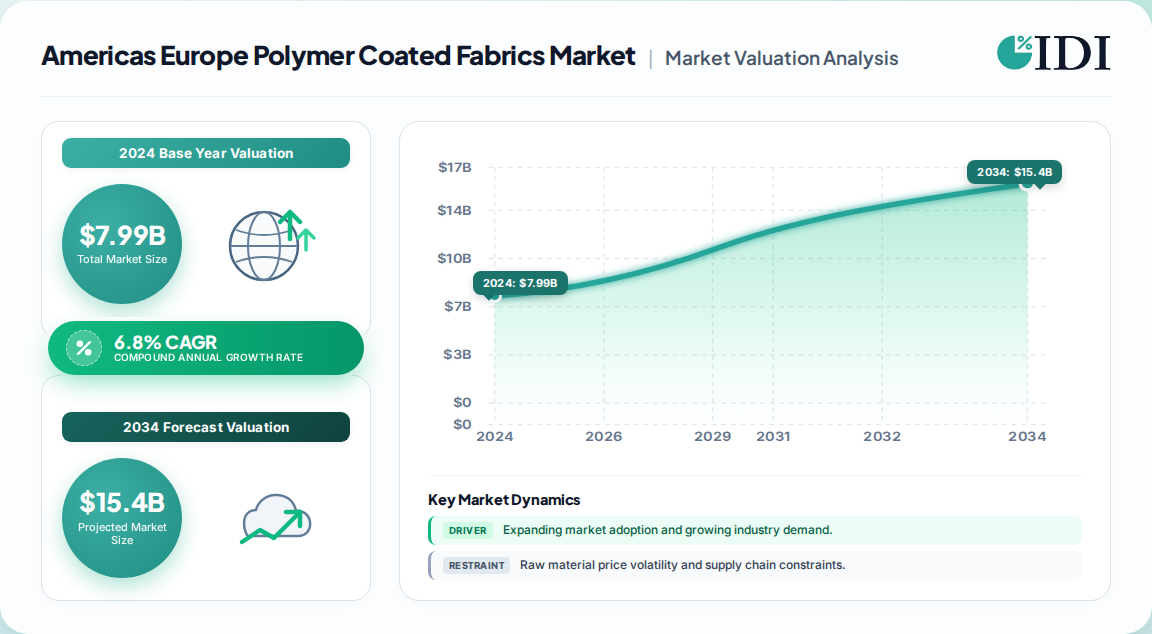
The Americas and Europe polymer coated fabrics market was estimated at 7.99 Billion in 2024 and is projected to reach roughly 11.85 Billion by 2030 at a 6.8% CAGR (2025–2030).
PVC dominates with a 73.5% revenue share in 2024, but polyurethane is the fastest-growing polymer at a 7.2% CAGR on lightweighting and low-VOC momentum.
Light vehicles led applications at 25.6% share in 2024; protective clothing is the fastest-growing application at 9.4% CAGR through 2030.
Central Europe held the largest regional share at 31.4% in 2024, led by Germany's manufacturing base and worker-safety regulation.
North America is the fastest-growing region at a 7.3% CAGR, anchored by the U.S. automotive interior and protective-textile demand.
Key vendors include OMNOVA, SPRADLING, SRF Ltd., BASF, and Continental AG, competing on sustainable formulations and distribution reach.
Why this matters for decision-makers: The 73.5% PVC concentration against a 7.2% polyurethane CAGR signals a structural share shift — suppliers who do not qualify bio-based and low-VOC PU lines by 2027 risk ceding premium automotive and PPE accounts to early movers.
Americas Europe Polymer Coated Fabrics Market Market Size (In Billion)
15.0B
10.0B
5.0B
0
7.990 B
2024
8.530 B
2025
9.110 B
2026
9.730 B
2027
10.39 B
2028
11.10 B
2029
11.85 B
2030
Americas Europe Polymer Coated Fabrics Market Market Size (In Billion)
Year
Market Size
2024
7.990 B
2025
8.530 B
2026
9.110 B
2027
9.730 B
2028
10.39 B
2029
11.10 B
2030
11.85 B
What is the Americas Europe Polymer Coated Fabrics Market?
The Americas and Europe polymer coated fabrics market covers textile substrates — polyester, nylon, fiberglass, cotton blends — treated with polymer coatings such as PVC, polyurethane, silicone, and fluoropolymer to deliver waterproofing, abrasion resistance, chemical resistance, and flame retardancy. It serves automotive interiors, protective clothing, construction membranes, furniture, and marine upholstery across the two regions.
Scope: what this report covers and excludes
This analysis covers polymer coated fabrics across the Americas and Europe by product (PVC, polyurethane, and other polymers), by application (light vehicles, protective clothing, construction, furniture, marine, and industrial), and by region — Central Europe, Western Europe, Southern Europe, Eastern Europe, and North America. This analysis does not cover uncoated textiles, standalone polymer films, non-coated geotextiles, or finished garments where coating does not define primary value.
How big is the market for Americas Europe Polymer Coated Fabrics Market?
The market is most defensibly sized at 7.99 Billion in 2024, growing at a 6.8% CAGR to roughly 11.85 Billion by 2030 — the figure best anchored to a disclosed base year, forward horizon, and segment splits. Competing estimates diverge materially on both base and growth rate.
Estimate
Base year
Horizon
CAGR
Definition / scope
Attribution
7.99 Billion
2024
2030
6.8%
Americas + Europe, polymer coated fabrics by product and application
One published industry estimate
5.8 Billion
2025
2030
5.0%
Americas + Europe, narrower application set
A competing analysis
20.87 Billion (global)
2026
2031
5.31%
Global polymer coated fabric, all regions
A third-party benchmark
Our analysis suggests the 7.99 Billion figure is the most defensible for regional decision-making: it aligns with the disclosed 31.4% Central Europe share, the 73.5% PVC concentration, and the 25.6% light-vehicle application share. The 5.8 Billion figure appears to exclude some industrial and construction applications, while the global figure is not directly comparable because it includes Asia-Pacific, which accounts for roughly 46% of global revenue. Buyers should treat the lower figure as a conservative floor, not a substitute.
How is the market segmented?
Segmentation is primarily by polymer chemistry and end-use application, with PVC and light vehicles anchoring current revenue while polyurethane and protective clothing drive incremental growth.
PVC's dominance is a cost and process-maturity story: it is cheap, abrasion-resistant, and widely qualified. The polyurethane acceleration reflects automotive OEM lightweighting targets and the removal of N-methyl-2-pyrrolidone from water-based systems. This divergence implies that volume growth and margin growth are increasingly separate stories — a critical distinction for investors evaluating coating capacity.
Which region leads in the Americas Europe Polymer Coated Fabrics Market?
Central Europe led with a 31.4% revenue share in 2024, driven by Germany's manufacturing depth and stringent worker-safety regulation; North America is the fastest-growing region at a 7.3% CAGR through 2030.
Americas Europe Polymer Coated Fabrics Market Regional Market Share
Loading chart...
Americas Europe Polymer Coated Fabrics Market Regional Market Share
Region
Market Share (%)
Central Europe
0.31%
North America
0.27%
Western Europe
0.2%
Southern Europe
0.12%
Eastern Europe
0.1%
Central Europe — 31.4% share (Germany dominant)
Germany
Poland
Czechia
North America — fastest-growing, 7.3% CAGR
United States
Canada
Mexico
Western Europe
France
United Kingdom
Netherlands
Southern Europe
Italy
Spain
Eastern Europe
Hungary
Romania
Germany's lead is not simply scale — it is regulatory pull. EU PPE regulation and REACH compliance have made Germany the qualification gateway for protective-clothing-grade coated fabrics, meaning suppliers who win German approvals typically inherit wider European access. North America's 7.3% CAGR, by contrast, is demand-led: U.S. automotive interior specifications and OSHA-driven protective apparel procurement are expanding faster than European replacement cycles.
What is driving growth — and what is holding it back?
Growth is driven by automotive lightweighting, worker-safety regulation, and construction membrane demand; it is restrained by crude-linked polymer price volatility and tightening environmental scrutiny of PVC and phthalates.
Membranes, awnings, upholstery tied to construction and disposable income
Crude-derived polymer price volatility
Restraint
High
PVC and PU feedstock costs swing with oil and gas
PVC and phthalate environmental scrutiny
Restraint
Medium-High
REACH and North American disclosure rules push reformulation costs
Microplastic-release regulation
Restraint
Medium
EU-leading rules raise compliance burden on coated textile converters
The balance favors growth, but the composition is shifting. Our analysis suggests the restraint impact is asymmetric: it falls hardest on commodity PVC converters with thin margins, while polyurethane and silicone specialists convert regulatory pressure into pricing power. Protective clothing's 9.4% CAGR is the clearest signal — regulation is not a headwind for the whole market, it is a reallocation mechanism.
Who are the leading vendors?
OMNOVA, SPRADLING, SRF Ltd., BASF, and Continental AG lead, with competition centered on sustainable formulations, automotive qualification, and distribution reach rather than raw capacity alone.
Company
Primary positioning
Strategic emphasis
OMNOVA North America
Coated fabrics and laminates
Engineered performance fabrics, North American automotive and industrial
SPRADLING
Coated and laminated textiles
Protective and industrial applications
SRF Ltd. (KAMA Holdings)
Diversified polymer coated fabrics
Broad product range, Indian manufacturing scale
BASF
Polymer chemistry and coatings
Sustainable and bio-based polymer inputs
Continental AG
Automotive interior surfaces
TPU and silicone-coated lines for EV interiors
Differentiation is increasingly chemistry-led rather than capacity-led. SRF's breadth and cost position contrast with Continental's OEM-integrated automotive qualification, while BASF competes upstream on polymer inputs. The moat for most vendors is qualification, not manufacturing: once a coated fabric is specified into an automotive interior or a certified PPE line, switching costs and requalification timelines protect incumbents. This implies consolidation pressure on sub-scale converters that cannot fund REACH and low-VOC reformulation.
What do buyers and operators need to know?
Selection should be driven by qualification status, not unit price. Buyers specifying automotive interiors must confirm low-VOC compliance and cabin-air standards; PPE buyers must verify chemical-resistance certification and wash-cycle durability. Requalifying a coated fabric supplier typically takes multiple production cycles, so switching costs are high and should be priced into any sourcing decision.
Procurement risk concentrates in two areas: feedstock exposure and regulatory transition. PVC pricing tracks crude and energy markets, so multi-year contracts without indexation transfer volatility to the buyer. Separately, phthalate and microplastic rules are tightening fastest in the EU, meaning a supplier qualified today may require reformulation before 2030.
Operators should also watch capacity geography. Central Europe's 31.4% share is a qualification hub, not just a demand center — building or acquiring coating capacity near German automotive and PPE clusters shortens qualification cycles. Finally, buyers should demand documented bio-based content and closed-loop recycling capability, because OEM sustainability scorecards are becoming a de facto gate for premium accounts.
Strategic Recommendations & Analyst Perspective
The balance of evidence favors a chemistry-shift thesis over a volume-growth thesis. At a 6.8% overall CAGR, the market is expanding steadily — but PVC's 73.5% share against polyurethane's 7.2% CAGR and protective clothing's 9.4% CAGR shows that incremental value is concentrating in performance and regulated segments. Investors should weight exposure toward PU, silicone, and bio-based capacity rather than commodity PVC lines.
The strongest counter-argument is that PVC's cost and recyclability advantages will defend its share far longer than the growth rates imply, particularly in construction and furniture where price sensitivity dominates. That is credible — but it argues for PVC remaining a volume anchor, not a margin engine. The risk is a supplier that treats PVC leadership as a durable profit moat and underinvests in reformulation.
Actionable strategy:
Prioritize REACH-compliant polyurethane and low-VOC capacity to capture European automotive and protective-clothing premiums ahead of tightening deadlines.
Build or secure qualification near Central European automotive and PPE clusters to compress time-to-specification.
Index PVC-linked contracts to feedstock to avoid absorbing crude volatility in multi-year agreements.
What would change this conclusion: if PVC reformulation (bio-attributed or recycled feedstock) scales faster than expected and erases the polyurethane performance premium, the chemistry-shift thesis weakens and PVC incumbents regain pricing power. Precise sub-segment forecasting — by country, application, and polymer grade — requires the full report's granular dataset.
Americas Europe Polymer Coated Fabrics Market Regional Market Share
Higher Coverage
Lower Coverage
No Coverage
Americas Europe Polymer Coated Fabrics Market REPORT HIGHLIGHTS
Research Methodology & Data Sources
Our rigorous research methodology combines multi-layered approaches with comprehensive quality assurance, ensuring precision, accuracy, and reliability in every market analysis.
Primary Research & Industry Fieldwork
Our research follows a 70/30 primary-to-secondary split. In-depth interviews were conducted across the value chain with raw material and polymer producers, specialized coated-fabric manufacturers, contract coaters and formulators, and global industrial distributors. Interviewees included VP-level Sourcing leads, Heads of R&D, Technical Directors, and Commercial Operations Leads, each selected for direct specification or procurement authority in automotive, protective clothing, and construction applications.
Key Stakeholders Interviewed
Key Stakeholders Interviewed
Stakeholder Role
Interview Share (%)
R&D & Technical Directors
35%
Procurement & Sourcing Leads
30%
Commercial Operations Leads
20%
Quality & Regulatory Managers
15%
Industry Ecosystem Breakdown
Industry Ecosystem Breakdown
Company Type
Representation (%)
Raw Material & Polymer Producers
30%
Coated Fabric Manufacturers
40%
Contract Coaters & Formulators
18%
Industrial Distributors
12%
Secondary Benchmarking & Public Trade Validation
We validated demand and trade flows against official multilateral databases including UN Comtrade, WTO, US ITC, and Eurostat, alongside corporate annual filings (10-K, SEC filings, investor presentations), patent databases, and recognized technical standards bodies and industry associations. Regulatory frameworks referenced include EU PPE regulation, REACH, OSHA guidelines, and ISO test standards for chemical resistance and flame retardancy.
Demand Modeling & Market Sizing Triangulation
Market sizing triangulates a Top-Down allocation (macroeconomic output, automotive production, construction spend, PPE procurement) against a Bottom-Up model (manufacturer coating capacity, product pricing, and end-use consumption by application). Divergences between the two approaches are reconciled through interview-based validation.
UN Comtrade — official international trade statistics
Eurostat — European production and trade data
US ITC — U.S. import/export and tariff data
EU PPE Regulation and REACH — regulatory compliance frameworks
ISO standards for coated fabric performance and flame retardancy
Aspects
Details
Study Period
2020-2034
Base Year
2025
Estimated Year
2026
Forecast Period
2026-2034
Historical Period
2020-2025
Growth Rate
CAGR of 6.8% from 2020-2034
Segmentation
By Product
Polyvinyl Chloride
Polyurethane
Other Polymers
By Application
Light Vehicles
Protective Clothing
Construction
Furniture
Marine
Industrial
By Geography
Central Europe
Germany
Poland
Czechia
Western Europe
France
United Kingdom
Netherlands
Southern Europe
Italy
Spain
Eastern Europe
Hungary
Romania
North America
United States
Canada
Mexico
Table of Contents
1. Americas Europe Polymer Coated Fabrics Market Introduction
1.1. Research Scope
1.2. Market Segmentation
1.3. Research Objective
1.4. Definitions and Assumptions
2. Americas Europe Polymer Coated Fabrics Market Executive Summary
2.1. Market Snapshot
3. Americas Europe Polymer Coated Fabrics Market Dynamics
3.1. Introduction
3.2. Market Drivers
3.3. Market Restrains
3.4. Market Trends
4. Americas Europe Polymer Coated Fabrics Market Factor Analysis
4.1. Porters Five Forces
4.1.1. Bargaining Power of Suppliers
4.1.2. Bargaining Power of Buyers
4.1.3. Threat of New Entrants
4.1.4. Threat of Substitutes
4.1.5. Competitive Rivalry
4.2. PESTEL analysis
4.3. BCG Analysis
4.3.1. Stars (High Growth, High Market Share)
4.3.2. Cash Cows (Low Growth, High Market Share)
4.3.3. Question Mark (High Growth, Low Market Share)
4.3.4. Dogs (Low Growth, Low Market Share)
4.4. Ansoff Matrix Analysis
4.5. Supply Chain Analysis
4.6. Regulatory Landscape
4.7. Current Market Potential and Opportunity Assessment (TAM–SAM–SOM Framework)
4.8. IDI Analyst Note
5. Americas Europe Polymer Coated Fabrics Market Analysis, Insights and Forecast, 2020-2034
5.1. Analysis, Insights and Forecast - by Product
5.1.1. Polyvinyl Chloride
5.1.2. Polyurethane
5.1.3. Other Polymers
5.2. Analysis, Insights and Forecast - by Application
5.2.1. Light Vehicles
5.2.2. Protective Clothing
5.2.3. Construction
5.2.4. Furniture
5.2.5. Marine
5.2.6. Industrial
5.3. Analysis, Insights and Forecast - by Region
5.3.1. Central Europe
5.3.2. Western Europe
5.3.3. Southern Europe
5.3.4. Eastern Europe
5.3.5. North America
6. Americas Europe Polymer Coated Fabrics Market Central Europe Analysis, Insights and Forecast, 2020-2034
6.1. Analysis, Insights and Forecast - by Product
6.1.1. Polyvinyl Chloride
6.1.2. Polyurethane
6.1.3. Other Polymers
6.2. Analysis, Insights and Forecast - by Application
6.2.1. Light Vehicles
6.2.2. Protective Clothing
6.2.3. Construction
6.2.4. Furniture
6.2.5. Marine
6.2.6. Industrial
7. Americas Europe Polymer Coated Fabrics Market Western Europe Analysis, Insights and Forecast, 2020-2034
7.1. Analysis, Insights and Forecast - by Product
7.1.1. Polyvinyl Chloride
7.1.2. Polyurethane
7.1.3. Other Polymers
7.2. Analysis, Insights and Forecast - by Application
7.2.1. Light Vehicles
7.2.2. Protective Clothing
7.2.3. Construction
7.2.4. Furniture
7.2.5. Marine
7.2.6. Industrial
8. Americas Europe Polymer Coated Fabrics Market Southern Europe Analysis, Insights and Forecast, 2020-2034
8.1. Analysis, Insights and Forecast - by Product
8.1.1. Polyvinyl Chloride
8.1.2. Polyurethane
8.1.3. Other Polymers
8.2. Analysis, Insights and Forecast - by Application
8.2.1. Light Vehicles
8.2.2. Protective Clothing
8.2.3. Construction
8.2.4. Furniture
8.2.5. Marine
8.2.6. Industrial
9. Americas Europe Polymer Coated Fabrics Market Eastern Europe Analysis, Insights and Forecast, 2020-2034
9.1. Analysis, Insights and Forecast - by Product
9.1.1. Polyvinyl Chloride
9.1.2. Polyurethane
9.1.3. Other Polymers
9.2. Analysis, Insights and Forecast - by Application
9.2.1. Light Vehicles
9.2.2. Protective Clothing
9.2.3. Construction
9.2.4. Furniture
9.2.5. Marine
9.2.6. Industrial
10. Americas Europe Polymer Coated Fabrics Market North America Analysis, Insights and Forecast, 2020-2034
10.1. Analysis, Insights and Forecast - by Product
10.1.1. Polyvinyl Chloride
10.1.2. Polyurethane
10.1.3. Other Polymers
10.2. Analysis, Insights and Forecast - by Application
10.2.1. Light Vehicles
10.2.2. Protective Clothing
10.2.3. Construction
10.2.4. Furniture
10.2.5. Marine
10.2.6. Industrial
11. Americas Europe Polymer Coated Fabrics Market Competitive Analysis
11.1. Company Profiles
11.2. Market Entropy
11.2.1. Company's Key Areas Served
11.2.2. Recent Developments
11.3. Company Market Share Analysis, 2026
11.3.1. Top 5 Companies Market Share Analysis
11.3.2. Top 3 Companies Market Share Analysis
11.4. List of Potential Customers
12. Americas Europe Polymer Coated Fabrics Market Research Methodology
List of Figures
Figure 1: Americas Europe Polymer Coated Fabrics Market Revenue Breakdown (Billion, %) by Product 2026 & 2034
Figure 2: Americas Europe Polymer Coated Fabrics Market Value Share (%), by Product 2026 & 2034
Figure 3: Americas Europe Polymer Coated Fabrics Market Value Share (%), by Application 2026 & 2034
Figure 4: Americas Europe Polymer Coated Fabrics Market Share (%) by Company 2026
List of Tables
Table 1: Americas Europe Polymer Coated Fabrics Market Revenue Billion Forecast, by Product 2020 & 2034
Table 2: Americas Europe Polymer Coated Fabrics Market Revenue Billion Forecast, by Application 2020 & 2034
Table 3: Americas Europe Polymer Coated Fabrics Market Revenue Billion Forecast, by Region 2020 & 2034
Table 4: Central Europe Americas Europe Polymer Coated Fabrics Market Revenue Billion Forecast, by Product 2020 & 2034
Table 5: Central Europe Americas Europe Polymer Coated Fabrics Market Revenue Billion Forecast, by Application 2020 & 2034
Table 6: Central Europe Americas Europe Polymer Coated Fabrics Market Revenue Billion Forecast, by Country 2020 & 2034
Table 7: Germany Americas Europe Polymer Coated Fabrics Market Revenue (Billion) Forecast, by Application 2020 & 2034
Table 8: Poland Americas Europe Polymer Coated Fabrics Market Revenue (Billion) Forecast, by Application 2020 & 2034
Table 9: Czechia Americas Europe Polymer Coated Fabrics Market Revenue (Billion) Forecast, by Application 2020 & 2034
Table 10: Western Europe Americas Europe Polymer Coated Fabrics Market Revenue Billion Forecast, by Product 2020 & 2034
Table 11: Western Europe Americas Europe Polymer Coated Fabrics Market Revenue Billion Forecast, by Application 2020 & 2034
Table 12: Western Europe Americas Europe Polymer Coated Fabrics Market Revenue Billion Forecast, by Country 2020 & 2034
Table 13: France Americas Europe Polymer Coated Fabrics Market Revenue (Billion) Forecast, by Application 2020 & 2034
Table 14: United Kingdom Americas Europe Polymer Coated Fabrics Market Revenue (Billion) Forecast, by Application 2020 & 2034
Netherlands Americas Europe Polymer Coated Fabrics Market Revenue (Billion) Forecast, by Application 2020 & 2034
Frequently Asked Questions
1. How big is the Americas and Europe polymer coated fabrics market?
It was estimated at 7.99 Billion in 2024 and is projected to reach roughly 11.85 Billion by 2030, growing at a 6.8% CAGR. Central Europe accounted for the largest regional share at 31.4% in 2024, led by Germany.
2. Which polymer type dominates the market?
Polyvinyl chloride (PVC) dominated with a 73.5% revenue share in 2024 due to cost efficiency, chemical resistance, and durability. Polyurethane is the fastest-growing polymer at a 7.2% CAGR, driven by automotive lightweighting and low-VOC requirements.
3. Which application is growing fastest?
Protective clothing is projected to grow at the fastest 9.4% CAGR through 2030, driven by EU PPE regulations and U.S. OSHA guidelines. Light vehicles remain the largest application at 25.6% revenue share in 2024.
4. Which region is the fastest growing?
North America is expected to register the fastest 7.3% CAGR over the forecast period, supported by safety regulations, lightweight vehicle demand, and a strong base of leading manufacturers. The U.S. dominates the North American market.
5. Who are the leading companies in the market?
Key companies include OMNOVA North America, SPRADLING, SRF Ltd. (KAMA Holdings), BASF, and Continental AG. Players compete through sustainable material innovation, automotive qualification, and expanded distribution networks.
Table 15:
Table 16: Southern Europe Americas Europe Polymer Coated Fabrics Market Revenue Billion Forecast, by Product 2020 & 2034
Table 17: Southern Europe Americas Europe Polymer Coated Fabrics Market Revenue Billion Forecast, by Application 2020 & 2034
Table 18: Southern Europe Americas Europe Polymer Coated Fabrics Market Revenue Billion Forecast, by Country 2020 & 2034
Table 19: Italy Americas Europe Polymer Coated Fabrics Market Revenue (Billion) Forecast, by Application 2020 & 2034
Table 20: Spain Americas Europe Polymer Coated Fabrics Market Revenue (Billion) Forecast, by Application 2020 & 2034
Table 21: Eastern Europe Americas Europe Polymer Coated Fabrics Market Revenue Billion Forecast, by Product 2020 & 2034
Table 22: Eastern Europe Americas Europe Polymer Coated Fabrics Market Revenue Billion Forecast, by Application 2020 & 2034
Table 23: Eastern Europe Americas Europe Polymer Coated Fabrics Market Revenue Billion Forecast, by Country 2020 & 2034
Table 24: Hungary Americas Europe Polymer Coated Fabrics Market Revenue (Billion) Forecast, by Application 2020 & 2034
Table 25: Romania Americas Europe Polymer Coated Fabrics Market Revenue (Billion) Forecast, by Application 2020 & 2034
Table 26: North America Americas Europe Polymer Coated Fabrics Market Revenue Billion Forecast, by Product 2020 & 2034
Table 27: North America Americas Europe Polymer Coated Fabrics Market Revenue Billion Forecast, by Application 2020 & 2034
Table 28: North America Americas Europe Polymer Coated Fabrics Market Revenue Billion Forecast, by Country 2020 & 2034
Table 29: United States Americas Europe Polymer Coated Fabrics Market Revenue (Billion) Forecast, by Application 2020 & 2034
Table 30: Canada Americas Europe Polymer Coated Fabrics Market Revenue (Billion) Forecast, by Application 2020 & 2034
Table 31: Mexico Americas Europe Polymer Coated Fabrics Market Revenue (Billion) Forecast, by Application 2020 & 2034