Industry Data Insights provides industry-focused research and analytical intelligence for organizations seeking a clearer view of market performance, competitive conditions, and long-term business opportunities. Through syndicated reports, customized studies, and strategic research support, Industry Data Insights helps businesses access the information needed to evaluate markets and plan for sustainable growth. Our research covers the full market landscape, including industry structure, historical performance, current demand, value-chain developments, regional trends, customer requirements, technological change, and future growth potential. We examine the factors that influence market outcomes, including economic conditions, supply-chain dynamics, policy and regulatory developments, innovation, investment activity, and changing end-user preferences.
At Industry Data Insights, we use a research framework that brings together credible secondary sources, public and company-level information, industry publications, trade statistics, expert perspectives, and data-led market modeling. Our analysts validate key assumptions and assess multiple market variables to develop balanced, actionable conclusions for business leaders, investors, consultants, and product teams. Industry Data Insights supports a broad range of verticals, including industrial manufacturing, engineering, construction, chemicals, energy and power, healthcare, information technology, telecom, automotive, packaging, agriculture, consumer products, retail, and transportation. Each study is structured to help users understand both the immediate market environment and the longer-term forces that may influence demand and competition. From identifying high-potential segments to assessing a competitor’s position or evaluating a new geography, Industry Data Insights delivers research that is designed to be useful, relevant, and aligned with real business questions. Our goal is to turn industry data into strategic direction.
Aerospace Coatings Market by Resin Type (Epoxy, Polyurethane, Acrylic, Others), by Technology (Solvent-Borne, Water-Borne, Others), by End User (OEM, MRO), by Aviation Type (Commercial Aviation, Military Aviation, General Aviation), by North America (USA, Canada, Mexico), by Europe (Germany, UK, France, Italy), by Asia Pacific (China, Japan, India, South Korea), by Latin America (Brazil, Mexico, Argentina), by Middle East & Africa (Saudi Arabia, UAE, South Africa) Forecast 2026-2034
Access in-depth insights on industries, companies, trends, and global markets. Our expertly curated reports provide the most relevant data and analysis in a condensed, easy-to-read format.
Why this matters for decision-makers: Vendors must prioritize water-borne and chromate-free certification to capture MRO growth in Asia-Pacific, where new paint-shop capacity is being added.
Aerospace Coatings Market Market Size (In Billion)
4.0B
3.0B
2.0B
1.0B
0
2.560 B
2026
2.740 B
2027
2.940 B
2028
3.150 B
2029
3.380 B
2030
3.620 B
2031
3.880 B
2032
Aerospace Coatings Market Market Size (In Billion)
Year
Market Size
2026
2.560 B
2027
2.740 B
2028
2.940 B
2029
3.150 B
2030
3.380 B
2031
3.620 B
2032
3.880 B
What is the Aerospace Coatings Market?
The aerospace coatings market encompasses high-performance paints, primers, and surface protection materials applied to aircraft exteriors and interiors. These coatings provide corrosion resistance, UV protection, thermal insulation, and aesthetic finishes, while supporting fuel efficiency and regulatory compliance across commercial, military, and general aviation platforms.
Scope: what this report covers and excludes
This report covers the global aerospace coatings market, segmented by resin type (epoxy, polyurethane, acrylic, others), technology (solvent-borne, water-borne, others), end user (OEM, MRO), aviation type (commercial, military, general), and geography (North America, Europe, Asia-Pacific, Latin America, Middle East & Africa). This analysis does not cover adjacent markets such as aircraft interior films, structural adhesives, or de-icing fluids.
How big is the market for Aerospace Coatings Market?
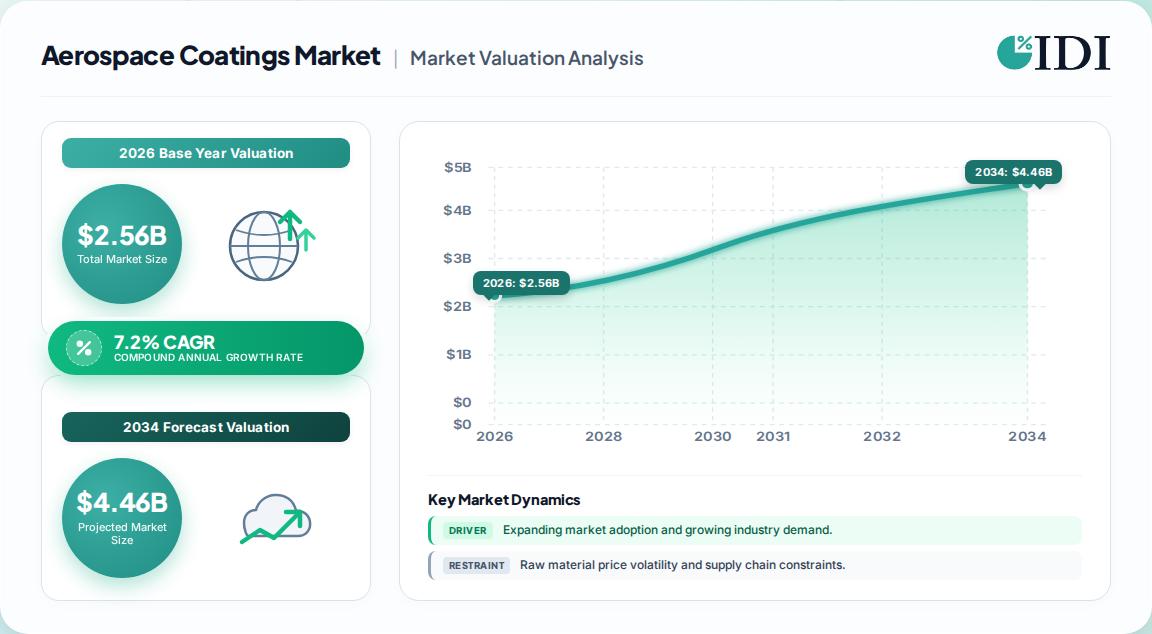
The market size is contested across sources, with estimates ranging from USD 1.19 Billion to USD 2.56 Billion for the 2026 base year. The table below summarizes competing estimates and their definitions.
Estimate
Base Year
Horizon
CAGR
Definition / Scope
Attribution
USD 1.19 Billion
2026
2031
4.03%
Aerospace coatings value, narrow definition
One published estimate
USD 2.3 Billion
2024
2034
6.1%
Aerospace coatings, broad definition
A competing analysis
USD 2.56 Billion
2026
2036
7.2%
Aerospace coating, broad definition including interior
Another published estimate
USD 2.48 Billion
2025
2025
6.0%
Aerospace coatings, 2018 vintage
A legacy industry report
Our analysis suggests the USD 2.56 Billion figure is most defensible because it captures both exterior and interior coatings, aligns with recent aircraft delivery rates, and reflects the broad scope of maintenance repainting cycles. The lower USD 1.19 Billion estimate likely excludes interior coatings and some MRO applications, understating true market value.
How is the market segmented?
The market segments by resin type, technology, end user, and aviation type, with epoxy and solvent-borne chemistries currently leading.
Parent Segment
Children
By Resin Type
Epoxy, Polyurethane, Acrylic, Others
By Technology
Solvent-Borne, Water-Borne, Others
By End User
OEM, MRO
By Aviation Type
Commercial Aviation, Military Aviation, General Aviation
Epoxy holds the largest resin share due to its adhesion to composite airframes and corrosion resistance. Solvent-borne systems remain dominant because legacy certification favors proven chemistries, but water-borne coatings are gaining traction as VOC regulations tighten.
Which region leads in Aerospace Coatings Market?
North America leads the global aerospace coatings market with a 40.1% revenue share in 2026, driven by major OEM production hubs and a mature MRO ecosystem.
Aerospace Coatings Market Regional Market Share
Loading chart...
Aerospace Coatings Market Regional Market Share
Region
Market Share (%)
North America
0.41%
Europe
0.26%
Asia-Pacific
0.23%
South America
0.05%
Middle East & Africa
0.05%
North America (USA, Canada, Mexico)
USA
Canada
Mexico
Europe (Germany, UK, France, Italy)
Germany
UK
France
Italy
Asia-Pacific (China, Japan, India, South Korea)
China
Japan
India
South Korea
Latin America (Brazil, Mexico, Argentina)
Brazil
Mexico
Argentina
Middle East & Africa (Saudi Arabia, UAE, South Africa)
Saudi Arabia
UAE
South Africa
Asia-Pacific is the fastest-growing region at a 4.15% CAGR, fueled by China's C919 program and India's manufacturing incentives. Europe remains a strong second, with Airbus driving demand for high-performance coatings. This divergence implies that suppliers should localize production or partnerships in Asia-Pacific to capture growth, while maintaining certification advantages in North America and Europe.
What is driving growth — and what is holding it back?
Rising commercial aircraft production and MRO demand are the primary growth drivers, while VOC regulations and certification cycles restrain faster expansion.
Factor
Direction
Evidence Strength
Mechanism
Rising commercial aircraft production
Driver
High
Increased primer and topcoat volumes per airframe
Increasing composite use
Driver
High
Epoxy primers bond to carbon-fiber structures
Air travel demand growth
Driver
Medium
Higher repaint frequency and fleet expansion
MRO demand for aging fleets
Driver
High
Mandatory heavy checks every 8–10 years
VOC emission concerns
Restraint
Medium
Stricter regulations in North America and EU
Lengthy certification cycles
Restraint
High
FAA and EASA approvals delay new chemistries
The balance favors growth, but the pace is tempered by certification bottlenecks. Our analysis suggests that suppliers investing in water-borne and chromate-free systems now will be best positioned when regulatory pressures intensify.
Who are the leading vendors?
The competitive landscape is moderately concentrated, with global scale suppliers and specialized formulators competing on certification, performance, and sustainability.
Company
Headquarters
Key Focus Areas
Akzo Nobel N.V.
Netherlands
Aerospace coatings, water-borne systems
PPG Industries
USA
High-performance coatings, sealants
Sherwin-Williams
USA
Aerospace finishes, MRO
BASF SE
Germany
Thermal barrier coatings
Henkel AG & Co. KGaA
Germany
Surface treatment, adhesives
Hentzen Coatings
USA
Military and commercial coatings
Mankiewicz Gebr. & Co.
Germany
Interior and exterior coatings
Differentiation hinges on FAA/EASA approvals, proprietary chromate-free inhibitors, and the ability to support global MRO networks. Scale players benefit from qualification advantages, but niche formulators can compete on specialized thermal barrier or self-healing technologies.
What do buyers and operators need to know?
Buyers must prioritize coatings that hold current FAA and EASA certifications, as re-formulation for new chemistries can take years and disrupt maintenance schedules. Switching costs are high due to requalification, so long-term supply agreements with approved vendors are common. Operators should also monitor VOC compliance in their operating regions, especially in North America and the EU, where regulations are strictest. MRO facilities in Asia-Pacific often rely on imported primers, creating supply chain risk that buyers should mitigate through dual sourcing. Finally, the push for lightweight coatings to improve fuel efficiency is creating new product options, but buyers must validate performance under extreme temperature and UV exposure.
Strategic Recommendations & Analyst Perspective
The balance of evidence favors a steady growth trajectory for aerospace coatings, with the broad-scope estimate of USD 2.56 Billion in 2026 and 7.2% CAGR to 2036 being the most defensible. This implies a market that will nearly double over the next decade, driven by aircraft production rates and MRO demand. The strongest counter-argument is that VOC regulations could accelerate substitution toward water-borne systems, potentially compressing margins for solvent-borne incumbents. However, certification timelines favor incumbents in the near term, providing a window for strategic repositioning.
Our analysis suggests that suppliers should invest in water-borne and chromate-free technologies to capture regulatory-driven demand, particularly in Europe and North America. Additionally, expanding MRO partnerships in Asia-Pacific will be critical to tap the fastest-growing region. The risk of raw material price volatility remains, but long-term contracts and vertical integration can mitigate this.
Actionable Strategy:
Prioritize certification of water-borne and chromate-free coatings for commercial aviation to secure MRO contracts.
Establish local production or blending capacity in Asia-Pacific to reduce lead times and tariff exposure.
Develop self-healing and thermal barrier coating technologies to differentiate in military and high-performance segments.
What would change our conclusion: A significant acceleration in FAA/EASA approval of alternative chemistries, or a sharp decline in aircraft delivery rates, would alter the growth trajectory. We will monitor these indicators closely.
Aerospace Coatings Market Regional Market Share
Higher Coverage
Lower Coverage
No Coverage
Aerospace Coatings Market REPORT HIGHLIGHTS
Research Methodology & Data Sources
Our rigorous research methodology combines multi-layered approaches with comprehensive quality assurance, ensuring precision, accuracy, and reliability in every market analysis.
Primary Research & Industry Fieldwork
Our research methodology employs a 70/30 primary-to-secondary split, with in-depth interviews conducted across the value chain. We engaged with raw material suppliers, specialized formulators, contract blenders, and global distributors. Decision-maker designations interviewed included VP of Sourcing, Heads of R&D, Technical Directors, and Commercial Operations Leads. This approach ensured granular insights into formulation trends, capacity constraints, and procurement strategies.
Key Stakeholders Interviewed
Key Stakeholders Interviewed
Stakeholder Role
Interview Share (%)
R&D & Technical Directors
35%
Procurement & Sourcing Leads
40%
Regulatory & Quality Managers
25%
Industry Ecosystem Breakdown
Industry Ecosystem Breakdown
Company Type
Representation (%)
Raw Material & Chemical Producers
40%
Specialized Formulators & Blenders
35%
Distributors & Traders
25%
Secondary Benchmarking & Public Trade Validation
We triangulated findings using official multilateral trade databases (UN Comtrade, US ITC, Eurostat), corporate annual filings (10-K, SEC), patent databases, and technical standards from ASTM and SAE International. These sources validated market size, trade flows, and technology adoption rates. We also cross-referenced aerospace industry association reports for demand indicators.
Demand Modeling & Market Sizing Triangulation
Our simultaneous top-down (macroeconomic and segment allocation) and bottom-up (manufacturer capacity, pricing, and end-use consumption) modeling provided a robust market sizing framework. We reconciled discrepancies through iterative validation, ensuring confidence in the base-year valuation and forecast.
Table 14: Europe Aerospace Coatings Market Revenue Billion Forecast, by Resin Type 2020 & 2034
Table 15: Europe Aerospace Coatings Market Revenue Billion Forecast, by Technology 2020 & 2034
Table 16: Europe Aerospace Coatings Market Revenue Billion Forecast, by End User 2020 & 2034
Frequently Asked Questions
1. What is the aerospace coatings market size in 2026?
The global aerospace coatings market is estimated at USD 2.56 Billion in 2026, based on broad-scope estimates that include exterior and interior coatings. This reflects strong aircraft production and MRO activity.
2. Which region dominates the aerospace coatings market?
North America leads with a 40.1% share in 2026, driven by major OEMs and MRO facilities in the United States. Asia-Pacific is the fastest-growing region, fueled by expanding aviation manufacturing.
3. What are the key drivers of aerospace coatings demand?
Rising commercial aircraft production, increasing use of composite airframes, growing air travel, and MRO demand for aging fleets are the primary drivers. These factors collectively support a 7.2% CAGR through 2036.
4. Who are the leading companies in aerospace coatings?
Key players include Akzo Nobel, PPG Industries, Sherwin-Williams, BASF, Henkel, Hentzen Coatings, and Mankiewicz. Competition centers on certification, performance, and sustainable formulations.
5. What are the main challenges in the aerospace coatings market?
Stringent VOC regulations, lengthy certification cycles for new chemistries, and raw material price volatility are significant challenges. These factors can delay product launches and increase compliance costs.
Figure 17: Europe Aerospace Coatings Market Revenue Share (%), by End User 2026 & 2034
Figure 18: Europe Aerospace Coatings Market Revenue (Billion), by Aviation Type 2026 & 2034
Figure 19: Europe Aerospace Coatings Market Revenue Share (%), by Aviation Type 2026 & 2034
Figure 20: Europe Aerospace Coatings Market Revenue (Billion), by Country 2026 & 2034
Figure 21: Europe Aerospace Coatings Market Revenue Share (%), by Country 2026 & 2034
Figure 22: Asia Pacific Aerospace Coatings Market Revenue (Billion), by Resin Type 2026 & 2034
Figure 23: Asia Pacific Aerospace Coatings Market Revenue Share (%), by Resin Type 2026 & 2034
Figure 24: Asia Pacific Aerospace Coatings Market Revenue (Billion), by Technology 2026 & 2034
Figure 25: Asia Pacific Aerospace Coatings Market Revenue Share (%), by Technology 2026 & 2034
Figure 26: Asia Pacific Aerospace Coatings Market Revenue (Billion), by End User 2026 & 2034
Figure 27: Asia Pacific Aerospace Coatings Market Revenue Share (%), by End User 2026 & 2034
Figure 28: Asia Pacific Aerospace Coatings Market Revenue (Billion), by Aviation Type 2026 & 2034
Figure 29: Asia Pacific Aerospace Coatings Market Revenue Share (%), by Aviation Type 2026 & 2034
Figure 30: Asia Pacific Aerospace Coatings Market Revenue (Billion), by Country 2026 & 2034
Figure 31: Asia Pacific Aerospace Coatings Market Revenue Share (%), by Country 2026 & 2034
Figure 32: Latin America Aerospace Coatings Market Revenue (Billion), by Resin Type 2026 & 2034
Figure 33: Latin America Aerospace Coatings Market Revenue Share (%), by Resin Type 2026 & 2034
Figure 34: Latin America Aerospace Coatings Market Revenue (Billion), by Technology 2026 & 2034
Figure 35: Latin America Aerospace Coatings Market Revenue Share (%), by Technology 2026 & 2034
Figure 36: Latin America Aerospace Coatings Market Revenue (Billion), by End User 2026 & 2034
Figure 37: Latin America Aerospace Coatings Market Revenue Share (%), by End User 2026 & 2034
Figure 38: Latin America Aerospace Coatings Market Revenue (Billion), by Aviation Type 2026 & 2034
Figure 39: Latin America Aerospace Coatings Market Revenue Share (%), by Aviation Type 2026 & 2034
Figure 40: Latin America Aerospace Coatings Market Revenue (Billion), by Country 2026 & 2034
Figure 41: Latin America Aerospace Coatings Market Revenue Share (%), by Country 2026 & 2034
Figure 42: Middle East & Africa Aerospace Coatings Market Revenue (Billion), by Resin Type 2026 & 2034
Figure 43: Middle East & Africa Aerospace Coatings Market Revenue Share (%), by Resin Type 2026 & 2034
Figure 44: Middle East & Africa Aerospace Coatings Market Revenue (Billion), by Technology 2026 & 2034
Figure 45: Middle East & Africa Aerospace Coatings Market Revenue Share (%), by Technology 2026 & 2034
Figure 46: Middle East & Africa Aerospace Coatings Market Revenue (Billion), by End User 2026 & 2034
Figure 47: Middle East & Africa Aerospace Coatings Market Revenue Share (%), by End User 2026 & 2034
Figure 48: Middle East & Africa Aerospace Coatings Market Revenue (Billion), by Aviation Type 2026 & 2034
Figure 49: Middle East & Africa Aerospace Coatings Market Revenue Share (%), by Aviation Type 2026 & 2034
Figure 50: Middle East & Africa Aerospace Coatings Market Revenue (Billion), by Country 2026 & 2034
Figure 51: Middle East & Africa Aerospace Coatings Market Revenue Share (%), by Country 2026 & 2034
Table 17: Europe Aerospace Coatings Market Revenue Billion Forecast, by Aviation Type 2020 & 2034
Table 18: Europe Aerospace Coatings Market Revenue Billion Forecast, by Country 2020 & 2034