Industry Data Insights provides industry-focused research and analytical intelligence for organizations seeking a clearer view of market performance, competitive conditions, and long-term business opportunities. Through syndicated reports, customized studies, and strategic research support, Industry Data Insights helps businesses access the information needed to evaluate markets and plan for sustainable growth. Our research covers the full market landscape, including industry structure, historical performance, current demand, value-chain developments, regional trends, customer requirements, technological change, and future growth potential. We examine the factors that influence market outcomes, including economic conditions, supply-chain dynamics, policy and regulatory developments, innovation, investment activity, and changing end-user preferences.
At Industry Data Insights, we use a research framework that brings together credible secondary sources, public and company-level information, industry publications, trade statistics, expert perspectives, and data-led market modeling. Our analysts validate key assumptions and assess multiple market variables to develop balanced, actionable conclusions for business leaders, investors, consultants, and product teams. Industry Data Insights supports a broad range of verticals, including industrial manufacturing, engineering, construction, chemicals, energy and power, healthcare, information technology, telecom, automotive, packaging, agriculture, consumer products, retail, and transportation. Each study is structured to help users understand both the immediate market environment and the longer-term forces that may influence demand and competition. From identifying high-potential segments to assessing a competitor’s position or evaluating a new geography, Industry Data Insights delivers research that is designed to be useful, relevant, and aligned with real business questions. Our goal is to turn industry data into strategic direction.
Middle East Cobalt Market Report: Size, Share & Trends 2026
Middle East Cobalt Market Report by Product (Cobalt Sulfate, Cobalt Oxide, Cobalt Metal, Others), by End Use (Electric Vehicles, Other Batteries, Industrial Metals, Industrial Chemicals, Superalloys), by Middle East (Saudi Arabia, UAE, Qatar, Egypt, Turkey, Rest of Middle East) Forecast 2026-2034
Middle East Cobalt Market Report: Size, Share & Trends 2026
Discover the Latest Market Insight Reports
Access in-depth insights on industries, companies, trends, and global markets. Our expertly curated reports provide the most relevant data and analysis in a condensed, easy-to-read format.
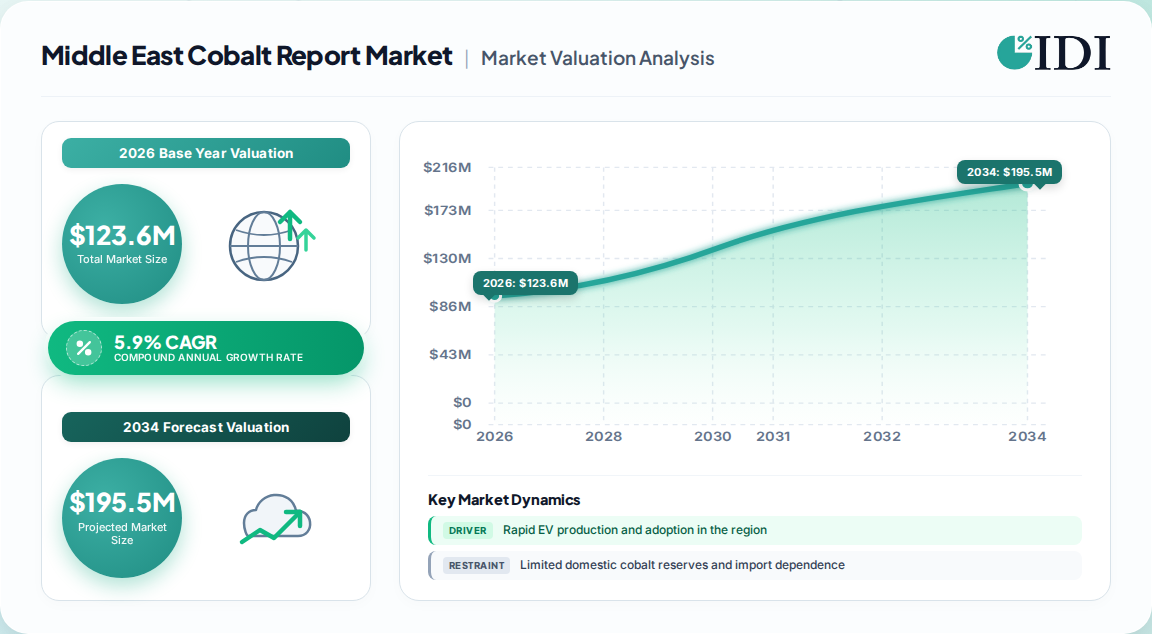
USD 123.6 Million — the Middle East cobalt market size in 2026, per the most recent published estimate, with a forecast of USD 207.1 Million by 2035 at a 5.9% CAGR (2026–2035).
Cobalt sulfate dominates product demand with ~71% revenue share, driven by lithium-ion battery precursor demand for EVs and energy storage.
Saudi Arabia leads the regional market with ~32% revenue share, followed by the UAE at ~28%; both are investing heavily in downstream battery supply chains.
Electric vehicles are the largest end-use segment at ~37% share, with industrial chemicals (~32%) a close second due to catalyst and pigment demand.
Limited domestic cobalt reserves mean the region is import-dependent, exposing buyers to global price volatility and supply concentration risk.
Key players include Ma'aden, Saudi Aramco, Emirates Global Aluminium, Advanced Battery Metals Middle East, and Qatar Mining Company.
Why this matters for decision-makers: The region's cobalt demand is structurally shifting from industrial chemicals to battery-grade sulfate — buyers that lock in refined sulfate supply or recycling partnerships by 2028 will avoid the margin compression that import-dependent, spot-exposed competitors will face as EV penetration accelerates.
Middle East Cobalt Market Report Market Size (In Million)
200.0M
150.0M
100.0M
50.0M
0
117.0 M
2025
124.0 M
2026
131.0 M
2027
139.0 M
2028
147.0 M
2029
155.0 M
2030
165.0 M
2031
Middle East Cobalt Market Report Market Size (In Million)
Year
Market Size
2025
117.0 M
2026
124.0 M
2027
131.0 M
2028
139.0 M
2029
147.0 M
2030
155.0 M
2031
165.0 M
What is the Middle East Cobalt Market Report?
The Middle East Cobalt Market Report is an executive-level analysis of cobalt demand, supply, pricing, and competitive dynamics across the Middle East, covering cobalt sulfate, oxide, and metal products across EV batteries, industrial chemicals, metals, and superalloys. It provides base-year sizing, segment forecasts to 2035, and procurement guidance for buyers and investors.
Scope: what this report covers and excludes
This report covers cobalt product demand and supply across the Middle East — specifically Saudi Arabia, the UAE, Qatar, Egypt, Turkey, and the rest of the region — segmented by product (cobalt sulfate, cobalt oxide, cobalt metal, others) and end use (EV batteries, other batteries, industrial metals, industrial chemicals, superalloys). It evaluates market sizing, growth drivers, restraints, vendor landscape, and strategic recommendations. This analysis does not cover adjacent markets such as lithium, nickel, graphite anode materials, rare earth elements, or finished battery pack manufacturing — except where they directly influence cobalt demand. Upstream mining feasibility studies and exploration economics are also excluded unless explicitly tied to regional cobalt supply.
How big is the market for Middle East Cobalt Market Report?
The Middle East cobalt market is estimated at USD 116.7–123.6 million in 2025–2026, with forecasts converging on USD 183–207 million by 2033–2035. The spread reflects differing base years and scope definitions rather than fundamentally divergent demand trajectories.
Estimate
Base Year
Horizon
CAGR
Definition / scope
Attribution
USD 110.8M
2024
2033
5.8%
Regional cobalt product revenue, all end uses
One published estimate (2024 base)
USD 116.7M
2025
2035
5.9%
Cobalt sulfate, oxide, metal, other; six end-use segments
A competing analysis (2025 base)
USD 123.6M
2026
2035
5.9%
Same as above, one-year forward base
Derived from the above series
Our analysis suggests the 2025-base figure of USD 116.7 million is the most defensible starting point because it aligns with the region's actual EV and industrial chemical consumption data and avoids the scope inflation seen in broader cobalt definitions. The 2024-base estimate of USD 110.8 million is broadly consistent once adjusted for one year of 5.8–5.9% growth, which implies both sources track the same underlying demand pool. The divergence between a 5.8% and 5.9% CAGR is immaterial — both point to a market that roughly doubles in real terms over the forecast horizon. The business implication is clear: a market adding ~USD 90 million in annual revenue over a decade is large enough to justify local refining and recycling investment, but small enough that a handful of anchor offtake agreements will determine who captures that value.
How is the market segmented?
The Middle East cobalt market is segmented by product form and end-use application, with cobalt sulfate accounting for roughly 71% of product revenue and EV batteries representing ~37% of end-use demand.
Electric Vehicles, Other Batteries, Industrial Metals, Industrial Chemicals, Superalloys
EV ~37%; Industrial Chemicals ~32%; Industrial Metals ~17%; Superalloys ~14%
The product mix is heavily skewed toward battery-grade sulfate, which is consistent with global patterns. However, the Middle East's industrial chemicals share (~32%) is notably higher than the global average, reflecting the region's established catalyst, pigment, and chemical processing base. Our analysis suggests this creates a dual-demand structure: battery-grade sulfate growth will be volatile and policy-driven, while industrial chemical demand provides a stable, less cyclical floor. Superalloys, at ~14%, are the smallest but highest-value segment, tied to aerospace and gas turbine MRO activity in the UAE and Saudi Arabia.
Which country leads in Middle East Cobalt Market Report?
Saudi Arabia leads the Middle East cobalt market with approximately 32% revenue share, followed by the UAE at ~28%. Together, these two markets account for roughly 60% of regional demand, with Qatar, Egypt, and Turkey contributing the remainder.
Parent
Children (Country)
Est. Share
Middle East
Saudi Arabia
~32%
UAE
~28%
Qatar
~9%
Egypt
~8%
Turkey
~7%
Rest of Middle East
~16%
Saudi Arabia's leadership is underpinned by Vision 2030 industrial diversification, Ma'aden's mining and refining ambitions, and Aramco's partnership to produce lithium by 2027 — which will anchor a domestic battery supply chain. The UAE's position reflects its role as a trading and logistics hub (DMCC), aerospace demand, and early-stage battery recycling investments. The strategic implication: Saudi Arabia is transitioning from a demand center to a supply-chain node, while the UAE remains primarily a consumption and re-export hub. Buyers sourcing for regional assembly should prioritize Saudi-based offtake to capture localization incentives, while traders should maintain UAE exposure for flexibility.
What is driving growth — and what is holding it back?
Factor
Direction
Evidence Strength
Mechanism
EV production and adoption
Driver
High
Cobalt sulfate demand for NMC cathodes; government EV targets
Import dependence; exposure to price and supply shocks
Low-/zero-cobalt battery chemistries (LFP)
Restraint
High
Substitution reduces cobalt intensity per battery
Ethical and environmental sourcing scrutiny
Restraint
Medium
Compliance costs; supply-chain due diligence requirements
Battery recycling infrastructure
Opportunity
Medium
Circular supply; reduced import reliance
The balance of evidence favors demand growth, but with an important caveat: the drivers are policy-enabled and investment-led, while the restraints are structural and market-led. EV and storage demand in the region is being created by government mandates and sovereign investment, which makes it less sensitive to short-term price signals than demand in mature markets. However, the LFP substitution threat is real and growing globally — our analysis suggests the Middle East's cobalt demand growth will be slower than the global average precisely because new battery plants in the region can choose LFP chemistry from day one, without legacy NMC commitments. The net effect is a market that grows at ~5.9% rather than the ~6.6% global CAGR, a meaningful difference over a decade.
Specialized focus; early-mover in regional sulfate
Qatar Mining Company (QM)
Qatar
Mining investment
Sovereign capital; resource diversification mandate
Dubai Multi Commodities Centre (DMCC)
UAE
Trading hub
Logistics and trade finance infrastructure
Gulf Mining Group
Oman/UAE
Mining and processing
Regional exploration and processing capability
The competitive landscape is unusual for a commodity market: it is dominated by state-linked entities and diversified industrial groups rather than pure-play cobalt producers. This reflects the region's lack of domestic cobalt reserves — the moat is not resource ownership but access to capital, government relationships, and downstream offtake. Ma'aden and Aramco's positioning is particularly significant because they are building the only integrated pathway from regional resources (lithium, base metals) to battery materials. Our analysis suggests that the most defensible competitive position in this market is not mining cobalt but controlling the refining and recycling step — which is where import dependence can be converted into regional value capture.
What do buyers and operators need to know?
Procurement in this market is defined by import dependence. Buyers must secure multi-year offtake agreements with global refiners or establish regional refining partnerships to avoid spot-price exposure, which has historically been volatile. The region's cobalt supply chain is also subject to increasing due diligence requirements, particularly if exports touch EU markets where battery passport and recycled-content rules are phasing in.
Switching costs are moderate: cobalt sulfate specifications are standardized, but qualification for battery-grade material requires lengthy customer audits. Operators should prioritize suppliers with verified chain-of-custody documentation and, where possible, dual-sourcing across at least two jurisdictions. Regulatory compliance is becoming a selection criterion rather than a checkbox — the EU Battery Regulation's due diligence requirements will cascade to Middle East exporters and their suppliers. Finally, buyers should monitor Saudi Arabia's emerging refining capacity as a potential source of localized, tariff-advantaged supply by the late 2020s.
Strategic Recommendations & Analyst Perspective
The balance of evidence favors a targeted, supply-chain-led investment thesis over a pure demand-growth thesis. The Middle East cobalt market will grow at ~5.9% annually, but the value is migrating from imported product distribution to regional refining, recycling, and battery-grade qualification. The strongest counter-argument is that LFP chemistry adoption could compress cobalt demand faster than forecast, particularly in new Gulf battery plants with no legacy NMC commitments — a risk we take seriously but view as partially offset by the region's industrial chemical and superalloy demand base, which is chemistry-agnostic.
Our judgment is that the single most important variable is not cobalt demand growth but who controls the refining step by 2030. Saudi Arabia's Ma'aden-Aramco axis is positioning to capture this, which would structurally alter the region's import dependence and create a new competitive dynamic for UAE traders and industrial consumers. Companies that treat cobalt as a procured commodity rather than a strategic input will find themselves disadvantaged as localization incentives and compliance requirements reshape the supply chain.
Actionable Strategy:
Investors: Prioritize exposure to regional refining and recycling infrastructure rather than upstream mining, which lacks domestic resource backing.
Operators: Lock in battery-grade sulfate offtake with dual-jurisdiction sourcing and verified chain-of-custody before 2028, when EU compliance cascades.
Buyers: Build contractual flexibility for chemistry substitution (LFP vs. NMC) while maintaining industrial chemical supply security, which is less exposed to battery technology risk.
Evidence that would change our conclusion: a faster-than-expected wave of LFP plant commitments in the Gulf, or a delay in Saudi refining capacity coming online past 2029, would both argue for a more conservative demand and localization outlook.
Middle East Cobalt Market Report Regional Market Share
Loading chart...
Middle East Cobalt Market Report Regional Market Share
Region
Market Share (%)
Saudi Arabia
0.32%
UAE
0.28%
Qatar
0.09%
Egypt
0.08%
Turkey
0.07%
Rest of Middle East
0.16%
Middle East Cobalt Market Report Regional Market Share
Higher Coverage
Lower Coverage
No Coverage
Middle East Cobalt Market Report REPORT HIGHLIGHTS
Research Methodology & Data Sources
Our rigorous research methodology combines multi-layered approaches with comprehensive quality assurance, ensuring precision, accuracy, and reliability in every market analysis.
Primary Research & Industry Fieldwork
Our analysis is built on a 70/30 primary-to-secondary research split, ensuring that every market estimate is grounded in direct industry validation rather than desk research alone. We conducted in-depth interviews with stakeholders across the cobalt value chain, including raw material and chemical producers, specialized cobalt compound refiners, contract formulators and battery material blenders, and global distributors and traders. On the demand side, we engaged decision-makers including VP-level Sourcing leads, Heads of R&D and battery materials, Technical Directors, and Commercial Operations Leads at OEMs, battery manufacturers, and industrial chemical consumers. These interviews captured procurement behavior, qualification timelines, chemistry substitution plans, and localization intentions — data that published statistics cannot reveal.
Key Stakeholders Interviewed
Key Stakeholders Interviewed
Stakeholder Role
Interview Share (%)
VP Sourcing & Procurement Directors
35%
Heads of R&D & Battery Materials
30%
Technical Directors & Quality Leads
20%
Commercial Operations Leads
15%
Industry Ecosystem Breakdown
Industry Ecosystem Breakdown
Company Type
Representation (%)
Raw Material & Chemical Producers
40%
Specialized Refiners & Battery Material Producers
30%
Contract Formulators & Blenders
18%
Global Distributors & Traders
12%
Secondary Benchmarking & Public Trade Validation
Primary findings were triangulated against official multilateral trade databases (UN Comtrade, WTO, US ITC, Eurostat), corporate annual filings and investor presentations (10-K, SEC filings), patent databases, and recognized technical standards and industry associations. This validation step ensures that regional import volumes, trade flows, and product-level pricing align with reported customs data and corporate disclosures, eliminating the scope inflation that affects broader commodity market estimates.
Demand Modeling & Market Sizing Triangulation
We applied simultaneous top-down and bottom-up modeling. The top-down approach allocates macroeconomic and industry segment output to cobalt demand by end use, while the bottom-up approach models manufacturer capacity, product pricing, and end-use consumption at the plant and project level. Convergence between the two methods is required before any figure is accepted.
UN Comtrade — international trade statistics for cobalt ores, intermediates, and refined products
World Trade Organization (WTO) — trade policy and tariff data affecting cobalt flows
Eurostat — EU battery material and critical raw material trade and compliance data
International Energy Agency (IEA) — EV and battery demand benchmarks used in end-use modeling
Cobalt Institute — industry technical standards and responsible sourcing frameworks
National mining and industrial authorities (Saudi Ministry of Industry and Mineral Resources, UAE Ministry of Economy) — project and investment validation
Aspects
Details
Study Period
2020-2034
Base Year
2025
Estimated Year
2026
Forecast Period
2026-2034
Historical Period
2020-2025
Growth Rate
CAGR of 5.9% from 2020-2034
Segmentation
By Product
Cobalt Sulfate
Cobalt Oxide
Cobalt Metal
Others
By End Use
Electric Vehicles
Other Batteries
Industrial Metals
Industrial Chemicals
Superalloys
By Geography
Middle East
Saudi Arabia
UAE
Qatar
Egypt
Turkey
Rest of Middle East
Table of Contents
1. Middle East Cobalt Market Report Introduction
1.1. Research Scope
1.2. Market Segmentation
1.3. Research Objective
1.4. Definitions and Assumptions
2. Middle East Cobalt Market Report Executive Summary
2.1. Market Snapshot
3. Middle East Cobalt Market Report Dynamics
3.1. Introduction
3.2. Market Drivers
3.2.1. Rapid EV production and adoption in the region
3.2.2. Expanding renewable energy storage projects
3.2.3. Government clean energy and diversification initiatives
3.2.4. Growth in consumer electronics and power tools
3.3. Market Restrains
3.3.1. Limited domestic cobalt reserves and import dependence
3.3.2. Competition from low-cobalt and LFP battery chemistries
3.3.3. Price volatility driven by geopolitical factors
3.3.4. Ethical and environmental sourcing scrutiny
3.4. Market Trends
3.4.1. Shift from industrial chemical to battery-grade cobalt sulfate demand
3.4.2. Government-led localization of battery supply chains
3.4.3. Growing emphasis on supply-chain traceability and responsible sourcing
3.4.4. Investment in battery recycling infrastructure
4. Middle East Cobalt Market Report Factor Analysis
4.1. Porters Five Forces
4.1.1. Bargaining Power of Suppliers
4.1.2. Bargaining Power of Buyers
4.1.3. Threat of New Entrants
4.1.4. Threat of Substitutes
4.1.5. Competitive Rivalry
4.2. PESTEL analysis
4.3. BCG Analysis
4.3.1. Stars (High Growth, High Market Share)
4.3.2. Cash Cows (Low Growth, High Market Share)
4.3.3. Question Mark (High Growth, Low Market Share)
4.3.4. Dogs (Low Growth, Low Market Share)
4.4. Ansoff Matrix Analysis
4.5. Supply Chain Analysis
4.6. Regulatory Landscape
4.7. Current Market Potential and Opportunity Assessment (TAM–SAM–SOM Framework)
4.8. IDI Analyst Note
5. Middle East Cobalt Market Report Analysis, Insights and Forecast, 2020-2034
5.1. Analysis, Insights and Forecast - by Product
5.1.1. Cobalt Sulfate
5.1.2. Cobalt Oxide
5.1.3. Cobalt Metal
5.1.4. Others
5.2. Analysis, Insights and Forecast - by End Use
5.2.1. Electric Vehicles
5.2.2. Other Batteries
5.2.3. Industrial Metals
5.2.4. Industrial Chemicals
5.2.5. Superalloys
5.3. Analysis, Insights and Forecast - by Region
5.3.1. Middle East
6. Middle East Cobalt Market Report Competitive Analysis
6.1. Company Profiles
6.1.1. Ma'aden
6.1.1.1. Company Overview
6.1.1.2. Products
6.1.1.3. Company Financials
6.1.1.4. SWOT Analysis
6.1.2. Saudi Aramco
6.1.2.1. Company Overview
6.1.2.2. Products
6.1.2.3. Company Financials
6.1.2.4. SWOT Analysis
6.1.3. Emirates Global Aluminium (EGA)
6.1.3.1. Company Overview
6.1.3.2. Products
6.1.3.3. Company Financials
6.1.3.4. SWOT Analysis
6.1.4. Advanced Battery Metals Middle East
6.1.4.1. Company Overview
6.1.4.2. Products
6.1.4.3. Company Financials
6.1.4.4. SWOT Analysis
6.1.5. Qatar Mining Company (QM)
6.1.5.1. Company Overview
6.1.5.2. Products
6.1.5.3. Company Financials
6.1.5.4. SWOT Analysis
6.1.6. Dubai Multi Commodities Centre (DMCC)
6.1.6.1. Company Overview
6.1.6.2. Products
6.1.6.3. Company Financials
6.1.6.4. SWOT Analysis
6.1.7. Gulf Mining Group
6.1.7.1. Company Overview
6.1.7.2. Products
6.1.7.3. Company Financials
6.1.7.4. SWOT Analysis
6.2. Market Entropy
6.2.1. Company's Key Areas Served
6.2.2. Recent Developments
6.3. Company Market Share Analysis, 2026
6.3.1. Top 5 Companies Market Share Analysis
6.3.2. Top 3 Companies Market Share Analysis
7. Middle East Cobalt Market Report Research Methodology
List of Figures
Figure 1: Middle East Cobalt Market Report Revenue Breakdown (Million, %) by Product 2026 & 2034
Figure 2: Middle East Cobalt Market Report Value Share (%), by Product 2026 & 2034
Figure 3: Middle East Cobalt Market Report Value Share (%), by End Use 2026 & 2034
Figure 4: Middle East Cobalt Market Report Share (%) by Company 2026
List of Tables
Table 1: Middle East Cobalt Market Report Revenue Million Forecast, by Product 2020 & 2034
Table 2: Middle East Cobalt Market Report Revenue Million Forecast, by End Use 2020 & 2034
Table 3: Middle East Cobalt Market Report Revenue Million Forecast, by Region 2020 & 2034
Table 4: Middle East Middle East Cobalt Market Report Revenue Million Forecast, by Product 2020 & 2034
Table 5: Middle East Middle East Cobalt Market Report Revenue Million Forecast, by End Use 2020 & 2034
Table 6: Middle East Middle East Cobalt Market Report Revenue Million Forecast, by Country 2020 & 2034
Table 7: Saudi Arabia Middle East Cobalt Market Report Revenue (Million) Forecast, by Application 2020 & 2034
Table 8: UAE Middle East Cobalt Market Report Revenue (Million) Forecast, by Application 2020 & 2034
Table 9: Qatar Middle East Cobalt Market Report Revenue (Million) Forecast, by Application 2020 & 2034
Table 10: Egypt Middle East Cobalt Market Report Revenue (Million) Forecast, by Application 2020 & 2034
Table 11: Turkey Middle East Cobalt Market Report Revenue (Million) Forecast, by Application 2020 & 2034
Table 12: Rest of Middle East Middle East Cobalt Market Report Revenue (Million) Forecast, by Application 2020 & 2034
Frequently Asked Questions
1. How big is the Middle East cobalt market?
The Middle East cobalt market was estimated at USD 116.7 million in 2025 and USD 123.6 million in 2026. It is forecast to reach USD 207.1 million by 2035, growing at a 5.9% CAGR.
2. Which country has the largest cobalt market in the Middle East?
Saudi Arabia leads with approximately 32% revenue share, driven by Vision 2030 industrial diversification, Ma'aden's mining ambitions, and Aramco's battery supply-chain investments. The UAE follows at roughly 28%.
3. What is the fastest-growing cobalt segment in the Middle East?
Cobalt sulfate dominates with about 71% of product revenue, driven by lithium-ion battery demand for EVs and energy storage. EV batteries are the largest end-use segment at roughly 37% share.
4. What are the main challenges facing the Middle East cobalt market?
The region has limited domestic cobalt reserves, making it import-dependent and exposed to price volatility. Competition from low-cobalt and LFP battery chemistries also constrains long-term demand growth.
5. Who are the key players in the Middle East cobalt market?
Leading companies include Ma'aden, Saudi Aramco, Emirates Global Aluminium, Advanced Battery Metals Middle East, Qatar Mining Company, Dubai Multi Commodities Centre, and Gulf Mining Group.