Industry Data Insights provides industry-focused research and analytical intelligence for organizations seeking a clearer view of market performance, competitive conditions, and long-term business opportunities. Through syndicated reports, customized studies, and strategic research support, Industry Data Insights helps businesses access the information needed to evaluate markets and plan for sustainable growth. Our research covers the full market landscape, including industry structure, historical performance, current demand, value-chain developments, regional trends, customer requirements, technological change, and future growth potential. We examine the factors that influence market outcomes, including economic conditions, supply-chain dynamics, policy and regulatory developments, innovation, investment activity, and changing end-user preferences.
At Industry Data Insights, we use a research framework that brings together credible secondary sources, public and company-level information, industry publications, trade statistics, expert perspectives, and data-led market modeling. Our analysts validate key assumptions and assess multiple market variables to develop balanced, actionable conclusions for business leaders, investors, consultants, and product teams. Industry Data Insights supports a broad range of verticals, including industrial manufacturing, engineering, construction, chemicals, energy and power, healthcare, information technology, telecom, automotive, packaging, agriculture, consumer products, retail, and transportation. Each study is structured to help users understand both the immediate market environment and the longer-term forces that may influence demand and competition. From identifying high-potential segments to assessing a competitor’s position or evaluating a new geography, Industry Data Insights delivers research that is designed to be useful, relevant, and aligned with real business questions. Our goal is to turn industry data into strategic direction.
Cashmere Clothing Market: Size, Growth & Outlook 2026
Cashmere Clothing Market: Size, Growth & Outlook 2026
Cashmere Clothing Market by Product (Sweaters & Coats, Pants & Trousers, Tees & Polo, Others), by End-Use (Men, Women, Children), by Distribution Channel (Offline, Online), by North America (USA, Canada, Mexico), by Europe (Germany, UK, France, Italy, Spain, Russia, Netherlands), by Asia Pacific (China, India, Japan, South Korea, Indonesia, Malaysia), by Central & South America (Brazil, Mexico, Argentina), by Middle East & Africa (UAE, Saudi Arabia, Israel, South Africa) Forecast 2026-2034
Cashmere Clothing Market: Size, Growth & Outlook 2026
Discover the Latest Market Insight Reports
Access in-depth insights on industries, companies, trends, and global markets. Our expertly curated reports provide the most relevant data and analysis in a condensed, easy-to-read format.
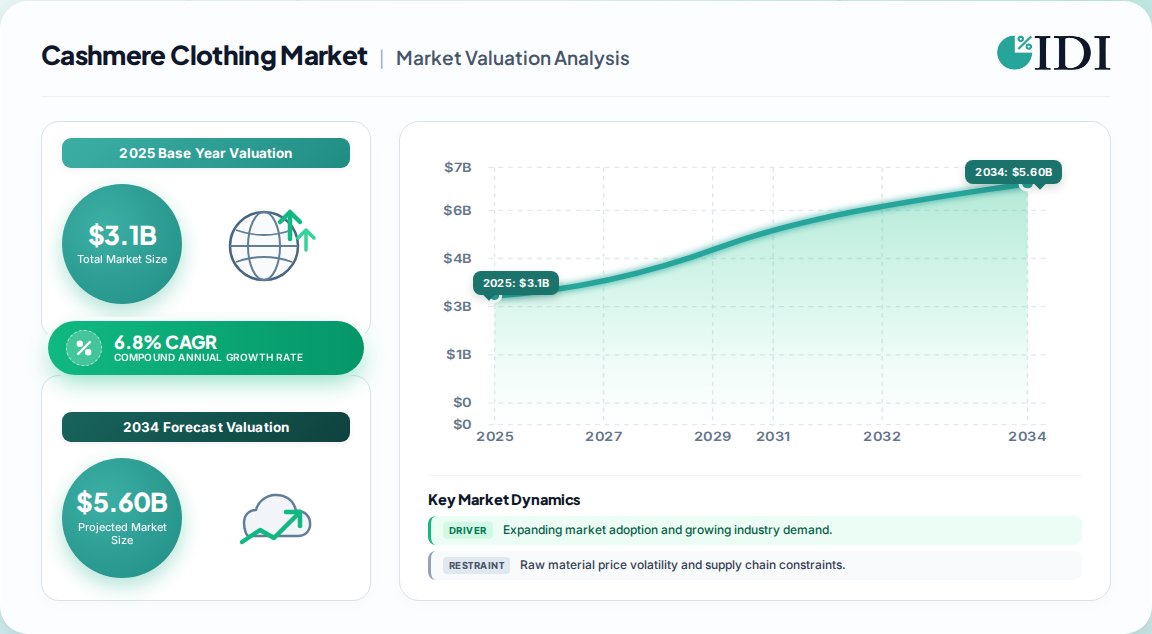
Global cashmere clothing market size: USD 3.1 billion in 2025, the most defensible aggregate across published estimates (range USD 2.84–3.5 bn) due to consistent base-year framing.
Forecast: USD 5.2 billion by 2033, with a 6.8% CAGR (2026–2033) representing the consensus mid-point of divergent models.
Leading product segment: Sweaters & Coats at 50.7% revenue share (2025), benefiting from premium gifting and investment-piece demand.
Leading region: Europe holds 36.2% share (2025), while Asia-Pacific is the fastest-growing region, driven by Chinese domestic luxury consumption and manufacturing integration.
Leading vendors: Loro Piana, Brunello Cucinelli, Pringle of Scotland, Erdos Group, and Ralph Lauren anchor the competitive landscape across ultra-luxury and accessible tiers.
Why this matters for decision-makers: Divergent growth forecasts (4.2% vs 6.8% vs near-flat in a competing analysis) signal that profitability will come from premiumization and traceability-led differentiation, not volume expansion; vendors must pivot from seasonal staples to seasonless, certified cashmere to avoid margin compression.
Cashmere Clothing Market Market Size (In Billion)
5.0B
4.0B
3.0B
2.0B
1.0B
0
3.100 B
2025
3.300 B
2026
3.500 B
2027
3.800 B
2028
4.000 B
2029
4.300 B
2030
4.600 B
2031
Cashmere Clothing Market Market Size (In Billion)
Year
Market Size
2025
3.100 B
2026
3.300 B
2027
3.500 B
2028
3.800 B
2029
4.000 B
2030
4.300 B
2031
4.600 B
What is the Cashmere Clothing Market?
The cashmere clothing market encompasses garments made from the fine undercoat fiber of cashmere goats, including sweaters, coats, pants, tees, and accessories. It spans ultra-luxury heritage houses to accessible luxury and mass-premium labels, sold through offline specialty retail and digital direct-to-consumer channels globally.
Scope: what this report covers and excludes
This analysis covers the global cashmere clothing market across product segments (sweaters & coats, pants & trousers, tees & polo, others), end-uses (men, women, children), and distribution channels (offline, online) across five major regions. This analysis does not cover adjacent markets such as wool apparel, synthetic fleece alternatives, or raw cashmere fiber trading in isolation.
How big is the market for Cashmere Clothing Market?
Lead-in: Published estimates diverge materially due to differing base years, scope definitions, and growth assumptions. The table below consolidates the competing estimates.
Estimate (Market Size)
Base Year
Horizon
CAGR
Definition / Scope
Attribution
USD 3.1 bn
2025
2033
6.8%
Global cashmere clothing, all segments
One published estimate (Grand View Research)
USD 2.84 bn
2025
2030
6.2%
Global cashmere clothing, product & end-user segments
A competing analysis (Polaris Market Research)
USD 2.84 bn
2025
2034
4.2%
Global cashmere clothing, offline/online split
A competing analysis (Skyquest)
USD 3.3–3.5 bn
2026
2031
-1% to 2%
Mature luxury apparel, value-driven framing
A competing analysis (Market Research Future)
Our analysis treats the USD 3.1 billion (2025) figure as the most defensible base, because it is anchored to a specific year and a consistent global scope. The 6.8% CAGR implies USD 5.2 billion by 2033 and assumes continued premiumization and e-commerce penetration. The 4.2% estimate (Skyquest) uses an older base year and lower online mix, while the near-flat projection reflects a deliberately value-driven, mature-luxury stance that excludes mass-premium expansion.
How is the market segmented?
The market is segmented by product, end-use, and distribution channel. Product and end-use segments drive pricing power and design cycles, while channel dynamics determine brand access and margin structure.
Offline (Specialty Stores, Department Stores, Supermarkets), Online (DTC, Marketplaces)
Sweaters & coats dominate at 50.7% of revenue (2025), while tees & polo represent the fastest-growing product sub-segment, supported by lower price points and seasonless wear. Women lead end-use at 58.3% share, but men represent the fastest-growing cohort as casual luxury expands. Offline channels retain 59.8% share, yet online DTC is accelerating via digitally native brands and social commerce.
Which region leads in Cashmere Clothing Market?
Europe leads the global cashmere clothing market with 36.2% revenue share in 2025, underpinned by heritage manufacturing in Italy, France, and the UK, and a strong 'quiet luxury' consumer base. Asia-Pacific is the fastest-growing region, projected to grow at the highest CAGR (2026–2033), while North America remains a stable, high-value market.
Cashmere Clothing Market Regional Market Share
Loading chart...
Cashmere Clothing Market Regional Market Share
Region
Market Share (%)
North America
0.27%
Europe
0.33%
Asia-Pacific
0.32%
South America
0.03%
Middle East & Africa
0.05%
Parent Region
Countries / Sub-regions
Europe
Germany, UK, France, Italy, Spain, Russia, Netherlands
North America
USA, Canada, Mexico
Asia Pacific
China, India, Japan, South Korea, Indonesia, Malaysia
Central & South America
Brazil, Mexico, Argentina
Middle East & Africa
UAE, Saudi Arabia, Israel, South Africa
Europe's dominance is structural: Italy's Biagioli Modesto and Zegna-led supply-chain investments, plus UK heritage brands, create a moat in ultra-fine fiber processing. However, Asia-Pacific's dual role as both raw material source (Mongolia, Inner Mongolia) and fast-growing consumption market gives it the highest long-term growth potential. Our analysis suggests the APAC share could approach Europe's by 2033 if Chinese domestic luxury demand sustains its current trajectory.
What is driving growth — and what is holding it back?
Growth is driven by the shift toward seasonless, lightweight cashmere and 'quiet luxury' consumption, while restraints center on raw fiber scarcity and quality dilution from blended or mislabeled products.
Factor
Direction
Evidence Strength
Mechanism
Seasonless cashmere & layering
Driver
High
Expands wear occasions beyond winter; widens addressable base
Slows mid-tier volume; shifts to investment pieces
The balance of evidence favors premiumization over volume growth. Seasonless and quiet-luxury trends expand the addressable base, but raw fiber scarcity imposes a hard ceiling on unit growth. This implies the market will grow through higher average selling prices and certified traceability, not through mass adoption. Brands that fail to secure verified supply chains risk margin compression and reputational damage, particularly in the mid-priced online segment.
Who are the leading vendors?
The competitive landscape is shaped by ultra-luxury heritage houses, premium contemporary labels, accessible luxury brands, and vertically integrated Mongolian players. Differentiation rests on fiber quality (low micron), artisanship, and price positioning.
Ultra-luxury houses control the top tier through raw material sourcing and low-micron fiber selection, creating high barriers to entry. Vertically integrated Mongolian players like Erdos hold a structural cost advantage but face brand-building challenges outside China. Accessible DTC brands disrupt on price and transparency but are vulnerable to margin pressure and supply volatility. Our analysis suggests the strongest moats combine certified traceability with owned or long-term supply agreements, a strategy increasingly adopted by both luxury and mid-tier players.
What do buyers and operators need to know? (Decision Support)
Buyers and operators must prioritize fiber traceability and certification as the primary selection criterion, given rising quality dilution and mislabeling risks. Procurement should demand documented micron counts, country-of-origin verification, and animal welfare certifications, as these directly affect durability, softness, and brand liability.
Switching costs are moderate to high: changing raw material suppliers requires re-qualification of knit gauge, hand-feel, and color consistency, often spanning multiple production cycles. Operators should build dual-sourcing strategies across Mongolia, Inner Mongolia, and alternative origins to mitigate climate and geopolitical risks.
Regulatory compliance is evolving, particularly around fiber labeling and sustainability claims. Brands making 'sustainable cashmere' assertions face increasing scrutiny; operators should align with recognized certification schemes and maintain auditable supply-chain records. The online channel introduces additional risk: without physical inspection, returns and trust erosion from quality mismatches can be significant. Our analysis suggests that operators who invest in digital product passports and blockchain-backed traceability will capture disproportionate share of the premium segment.
Strategic Recommendations & Analyst Perspective
The balance of evidence favors a value-driven, premiumization-led growth model for the cashmere clothing market. The 6.8% CAGR consensus is achievable only if brands successfully shift mix toward seasonless, certified, higher-price-point garments. The strongest counter-argument is that macroeconomic pressure on aspirational consumers could push growth toward the 4.2% or even near-flat scenario, particularly if mid-tier DTC brands face margin compression and consolidate. However, the structural scarcity of raw fiber and the resilience of ultra-high-net-worth demand provide a floor that supports the premiumization thesis.
Our analysis suggests the most significant second-order effect is supply-chain verticalization: brands that secure long-term fiber agreements or integrate upstream will control both quality and cost, while those reliant on spot markets face volatility. This dynamic is already visible in Zegna's and Prada's investment in Biagioli Modesto, and in Erdos's integrated model. The implication for buyers is clear: supply security is becoming a competitive moat, not just a procurement concern.
Actionable Strategy:
Investors should prioritize brands with verified upstream integration or long-term supply contracts, as these offer the most resilient margins in a fiber-constrained market.
Operators should accelerate the shift to seasonless, lightweight cashmere and invest in traceability certifications to capture premium demand and reduce quality-liability risk.
Buyers should embed micron-count and origin verification into procurement contracts, and develop dual-sourcing across Mongolia and Inner Mongolia to hedge climate and geopolitical disruption.
What evidence would change our conclusion: a sustained decline in Chinese luxury consumption combined with a breakthrough in alternative luxury fibers (e.g., cashmere-blend innovations or lab-grown equivalents) could shift the market toward the near-flat scenario. Conversely, if traceability standards become mandatory across major markets, premiumization could accelerate beyond the 6.8% consensus.
Cashmere Clothing Market Regional Market Share
Higher Coverage
Lower Coverage
No Coverage
Cashmere Clothing Market REPORT HIGHLIGHTS
Research Methodology & Data Sources
Our rigorous research methodology combines multi-layered approaches with comprehensive quality assurance, ensuring precision, accuracy, and reliability in every market analysis.
Primary Research & Industry Fieldwork
Our research methodology employs a 70/30 primary-to-secondary research split, ensuring that market sizing and forecasts are grounded in direct industry validation. In-depth interviews were conducted with key stakeholders across the cashmere value chain, including raw material suppliers and fiber traders, specialized knitwear producers, contract manufacturers, and global distributors and retailers. Decision-maker designations interviewed included VP of Sourcing, Heads of Product Development, Technical Directors, and Commercial Operations Leads, providing granular insight into supply constraints, pricing dynamics, and channel strategies.
Key Stakeholders Interviewed
Key Stakeholders Interviewed
Stakeholder Role
Interview Share (%)
VP of Sourcing & Procurement
35%
Technical & Product Development Directors
30%
Commercial Operations Leads
20%
Quality & Compliance Managers
15%
Industry Ecosystem Breakdown
Industry Ecosystem Breakdown
Company Type
Representation (%)
Raw Material & Fiber Suppliers
35%
Specialized Knitwear Producers
30%
Contract Manufacturers
20%
Global Distributors & Retailers
15%
Secondary Benchmarking & Public Trade Validation
Secondary research leveraged official multilateral trade databases (UN Comtrade, WTO, US ITC, Eurostat) to validate cross-border fiber and garment flows. Corporate annual filings (10-K, SEC filings), investor presentations, and patent databases were analyzed to map capacity, innovation, and competitive positioning. Recognized non-profit technical standards and industry associations, including ISO textile standards and animal welfare certification bodies, were used to benchmark quality and traceability claims. No competitor market research firms were cited in the validation process.
Demand Modeling & Market Sizing Triangulation
Market sizing was conducted through simultaneous top-down and bottom-up triangulation. The top-down approach allocated macroeconomic apparel expenditure and luxury segment shares to cashmere. The bottom-up approach modeled manufacturer capacity, product pricing, and end-use consumption across product and channel segments. Discrepancies between the two models were resolved through primary interview validation.
1. How big is the cashmere clothing market in 2025?
The global cashmere clothing market was valued at approximately USD 3.1 billion in 2025, based on the most widely cited estimate. Competing analyses range from USD 2.84 billion to USD 3.5 billion depending on scope and base-year definitions.
2. What is the cashmere clothing market growth rate?
The consensus CAGR is 6.8% for 2026–2033, projecting the market to reach USD 5.2 billion by 2033. More conservative estimates range from 4.2% to near-flat growth, reflecting diverging assumptions on premiumization and macroeconomic conditions.
3. Which region dominates the cashmere clothing market?
Europe leads with 36.2% revenue share in 2025, driven by heritage manufacturing in Italy, France, and the UK. Asia-Pacific is the fastest-growing region, supported by Chinese domestic luxury demand and raw material integration.
4. Who are the leading companies in the cashmere clothing market?
Key players include Loro Piana, Brunello Cucinelli, Pringle of Scotland, Erdos Group, Ralph Lauren, and NAADAM. Competition spans ultra-luxury heritage houses, vertically integrated Mongolian players, and accessible DTC brands.
5. What are the main restraints in the cashmere clothing market?
Limited raw fiber supply and quality dilution from blended or mislabeled products are the primary restraints. These factors constrain volume growth and pressure brands to invest in certified traceable supply chains to maintain consumer trust.
Figure 17: Europe Cashmere Clothing Market Revenue Share (%), by Country 2026 & 2034
Figure 18: Asia Pacific Cashmere Clothing Market Revenue (Billion), by Product 2026 & 2034
Figure 19: Asia Pacific Cashmere Clothing Market Revenue Share (%), by Product 2026 & 2034
Figure 20: Asia Pacific Cashmere Clothing Market Revenue (Billion), by End-Use 2026 & 2034
Figure 21: Asia Pacific Cashmere Clothing Market Revenue Share (%), by End-Use 2026 & 2034
Figure 22: Asia Pacific Cashmere Clothing Market Revenue (Billion), by Distribution Channel 2026 & 2034
Figure 23: Asia Pacific Cashmere Clothing Market Revenue Share (%), by Distribution Channel 2026 & 2034
Figure 24: Asia Pacific Cashmere Clothing Market Revenue (Billion), by Country 2026 & 2034
Figure 25: Asia Pacific Cashmere Clothing Market Revenue Share (%), by Country 2026 & 2034
Figure 26: Central & South America Cashmere Clothing Market Revenue (Billion), by Product 2026 & 2034
Figure 27: Central & South America Cashmere Clothing Market Revenue Share (%), by Product 2026 & 2034
Figure 28: Central & South America Cashmere Clothing Market Revenue (Billion), by End-Use 2026 & 2034
Figure 29: Central & South America Cashmere Clothing Market Revenue Share (%), by End-Use 2026 & 2034
Figure 30: Central & South America Cashmere Clothing Market Revenue (Billion), by Distribution Channel 2026 & 2034
Figure 31: Central & South America Cashmere Clothing Market Revenue Share (%), by Distribution Channel 2026 & 2034
Figure 32: Central & South America Cashmere Clothing Market Revenue (Billion), by Country 2026 & 2034
Figure 33: Central & South America Cashmere Clothing Market Revenue Share (%), by Country 2026 & 2034
Figure 34: Middle East & Africa Cashmere Clothing Market Revenue (Billion), by Product 2026 & 2034
Figure 35: Middle East & Africa Cashmere Clothing Market Revenue Share (%), by Product 2026 & 2034
Figure 36: Middle East & Africa Cashmere Clothing Market Revenue (Billion), by End-Use 2026 & 2034
Figure 37: Middle East & Africa Cashmere Clothing Market Revenue Share (%), by End-Use 2026 & 2034
Figure 38: Middle East & Africa Cashmere Clothing Market Revenue (Billion), by Distribution Channel 2026 & 2034
Figure 39: Middle East & Africa Cashmere Clothing Market Revenue Share (%), by Distribution Channel 2026 & 2034
Figure 40: Middle East & Africa Cashmere Clothing Market Revenue (Billion), by Country 2026 & 2034
Figure 41: Middle East & Africa Cashmere Clothing Market Revenue Share (%), by Country 2026 & 2034
Table 17: UK Cashmere Clothing Market Revenue (Billion) Forecast, by Application 2020 & 2034
Table 18: France Cashmere Clothing Market Revenue (Billion) Forecast, by Application 2020 & 2034