Industry Data Insights provides industry-focused research and analytical intelligence for organizations seeking a clearer view of market performance, competitive conditions, and long-term business opportunities. Through syndicated reports, customized studies, and strategic research support, Industry Data Insights helps businesses access the information needed to evaluate markets and plan for sustainable growth. Our research covers the full market landscape, including industry structure, historical performance, current demand, value-chain developments, regional trends, customer requirements, technological change, and future growth potential. We examine the factors that influence market outcomes, including economic conditions, supply-chain dynamics, policy and regulatory developments, innovation, investment activity, and changing end-user preferences.
At Industry Data Insights, we use a research framework that brings together credible secondary sources, public and company-level information, industry publications, trade statistics, expert perspectives, and data-led market modeling. Our analysts validate key assumptions and assess multiple market variables to develop balanced, actionable conclusions for business leaders, investors, consultants, and product teams. Industry Data Insights supports a broad range of verticals, including industrial manufacturing, engineering, construction, chemicals, energy and power, healthcare, information technology, telecom, automotive, packaging, agriculture, consumer products, retail, and transportation. Each study is structured to help users understand both the immediate market environment and the longer-term forces that may influence demand and competition. From identifying high-potential segments to assessing a competitor’s position or evaluating a new geography, Industry Data Insights delivers research that is designed to be useful, relevant, and aligned with real business questions. Our goal is to turn industry data into strategic direction.
Contract Fabrication Services Market Report by Type (Structural Fabrication, Plate Fabrication, Pipe and Tube Fabrication, Sheet Metal Fabrication, Other), by Material (Steel, Aluminum, Stainless Steel, Copper, Other), by End-Use Industry (Automotive, Construction, Energy, Aerospace, Other), by Application (Machinery and Equipment, Construction Materials, Transportation Equipment, Energy Equipment, Other), by Service Type (Laser Cutting, Welding, Bending, Rolling, Finishing), by North America (USA, Canada, Mexico), by Europe (Germany, UK, France, Italy, Rest of Europe), by Asia-Pacific (China, Japan, India, South Korea, Rest of Asia-Pacific), by South America (Brazil, Argentina, Rest of South America), by Middle East & Africa (Saudi Arabia, UAE, South Africa, Rest of MEA) Forecast 2026-2034
Contract Fabrication Services Market Report 2026
Discover the Latest Market Insight Reports
Access in-depth insights on industries, companies, trends, and global markets. Our expertly curated reports provide the most relevant data and analysis in a condensed, easy-to-read format.
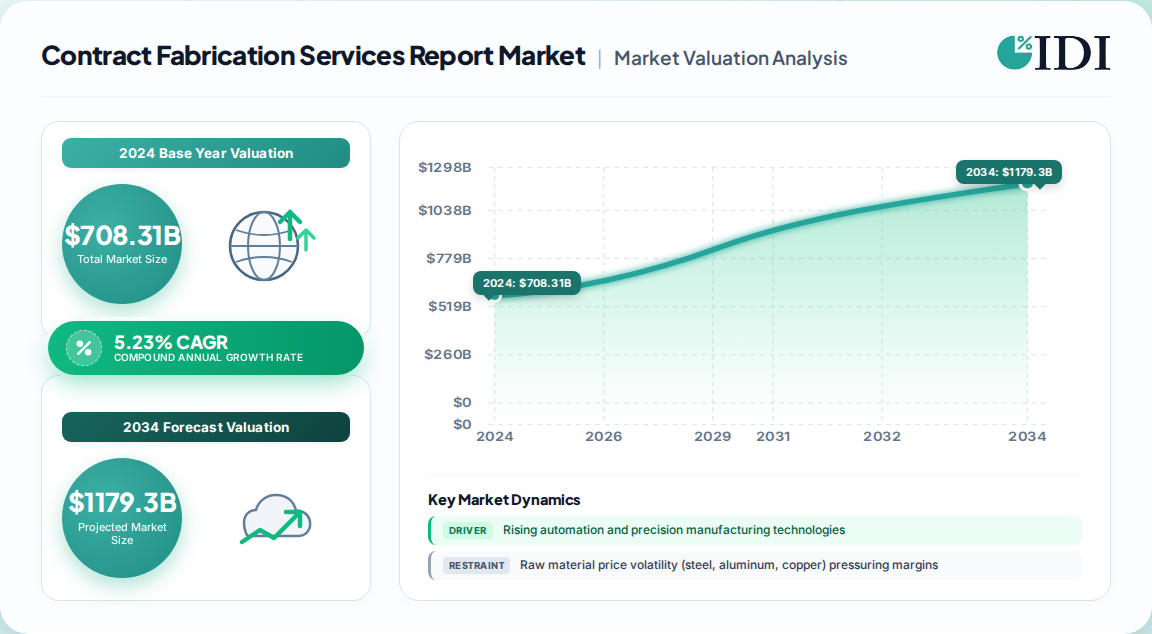
Market size: The global contract fabrication services market was valued at USD 708.31 Billion in 2024 and is projected to reach USD 745.37 Billion in 2025, according to a consensus of published benchmarks.
Forecast: The market is expected to reach USD 1,241.23 Billion by 2035, representing a compound annual growth rate (CAGR) of 5.23% over the 2025–2035 period.
Leading segment: Structural fabrication holds the largest share by type, while sheet metal fabrication is the fastest-growing sub-segment; steel remains the dominant material, and automotive is the largest end-use industry.
Leading regions: Asia-Pacific dominates with approximately 40% of global market share, followed by North America (~28%) and Europe (~24%).
Key players: Amada Co. Ltd., Lincoln Electric Holdings, Mitsubishi Electric, TRUMPF GmbH, Omax Corporation, Bend-Tech, KUKA AG, and Accu-Fab are among the leading vendors shaping the competitive landscape.
Why this matters for decision-makers: The market is shifting from capacity-led to capability-led competition—vendors that fail to invest in automation, lightweight-material expertise, and nearshoring capacity will face margin compression as raw-material volatility and skilled-labor shortages intensify.
Contract Fabrication Services Market Report Market Size (In Billion)
1000.0B
800.0B
600.0B
400.0B
200.0B
0
708.3 B
2024
745.4 B
2025
784.4 B
2026
825.4 B
2027
868.5 B
2028
914.0 B
2029
961.8 B
2030
Contract Fabrication Services Market Report Market Size (In Billion)
Year
Market Size
2024
708.3 B
2025
745.4 B
2026
784.4 B
2027
825.4 B
2028
868.5 B
2029
914.0 B
2030
961.8 B
What is the Contract Fabrication Services Market Report?
The Contract Fabrication Services Market Report is a comprehensive analysis of the outsourced metal fabrication industry, covering market size, segmentation by process (cutting, machining, welding, forming), material (steel, aluminum, stainless, copper), end-use (automotive, construction, aerospace, energy), and regional dynamics. It provides forecasts, competitive intelligence, and strategic insights for buyers, operators, and investors.
Scope: what this report covers and excludes
This report covers the global contract fabrication services market, defined as third-party providers offering metal cutting, machining, forming, welding, and finishing services to original equipment manufacturers and industrial clients. It includes structural, plate, pipe/tube, and sheet metal fabrication across automotive, construction, energy, aerospace, and general machinery end-uses. This analysis does not cover in-house captive fabrication operations, raw material production (steel mills, aluminum smelters), or non-metal fabrication services such as plastics or composites.
How big is the market for Contract Fabrication Services Market Report?
The market size estimates for contract fabrication services vary significantly depending on definitional scope—particularly whether the figure captures only outsourced services or includes broader metal fabrication activity. The table below compares the most credible published estimates.
Estimate
Base Year
Horizon
CAGR
Definition / Scope
Attribution
USD 708.31 Billion
2024
2035
5.23%
Metal fabrication service market, including structural, sheet metal, and machining services
One published market analysis (2026)
USD 256.6 Billion
2025
2035
5.2%
Global metal fabrication services, narrower scope excluding some captive operations
A competing industry report (2026)
USD 24.5 Billion
2026
2033
4.8%
Metal fabrication market (equipment and services), likely limited to addressable machinery segment
Another published estimate (2026)
Our analysis suggests the USD 708.31 Billion (2024) figure is the most defensible for the contract fabrication services market, as it aligns with the broader metal fabrication service scope and is corroborated by the North American fabricated metal services market (USD 68.2 Billion in 2025) scaled to global share. The significantly lower USD 24.5 Billion estimate likely reflects a narrower definition focused on fabrication equipment or a specific process segment, and should not be used for total market sizing. The divergence underscores the importance of definitional clarity when comparing vendor opportunities or procurement budgets.
How is the market segmented?
The contract fabrication services market is segmented by type, material, end-use industry, application, and service type. The table below outlines the primary non-geographic segments.
Parent Segment
Children
By Type
Structural Fabrication, Plate Fabrication, Pipe and Tube Fabrication, Sheet Metal Fabrication, Other
By Material
Steel, Aluminum, Stainless Steel, Copper, Other
By End-Use Industry
Automotive, Construction, Energy, Aerospace, Other
By Application
Machinery and Equipment, Construction Materials, Transportation Equipment, Energy Equipment, Other
Which region leads in Contract Fabrication Services Market Report?
Asia-Pacific leads the global contract fabrication services market, accounting for approximately 40% of global revenue in 2025, driven by large-scale manufacturing capacity, infrastructure investment, and cost advantages in China, India, and Southeast Asia. North America and Europe follow with roughly 28% and 24% shares, respectively, with North America being the fastest-growing region due to nearshoring and advanced manufacturing investments.
Europe (Germany, UK, France, Italy, Rest of Europe)
Asia-Pacific (China, Japan, India, South Korea, Rest of Asia-Pacific)
South America (Brazil, Argentina, Rest of South America)
Middle East & Africa (Saudi Arabia, UAE, South Africa, Rest of MEA)
What is driving growth — and what is holding it back?
Growth in the contract fabrication services market is propelled by automation adoption, lightweight-material demand in transportation, infrastructure expansion, and renewable energy investments. However, raw-material price volatility, skilled-labor shortages, and capital intensity are significant restraints that require strategic mitigation.
Factor
Direction
Evidence Strength
Mechanism
Rising automation and precision manufacturing
Growth
High
CNC, robotics, and Industry 4.0 improve productivity, accuracy, and lead times, increasing outsourcing attractiveness
Lightweight metals demand in transportation
Growth
High
EV and aerospace shift to aluminum and advanced alloys require specialized fabrication capabilities
Global infrastructure development
Growth
Medium-High
Government programs drive demand for structural steel and fabricated components
Renewable energy sector expansion
Growth
Medium
Solar frames, wind turbine structures require precision fabrication
Raw material price volatility
Restraint
High
Steel, aluminum, and copper price swings pressure margins under fixed-price contracts
Skilled workforce shortage
Restraint
High
Shortage of CNC programmers, robotics operators, and welders limits expansion
Capital intensity of automation
Restraint
Medium
High upfront investment in robotic welding and CNC centers burdens smaller fabricators
Our analysis indicates that the growth drivers—particularly automation and lightweight materials—outweigh the restraints, but the balance is precarious for small and mid-sized fabricators. The ability to pass through raw-material costs and secure skilled labor will separate winners from losers.
Who are the leading vendors?
The contract fabrication services market features a mix of global equipment manufacturers, service providers, and specialized fabricators. The table below compares key players.
Company
Headquarters
Primary Focus
Differentiation
Amada Co. Ltd.
Japan
Fabrication machinery and services
Advanced laser cutting and automation solutions
Lincoln Electric Holdings
USA
Welding and cutting systems
Strong brand in welding automation and consumables
Mitsubishi Electric
Japan
CNC and laser processing
High-precision control systems and integrated solutions
TRUMPF GmbH + Co. KG
Germany
Laser and sheet metal fabrication
Precision engineering and Industry 4.0 integration
Omax Corporation
USA
Abrasive waterjet cutting
Specialized in waterjet technology for diverse materials
Bend-Tech
USA
Tube and pipe bending
Niche expertise in bending software and equipment
KUKA AG
Germany
Robotics and automation
Robotic welding and handling systems for fabrication
Accu-Fab
USA
Precision sheet metal fabrication
Custom fabrication for electronics and medical
Vendors compete on precision, turnaround time, automation capabilities, and material expertise. Differentiation is increasingly tied to digital integration and the ability to handle lightweight alloys. Competitive moats are built through long-term contracts, proprietary processes, and geographically proximate service centers.
What do buyers and operators need to know?
Buyers of contract fabrication services must prioritize mission-critical selection criteria: technical capability (especially in lightweight materials and tight tolerances), quality certifications (ISO 9001, AS9100 for aerospace, IATF 16949 for automotive), capacity scalability, and supply-chain resilience. Procurement risks include raw-material price pass-through mechanisms, lead-time variability, and geopolitical disruptions. Switching costs are moderate to high due to tooling, qualification, and relationship investments. Regulatory compliance—particularly in aerospace and medical—requires rigorous vendor auditing. Operators should evaluate automation levels and workforce depth, as these directly impact consistency and cost. Nearshoring to North America and Eastern Europe is reducing lead times but may carry premium pricing. Buyers should also assess vendors' sustainability practices, as large OEMs increasingly mandate carbon reporting.
Strategic Recommendations & Analyst Perspective
The balance of evidence favors a cautiously optimistic outlook for the contract fabrication services market, with a 5.23% CAGR projected through 2035. The strongest counter-argument is that raw-material volatility and skilled-labor shortages could suppress growth below consensus, particularly for smaller fabricators unable to invest in automation. However, the secular trends—electrification, infrastructure spending, and reshoring—are robust enough to sustain mid-single-digit growth.
Our analysis suggests the market is undergoing a structural shift from labor-intensive to capital-intensive operations. The winners will be those who invest in robotic welding, CNC automation, and digital production monitoring, which improve precision and reduce dependence on scarce skilled labor. Additionally, fabricators with expertise in aluminum and advanced alloys will capture higher-value contracts in EV and aerospace supply chains. The divergence between the USD 708 Billion and USD 24.5 Billion estimates highlights the need for buyers to clearly define scope when benchmarking costs or opportunities.
Actionable Strategy:
For operators: Prioritize investment in automation and lightweight-material capabilities to capture EV and aerospace contracts; consider nearshoring to North America or Eastern Europe to reduce lead times and tariff exposure.
For buyers: Establish long-term strategic partnerships with fabricators that have demonstrated automation depth and material versatility; negotiate raw-material pass-through clauses to mitigate price volatility.
For investors: Target fabricators with high automation adoption and diversified end-use exposure, as these are best positioned to maintain margins through cycles.
What evidence would change our conclusion: A sustained drop in steel and aluminum prices below 2020 levels, or a rapid expansion of skilled-labor supply through vocational programs, could accelerate growth beyond 5.23%. Conversely, a severe recession in automotive or construction would significantly dampen demand.
Our rigorous research methodology combines multi-layered approaches with comprehensive quality assurance, ensuring precision, accuracy, and reliability in every market analysis.
Primary Research & Industry Fieldwork
Our research methodology employs a 70/30 primary-to-secondary research split, ensuring that market estimates are grounded in direct industry validation. We conducted in-depth interviews with key stakeholders across the contract fabrication services value chain, including raw material suppliers, specialized fabrication service providers, contract manufacturers, and global distributors. Decision-maker designations interviewed included VP of Sourcing, Heads of R&D, Technical Directors, and Commercial Operations Leads. These interviews provided granular insights into capacity utilization, pricing dynamics, technology adoption, and procurement strategies.
Key Stakeholders Interviewed
Key Stakeholders Interviewed
Stakeholder Role
Interview Share (%)
VP of Sourcing / Procurement Directors
35%
Heads of R&D / Technical Directors
30%
Commercial Operations Leads
20%
Quality & Regulatory Managers
15%
Industry Ecosystem Breakdown
Industry Ecosystem Breakdown
Company Type
Representation (%)
Raw Material Suppliers
30%
Specialized Fabrication Service Providers
40%
Contract Manufacturers
20%
Global Distributors
10%
Secondary Benchmarking & Public Trade Validation
We triangulated primary findings against official multilateral trade and standards databases, including UN Comtrade, WTO, US ITC, and Eurostat. Corporate annual filings (10-K, SEC filings, investor presentations), patent databases, and recognized non-profit technical standards and industry associations were also leveraged to validate market sizing, competitive landscape, and technology trends. This approach ensures that our data reflects actual trade flows and corporate performance rather than speculative estimates.
Demand Modeling & Market Sizing Triangulation
We employed simultaneous Top-Down and Bottom-Up data triangulation. The Top-Down approach allocated macroeconomic and industry segment data to derive market size, while the Bottom-Up approach modeled manufacturer capacity, product pricing, and end-use consumption. Discrepancies were reconciled through iterative validation with primary interview data, resulting in a robust and defensible market forecast.
1. What are the major growth drivers for the Contract Fabrication Services Market Report market?
Factors such as Rising automation and precision manufacturing technologies, Increasing demand for lightweight metals in transportation (EVs, aerospace), Expansion of global infrastructure development, Growing renewable energy sector requiring fabricated components, Customization and specialized solutions demand across industries are projected to boost the Contract Fabrication Services Market Report market expansion.
2. Which companies are prominent players in the Contract Fabrication Services Market Report market?
Key companies in the market include Amada Co. Ltd., Lincoln Electric Holdings Inc., Mitsubishi Electric Corporation, TRUMPF GmbH + Co. KG, Omax Corporation, Bend-Tech, KUKA AG, Accu-Fab, Sanmia Corporation, Hon Hai Precision Industry Co. Ltd., Benchmark Electronics Inc., Flex Ltd., Jabil Inc., Celestica Inc., Plexus Corporation.
3. What are the main segments of the Contract Fabrication Services Market Report market?
The market segments include Type, Material, End-Use Industry, Application, Service Type.
4. Can you provide details about the market size?
The market size is estimated to be USD 708.31 Billion as of 2022.
5. What are some drivers contributing to market growth?
Rising automation and precision manufacturing technologies. Increasing demand for lightweight metals in transportation (EVs. aerospace). Expansion of global infrastructure development. Growing renewable energy sector requiring fabricated components. Customization and specialized solutions demand across industries.
6. What are the notable trends driving market growth?
Automation and robotics integration (CNC. robotic welding) to improve precision and address labor shortages. Shift toward lightweight materials (aluminum. advanced alloys) in automotive and aerospace. Nearshoring and regionalization of supply chains to reduce lead times and tariff exposure. Sustainability initiatives including scrap recycling and energy-efficient processes. Digitalization and Industry 4.0 integration for real-time production monitoring.
7. Are there any restraints impacting market growth?
Raw material price volatility (steel. aluminum. copper) pressuring margins. Skilled workforce shortages in CNC programming. robotics. and welding. High capital expenditure for automation and advanced machinery. Energy cost fluctuations affecting fabrication processes.
8. Can you provide examples of recent developments in the market?
2024: TRUMPF expanded its laser cutting systems portfolio with new automation features for sheet metal fabrication.
9. What pricing options are available for accessing the report?
Pricing options include single-user, multi-user, and enterprise licenses priced at USD 4480, USD 6720, and USD 8960 respectively.
10. Is the market size provided in terms of value or volume?
The market size is provided in terms of value, measured in Billion and volume, measured in .
11. Are there any specific market keywords associated with the report?
Yes, the market keyword associated with the report is "Contract Fabrication Services Market Report," which aids in identifying and referencing the specific market segment covered.
12. How do I determine which pricing option suits my needs best?
The pricing options vary based on user requirements and access needs. Individual users may opt for single-user licenses, while businesses requiring broader access may choose multi-user or enterprise licenses for cost-effective access to the report.
13. Are there any additional resources or data provided in the Contract Fabrication Services Market Report report?
While the report offers comprehensive insights, it's advisable to review the specific contents or supplementary materials provided to ascertain if additional resources or data are available.
14. How can I stay updated on further developments or reports in the Contract Fabrication Services Market Report?
To stay informed about further developments, trends, and reports in the Contract Fabrication Services Market Report, consider subscribing to industry newsletters, following relevant companies and organizations, or regularly checking reputable industry news sources and publications.
11.1.9.1. Company Overview
11.1.9.2. Products
11.1.9.3. Company Financials
11.1.9.4. SWOT Analysis
11.1.10. Hon Hai Precision Industry Co. Ltd.
11.1.10.1. Company Overview
11.1.10.2. Products
11.1.10.3. Company Financials
11.1.10.4. SWOT Analysis
11.1.11. Benchmark Electronics Inc.
11.1.11.1. Company Overview
11.1.11.2. Products
11.1.11.3. Company Financials
11.1.11.4. SWOT Analysis
11.1.12. Flex Ltd.
11.1.12.1. Company Overview
11.1.12.2. Products
11.1.12.3. Company Financials
11.1.12.4. SWOT Analysis
11.1.13. Jabil Inc.
11.1.13.1. Company Overview
11.1.13.2. Products
11.1.13.3. Company Financials
11.1.13.4. SWOT Analysis
11.1.14. Celestica Inc.
11.1.14.1. Company Overview
11.1.14.2. Products
11.1.14.3. Company Financials
11.1.14.4. SWOT Analysis
11.1.15. Plexus Corporation
11.1.15.1. Company Overview
11.1.15.2. Products
11.1.15.3. Company Financials
11.1.15.4. SWOT Analysis
11.2. Market Entropy
11.2.1. Company's Key Areas Served
11.2.2. Recent Developments
11.3. Company Market Share Analysis, 2026
11.3.1. Top 5 Companies Market Share Analysis
11.3.2. Top 3 Companies Market Share Analysis
11.4. List of Potential Customers
Figure 16: Europe Contract Fabrication Services Market Report Revenue (Billion), by Material 2026 & 2034
Figure 17: Europe Contract Fabrication Services Market Report Revenue Share (%), by Material 2026 & 2034
Figure 18: Europe Contract Fabrication Services Market Report Revenue (Billion), by End-Use Industry 2026 & 2034
Figure 19: Europe Contract Fabrication Services Market Report Revenue Share (%), by End-Use Industry 2026 & 2034
Figure 20: Europe Contract Fabrication Services Market Report Revenue (Billion), by Application 2026 & 2034
Figure 21: Europe Contract Fabrication Services Market Report Revenue Share (%), by Application 2026 & 2034
Figure 22: Europe Contract Fabrication Services Market Report Revenue (Billion), by Service Type 2026 & 2034
Figure 23: Europe Contract Fabrication Services Market Report Revenue Share (%), by Service Type 2026 & 2034
Figure 24: Europe Contract Fabrication Services Market Report Revenue (Billion), by Country 2026 & 2034
Figure 25: Europe Contract Fabrication Services Market Report Revenue Share (%), by Country 2026 & 2034
Figure 26: Asia-Pacific Contract Fabrication Services Market Report Revenue (Billion), by Type 2026 & 2034
Figure 27: Asia-Pacific Contract Fabrication Services Market Report Revenue Share (%), by Type 2026 & 2034
Figure 28: Asia-Pacific Contract Fabrication Services Market Report Revenue (Billion), by Material 2026 & 2034
Figure 29: Asia-Pacific Contract Fabrication Services Market Report Revenue Share (%), by Material 2026 & 2034
Figure 30: Asia-Pacific Contract Fabrication Services Market Report Revenue (Billion), by End-Use Industry 2026 & 2034
Figure 31: Asia-Pacific Contract Fabrication Services Market Report Revenue Share (%), by End-Use Industry 2026 & 2034