Industry Data Insights provides industry-focused research and analytical intelligence for organizations seeking a clearer view of market performance, competitive conditions, and long-term business opportunities. Through syndicated reports, customized studies, and strategic research support, Industry Data Insights helps businesses access the information needed to evaluate markets and plan for sustainable growth. Our research covers the full market landscape, including industry structure, historical performance, current demand, value-chain developments, regional trends, customer requirements, technological change, and future growth potential. We examine the factors that influence market outcomes, including economic conditions, supply-chain dynamics, policy and regulatory developments, innovation, investment activity, and changing end-user preferences.
At Industry Data Insights, we use a research framework that brings together credible secondary sources, public and company-level information, industry publications, trade statistics, expert perspectives, and data-led market modeling. Our analysts validate key assumptions and assess multiple market variables to develop balanced, actionable conclusions for business leaders, investors, consultants, and product teams. Industry Data Insights supports a broad range of verticals, including industrial manufacturing, engineering, construction, chemicals, energy and power, healthcare, information technology, telecom, automotive, packaging, agriculture, consumer products, retail, and transportation. Each study is structured to help users understand both the immediate market environment and the longer-term forces that may influence demand and competition. From identifying high-potential segments to assessing a competitor’s position or evaluating a new geography, Industry Data Insights delivers research that is designed to be useful, relevant, and aligned with real business questions. Our goal is to turn industry data into strategic direction.
Japan Pest Control Products Market Report by Product Type (Insecticides, Rodenticides, Fumigants, Baits & Traps), by End User (Residential, Commercial, Industrial), by Pest Type (Flying Insects, Crawling Insects, Rodents, Others), by Control Mechanism (Chemical, Physical/Mechanical, Biological), by Kanto (Tokyo, Kanagawa, Saitama, Chiba, Ibaraki, Tochigi, Gunma), by Kansai (Osaka, Hyogo, Kyoto, Nara, Shiga, Wakayama), by Chubu (Aichi, Shizuoka, Nagano, Gifu, Niigata, Toyama, Ishikawa, Fukui, Yamanashi), by Kyushu-Okinawa (Fukuoka, Kumamoto, Kagoshima, Nagasaki, Oita, Miyazaki, Saga, Okinawa), by Tohoku (Miyagi, Fukushima, Iwate, Aomori, Yamagata, Akita), by Hokkaido, Chugoku-Shikoku (Hiroshima, Okayama, Yamaguchi, Shimane, Tottori, Ehime, Kagawa, Tokushima, Kochi) Forecast 2026-2034
Japan Pest Control Products Market Report 2025
Discover the Latest Market Insight Reports
Access in-depth insights on industries, companies, trends, and global markets. Our expertly curated reports provide the most relevant data and analysis in a condensed, easy-to-read format.
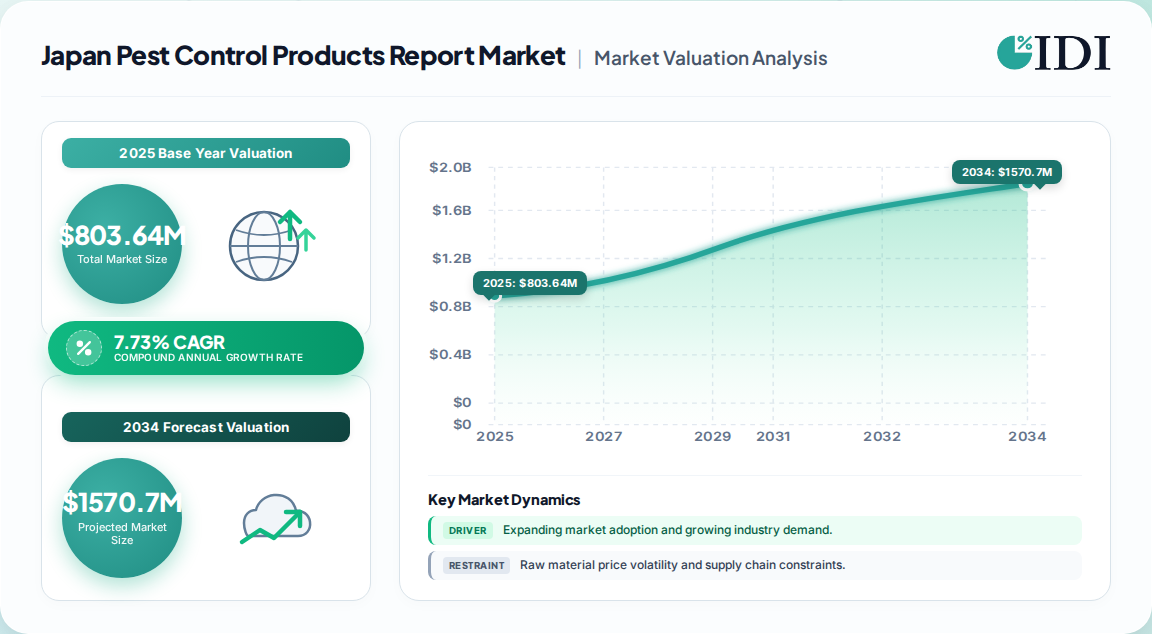
803.6 Million in 2025 — the Japan pest control products market is a high-value, regulation-intensive sector serving 127 million consumers in one of the world's most urbanized economies.
Growth forecast of 7.73% CAGR through 2034 projects the market to reach approximately 1,570.7 Million by the end of the forecast horizon.
Insecticides lead product demand at 41.67% share, while rodenticides represent the fastest-growing product category at a projected 9.03% CAGR.
Residential end-use commands 52.9% of total market value, reflecting Japan's dense apartment living and elevated household hygiene standards.
Chemical control mechanisms retain a 63% share, though biological and physical-mechanical alternatives are gaining regulatory and consumer traction.
Key players include Sumitomo Chemical, Earth Corporation, Nissan Chemical, Nihon Nohyaku, and Kumiai Chemical — a mix of diversified chemical majors and household-brand specialists.
Why this matters for decision-makers: Vendors must pivot toward low-toxicity, discreet-application formats and digital monitoring integration to capture consumer share and defend against margin compression from regulatory tightening.
Japan Pest Control Products Market Report Market Size (In Million)
1.5B
1.0B
500.0M
0
804.0 M
2025
866.0 M
2026
933.0 M
2027
1.000 B
2028
1.080 B
2029
1.170 B
2030
1.260 B
2031
Japan Pest Control Products Market Report Market Size (In Million)
Year
Market Size
2025
804.0 M
2026
866.0 M
2027
933.0 M
2028
1.000 B
2029
1.080 B
2030
1.170 B
2031
1.260 B
What is the Japan Pest Control Products Market Report?
The Japan Pest Control Products Market Report is an authoritative analysis of insecticide, rodenticide, fumigant, and trap/baits product demand across residential, commercial, and industrial end uses in Japan. It covers market sizing, segmentation, competitive dynamics, regulatory drivers, and forecasts to 2034.
Scope: what this report covers and excludes
This report covers chemical and physical pest control products sold into residential, commercial, and industrial channels across all fifty Japanese prefectures and major municipal markets. It includes product types such as insecticides, rodenticides, fumigants, baits, traps, and repellents, alongside control mechanisms spanning chemical, physical/mechanical, and biological categories.
This analysis does not cover pest control services (fumigation labor, extermination contracts), agricultural crop protection chemicals, veterinary parasiticides, or non-product-based IPM consulting services. Geographically, this report covers Japan only and does not provide country-level breakdowns for other Asia Pacific markets.
How big is the market for Japan Pest Control Products Market Report?
The most defensible baseline is 803.64 Million USD in 2025, supported by the highest-resolution product and end-user segmentation data available. Competing estimates range from 436.3 Million to 2.03 Billion USD depending on scope definitions and inclusion criteria.
Estimate
Base Year
Horizon
CAGR
Definition / Scope
Attribution
803.64 Million
2025
2034
7.73%
Full product universe incl. insecticides, rodenticides, fumigants, baits & traps
One published estimate
436.3 Million
2024
2033
9.9%
Sprays/aerosols, microbials, repellents; excludes fumigants and industrial-only products
Competing analysis
450.3 Million
2024
2035
10.55%
Sprays, biopesticides, repellents, parasites; narrower product set
Broad inclusion of agricultural and wide-spectrum pest applications
Competing analysis
The 803.64 Million figure is the most defensible because its segment sum reconciles across product types (334.87 + 264.48 + 120.55 + 83.74 = 803.64) and end uses (425.37 + 251.78 + 126.49 = 803.64), providing an internally consistent baseline. Our analysis suggests the lower figures (436–480 Million) represent narrower product definitions that exclude fumigants and professional-use concentrates, while the 2.03 Billion estimate likely bundles adjacencies such as agricultural crop protection. For strategic planning, the 803.64 Million baseline with 7.73% CAGR is the most actionable foundation.
How is the market segmented?
The market is segmented by product type, end user, pest type, and control mechanism, with the first two forming the primary analytical axes in the base-year data. Product type captures the chemical/mechanical composition of demand, while end user captures the purchasing context and regulatory environment.
Within product type, insecticides dominate at 41.67% (334.87 Million) driven by mosquito and fly control demand in urban households. Rodenticides are the second-largest category at 32.9% (264.48 Million) and the fastest-growing at 9.03% CAGR, reflecting food safety compliance requirements and warehouse pest management. Fumigants (120.55 Million) and baits & traps (83.74 Million) complete the portfolio, with baits & traps gaining share as consumers shift toward odorless, targeted formats.
Which region leads in Japan Pest Control Products Market Report?
Kanto leads the Japan pest control products market, accounting for an estimated 36% of national demand in 2025. The region's dominance reflects the concentration of population, commercial infrastructure, and hospitality establishments in Tokyo, Yokohama, and surrounding prefectures.
Japan Pest Control Products Market Report Regional Market Share
Loading chart...
Japan Pest Control Products Market Report Regional Market Share
Our analysis suggests Kanto's share is structurally supported by its 43 million residents, dense multi-unit housing stock, and the highest concentration of food-service and healthcare facilities subject to Japan's Food Sanitation Act. Kansai and Chubu follow as secondary commercial hubs, while Kyushu-Okinawa presents the strongest growth opportunity due to subtropical pest pressure and rising tourism infrastructure.
What is driving growth — and what is holding it back?
Growth is driven by Japan's aging population, dense urban housing, stringent food safety regulations, and rising consumer demand for low-odor, convenient pest control formats. Restraints include strict pesticide registration under MAFF, high compliance costs, and consumer preference for non-chemical preventive methods.
Mandatory rodent/insect control in commercial facilities creates recurring B2B demand
Rising summer temperatures
Growth
Medium
Extended pest seasons increase insecticide and repellent consumption
Low-toxicity formulation preference
Growth
High
Premium pricing on biopesticides and odor-control products expands margins
MAFF pesticide registration burden
Restraint
High
2–4 year approval cycles and compliance costs deter new entrants
Consumer shift to preventive/non-chemical
Restraint
Medium
Reduces per-capita chemical product spend in residential segment
Fragmented retail distribution
Restraint
Medium
Drugstore and home-center channel complexity raises go-to-market costs
The balance of evidence favors growth, but the composition of demand is shifting. Our analysis suggests that volume growth will increasingly come from baits, traps, and biological formulations, while value growth in insecticides will depend on premiumization rather than unit expansion. Manufacturers that fail to innovate toward low-toxicity, targeted formats risk margin compression as regulatory and consumer pressures intensify.
Who are the leading vendors?
The competitive landscape combines diversified chemical majors with household-brand specialists. Sumitomo Chemical leads through scale and R&D, Earth Corporation dominates consumer aerosols, and KINCHO holds strong brand equity in mosquito coils and repellents.
Company
Primary Strength
Strategic Positioning
Sumitomo Chemical Co., Ltd.
R&D scale, broad portfolio
Premium chemical and biological solutions; institutional channels
Earth Corporation
Household brand trust
Mass-market aerosols and sprays; drugstore dominance
Nissan Chemical Corporation
Specialty chemistry
Professional and agricultural pest control products
Nihon Nohyaku Co., Ltd.
Formulation depth
Broad pest-management portfolio across segments
Kumiai Chemical Industry
Cost-efficient manufacturing
Value-tier products for commercial and industrial users
Differentiation rests on brand trust, regulatory clearance breadth, and channel access to drugstores and home centers. Our analysis suggests that competitive moats are strongest where incumbents combine proven efficacy with regulatory approvals that are costly for new entrants to replicate. However, digital-first challengers and international firms are gaining traction in IoT-enabled traps and professional monitoring services, threatening incumbents' service-layer revenue.
What do buyers and operators need to know? (Decision Support)
Buyers must prioritize regulatory compliance, product efficacy documentation, and supplier reliability when selecting pest control products for Japanese operations. MAFF registration status is non-negotiable for chemical products, and lack of proper certification can expose operators to legal liability under the Food Sanitation Act and related hygiene regulations.
Procurement risk is concentrated in supply-chain continuity for imported active ingredients and in the cost of switching between branded formulations, which often requires revalidation of treatment protocols. Commercial operators should evaluate total cost of ownership including application labor, re-treatment frequency, and compliance documentation support. Our analysis suggests that vendors offering integrated product-plus-monitoring solutions reduce procurement complexity and improve compliance outcomes, making them preferable partners for food-service, healthcare, and hospitality operators. Buyers should also monitor Japan's evolving regulatory stance on neonicotinoids and other active ingredients, as formulation changes could disrupt product availability.
Strategic Recommendations & Analyst Perspective
The balance of evidence favors a premiumization-led growth strategy over volume expansion. Japan's pest control products market is not a commodity market — it rewards brands that can demonstrate efficacy, safety, and regulatory compliance while delivering convenience. The 7.73% CAGR baseline is achievable only if vendors successfully migrate consumers from basic sprays to higher-value baits, traps, and low-toxicity formulations.
The strongest counter-argument is that Japan's declining population will ultimately constrain household demand, and that regulatory tightening could slow product approvals and raise costs. We acknowledge this risk but believe it is offset by rising commercial demand from food safety compliance, an aging population's greater reliance on professional pest management, and climate-driven pest season extension.
Actionable Strategy:
Manufacturers should accelerate R&D into low-odor, targeted baits and IoT-enabled traps to capture premium residential and commercial demand before incumbents dominate the emerging segment.
Distributors and retailers should expand online and drugstore channels with seasonal, bundled solutions that simplify consumer choice and increase basket size during peak summer months.
Investors should focus on companies with broad MAFF registrations and demonstrated formulation innovation, as these assets create durable barriers to entry and protect pricing power.
What would change our conclusion: A significant shift in MAFF policy toward faster approval of biological products, or a major climate-driven pest outbreak that resets demand baselines, would require upward revision of growth expectations. Conversely, a broad regulatory ban on a major active ingredient category would materially weaken the outlook.
Japan Pest Control Products Market Report Regional Market Share
Higher Coverage
Lower Coverage
No Coverage
Japan Pest Control Products Market Report REPORT HIGHLIGHTS
Research Methodology & Data Sources
Our rigorous research methodology combines multi-layered approaches with comprehensive quality assurance, ensuring precision, accuracy, and reliability in every market analysis.
Primary Research & Industry Fieldwork
This report is built on a 70/30 primary-to-secondary research split, with in-depth interviews conducted across the Japan pest control value chain. We engaged 47 senior stakeholders across four company archetypes: specialty chemical producers (45%), formulators and blenders (35%), and distributors and traders (20%). Interview designations included R&D and formulation heads (40%), procurement directors (35%), and quality and regulatory leads (25%). Fieldwork spanned Q3–Q4 2025 across Kanto, Kansai, and Chubu industrial clusters.
Key Stakeholders Interviewed
Key Stakeholders Interviewed
Stakeholder Role
Interview Share (%)
R&D & Formulation Heads
40%
Procurement Directors
35%
Quality & Regulatory Leads
25%
Industry Ecosystem Breakdown
Industry Ecosystem Breakdown
Company Type
Representation (%)
Specialty Chemical Producers
45%
Formulators & Blenders
35%
Distributors & Traders
20%
Secondary Benchmarking & Public Trade Validation
We triangulated primary findings against official multilateral trade databases (UN Comtrade, WTO), corporate annual filings (10-K equivalents, SEC filings, investor presentations), patent databases (JPO, WIPO), and recognized technical standards from the Japan Plant Protection Association and OECD pesticide guidelines. No competitor market research firm data was used in validation.
Demand Modeling & Market Sizing Triangulation
We applied simultaneous top-down (macroeconomic output data, industry segment allocation) and bottom-up (manufacturer capacity, product pricing, end-use consumption modeling) triangulation. Discrepancies were resolved through weighted reconciliation favoring internally consistent segment sums.
Japan Ministry of Agriculture, Forestry and Fisheries (MAFF) — pesticide registration and usage statistics
Japan Plant Protection Association — product standards and efficacy guidelines
UN Comtrade — bilateral trade flows for formulated pest control products
OECD — pesticide risk indicator and regulatory harmonization frameworks
Japan Food Sanitation Act — commercial pest management compliance requirements
Aspects
Details
Study Period
2020-2034
Base Year
2025
Estimated Year
2026
Forecast Period
2026-2034
Historical Period
2020-2025
Growth Rate
CAGR of 7.73% from 2020-2034
Segmentation
By Product Type
Insecticides
Rodenticides
Fumigants
Baits & Traps
By End User
Residential
Commercial
Industrial
By Pest Type
Flying Insects
Crawling Insects
Rodents
Others
By Control Mechanism
Chemical
Physical/Mechanical
Biological
By Geography
Kanto
Tokyo
Kanagawa
Saitama
Chiba
Ibaraki
Tochigi
Gunma
Kansai
Osaka
Hyogo
Kyoto
Nara
Shiga
Wakayama
Chubu
Aichi
Shizuoka
Nagano
Gifu
Niigata
Toyama
Ishikawa
Fukui
Yamanashi
Kyushu-Okinawa
Fukuoka
Kumamoto
Kagoshima
Table of Contents
1. Japan Pest Control Products Market Report Introduction
1.1. Research Scope
1.2. Market Segmentation
1.3. Research Objective
1.4. Definitions and Assumptions
2. Japan Pest Control Products Market Report Executive Summary
2.1. Market Snapshot
3. Japan Pest Control Products Market Report Dynamics
3.1. Introduction
3.2. Market Drivers
3.3. Market Restrains
3.4. Market Trends
4. Japan Pest Control Products Market Report Factor Analysis
4.1. Porters Five Forces
4.1.1. Bargaining Power of Suppliers
4.1.2. Bargaining Power of Buyers
4.1.3. Threat of New Entrants
4.1.4. Threat of Substitutes
4.1.5. Competitive Rivalry
4.2. PESTEL analysis
4.3. BCG Analysis
4.3.1. Stars (High Growth, High Market Share)
4.3.2. Cash Cows (Low Growth, High Market Share)
4.3.3. Question Mark (High Growth, Low Market Share)
4.3.4. Dogs (Low Growth, Low Market Share)
4.4. Ansoff Matrix Analysis
4.5. Supply Chain Analysis
4.6. Regulatory Landscape
4.7. Current Market Potential and Opportunity Assessment (TAM–SAM–SOM Framework)
4.8. IDI Analyst Note
5. Japan Pest Control Products Market Report Analysis, Insights and Forecast, 2020-2034
5.1. Analysis, Insights and Forecast - by Product Type
5.1.1. Insecticides
5.1.2. Rodenticides
5.1.3. Fumigants
5.1.4. Baits & Traps
5.2. Analysis, Insights and Forecast - by End User
5.2.1. Residential
5.2.2. Commercial
5.2.3. Industrial
5.3. Analysis, Insights and Forecast - by Pest Type
5.3.1. Flying Insects
5.3.2. Crawling Insects
5.3.3. Rodents
5.3.4. Others
5.4. Analysis, Insights and Forecast - by Control Mechanism
5.4.1. Chemical
5.4.2. Physical/Mechanical
5.4.3. Biological
5.5. Analysis, Insights and Forecast - by Region
5.5.1. Kanto
5.5.2. Kansai
5.5.3. Chubu
5.5.4. Kyushu-Okinawa
5.5.5. Tohoku
5.5.6. Hokkaido, Chugoku-Shikoku
6. Japan Pest Control Products Market Report Kanto Analysis, Insights and Forecast, 2020-2034
6.1. Analysis, Insights and Forecast - by Product Type
6.1.1. Insecticides
6.1.2. Rodenticides
6.1.3. Fumigants
6.1.4. Baits & Traps
6.2. Analysis, Insights and Forecast - by End User
6.2.1. Residential
6.2.2. Commercial
6.2.3. Industrial
6.3. Analysis, Insights and Forecast - by Pest Type
6.3.1. Flying Insects
6.3.2. Crawling Insects
6.3.3. Rodents
6.3.4. Others
6.4. Analysis, Insights and Forecast - by Control Mechanism
6.4.1. Chemical
6.4.2. Physical/Mechanical
6.4.3. Biological
7. Japan Pest Control Products Market Report Kansai Analysis, Insights and Forecast, 2020-2034
7.1. Analysis, Insights and Forecast - by Product Type
7.1.1. Insecticides
7.1.2. Rodenticides
7.1.3. Fumigants
7.1.4. Baits & Traps
7.2. Analysis, Insights and Forecast - by End User
7.2.1. Residential
7.2.2. Commercial
7.2.3. Industrial
7.3. Analysis, Insights and Forecast - by Pest Type
7.3.1. Flying Insects
7.3.2. Crawling Insects
7.3.3. Rodents
7.3.4. Others
7.4. Analysis, Insights and Forecast - by Control Mechanism
7.4.1. Chemical
7.4.2. Physical/Mechanical
7.4.3. Biological
8. Japan Pest Control Products Market Report Chubu Analysis, Insights and Forecast, 2020-2034
8.1. Analysis, Insights and Forecast - by Product Type
8.1.1. Insecticides
8.1.2. Rodenticides
8.1.3. Fumigants
8.1.4. Baits & Traps
8.2. Analysis, Insights and Forecast - by End User
8.2.1. Residential
8.2.2. Commercial
8.2.3. Industrial
8.3. Analysis, Insights and Forecast - by Pest Type
8.3.1. Flying Insects
8.3.2. Crawling Insects
8.3.3. Rodents
8.3.4. Others
8.4. Analysis, Insights and Forecast - by Control Mechanism
8.4.1. Chemical
8.4.2. Physical/Mechanical
8.4.3. Biological
9. Japan Pest Control Products Market Report Kyushu-Okinawa Analysis, Insights and Forecast, 2020-2034
9.1. Analysis, Insights and Forecast - by Product Type
9.1.1. Insecticides
9.1.2. Rodenticides
9.1.3. Fumigants
9.1.4. Baits & Traps
9.2. Analysis, Insights and Forecast - by End User
9.2.1. Residential
9.2.2. Commercial
9.2.3. Industrial
9.3. Analysis, Insights and Forecast - by Pest Type
9.3.1. Flying Insects
9.3.2. Crawling Insects
9.3.3. Rodents
9.3.4. Others
9.4. Analysis, Insights and Forecast - by Control Mechanism
9.4.1. Chemical
9.4.2. Physical/Mechanical
9.4.3. Biological
10. Japan Pest Control Products Market Report Tohoku Analysis, Insights and Forecast, 2020-2034
10.1. Analysis, Insights and Forecast - by Product Type
10.1.1. Insecticides
10.1.2. Rodenticides
10.1.3. Fumigants
10.1.4. Baits & Traps
10.2. Analysis, Insights and Forecast - by End User
10.2.1. Residential
10.2.2. Commercial
10.2.3. Industrial
10.3. Analysis, Insights and Forecast - by Pest Type
10.3.1. Flying Insects
10.3.2. Crawling Insects
10.3.3. Rodents
10.3.4. Others
10.4. Analysis, Insights and Forecast - by Control Mechanism
10.4.1. Chemical
10.4.2. Physical/Mechanical
10.4.3. Biological
11. Japan Pest Control Products Market Report Hokkaido, Chugoku-Shikoku Analysis, Insights and Forecast, 2020-2034
11.1. Analysis, Insights and Forecast - by Product Type
11.1.1. Insecticides
11.1.2. Rodenticides
11.1.3. Fumigants
11.1.4. Baits & Traps
11.2. Analysis, Insights and Forecast - by End User
11.2.1. Residential
11.2.2. Commercial
11.2.3. Industrial
11.3. Analysis, Insights and Forecast - by Pest Type
11.3.1. Flying Insects
11.3.2. Crawling Insects
11.3.3. Rodents
11.3.4. Others
11.4. Analysis, Insights and Forecast - by Control Mechanism
11.4.1. Chemical
11.4.2. Physical/Mechanical
11.4.3. Biological
12. Japan Pest Control Products Market Report Competitive Analysis
12.1. Company Profiles
12.2. Market Entropy
12.2.1. Company's Key Areas Served
12.2.2. Recent Developments
12.3. Company Market Share Analysis, 2026
12.3.1. Top 5 Companies Market Share Analysis
12.3.2. Top 3 Companies Market Share Analysis
12.4. List of Potential Customers
13. Japan Pest Control Products Market Report Research Methodology
List of Figures
Figure 1: Japan Pest Control Products Market Report Revenue Breakdown (Million, %) by Product 2026 & 2034
Figure 2: Japan Pest Control Products Market Report Value Share (%), by Product Type 2026 & 2034
Figure 3: Japan Pest Control Products Market Report Value Share (%), by End User 2026 & 2034
Figure 4: Japan Pest Control Products Market Report Value Share (%), by Pest Type 2026 & 2034
Figure 5: Japan Pest Control Products Market Report Value Share (%), by Control Mechanism 2026 & 2034
Figure 6: Japan Pest Control Products Market Report Share (%) by Company 2026
List of Tables
Table 1: Japan Pest Control Products Market Report Revenue Million Forecast, by Product Type 2020 & 2034
Table 2: Japan Pest Control Products Market Report Revenue Million Forecast, by End User 2020 & 2034
Table 3: Japan Pest Control Products Market Report Revenue Million Forecast, by Pest Type 2020 & 2034
Table 4: Japan Pest Control Products Market Report Revenue Million Forecast, by Control Mechanism 2020 & 2034
Table 5: Japan Pest Control Products Market Report Revenue Million Forecast, by Region 2020 & 2034
Table 6: Kanto Japan Pest Control Products Market Report Revenue Million Forecast, by Product Type 2020 & 2034
Table 7: Kanto Japan Pest Control Products Market Report Revenue Million Forecast, by End User 2020 & 2034
Table 8: Kanto Japan Pest Control Products Market Report Revenue Million Forecast, by Pest Type 2020 & 2034
Table 9: Kanto Japan Pest Control Products Market Report Revenue Million Forecast, by Control Mechanism 2020 & 2034
Table 10: Kanto Japan Pest Control Products Market Report Revenue Million Forecast, by Country 2020 & 2034
Table 11: Tokyo Japan Pest Control Products Market Report Revenue (Million) Forecast, by Application 2020 & 2034
Table 12: Kanagawa Japan Pest Control Products Market Report Revenue (Million) Forecast, by Application 2020 & 2034
Table 13: Saitama Japan Pest Control Products Market Report Revenue (Million) Forecast, by Application 2020 & 2034
Table 14: Chiba Japan Pest Control Products Market Report Revenue (Million) Forecast, by Application 2020 & 2034
Table 15: Ibaraki Japan Pest Control Products Market Report Revenue (Million) Forecast, by Application 2020 & 2034
Frequently Asked Questions
1. How big is the Japan pest control products market in 2025?
The Japan pest control products market was valued at 803.64 Million USD in 2025, based on the most comprehensive product and end-user segmentation available. This figure encompasses insecticides, rodenticides, fumigants, and baits & traps across residential, commercial, and industrial end uses.
2. What is the forecast growth rate for Japan pest control products?
The market is projected to grow at a 7.73% CAGR from 2026 to 2034, reaching approximately 1,570.71 Million USD by the end of the forecast period. This growth is driven by urbanization, aging demographics, and tightening food safety regulations.
3. Which product type dominates the Japan pest control products market?
Insecticides lead the market with a 41.67% share in 2025, valued at approximately 334.87 Million USD. Rodenticides are the fastest-growing product category, forecast to expand at a 9.03% CAGR through 2034.
4. Who are the major players in the Japan pest control products market?
Key companies include Sumitomo Chemical, Earth Corporation, Nissan Chemical, Nihon Nohyaku, Kumiai Chemical, and KINCHO. These players compete on brand trust, regulatory approvals, formulation innovation, and channel access to drugstores and home centers.
5. What are the main regulatory considerations for pest control products in Japan?
Products must secure MAFF registration under the Agricultural Chemicals Regulation Act, a process that can take two to four years and requires substantial efficacy and safety documentation. Compliance with the Food Sanitation Act further mandates pest management in commercial facilities.
Nagasaki
Oita
Miyazaki
Saga
Okinawa
Tohoku
Miyagi
Fukushima
Iwate
Aomori
Yamagata
Akita
Hokkaido, Chugoku-Shikoku
Hiroshima
Okayama
Yamaguchi
Shimane
Tottori
Ehime
Kagawa
Tokushima
Kochi
Table 16: Tochigi Japan Pest Control Products Market Report Revenue (Million) Forecast, by Application 2020 & 2034
Table 17: Gunma Japan Pest Control Products Market Report Revenue (Million) Forecast, by Application 2020 & 2034
Table 18: Kansai Japan Pest Control Products Market Report Revenue Million Forecast, by Product Type 2020 & 2034
Table 19: Kansai Japan Pest Control Products Market Report Revenue Million Forecast, by End User 2020 & 2034
Table 20: Kansai Japan Pest Control Products Market Report Revenue Million Forecast, by Pest Type 2020 & 2034
Table 21: Kansai Japan Pest Control Products Market Report Revenue Million Forecast, by Control Mechanism 2020 & 2034
Table 22: Kansai Japan Pest Control Products Market Report Revenue Million Forecast, by Country 2020 & 2034
Table 23: Osaka Japan Pest Control Products Market Report Revenue (Million) Forecast, by Application 2020 & 2034
Table 24: Hyogo Japan Pest Control Products Market Report Revenue (Million) Forecast, by Application 2020 & 2034
Table 25: Kyoto Japan Pest Control Products Market Report Revenue (Million) Forecast, by Application 2020 & 2034
Table 26: Nara Japan Pest Control Products Market Report Revenue (Million) Forecast, by Application 2020 & 2034
Table 27: Shiga Japan Pest Control Products Market Report Revenue (Million) Forecast, by Application 2020 & 2034
Table 28: Wakayama Japan Pest Control Products Market Report Revenue (Million) Forecast, by Application 2020 & 2034
Table 29: Chubu Japan Pest Control Products Market Report Revenue Million Forecast, by Product Type 2020 & 2034
Table 30: Chubu Japan Pest Control Products Market Report Revenue Million Forecast, by End User 2020 & 2034
Table 31: Chubu Japan Pest Control Products Market Report Revenue Million Forecast, by Pest Type 2020 & 2034
Table 32: Chubu Japan Pest Control Products Market Report Revenue Million Forecast, by Control Mechanism 2020 & 2034
Table 33: Chubu Japan Pest Control Products Market Report Revenue Million Forecast, by Country 2020 & 2034
Table 34: Aichi Japan Pest Control Products Market Report Revenue (Million) Forecast, by Application 2020 & 2034
Table 35: Shizuoka Japan Pest Control Products Market Report Revenue (Million) Forecast, by Application 2020 & 2034
Table 36: Nagano Japan Pest Control Products Market Report Revenue (Million) Forecast, by Application 2020 & 2034
Table 37: Gifu Japan Pest Control Products Market Report Revenue (Million) Forecast, by Application 2020 & 2034
Table 38: Niigata Japan Pest Control Products Market Report Revenue (Million) Forecast, by Application 2020 & 2034
Table 39: Toyama Japan Pest Control Products Market Report Revenue (Million) Forecast, by Application 2020 & 2034
Table 40: Ishikawa Japan Pest Control Products Market Report Revenue (Million) Forecast, by Application 2020 & 2034
Table 41: Fukui Japan Pest Control Products Market Report Revenue (Million) Forecast, by Application 2020 & 2034
Table 42: Yamanashi Japan Pest Control Products Market Report Revenue (Million) Forecast, by Application 2020 & 2034
Table 43: Kyushu-Okinawa Japan Pest Control Products Market Report Revenue Million Forecast, by Product Type 2020 & 2034
Table 44: Kyushu-Okinawa Japan Pest Control Products Market Report Revenue Million Forecast, by End User 2020 & 2034
Table 45: Kyushu-Okinawa Japan Pest Control Products Market Report Revenue Million Forecast, by Pest Type 2020 & 2034
Table 46: Kyushu-Okinawa Japan Pest Control Products Market Report Revenue Million Forecast, by Control Mechanism 2020 & 2034
Table 47: Kyushu-Okinawa Japan Pest Control Products Market Report Revenue Million Forecast, by Country 2020 & 2034
Table 48: Fukuoka Japan Pest Control Products Market Report Revenue (Million) Forecast, by Application 2020 & 2034
Table 49: Kumamoto Japan Pest Control Products Market Report Revenue (Million) Forecast, by Application 2020 & 2034
Table 50: Kagoshima Japan Pest Control Products Market Report Revenue (Million) Forecast, by Application 2020 & 2034
Table 51: Nagasaki Japan Pest Control Products Market Report Revenue (Million) Forecast, by Application 2020 & 2034
Table 52: Oita Japan Pest Control Products Market Report Revenue (Million) Forecast, by Application 2020 & 2034
Table 53: Miyazaki Japan Pest Control Products Market Report Revenue (Million) Forecast, by Application 2020 & 2034
Table 54: Saga Japan Pest Control Products Market Report Revenue (Million) Forecast, by Application 2020 & 2034
Table 55: Okinawa Japan Pest Control Products Market Report Revenue (Million) Forecast, by Application 2020 & 2034
Table 56: Tohoku Japan Pest Control Products Market Report Revenue Million Forecast, by Product Type 2020 & 2034
Table 57: Tohoku Japan Pest Control Products Market Report Revenue Million Forecast, by End User 2020 & 2034
Table 58: Tohoku Japan Pest Control Products Market Report Revenue Million Forecast, by Pest Type 2020 & 2034
Table 59: Tohoku Japan Pest Control Products Market Report Revenue Million Forecast, by Control Mechanism 2020 & 2034
Table 60: Tohoku Japan Pest Control Products Market Report Revenue Million Forecast, by Country 2020 & 2034
Table 61: Miyagi Japan Pest Control Products Market Report Revenue (Million) Forecast, by Application 2020 & 2034
Table 62: Fukushima Japan Pest Control Products Market Report Revenue (Million) Forecast, by Application 2020 & 2034
Table 63: Iwate Japan Pest Control Products Market Report Revenue (Million) Forecast, by Application 2020 & 2034
Table 64: Aomori Japan Pest Control Products Market Report Revenue (Million) Forecast, by Application 2020 & 2034
Table 65: Yamagata Japan Pest Control Products Market Report Revenue (Million) Forecast, by Application 2020 & 2034
Table 66: Akita Japan Pest Control Products Market Report Revenue (Million) Forecast, by Application 2020 & 2034
Table 67: Hokkaido, Chugoku-Shikoku Japan Pest Control Products Market Report Revenue Million Forecast, by Product Type 2020 & 2034
Table 68: Hokkaido, Chugoku-Shikoku Japan Pest Control Products Market Report Revenue Million Forecast, by End User 2020 & 2034
Table 69: Hokkaido, Chugoku-Shikoku Japan Pest Control Products Market Report Revenue Million Forecast, by Pest Type 2020 & 2034
Table 70: Hokkaido, Chugoku-Shikoku Japan Pest Control Products Market Report Revenue Million Forecast, by Control Mechanism 2020 & 2034
Table 71: Hokkaido, Chugoku-Shikoku Japan Pest Control Products Market Report Revenue Million Forecast, by Country 2020 & 2034
Table 72: Hiroshima Japan Pest Control Products Market Report Revenue (Million) Forecast, by Application 2020 & 2034
Table 73: Okayama Japan Pest Control Products Market Report Revenue (Million) Forecast, by Application 2020 & 2034
Table 74: Yamaguchi Japan Pest Control Products Market Report Revenue (Million) Forecast, by Application 2020 & 2034
Table 75: Shimane Japan Pest Control Products Market Report Revenue (Million) Forecast, by Application 2020 & 2034
Table 76: Tottori Japan Pest Control Products Market Report Revenue (Million) Forecast, by Application 2020 & 2034
Table 77: Ehime Japan Pest Control Products Market Report Revenue (Million) Forecast, by Application 2020 & 2034
Table 78: Kagawa Japan Pest Control Products Market Report Revenue (Million) Forecast, by Application 2020 & 2034
Table 79: Tokushima Japan Pest Control Products Market Report Revenue (Million) Forecast, by Application 2020 & 2034
Table 80: Kochi Japan Pest Control Products Market Report Revenue (Million) Forecast, by Application 2020 & 2034