Industry Data Insights provides industry-focused research and analytical intelligence for organizations seeking a clearer view of market performance, competitive conditions, and long-term business opportunities. Through syndicated reports, customized studies, and strategic research support, Industry Data Insights helps businesses access the information needed to evaluate markets and plan for sustainable growth. Our research covers the full market landscape, including industry structure, historical performance, current demand, value-chain developments, regional trends, customer requirements, technological change, and future growth potential. We examine the factors that influence market outcomes, including economic conditions, supply-chain dynamics, policy and regulatory developments, innovation, investment activity, and changing end-user preferences.
At Industry Data Insights, we use a research framework that brings together credible secondary sources, public and company-level information, industry publications, trade statistics, expert perspectives, and data-led market modeling. Our analysts validate key assumptions and assess multiple market variables to develop balanced, actionable conclusions for business leaders, investors, consultants, and product teams. Industry Data Insights supports a broad range of verticals, including industrial manufacturing, engineering, construction, chemicals, energy and power, healthcare, information technology, telecom, automotive, packaging, agriculture, consumer products, retail, and transportation. Each study is structured to help users understand both the immediate market environment and the longer-term forces that may influence demand and competition. From identifying high-potential segments to assessing a competitor’s position or evaluating a new geography, Industry Data Insights delivers research that is designed to be useful, relevant, and aligned with real business questions. Our goal is to turn industry data into strategic direction.
Ladies Wristwatch Market Report: Size, Share & 2033 Outlook
Ladies Wristwatch Market Report
Updated On
Nov 22 2026
Total Pages
274
Khageshwar Rongkali
Senior Analyst
Ladies Wristwatch Market Report: Size, Share & 2033 Outlook
Ladies Wristwatch Market Report by Type (Analog(Mechanical, Quartz), Digital), by Price Range (Economy, Mid-Range, Premium, Luxury, Ultra Luxury), by Distribution Channel (Offline(Specialty Stores, Department Stores, Boutiques), Online(E-commerce, DTC)), by Asia Pacific (China, Japan, India, South Korea, ASEAN), by Europe (France, Italy, UK, Germany, Switzerland, Spain), by North America (USA, Canada, Mexico), by Latin America (Brazil, Argentina, Chile), by Middle East & Africa (UAE, Saudi Arabia, South Africa) Forecast 2026-2034
Ladies Wristwatch Market Report: Size, Share & 2033 Outlook
Discover the Latest Market Insight Reports
Access in-depth insights on industries, companies, trends, and global markets. Our expertly curated reports provide the most relevant data and analysis in a condensed, easy-to-read format.
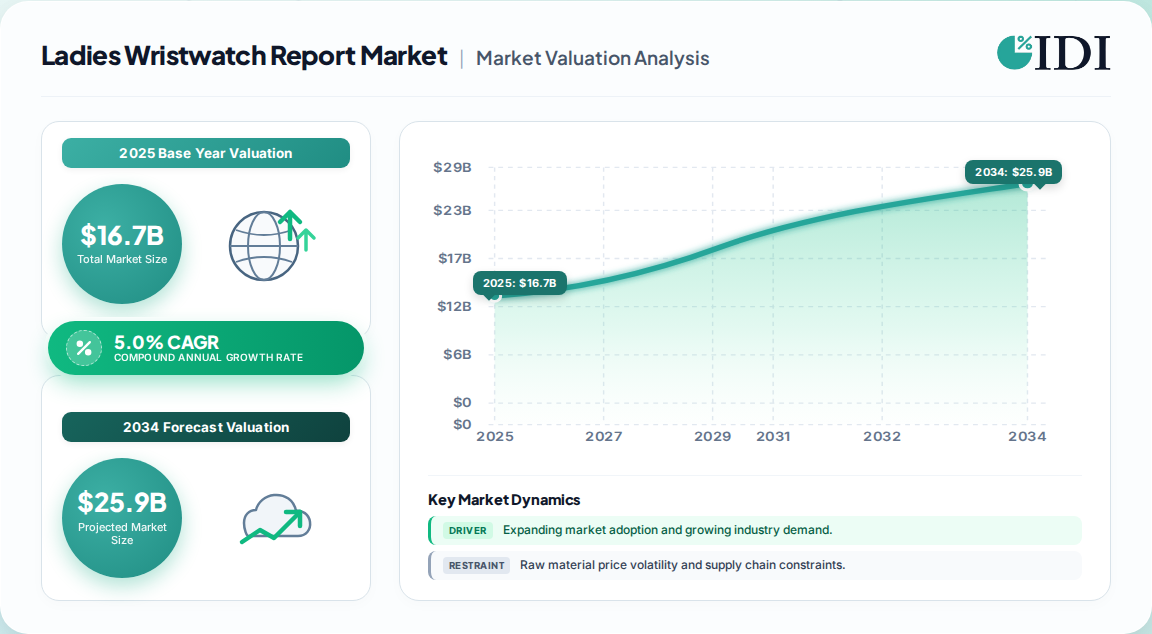
16.7 Billion in 2025: the global ladies wristwatch market, forecast to reach 24.5 Billion by 2033 at a 5.0% CAGR (2026–2033).
Asia Pacific leads with an estimated 49% revenue share in 2025, anchored by China as the single largest country market.
Analog dominates product mix at roughly 93% of 2025 revenue; the premium price tier is the largest value band at ~41%.
Offline retail still controls ~75% of sales, though online is the fastest-growing channel at promotional and DTC levels.
Key players include Cartier, Swatch Group brands, LVMH, Fossil, Michael Kors, Movado, Timex and Seiko.
Restraint to watch: smartwatch substitution continues to compress the mid-price analog tier, not luxury.
Why this matters for decision-makers: value is concentrating at the premium and luxury extremes; vendors that anchor in the contested mid-range face the steepest margin compression.
Ladies Wristwatch Market Report Market Size (In Billion)
25.0B
20.0B
15.0B
10.0B
5.0B
0
16.70 B
2025
17.50 B
2026
18.40 B
2027
19.30 B
2028
20.30 B
2029
21.30 B
2030
22.40 B
2031
Ladies Wristwatch Market Report Market Size (In Billion)
Year
Market Size
2025
16.70 B
2026
17.50 B
2027
18.40 B
2028
19.30 B
2029
20.30 B
2030
21.30 B
2031
22.40 B
What is the Ladies Wristwatch Market Report?
The ladies wristwatch market report quantifies and forecasts global demand for women's analog and digital timepieces across economy, mid-range, premium, luxury and ultra-luxury price bands, sold through offline and online channels. It sizes revenue by type, price tier, distribution channel and region through 2033, with competitive and demand-driver analysis.
Scope: what this report covers and excludes
The scope is global: women's analog and digital wristwatches across five price tiers and two distribution channels, with regional coverage spanning North America, Europe, Asia Pacific, Latin America and the Middle East & Africa. All revenue is retail-level unless stated.
This analysis does not cover men's and unisex segments as primary sizing objects, smartwatch operating-system ecosystems, pocket and fusee watches, watch components sold as spares, or pre-owned and auction-only trading platforms — each of which is a materially different demand curve.
How big is the market for Ladies Wristwatch Market Report?
The most defensible consensus figure is 16.7 Billion in 2025, rising to 24.5 Billion by 2033 at 5.0% CAGR — a mid-single-digit trajectory consistent with a mature accessories category absorbing smartwatch substitution at the mid-tier.
Estimate
Base year
Horizon
CAGR
Definition / scope
Attribution
16.7 Billion
2025
2033
5.0%
Global women's analog + digital wristwatches, retail value
One published estimate
15.9 Billion
2024
2033
5.0%
Same scope, prior base year
A competing analysis
2.63 Billion (U.S.)
2024
2035
6.24%
United States only, women's watches
A competing analysis
122–132 Billion
2025/2026
2032–2034
5.2–6.7%
Total watch market, all genders incl. smart
Third-party benchmarks
Our analysis treats the 16.7 Billion (2025) figure as the anchor because it is internally consistent with the 15.9 Billion (2024) prior estimate at the same 5.0% growth rate. The apparent gap is a base-year roll-forward, not a methodological conflict. The U.S. figure is not comparable in scale — it is a single-country cut, and its higher 6.24% CAGR implies the U.S. premium and luxury tiers are outgrowing the global average, which is plausible given U.S. discretionary spending patterns.
How is the market segmented?
Segmentation follows three orthogonal axes — movement type, price band and channel — each of which behaves as a distinct demand engine rather than a simple split of the same buyers.
So what: the analog dominance is a value statement, not a volume statement — quartz analog drives unit volume while mechanical analog drives price realization. A vendor optimizing for revenue share and a vendor optimizing for units will make opposite portfolio bets.
Which region leads in Ladies Wristwatch Market Report?
Asia Pacific is the leading region, holding an estimated 49% of 2025 global revenue, with China the single largest country market and India the fastest-scaling volume tier as aspirational premium demand widens.
Asia Pacific — China, Japan, India, South Korea, ASEAN-5
Europe — France, Italy, UK, Germany, Switzerland, Spain
North America — United States, Canada, Mexico
Latin America — Brazil, Argentina, Chile, Colombia
Middle East & Africa — UAE, Saudi Arabia, South Africa
Our analysis suggests the Asia Pacific lead is structurally different from a North American or European one. Roughly half of regional revenue is concentrated in a single country, which means a China slowdown moves the global headline number — Swiss export data already showing double-digit declines into China in 2025 reinforce that exposure. Europe and North America, by contrast, are diversified across many mid-sized markets and are far more resilient to any one country's cycle.
What is driving growth — and what is holding it back?
The primary driver is the repositioning of the ladies watch from a timekeeping instrument to a self-expression and gifting product, with rising female workforce participation and disposable income funding that substitution.
Factor
Direction
Evidence strength
Mechanism
Premium accessory demand
Growth
Strong
Watches priced as fashion and identity, not utility
Hybrid & connected designs
Growth
Moderate
Captures function-seeking buyers without abandoning analog look
Price-anchors the economy tier; deflates brand pricing power
Luxury cyclicality
Restraint
Strong
Premium SKUs sensitive to confidence and discretionary spend
The balance is asymmetric. Growth drivers work hardest at the premium and luxury extremes; restraints bite hardest in the mid-range. This implies a barbell structure — the value pool is splitting toward accessible entry price points and true luxury, leaving the 500–1,500 dollar band structurally squeezed. Operators building a portfolio for the next decade should not assume the mid-tier recovers.
Who are the leading vendors?
The competitive field splits into three archetypes: heritage luxury houses, branded fashion-accessory groups, and diversified timepiece manufacturers — each defending a different moat.
Vendor
Archetype
Primary moat
Price posture
Cartier (Richemont)
Heritage luxury
Design equity, jewellery adjacency
Luxury / ultra-luxury
Swatch Group brands
Diversified manufacturer
Movement vertical integration, brand ladder
Mid to premium
LVMH brands
Heritage luxury
Portfolio cross-sell, boutique network
Premium to ultra-luxury
Fossil Group
Fashion-accessory group
Licensed brand portfolio, channel reach
Economy to mid-range
Michael Kors
Fashion-accessory group
Fashion brand heat, licensing scale
Mid-range
Movado
Branded manufacturer
Design signature, department-store presence
Premium
Timex / Seiko
Volume manufacturer
Scale, distribution breadth, value engineering
Economy to mid-range
Our analysis suggests the durable moats are jewellery-adjacent design equity (Cartier) and vertical movement integration (Swatch), because both survive a smartwatch pricing attack. Licensed fashion brands hold real revenue but face the weakest long-run positioning: when the brand licence cycles out or fashion heat cools, there is little technical asset left to defend.
What do buyers and operators need to know?
Procurement and portfolio decisions in this category hinge on four non-obvious factors, and getting any of them wrong is expensive.
Brand-licence durability. A large share of mid-tier supply is licensed rather than owned. Buyers should diligence remaining licence term, renewal history and the licensor's exit economics before committing multi-year volume — a licence loss can strand an entire SKU line.
Channel conflict and grey market. With roughly three-quarters of value still offline, online discounting creates visible price divergence between boutiques and marketplaces. This erodes the premium positioning that justifies the entire price ladder.
Counterfeit and authentication exposure. Counterfeit availability is a measurable demand leak, particularly in European and cross-border e-commerce channels. Authentication partnerships and serialized traceability are becoming procurement prerequisites rather than differentiators.
Tariff and classification risk. Wristwatch imports are tariff-sensitive and classification-dependent (precious-metal case versus other). Operators planning cross-border sourcing should model duty scenarios explicitly rather than at portfolio average.
Sustainability claims liability. Recycled-metal and ethical-sourcing claims are increasingly audited. Unsubstantiated claims carry regulatory and reputational cost that outweighs the margin gained.
Strategic Recommendations & Analyst Perspective
The balance of evidence favors a barbell strategy over a mid-tier growth strategy. Demand is expanding at 5.0% in aggregate, but that aggregate conceals a structural split: premium-plus tiers are gaining value share while the mid-range absorbs both smartwatch substitution and discount-driven fashion competition. A portfolio built around the 500–1,500 dollar band is exposed to the worst of both.
The strongest counter-argument is that hybrid connected watches could re-legitimize the mid-tier by giving function-seeking buyers a reason to stay in an analog form factor. That is a genuine possibility, and Asia Pacific's scale could accelerate it. But the evidence so far is directional rather than conclusive — hybrid remains a minority of revenue, and the smartwatch players are moving faster on health features than traditional houses are on connectivity. Our view is that hybrid extends the mid-tier's life rather than reversing its share decline.
Actionable strategy:
Operators should concentrate capital in the ultra-luxury and accessible-premium poles, using mid-tier only as a customer-acquisition funnel into higher tiers.
Investors should weight Asia Pacific exposure but stress-test for single-country concentration risk, since roughly half of regional value sits in China.
Brands should treat online as a DTC and clienteling channel, not a discount channel, to avoid cannibalizing the offline price architecture that funds the category.
What would change our conclusion: sustained mid-tier volume recovery alongside hybrid penetration above 15% of women's units, or a rebound in Swiss exports into China that reverses the 2025 decline. Either would signal the mid-tier squeeze is cyclical rather than structural, and would justify a materially different portfolio posture.
Where the data ends: this overview establishes direction and scale, but precise sub-segment forecasting — ultra-luxury versus luxury splits, country-level channel economics, and licence-by-licence revenue attribution — requires the full report's model-level detail.
Our rigorous research methodology combines multi-layered approaches with comprehensive quality assurance, ensuring precision, accuracy, and reliability in every market analysis.
Primary Research & Industry Fieldwork
Our research program applies a 70/30 primary-to-secondary split, prioritizing direct verification of revenue, capacity and pricing data. We conducted structured in-depth interviews across the value chain with movement and component suppliers, finished-watch assemblers, licensed-brand operators, and global distributors and boutique retailers. Within these organizations we targeted decision-makers holding direct commercial accountability: VP-level Sourcing, Heads of Product Development, Commercial Operations Leads, and brand-licensing managers. Interviews were conducted under confidentiality to encourage disclosure of realized price points and channel margins.
Key Stakeholders Interviewed
Key Stakeholders Interviewed
Stakeholder Role
Interview Share (%)
Sourcing & Procurement Leads
30%
Product Development & Design Heads
30%
Commercial Operations Leads
25%
Brand Licensing Managers
15%
Industry Ecosystem Breakdown
Industry Ecosystem Breakdown
Company Type
Representation (%)
Component & Movement Suppliers
30%
Finished-Watch Manufacturers
35%
Licensed Brand Operators
20%
Distributors & Boutique Retailers
15%
Secondary Benchmarking & Public Trade Validation
Every primary dataset is cross-validated against official sources. We use UN Comtrade and USITC tariff and trade statistics for cross-border volume reconciliation, Eurostat for European consumption patterns, and corporate annual filings (10-K, SEC and equivalent disclosures) for vendor-level revenue verification. Patent and registered-design databases inform our view of connected and hybrid-watch innovation pipelines. Industry association and technical standards publications are used to validate materials, sourcing and labelling claims.
Demand Modeling & Market Sizing Triangulation
We run simultaneous top-down and bottom-up models. The top-down model allocates macroeconomic consumer-accessories spend by segment and region. The bottom-up model builds from manufacturer capacity, realized average selling price by tier, and end-use consumption patterns. Divergence between the two is resolved through channel-level reconciliation rather than averaging.
Table 14: Europe Ladies Wristwatch Market Report Revenue Billion Forecast, by Type 2020 & 2034
Table 15: Europe Ladies Wristwatch Market Report Revenue Billion Forecast, by Price Range 2020 & 2034
Europe Ladies Wristwatch Market Report Revenue Billion Forecast, by Distribution Channel 2020 & 2034
Frequently Asked Questions
1. How big is the ladies wristwatch market?
The global ladies wristwatch market was valued at 16.7 Billion in 2025 and is projected to reach 24.5 Billion by 2033, growing at a 5.0% CAGR over 2026–2033, according to consensus industry estimates.
2. Which region dominates the ladies wristwatch market?
Asia Pacific dominates with roughly 49% of global revenue in 2025, led by China as the largest single country market. Europe and North America follow as diversified, mature demand centres with strong premium-tier concentration.
3. What is the fastest-growing segment?
Digital and hybrid-connected models are growing fastest from a small base, while premium and luxury price tiers capture the most incremental value. Analog still holds roughly 93% of revenue, so growth is a share shift rather than a format replacement.
4. Is online retail displacing offline watch sales?
Not yet in value terms. Offline retains roughly 75% of sales because buyers still inspect and try on premium timepieces. Online is growing considerably faster and is reshaping discovery, gifting and entry-tier purchasing rather than displacing boutiques.
5. What is the biggest risk to the ladies wristwatch market?
Smartwatch substitution is the most material restraint, particularly for mid-priced analog watches and buyers aged 25–44. Luxury tiers are insulated by craftsmanship and brand equity, so the risk is concentrated rather than uniform.
Figure 17: Europe Ladies Wristwatch Market Report Revenue Share (%), by Country 2026 & 2034
Figure 18: North America Ladies Wristwatch Market Report Revenue (Billion), by Type 2026 & 2034
Figure 19: North America Ladies Wristwatch Market Report Revenue Share (%), by Type 2026 & 2034
Figure 20: North America Ladies Wristwatch Market Report Revenue (Billion), by Price Range 2026 & 2034
Figure 21: North America Ladies Wristwatch Market Report Revenue Share (%), by Price Range 2026 & 2034
Figure 22: North America Ladies Wristwatch Market Report Revenue (Billion), by Distribution Channel 2026 & 2034
Figure 23: North America Ladies Wristwatch Market Report Revenue Share (%), by Distribution Channel 2026 & 2034
Figure 24: North America Ladies Wristwatch Market Report Revenue (Billion), by Country 2026 & 2034
Figure 25: North America Ladies Wristwatch Market Report Revenue Share (%), by Country 2026 & 2034
Figure 26: Latin America Ladies Wristwatch Market Report Revenue (Billion), by Type 2026 & 2034
Figure 27: Latin America Ladies Wristwatch Market Report Revenue Share (%), by Type 2026 & 2034
Figure 28: Latin America Ladies Wristwatch Market Report Revenue (Billion), by Price Range 2026 & 2034
Figure 29: Latin America Ladies Wristwatch Market Report Revenue Share (%), by Price Range 2026 & 2034
Figure 30: Latin America Ladies Wristwatch Market Report Revenue (Billion), by Distribution Channel 2026 & 2034
Figure 31: Latin America Ladies Wristwatch Market Report Revenue Share (%), by Distribution Channel 2026 & 2034
Figure 32: Latin America Ladies Wristwatch Market Report Revenue (Billion), by Country 2026 & 2034
Figure 33: Latin America Ladies Wristwatch Market Report Revenue Share (%), by Country 2026 & 2034
Figure 34: Middle East & Africa Ladies Wristwatch Market Report Revenue (Billion), by Type 2026 & 2034
Figure 35: Middle East & Africa Ladies Wristwatch Market Report Revenue Share (%), by Type 2026 & 2034
Figure 36: Middle East & Africa Ladies Wristwatch Market Report Revenue (Billion), by Price Range 2026 & 2034
Figure 37: Middle East & Africa Ladies Wristwatch Market Report Revenue Share (%), by Price Range 2026 & 2034
Figure 38: Middle East & Africa Ladies Wristwatch Market Report Revenue (Billion), by Distribution Channel 2026 & 2034
Figure 39: Middle East & Africa Ladies Wristwatch Market Report Revenue Share (%), by Distribution Channel 2026 & 2034
Figure 40: Middle East & Africa Ladies Wristwatch Market Report Revenue (Billion), by Country 2026 & 2034
Figure 41: Middle East & Africa Ladies Wristwatch Market Report Revenue Share (%), by Country 2026 & 2034
Table 16:
Table 17: Europe Ladies Wristwatch Market Report Revenue Billion Forecast, by Country 2020 & 2034
Table 18: France Ladies Wristwatch Market Report Revenue (Billion) Forecast, by Application 2020 & 2034