Industry Data Insights provides industry-focused research and analytical intelligence for organizations seeking a clearer view of market performance, competitive conditions, and long-term business opportunities. Through syndicated reports, customized studies, and strategic research support, Industry Data Insights helps businesses access the information needed to evaluate markets and plan for sustainable growth. Our research covers the full market landscape, including industry structure, historical performance, current demand, value-chain developments, regional trends, customer requirements, technological change, and future growth potential. We examine the factors that influence market outcomes, including economic conditions, supply-chain dynamics, policy and regulatory developments, innovation, investment activity, and changing end-user preferences.
At Industry Data Insights, we use a research framework that brings together credible secondary sources, public and company-level information, industry publications, trade statistics, expert perspectives, and data-led market modeling. Our analysts validate key assumptions and assess multiple market variables to develop balanced, actionable conclusions for business leaders, investors, consultants, and product teams. Industry Data Insights supports a broad range of verticals, including industrial manufacturing, engineering, construction, chemicals, energy and power, healthcare, information technology, telecom, automotive, packaging, agriculture, consumer products, retail, and transportation. Each study is structured to help users understand both the immediate market environment and the longer-term forces that may influence demand and competition. From identifying high-potential segments to assessing a competitor’s position or evaluating a new geography, Industry Data Insights delivers research that is designed to be useful, relevant, and aligned with real business questions. Our goal is to turn industry data into strategic direction.
5g Router Market Report by Type (Dual SIM, Single SIM), by Application (Self-service Terminal, Industrial Control, Smart Grid, Pipeline Network Monitoring, Others), by North America (United States, Canada, Mexico), by Europe (Germany, UK, France, Italy, Rest of Europe), by Asia Pacific (China, Japan, South Korea, India, Rest of APAC), by Latin America (Brazil, Mexico, Argentina), by Middle East & Africa (Saudi Arabia, UAE, South Africa) Forecast 2026-2034
Access in-depth insights on industries, companies, trends, and global markets. Our expertly curated reports provide the most relevant data and analysis in a condensed, easy-to-read format.
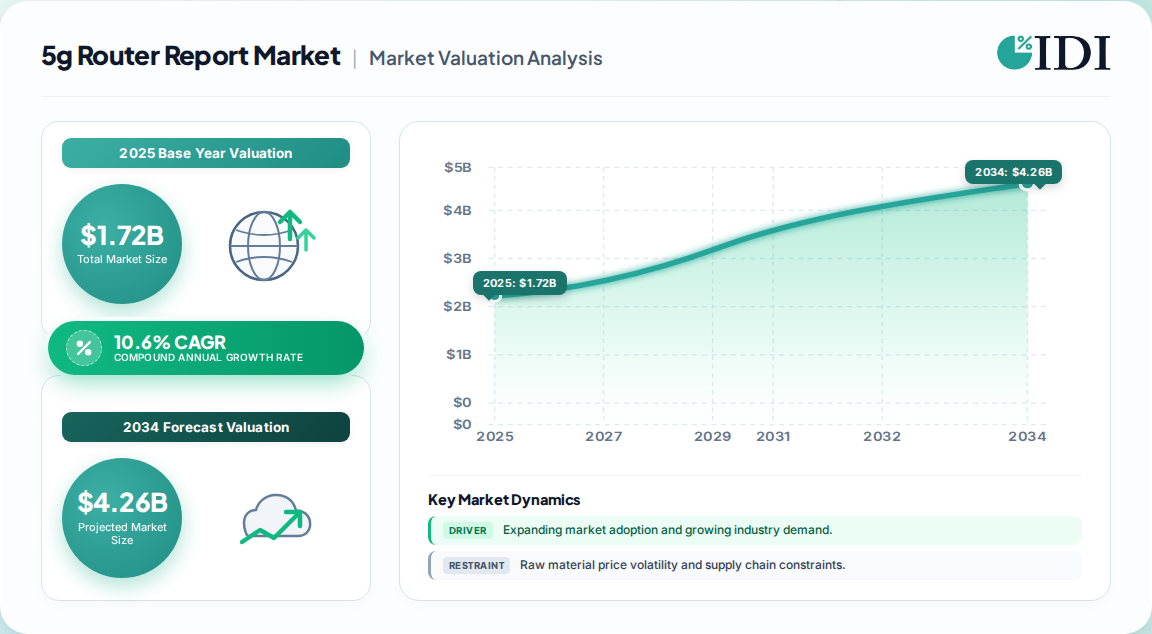
USD 1.72 billion in 2025, rising to USD 4.73 billion by 2035 — a near-2.7x expansion at a stated 10.6% CAGR across the global 5G outdoor router market.
Dual SIM hardware holds the largest revenue share, while single-SIM units are the fastest-growing configuration as carrier diversity and failover move into mainstream buyer requirements.
Self-service terminals dominate application demand today; smart grid deployments are the fastest-growing application category as utilities digitise distribution infrastructure.
North America is the largest regional market, anchored by advanced carrier infrastructure and enterprise edge refresh cycles; Asia-Pacific is the fastest-growing, driven by urbanisation and smart-city tenders.
Huawei, Ericsson, Nokia, ZTE, Samsung and Cisco anchor the vendor landscape, with Qualcomm, TP-Link and D-Link supplying silicon and CPE-adjacent hardware.
Why this matters for decision-makers: The gap between outdoor 5G routers (~USD 1.7B) and the broader Wi-Fi router market (~USD 16B) signals that 5G CPE is still an early-adopter category — procurement teams that lock carrier-agnostic, dual-SIM designs now will avoid expensive re-architecture as FWA traffic scales.
5g Router Market Report Market Size (In Billion)
3.0B
2.0B
1.0B
0
1.560 B
2024
1.720 B
2025
1.910 B
2026
2.110 B
2027
2.330 B
2028
2.580 B
2029
2.850 B
2030
5g Router Market Report Market Size (In Billion)
Year
Market Size
2024
1.560 B
2025
1.720 B
2026
1.910 B
2027
2.110 B
2028
2.330 B
2029
2.580 B
2030
2.850 B
What is the 5g Router Market Report?
The 5G router market report covers outdoor-rated and fixed-wireless CPE that terminates 5G NR traffic and distributes connectivity to end devices. It sizes hardware revenue by SIM configuration and application — self-service terminals, industrial control, smart grids and pipeline monitoring — across North America, Europe, Asia-Pacific and rest-of-world through 2035.
Scope: what this report covers and excludes
This analysis treats the global 5G outdoor router market as its scope: purpose-built, environmentally hardened 5G CPE and integrated router hardware sold to telecom operators, utilities, industrial integrators and smart-city projects. It sizes value in USD, split by SIM configuration and by application, with a regional lens on North America, Europe, Asia-Pacific and rest-of-world. This analysis does not cover indoor home 5G gateways, Wi-Fi-only mesh routers, enterprise core/edge routing backplanes, or the 5G radio access network equipment market. Those adjacencies are referenced only as demand context, never as part of the sized universe.
How big is the market for 5g Router Market Report?
The most defensible read is USD 1.72 billion in 2025, compounding at 10.6% to USD 4.73 billion by 2035 — the estimate anchored to a stated base, a stated CAGR and a stated horizon, which makes it internally consistent and reproducible. Competing analyses diverge sharply on both definition and trajectory, as the table below shows.
Estimate
Base year
Horizon
CAGR
Definition / scope
Attribution
USD 1.72 Billion
2025
2035
10.6%
5G outdoor routers, dual/single SIM, by application
One published estimate (secondary aggregator)
USD 1.56 Billion
2024
2035
10.6%
Same 5G outdoor router universe, previous base year
The divergence is definitional, not directional. Analyses quoting a 7.7% CAGR include home-grade 5G CPE and enterprise routers in the denominator, which dilutes growth because that mix is more price-competitive. Our analysis suggests the outdoor-only figure is the right benchmark for infrastructure buyers: it removes consumer CPE noise and tracks operator and utility capex more faithfully. Treat any 5G router figure that exceeds USD 10 billion today as a broader wireless-router universe in disguise.
How is the market segmented?
Segmentation is deliberately narrow: two SIM configurations and five application verticals define nearly all differentiation in this category, with hardware durability and carrier agnosticism as the real competitive axes.
Parent segment
Children
Commercial reading
By Type
Dual SIM (largest), Single SIM (fastest-growing)
Dual SIM serves failover-critical sites; single SIM wins on BOM cost
Retail/ATM connectivity is volume; utility and pipeline telemetry is margin
The SO WHAT: The segmentation is unusually application-concentrated. Self-service terminals alone anchor the largest share, meaning a single demand vertical — retail banking, ticketing and vending communications — can swing annual order books. Vendors with exposure there should hedge into smart grid and pipeline monitoring, where multi-year utility contracts reduce volatility.
Which region leads in 5g Router Market Report?
North America leads in value, but Asia-Pacific is where incremental growth is being created — a classic mature-versus-emerging split that should shape go-to-market sequencing rather than simply ranking regions.
5g Router Market Report Regional Market Share
Loading chart...
5g Router Market Report Regional Market Share
Region
Market Share (%)
North America
0.34%
Europe
0.23%
Asia-Pacific
0.31%
Latin America
0.06%
Middle East & Africa
0.06%
North America — largest revenue pool; advanced carrier densification, enterprise edge refresh, strong industrial-control demand.
United States, Canada, Mexico
Europe — regulation-led adoption; smart-city tenders and utility digitisation; Germany, UK and France lead.
Germany, UK, France, Italy, Rest of Europe
Asia-Pacific — fastest growing; urbanisation, smart-city capex and aggressive 5G rollout in China and India.
China, Japan, South Korea, India, Rest of APAC
Latin America — early-stage; fibre-scarce suburbs favour fixed-wireless access.
Brazil, Mexico, Argentina
Middle East & Africa — tender-driven; Saudi Arabia and UAE lead on digital-transformation programmes.
Saudi Arabia, UAE, South Africa
SO WHAT: A North America-heavy revenue base combined with Asia-Pacific growth means a vendor with a single regional channel partner cannot capture the next leg of the forecast. Local certification and carrier relationships matter more than product parity in APAC.
What is driving growth — and what is holding it back?
Growth is demand-pull, not supply-push: connectivity requirements from cities, utilities and remote-work infrastructure are structurally rising, while cost and spectrum friction cap how fast that demand converts into shipped units.
Factor
Direction
Evidence strength
Mechanism
Smart-city investment programmes
Driver
Moderate–High
Traffic, safety and environmental monitoring need hardened connectivity
High-speed internet demand / FWA
Driver
High
Fibre-scarce areas adopt 5G CPE instead of trenching
Remote and hybrid work
Driver
Moderate
Site-level connectivity for distributed operations
Margin pressure in consumer-adjacent configurations
Our analysis suggests the restraint side is under-modelled. Regulatory alignment around security baselines lengthens device certification, and the parallel Wi-Fi router market explicitly cites 5G FWA CPE as a share-capturing substitute in suburban areas. In this category that is inverted — 5G CPE is the market — but it means price competition arrives faster than the 10.6% CAGR headline implies.
Who are the leading vendors?
The vendor field splits into network-infrastructure incumbents with carrier relationships and CPE/silicon specialists with cost and channel advantages — a two-tier structure that determines who wins tenders versus who wins volume.
Vendor
Base / HQ
Structural advantage
Primary battleground
Huawei
China
End-to-end 5G portfolio, carrier reach
APAC and MEA operator tenders
Ericsson
Sweden
RAN-adjacent integration, operator trust
Europe, North America
Nokia
Finland
Carrier-grade reliability, utility partnerships
Europe, industrial verticals
ZTE
China
Cost leadership, fast rollout cycles
APAC volume deployments
Samsung
South Korea
Silicon-to-device integration
APAC, North America FWA
Cisco
USA
Enterprise networking and security stack
Enterprise and industrial control
Qualcomm
USA
5G modem silicon leadership
Supplier to all tiers
TP-Link / D-Link
China / Taiwan
CPE cost and retail channel
SMB and single-SIM volume
SO WHAT: Moats here are built on certification and carrier trust, not on spec sheets. Infrastructure incumbents win multi-year operator and utility contracts; CPE specialists win price-sensitive single-sim volume. Buyers evaluating vendors should weight local-type-approval history and firmware lifecycle guarantees above raw throughput claims.
What do buyers and operators need to know?
Procurement in this category fails on lifecycle, not on hardware. The most common error is specifying peak throughput while under-specifying thermal envelope, ingress protection and remote firmware management — the three attributes that actually determine field survival.
Selection criteria should be ranked: carrier and band certification in the target geography; dual-SIM failover behaviour under real handover conditions; management-plane compatibility with existing network operations tooling; and documented firmware support windows of five years or more. Switching costs are high because outdoor units are physically installed and often integrated into utility SCADA or retail terminal estates — a rip-and-replace decision carries truck-roll and downtime costs well beyond the unit price.
Compliance risk is the second frontier. Security baselines for network-edge devices are tightening, and certification delays directly translate into deferred deployment. Operators should contract for regulatory re-certification support, not just initial approval. The gap: this overview establishes the strategic frame, but per-application unit economics and carrier-by-carrier certification timelines require the full report's sub-segment forecasting.
Strategic Recommendations & Analyst Perspective
The balance of evidence favours the outdoor-only reading: roughly USD 1.7 billion today compounding at about 10.6% to USD 4.7 billion by 2035. The strongest counter-argument is that the broader 5G router category grows more slowly (around 7.7%) and that consumer-grade FWA substitution will compress outdoor pricing. That argument is credible for single-SIM units but misreads the category — utility, pipeline and smart-city buyers are not substituting home gateways into hardened field enclosures.
Our judgement is that the real constraint on this market is certification throughput, not demand. Smart-city and grid programmes are funded and politically durable; what gates deployment is the pace at which new SKUs clear regional type approval and security baselines. Vendors that pre-invest in multi-region certification will convert demand faster than rivals with superior silicon.
For vendors: Prioritise dual-SIM, carrier-agnostic designs with long firmware support windows to win utility and smart-grid contracts, where switching costs protect margin.
For operators and integrators: Contract for certification continuity and remote management compatibility at tender stage; these determine total cost of ownership more than unit price.
For investors: Watch Asia-Pacific tender pipelines and smart-grid capex as the leading indicator of the 2027–2030 revenue inflection, rather than North American replacement cycles.
Evidence that would change our conclusion: sustained evidence of single-SIM pricing collapse below utility-grade thresholds, or accelerated carrier adoption of integrated RAN-plus-CPE bundles that disintermediate standalone outdoor router vendors.
5g Router Market Report Regional Market Share
Higher Coverage
Lower Coverage
No Coverage
5g Router Market Report REPORT HIGHLIGHTS
Research Methodology & Data Sources
Our rigorous research methodology combines multi-layered approaches with comprehensive quality assurance, ensuring precision, accuracy, and reliability in every market analysis.
Primary Research & Industry Fieldwork
This study applies a 70/30 primary-to-secondary research split. Structured depth interviews were conducted across the 5G CPE value chain with 5G modem and RF component suppliers, outdoor router OEMs, contract manufacturing partners, carrier procurement groups and regional industrial distributors. Within respondent organisations, we targeted decision-maker designations including VP of Network Procurement, Head of R&D for CPE Platforms, Technical Directors for Field Deployment and Commercial Operations Leads for carrier channels. Interview guides probed certification timelines, dual-SIM failover requirements and firmware lifecycle expectations.
Key Stakeholders Interviewed
Key Stakeholders Interviewed
Stakeholder Role
Interview Share (%)
VP / Director of Network Procurement
34%
Heads of R&D, CPE Platforms
28%
Technical Directors, Field Deployment
23%
Commercial Operations Leads
15%
Industry Ecosystem Breakdown
Industry Ecosystem Breakdown
Company Type
Representation (%)
5G Modem & RF Component Suppliers
32%
Outdoor Router OEMs & Contract Manufacturers
38%
Carrier Procurement & Network Operations
20%
Industrial Distributors & Integrators
10%
Secondary Benchmarking & Public Trade Validation
Findings were cross-checked against official multilateral trade statistics (UN Comtrade, WTO, US ITC, Eurostat), corporate annual filings and investor presentations (10-K and equivalent disclosures), patent filings covering antenna and thermal design, and technical standards published by recognised industry associations. No third-party market-research publisher data is used as a validation source.
Demand Modeling & Market Sizing Triangulation
We run simultaneous Top-Down and Bottom-Up models. The top-down path allocates macroeconomic telecom and industrial capex into the outdoor CPE segment by application vertical. The bottom-up path builds from manufacturer capacity, ASP bands and end-use consumption volumes by region. Divergences above a defined tolerance trigger re-interrogation of interview data.
The global 5G outdoor router market is estimated at USD 1.72 billion in 2025 and is projected to reach USD 4.73 billion by 2035, growing at a 10.6% CAGR over the forecast period.
2. Which region dominates the 5G router market?
North America holds the largest revenue share, supported by advanced carrier infrastructure and enterprise edge demand. Asia-Pacific is the fastest-growing region, driven by urbanisation and smart-city investment.
3. Who are the leading 5G router vendors?
Huawei, Ericsson, Nokia, ZTE, Samsung and Cisco lead the vendor landscape, with Qualcomm supplying modem silicon and TP-Link and D-Link competing in cost-sensitive CPE segments.
4. What is the fastest-growing 5G router segment?
Single-SIM routers are the fastest-growing configuration by type, while smart grid is the fastest-growing application as utilities digitise distribution and telemetry infrastructure.
Figure 17:
Figure 18: Asia Pacific 5g Router Market Report Revenue (Billion), by Country 2026 & 2034
Figure 19: Asia Pacific 5g Router Market Report Revenue Share (%), by Country 2026 & 2034
Figure 20: Latin America 5g Router Market Report Revenue (Billion), by Type 2026 & 2034
Figure 21: Latin America 5g Router Market Report Revenue Share (%), by Type 2026 & 2034
Figure 22: Latin America 5g Router Market Report Revenue (Billion), by Application 2026 & 2034
Figure 23: Latin America 5g Router Market Report Revenue Share (%), by Application 2026 & 2034
Figure 24: Latin America 5g Router Market Report Revenue (Billion), by Country 2026 & 2034
Figure 25: Latin America 5g Router Market Report Revenue Share (%), by Country 2026 & 2034
Figure 26: Middle East & Africa 5g Router Market Report Revenue (Billion), by Type 2026 & 2034
Figure 27: Middle East & Africa 5g Router Market Report Revenue Share (%), by Type 2026 & 2034
Figure 28: Middle East & Africa 5g Router Market Report Revenue (Billion), by Application 2026 & 2034
Figure 29: Middle East & Africa 5g Router Market Report Revenue Share (%), by Application 2026 & 2034
Figure 30: Middle East & Africa 5g Router Market Report Revenue (Billion), by Country 2026 & 2034
Figure 31: Middle East & Africa 5g Router Market Report Revenue Share (%), by Country 2026 & 2034
Table 17: Rest of Europe 5g Router Market Report Revenue (Billion) Forecast, by Application 2020 & 2034
Table 18: Asia Pacific 5g Router Market Report Revenue Billion Forecast, by Type 2020 & 2034
Table 19: Asia Pacific 5g Router Market Report Revenue Billion Forecast, by Application 2020 & 2034
Table 20: Asia Pacific 5g Router Market Report Revenue Billion Forecast, by Country 2020 & 2034
Table 21: China 5g Router Market Report Revenue (Billion) Forecast, by Application 2020 & 2034
Table 22: Japan 5g Router Market Report Revenue (Billion) Forecast, by Application 2020 & 2034
Table 23: South Korea 5g Router Market Report Revenue (Billion) Forecast, by Application 2020 & 2034
Table 24: India 5g Router Market Report Revenue (Billion) Forecast, by Application 2020 & 2034
Table 25: Rest of APAC 5g Router Market Report Revenue (Billion) Forecast, by Application 2020 & 2034
Table 26: Latin America 5g Router Market Report Revenue Billion Forecast, by Type 2020 & 2034
Table 27: Latin America 5g Router Market Report Revenue Billion Forecast, by Application 2020 & 2034
Table 28: Latin America 5g Router Market Report Revenue Billion Forecast, by Country 2020 & 2034
Table 29: Brazil 5g Router Market Report Revenue (Billion) Forecast, by Application 2020 & 2034