Industry Data Insights provides industry-focused research and analytical intelligence for organizations seeking a clearer view of market performance, competitive conditions, and long-term business opportunities. Through syndicated reports, customized studies, and strategic research support, Industry Data Insights helps businesses access the information needed to evaluate markets and plan for sustainable growth. Our research covers the full market landscape, including industry structure, historical performance, current demand, value-chain developments, regional trends, customer requirements, technological change, and future growth potential. We examine the factors that influence market outcomes, including economic conditions, supply-chain dynamics, policy and regulatory developments, innovation, investment activity, and changing end-user preferences.
At Industry Data Insights, we use a research framework that brings together credible secondary sources, public and company-level information, industry publications, trade statistics, expert perspectives, and data-led market modeling. Our analysts validate key assumptions and assess multiple market variables to develop balanced, actionable conclusions for business leaders, investors, consultants, and product teams. Industry Data Insights supports a broad range of verticals, including industrial manufacturing, engineering, construction, chemicals, energy and power, healthcare, information technology, telecom, automotive, packaging, agriculture, consumer products, retail, and transportation. Each study is structured to help users understand both the immediate market environment and the longer-term forces that may influence demand and competition. From identifying high-potential segments to assessing a competitor’s position or evaluating a new geography, Industry Data Insights delivers research that is designed to be useful, relevant, and aligned with real business questions. Our goal is to turn industry data into strategic direction.
North America Baby Food Market: Size, Share & 2030 Forecast
North America Baby Food Market: Size, Share & 2030 Forecast
North America Baby Food Market by Application (Milk Formula, Dried Baby Food, Prepared Baby Food, Snacks & Beverages), by Product Nature (Conventional, Organic), by Distribution Channel (Supermarkets/Hypermarkets, Drugstores/Pharmacies, Convenience Stores, Online Retail, Other), by Age Group (0–6 Months, 6–12 Months, Beyond 12 Months), by North America (United States, Canada, Mexico) Forecast 2026-2034
North America Baby Food Market: Size, Share & 2030 Forecast
Discover the Latest Market Insight Reports
Access in-depth insights on industries, companies, trends, and global markets. Our expertly curated reports provide the most relevant data and analysis in a condensed, easy-to-read format.
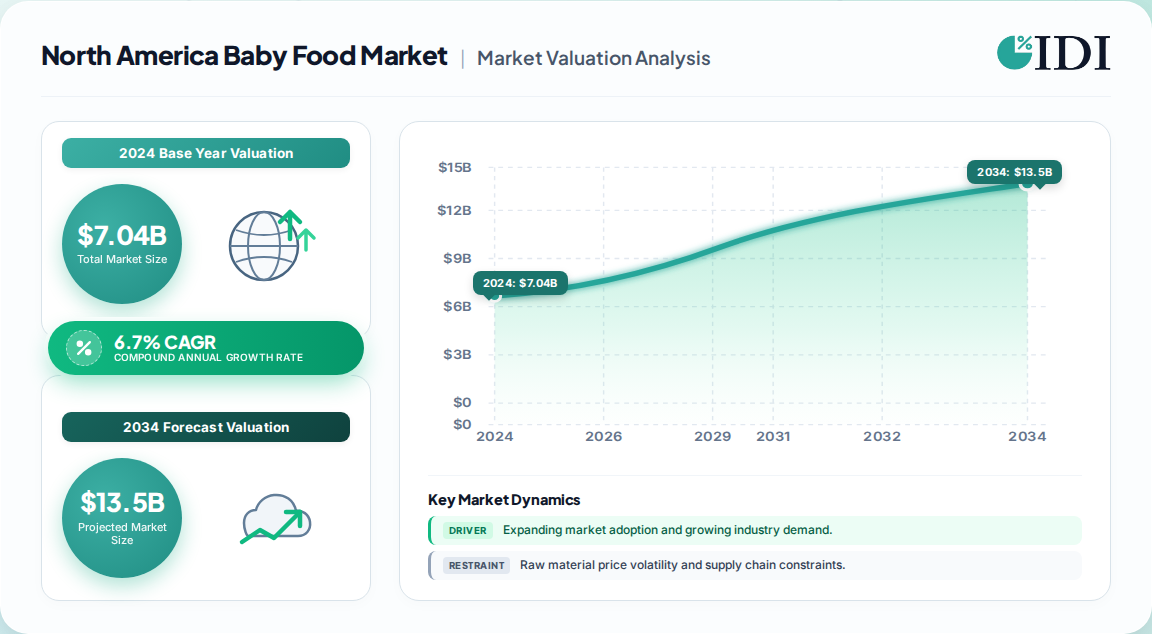
The North America baby food market was valued at 7.04 billion in 2024 and is projected to reach around 10.9 billion by 2030, expanding at a 6.7% CAGR (2025–2030) according to the most recent published estimate.
Forecasts diverge: a competing analysis models a slower 5.25% CAGR, implying the difference between a ~10.9 billion and a ~9.5 billion 2030 outcome — a roughly 1.4 billion swing for the same region.
Milk formula is the dominant application, holding 50.1% of 2024 revenue; prepared baby food is the fastest-growing segment at a 7.8% CAGR.
Supermarkets lead distribution, but online retail is the fastest-growing channel as subscription models and DTC brands scale.
The U.S. accounts for 61.2% of regional revenue; Mexico is the fastest-growing country market at a 7.5% CAGR.
The competitive field is fragmented and brand-differentiated, led by Nestlé (Gerber), Danone, Abbott, Hero Group (Beech-Nut) and Hain Celestial.
Why this matters for decision-makers: the 5.25%-vs-6.7% growth gap means buyers must stress-test volume assumptions against birth-rate data before committing to premium capacity — brands that over-index on formula alone risk margin compression as prepared-food and organic demand outpaces the base.
North America Baby Food Market Market Size (In Billion)
15.0B
10.0B
5.0B
0
7.040 B
2024
7.510 B
2025
8.010 B
2026
8.550 B
2027
9.130 B
2028
9.740 B
2029
10.39 B
2030
North America Baby Food Market Market Size (In Billion)
Year
Market Size
2024
7.040 B
2025
7.510 B
2026
8.010 B
2027
8.550 B
2028
9.130 B
2029
9.740 B
2030
10.39 B
What is the North America Baby Food Market?
The North America baby food market covers commercially prepared nutrition for infants and toddlers across the U.S., Canada and Mexico — including milk formula, dried cereals, prepared purees and meals, and snacks — sold through supermarkets, pharmacies, convenience stores and online channels under strict FDA, CFIA and COFEPRIS safety and labeling rules.
Scope: what this report covers and excludes
This analysis covers packaged infant and toddler nutrition across three countries and five distribution channels, spanning milk formula, dried, prepared and snack products, conventional and organic. This analysis does not cover fresh or home-prepared infant foods, adult clinical nutrition, pediatric pharmaceuticals, or baby-care non-food categories such as diapers and feeding hardware.
How big is the North America Baby Food Market?
Published estimates for the North America baby food market converge on a base of roughly 7.0 billion in 2024, but diverge on growth: the higher 6.7% view reflects premiumization and prepared-food momentum, while the 5.25% view reflects birth-rate headwinds and breastfeeding preference.
Milk formula, dried, prepared, other; five channels
A competing analysis
78.6 Billion global (2025)
2025
2026–2034
5.6%
Global baby food, all products
Third-party global benchmark
The 6.7% CAGR is the more defensible regional figure: it is anchored to a 2024 base, tracks the prepared-food and organic acceleration visible across U.S. and Canadian retail, and is consistent with double-digit online-channel growth. Our analysis suggests the 5.25% view is a conservative floor that underweights Mexico's 7.5% trajectory and the premiumization already embedded in U.S. basket values.
How is the market segmented?
Segmentation follows three non-geographic axes — application, distribution channel and product nature — each with distinct growth economics that materially change a buyer's addressable opportunity.
Supermarkets/Hypermarkets, Drugstores/Pharmacies, Convenience Stores, Online Retail, Other
Age Group
0–6 Months, 6–12 Months, Beyond 12 Months
Milk formula's 50.1% share makes it the volume anchor, but prepared baby food's 7.8% CAGR is where incremental revenue is accruing. Organic is the fastest-growing nature segment, and online the fastest-growing channel — a combination that favors asset-light, DTC-capable brands over legacy shelf-space incumbents.
Which country leads in the North America Baby Food Market?
The United States leads with 61.2% of 2024 regional revenue, followed by Canada and Mexico; Mexico is the fastest-growing country market at a 7.5% CAGR, narrowing the gap over the forecast horizon.
North America
United States (61.2% share, 2024)
Canada (lucrative, premium-led)
Mexico (7.5% CAGR, fastest-growing)
Country
2024 Share
Growth Outlook
United States
61.2%
Mature, premium-led
Canada
~22% (implied)
Steady, organic-driven
Mexico
~17% (implied)
Fastest at 7.5% CAGR
U.S. dominance rests on purchasing power, dense retail and e-commerce infrastructure, and the deepest brand portfolio. Canada's growth is quality-led — organic and premium formats — while Mexico's is access-led, driven by urbanization and rising disposable income. The practical implication: U.S. scale still sets the pricing benchmark, but Mexico is where incremental volume growth will be won.
What is driving growth — and what is holding it back?
Growth is driven by parental nutrition awareness, working-parent convenience demand and premium/organic trade-up, while restraints center on declining birth rates and breastfeeding preference — the net balance still favors expansion at mid-single-digit-plus rates.
Factor
Direction
Evidence strength
Mechanism
Nutrition awareness & clean-label demand
Driver
High
Premium/organic trade-up lifts basket value
Working-parent convenience (RTE, pouches)
Driver
High
Female labor participation raises packaged demand
Product & packaging innovation
Driver
Medium-High
Recyclable pouches, functional fortification
E-commerce & subscription models
Driver
High
Expands access, DTC brand entry
Declining birth rates
Restraint
High
Shrinks the core infant population
Breastfeeding & home-prep preference
Restraint
Medium
Limits packaged adoption at 0–6 months
Recall & food-safety risk
Restraint
Medium
Erodes trust, disrupts supply
The driver set is value-led rather than volume-led: premiumization and prepared-food mix shift can offset flat or falling unit volumes. This divergence implies that revenue forecasts assuming volume growth alone are fragile — the more resilient model assumes price/mix expansion carries growth, with Mexico and online channels supplying the volume upside.
Who are the leading vendors?
Competition is fragmented and brand-differentiated, with Nestlé (Gerber), Danone, Abbott, Hero Group (Beech-Nut) and Hain Celestial leading alongside store brands and specialty entrants.
Company
Portfolio strength
Strategic posture
Nestlé (Gerber)
Broadest: formula, purees, snacks
Innovation & sustainability leadership
Danone
Formula & specialized nutrition
Pediatric-channel partnerships
Abbott
Infant formula (Similac)
Clinical credibility, scale
Hero Group (Beech-Nut)
Purees & cereals
Value-premium positioning
Hain Celestial
Organic/natural
Clean-label niche
Moats rest on regulatory compliance, brand trust and distribution breadth rather than proprietary technology. The 2022 Abbott recall illustrates how quickly a trust-sensitive category can punish operational failure — safety assurance is itself a competitive asset, and smaller entrants compete on transparency and organic provenance.
What do buyers and operators need to know? (Decision Support)
Procurement decisions hinge on regulatory clearance, safety record and channel fit more than headline price. Infant formula is the most tightly regulated segment, with nutrient specifications, pathogen testing and pre-market submission requirements raising switching costs and favoring established suppliers.
Buyers should prioritize suppliers with verifiable recall history, certified organic provenance and reliable cold-chain or shelf-stable logistics. Channel strategy matters: supermarket shelf space still drives trial, but online subscription economics determine lifetime value. Contract terms should address contamination liability and recall contingency, given the category's trust sensitivity.
Strategic Recommendations & Analyst Perspective
The balance of evidence favors the 6.7% regional CAGR over the 5.25% alternative, because premiumization and the prepared-food mix shift are already embedded in observed retail behavior. The strongest counter-argument is demographic: falling birth rates could compress volume faster than price/mix can compensate, validating the conservative view.
Our judgment is that growth will be value-led and uneven — strong in Mexico, organics and online; mature in U.S. formula. The implication is that capital should follow prepared food and organic formats rather than legacy formula capacity, where margin pressure from store brands is most acute.
Investors: overweight prepared-food and organic exposure; underweight pure-formula plays.
Operators: build Mexico and online-channel capability as the primary growth engines.
Brands: treat food-safety assurance and recyclable packaging as differentiation, not compliance cost.
Evidence that would change this conclusion: sustained U.S. birth-rate decline below replacement, or a major multi-brand recall, would shift the defensible CAGR toward the 5.25% floor.
North America Baby Food Market Regional Market Share
Loading chart...
North America Baby Food Market Regional Market Share
Region
Market Share (%)
United States
0.61%
Canada
0.22%
Mexico
0.17%
North America Baby Food Market Regional Market Share
Higher Coverage
Lower Coverage
No Coverage
North America Baby Food Market REPORT HIGHLIGHTS
Research Methodology & Data Sources
Our rigorous research methodology combines multi-layered approaches with comprehensive quality assurance, ensuring precision, accuracy, and reliability in every market analysis.
Primary Research & Industry Fieldwork
Our research framework applies a 70/30 primary-to-secondary split, with 70% of analytical weight assigned to structured primary validation. We conducted in-depth interviews across the infant nutrition value chain, including raw material and ingredient suppliers, specialized baby food producers, contract formulators and co-manufacturers, and regional distributors. Interviewees were drawn from senior decision-maker roles — VP of Sourcing, Heads of R&D and Product Development, Quality and Regulatory Directors, and Commercial Operations Leads — ensuring demand signals were captured at both procurement and go-to-market levels.
Key Stakeholders Interviewed
Key Stakeholders Interviewed
Stakeholder Role
Interview Share (%)
R&D & Product Development Heads
35%
Procurement & Sourcing Directors
35%
Quality & Regulatory Affairs Leads
30%
Industry Ecosystem Breakdown
Industry Ecosystem Breakdown
Company Type
Representation (%)
Ingredient & Raw Material Suppliers
40%
Baby Food Producers & Co-Manufacturers
35%
Distributors & Retail Channel Partners
25%
Secondary Benchmarking & Public Trade Validation
Secondary validation drew on official multilateral and national databases, including UN Comtrade, WTO tariff and trade records, US ITC import-export data and Eurostat trade statistics. Corporate annual filings, 10-K submissions and investor presentations were used to calibrate manufacturer revenue and capacity. Patent databases and recognized non-profit technical standards bodies, including FDA infant formula requirements and Codex Alimentarius guidance, were referenced to validate regulatory and formulation assumptions.
Demand Modeling & Market Sizing Triangulation
We applied simultaneous top-down and bottom-up triangulation. The top-down model allocates macroeconomic and packaged-food expenditure to the infant nutrition category by country and channel. The bottom-up model builds from manufacturer capacity, product pricing and end-use consumption at household and institutional level. Convergence between the two models was tested for each segment and country.
U.S. Food and Drug Administration (FDA) — infant formula safety and nutrient requirements
USDA Economic Research Service — food expenditure and consumption data
UN Comtrade — bilateral trade flows for prepared and formula infant foods
Codex Alimentarius (FAO/WHO) — complementary feeding and labelling standards
Aspects
Details
Study Period
2020-2034
Base Year
2025
Estimated Year
2026
Forecast Period
2026-2034
Historical Period
2020-2025
Growth Rate
CAGR of 6.7% from 2020-2034
Segmentation
By Application
Milk Formula
Dried Baby Food
Prepared Baby Food
Snacks & Beverages
By Product Nature
Conventional
Organic
By Distribution Channel
Supermarkets/Hypermarkets
Drugstores/Pharmacies
Convenience Stores
Online Retail
Other
By Age Group
0–6 Months
6–12 Months
Beyond 12 Months
By Geography
North America
United States
Canada
Mexico
Table of Contents
1. North America Baby Food Market Introduction
1.1. Research Scope
1.2. Market Segmentation
1.3. Research Objective
1.4. Definitions and Assumptions
2. North America Baby Food Market Executive Summary
2.1. Market Snapshot
3. North America Baby Food Market Dynamics
3.1. Introduction
3.2. Market Drivers
3.3. Market Restrains
3.4. Market Trends
4. North America Baby Food Market Factor Analysis
4.1. Porters Five Forces
4.1.1. Bargaining Power of Suppliers
4.1.2. Bargaining Power of Buyers
4.1.3. Threat of New Entrants
4.1.4. Threat of Substitutes
4.1.5. Competitive Rivalry
4.2. PESTEL analysis
4.3. BCG Analysis
4.3.1. Stars (High Growth, High Market Share)
4.3.2. Cash Cows (Low Growth, High Market Share)
4.3.3. Question Mark (High Growth, Low Market Share)
4.3.4. Dogs (Low Growth, Low Market Share)
4.4. Ansoff Matrix Analysis
4.5. Supply Chain Analysis
4.6. Regulatory Landscape
4.7. Current Market Potential and Opportunity Assessment (TAM–SAM–SOM Framework)
4.8. IDI Analyst Note
5. North America Baby Food Market Analysis, Insights and Forecast, 2020-2034
5.1. Analysis, Insights and Forecast - by Application
5.1.1. Milk Formula
5.1.2. Dried Baby Food
5.1.3. Prepared Baby Food
5.1.4. Snacks & Beverages
5.2. Analysis, Insights and Forecast - by Product Nature
5.2.1. Conventional
5.2.2. Organic
5.3. Analysis, Insights and Forecast - by Distribution Channel
5.3.1. Supermarkets/Hypermarkets
5.3.2. Drugstores/Pharmacies
5.3.3. Convenience Stores
5.3.4. Online Retail
5.3.5. Other
5.4. Analysis, Insights and Forecast - by Age Group
5.4.1. 0–6 Months
5.4.2. 6–12 Months
5.4.3. Beyond 12 Months
5.5. Analysis, Insights and Forecast - by Region
5.5.1. North America
6. North America Baby Food Market Competitive Analysis
6.1. Company Profiles
6.2. Market Entropy
6.2.1. Company's Key Areas Served
6.2.2. Recent Developments
6.3. Company Market Share Analysis, 2026
6.3.1. Top 5 Companies Market Share Analysis
6.3.2. Top 3 Companies Market Share Analysis
6.4. List of Potential Customers
7. North America Baby Food Market Research Methodology
List of Figures
Figure 1: North America Baby Food Market Revenue Breakdown (Billion, %) by Product 2026 & 2034
Figure 2: North America Baby Food Market Value Share (%), by Application 2026 & 2034
Figure 3: North America Baby Food Market Value Share (%), by Product Nature 2026 & 2034
Figure 4: North America Baby Food Market Value Share (%), by Distribution Channel 2026 & 2034
Figure 5: North America Baby Food Market Value Share (%), by Age Group 2026 & 2034
Figure 6: North America Baby Food Market Share (%) by Company 2026
List of Tables
Table 1: North America Baby Food Market Revenue Billion Forecast, by Application 2020 & 2034
Table 2: North America Baby Food Market Revenue Billion Forecast, by Product Nature 2020 & 2034
Table 3: North America Baby Food Market Revenue Billion Forecast, by Distribution Channel 2020 & 2034
Table 4: North America Baby Food Market Revenue Billion Forecast, by Age Group 2020 & 2034
Table 5: North America Baby Food Market Revenue Billion Forecast, by Region 2020 & 2034
Table 6: North America North America Baby Food Market Revenue Billion Forecast, by Application 2020 & 2034
Table 7: North America North America Baby Food Market Revenue Billion Forecast, by Product Nature 2020 & 2034
Table 8: North America North America Baby Food Market Revenue Billion Forecast, by Distribution Channel 2020 & 2034
Table 9: North America North America Baby Food Market Revenue Billion Forecast, by Age Group 2020 & 2034
Table 10: North America North America Baby Food Market Revenue Billion Forecast, by Country 2020 & 2034
Table 11: United States North America Baby Food Market Revenue (Billion) Forecast, by Application 2020 & 2034
Table 12: Canada North America Baby Food Market Revenue (Billion) Forecast, by Application 2020 & 2034
Table 13: Mexico North America Baby Food Market Revenue (Billion) Forecast, by Application 2020 & 2034
Frequently Asked Questions
1. How big is the North America baby food market?
The North America baby food market was valued at 7.04 billion in 2024, with published forecasts projecting roughly 10.9 billion by 2030 at a 6.7% CAGR. A more conservative analysis models a 5.25% CAGR, implying a slower path to about 9.5 billion.
2. What is the fastest-growing segment in the North America baby food market?
Prepared baby food is the fastest-growing application at a 7.8% CAGR, driven by ready-to-eat convenience. Organic products and online retail are also expanding faster than the market average, supported by working-parent demand.
3. Which country dominates the North America baby food market?
The United States dominates with 61.2% of 2024 regional revenue, supported by high purchasing power and dense retail networks. Mexico is the fastest-growing country market at a 7.5% CAGR, driven by urbanization and rising incomes.
4. Who are the leading companies in the North America baby food market?
Key players include Nestlé (Gerber), Danone, Abbott Laboratories, Hero Group (Beech-Nut) and Hain Celestial. The market is fragmented, with store brands and specialty organic entrants competing on price, transparency and clean-label positioning.
5. What is holding back growth in the North America baby food market?
Declining birth rates and breastfeeding preference restrain packaged baby food demand, particularly in the 0–6 month segment. Food-safety recalls also erode consumer trust in a category where reliability is a primary purchase criterion.