Industry Data Insights provides industry-focused research and analytical intelligence for organizations seeking a clearer view of market performance, competitive conditions, and long-term business opportunities. Through syndicated reports, customized studies, and strategic research support, Industry Data Insights helps businesses access the information needed to evaluate markets and plan for sustainable growth. Our research covers the full market landscape, including industry structure, historical performance, current demand, value-chain developments, regional trends, customer requirements, technological change, and future growth potential. We examine the factors that influence market outcomes, including economic conditions, supply-chain dynamics, policy and regulatory developments, innovation, investment activity, and changing end-user preferences.
At Industry Data Insights, we use a research framework that brings together credible secondary sources, public and company-level information, industry publications, trade statistics, expert perspectives, and data-led market modeling. Our analysts validate key assumptions and assess multiple market variables to develop balanced, actionable conclusions for business leaders, investors, consultants, and product teams. Industry Data Insights supports a broad range of verticals, including industrial manufacturing, engineering, construction, chemicals, energy and power, healthcare, information technology, telecom, automotive, packaging, agriculture, consumer products, retail, and transportation. Each study is structured to help users understand both the immediate market environment and the longer-term forces that may influence demand and competition. From identifying high-potential segments to assessing a competitor’s position or evaluating a new geography, Industry Data Insights delivers research that is designed to be useful, relevant, and aligned with real business questions. Our goal is to turn industry data into strategic direction.
Womens Trousers Market Report: Size, Share & 2034 Outlook
Womens Trousers Market Report by Fibre (Cotton, Polyester, Cellulosic, Others), by Distribution Channel (Offline, Online), by Product Type (Leggings, Palazzo, Tailored, Cargo, Wide-Leg, Straight, Flare), by End Use (Casual, Formal & Workwear, Active-inspired, Occasion), by Asia Pacific (China, Japan, India, South Korea), by Europe (Germany, UK, France, Italy), by North America (USA, Canada, Mexico), by Latin America (Brazil, Argentina, Mexico), by Middle East & Africa (Saudi Arabia, UAE, South Africa) Forecast 2026-2034
Womens Trousers Market Report: Size, Share & 2034 Outlook
Discover the Latest Market Insight Reports
Access in-depth insights on industries, companies, trends, and global markets. Our expertly curated reports provide the most relevant data and analysis in a condensed, easy-to-read format.
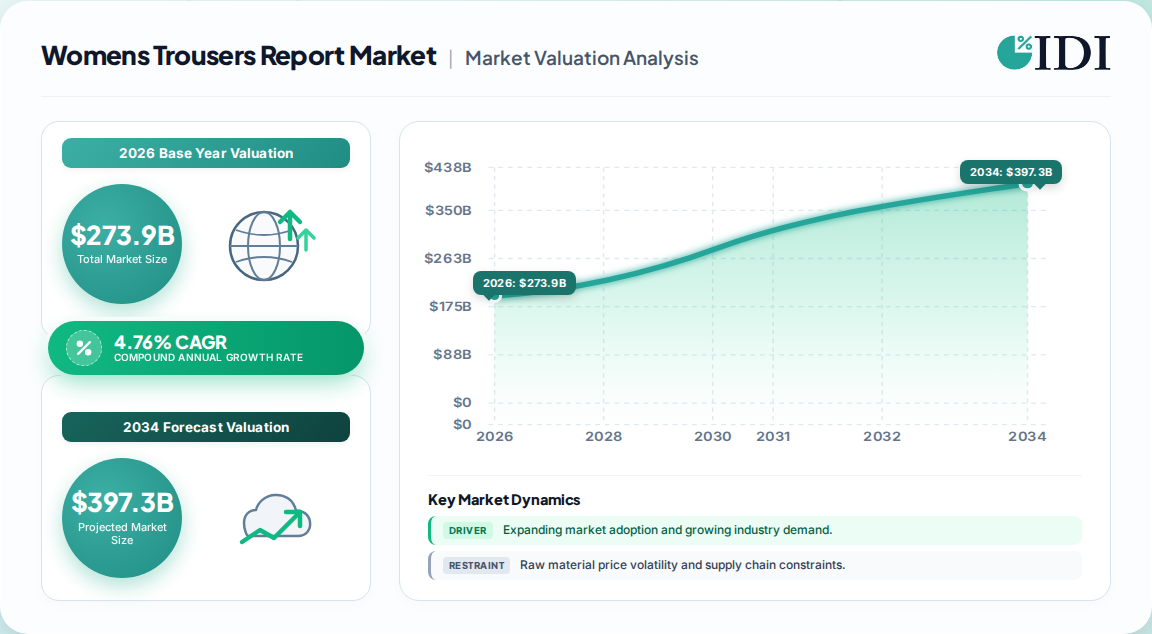
$273.90 Billion in 2026 global revenue, rising to $397.33 Billion by 2034 at a 4.76% CAGR (2026–2034), per one published estimate.
Cotton is the leading fibre at 48.7% share ($127.33 Billion in 2025); polyester is the fastest-growing fibre on durability and recycled-content gains.
Offline retail holds 68.4% of channel value, but online is growing at 7.46% CAGR — over 2.5x the total market rate.
Asia Pacific leads with 38.6% share (2025); North America is the fastest-growing region at 6.71% CAGR.
Competitive intensity is high: H&M, UNIQLO, Inditex, Gap, Levi Strauss and Lululemon compete on silhouette velocity, not price alone.
Reported market sizes diverge by more than 4x across publishers — scope and category definition, not demand, explain most of the gap.
Why this matters for decision-makers: Margin will accrue to vendors who pair trend-responsive silhouette development with online-first distribution; laggards face inventory write-downs as wide-leg and relaxed fits displace legacy skinny inventory.
Womens Trousers Market Report Market Size (In Billion)
400.0B
300.0B
200.0B
100.0B
0
261.4 B
2025
273.9 B
2026
286.9 B
2027
300.6 B
2028
314.9 B
2029
329.9 B
2030
345.6 B
2031
Womens Trousers Market Report Market Size (In Billion)
Year
Market Size
2025
261.4 B
2026
273.9 B
2027
286.9 B
2028
300.6 B
2029
314.9 B
2030
329.9 B
2031
345.6 B
What is the Womens Trousers Market Report?
The womens trousers market covers lower-body garments designed for women — tailored, casual, active-inspired and wide-leg styles — segmented by fibre (cotton, polyester, cellulosic), distribution channel (offline, online) and region. It is valued at $273.90 Billion in 2026 and forecast to reach $397.33 Billion by 2034. This report quantifies demand, channel shift and competitive positioning.
Scope: what this report covers and excludes
This analysis covers women's trousers across fibre types (cotton, polyester, cellulosic), distribution channels (offline and online), and five global regions — with country-level detail for major markets. It includes leggings, palazzo, tailored, cargo and wide-leg silhouettes sold through retail and e-commerce. This analysis does not cover men's or children's trousers, skirts, dresses, shorts as a standalone category, underwear, or track and jogging pants, which sit in adjacent apparel segments.
How big is the market for Womens Trousers Market Report?
The global womens trousers market was valued at roughly $273.90 Billion in 2026, with forecasts to $397.33 Billion by 2034 at a 4.76% CAGR — but published estimates vary widely because category boundaries differ. The table below compares the leading published figures.
Estimate
Base Year
Horizon
CAGR
Definition / scope
Attribution
$273.90 Billion → $397.33 Billion
2026
2034
4.76%
Women's trousers, fibre + channel segments
One published estimate
$211.95 Billion → $293.06 Billion
2021
2028
4.7%
Women's trousers, incl. all trouser silhouettes
A competing analysis
$67.03 Billion → $104.45 Billion
2025
2033
5.7%
Narrower: leggings and palazzo focus
A third published analysis
$261.45 Billion (2025 base)
2025
2034
4.76%
Same publisher, prior base year
One published estimate
Our analysis suggests the $273.90 Billion figure is the most defensible planning benchmark: its 4.76% CAGR is corroborated by the independent 4.7% estimate, and its scope explicitly includes all trouser silhouettes. The $67 Billion figure appears to exclude denim and tailored categories, making it unsuitable for total-addressable-market sizing. Buyers should anchor strategy on the ~4.7–4.8% growth band and treat the 5.7% figure as a segment-level, not market-level, growth rate.
How is the market segmented?
The market segments primarily by fibre, distribution channel, and product type; cotton dominates value while online dominates growth. Brand and price tier are secondary lenses that shape margin, not volume.
Work-to-leisure convergence is the core demand signal
So what: Fibre and channel are the two levers that most directly determine cost structure and margin. Cotton's dominance constrains input-cost flexibility, while the online channel's 7.46% CAGR means digital shelf execution is now a growth prerequisite, not an optional channel.
Which region leads the womens trousers market?
Asia Pacific leads with 38.6% of global value in 2025, driven by China, India and Japan's manufacturing scale and rising working-women participation; North America is the fastest-growing region at 6.71% CAGR through 2034.
Asia Pacific — China, Japan, India, South Korea, ASEAN
Europe — Germany, UK, France, Italy, Spain
North America — USA, Canada, Mexico
Latin America — Brazil, Argentina, Mexico
Middle East & Africa — Saudi Arabia, UAE, South Africa
Region
2025 Share
Growth Signal
Asia Pacific
38.6%
Largest; scale-led
Europe
24.3%
Mature; premium-weighted
North America
21.8%
Fastest at 6.71% CAGR
Latin America
8.6%
E-commerce-led upside
Middle East & Africa
6.7%
Emerging; modest base
The divergence matters: Asia Pacific's lead is a production-and-consumption story, while North America's growth is a channel-and-format story — online penetration plus athleisure-adjacent demand. Operators should not treat regional share and regional growth as the same signal. Europe's premium weighting also implies higher revenue per unit, which the share table understates.
What is driving growth — and what is holding it back?
Growth is driven by work-to-leisure versatility and rising female workforce participation, while raw-material volatility and fast fashion-cycle inventory risk are the principal restraints.
Factor
Direction
Evidence strength
Mechanism
Versatile work-to-leisure demand
Driver
High
Multi-occasion trousers raise replacement frequency
Rising female workforce participation
Driver
High
Structural demand for formal and smart-casual
Performance-inspired everyday fabrics
Driver
Medium-High
Stretch, wrinkle resistance expand use cases
Online channel and 3D/AI fit tools
Driver
Medium
Lower purchase friction, higher conversion
Raw-material and sourcing cost inflation
Restraint
High
Cotton, freight, tariff and FX pressure on margin
Fast-changing silhouette cycles
Restraint
High
Inventory obsolescence and stockout risk
Sustainability and textile-waste scrutiny
Restraint
Medium
Compliance cost; demand shift to eco-fabrics
The balance: Drivers are structural and durable — workforce participation and wardrobe versatility will not reverse. Restraints are cyclical and manageable through sourcing discipline and demand sensing. Our analysis suggests the net growth rate of ~4.7–4.8% is a floor rather than a ceiling, because the online channel's 7.46% CAGR will gradually lift the blended rate as digital share rises from its current ~32% base.
Who are the leading vendors?
The market is fragmented and fast-fashion-led, with H&M, Inditex, UNIQLO (Fast Retailing), Gap, Levi Strauss and Lululemon occupying distinct strategic positions from value-fast-fashion to premium performance.
Company
Strategic Position
Differentiation / Moat
Inditex (Zara)
Fast fashion, global
Speed-to-shelf and vertical integration
H&M Group
Fast fashion, value
Scale, broad assortment, Studio design credibility
Differentiation: Moats are built on two axes — supply-chain velocity (Inditex, H&M) and fabric technology (UNIQLO, Lululemon). Our analysis suggests the mid-market is the most exposed position: it lacks the cost base of value players and the technical narrative of premium players, and is most vulnerable to online-native challengers.
What do buyers and operators need to know?
Selection criteria are shifting from price-per-unit to fit consistency, fabric performance and replenishment speed. Procurement teams should prioritize suppliers able to deliver multi-fibre blends (cotton-polyester-elastane) with verified stretch recovery, because stretch failure is the leading cause of return-driven margin erosion in online trousers.
Inventory risk is the central operational exposure. Silhouette cycles — wide-leg, barrel, straight, cargo — can turn within a single season, and forecasting errors compound in long-lead-time sourcing. Buyers should negotiate shorter lead times, in-season reorder clauses, and markdown-sharing terms rather than chasing the lowest FOB price. Switching costs are moderate for basic cotton programmes but high for technical or performance fabrics, where fabric certification and fit blocks take multiple cycles to re-establish.
Regulatory and compliance exposure is rising around fibre composition labelling, chemical restrictions in dyeing and finishing, and extended producer responsibility for textile waste in Europe. Operators sourcing from Asia Pacific should map traceability to tier-2 fibre suppliers now, as disclosure requirements are tightening. The commercial implication is clear: compliance capability is becoming a vendor selection criterion, not a back-office function.
Strategic Recommendations & Analyst Perspective
The balance of evidence favours a constructive but selective outlook. A ~4.76% CAGR is unremarkable in isolation, but it masks a channel rotation — online growing at 7.46% — that will redistribute margin toward digital-native and omnichannel operators. The strongest counter-argument is that online growth in trousers is structurally capped by fit uncertainty and return rates; if return-driven costs rise, the online margin advantage could compress. That risk is real, but 3D fitting and AI-assisted sizing are already eroding it, which is why we treat the cap as friction rather than a ceiling.
Our second judgement concerns fibre strategy. Cotton's 48.7% share is a demand fact, not a strategic recommendation — it is also the segment most exposed to input-cost volatility and water-related sustainability scrutiny. Our analysis suggests the highest-margin whitespace sits in cellulosic and recycled-polyester blends that deliver cotton-like hand-feel with better sustainability credentials and lower price volatility.
Actionable strategy:
Prioritize online-first assortment and fit tools to capture the 7.46% channel CAGR; treat physical retail as experience and returns infrastructure.
Diversify fibre exposure toward cellulosic and recycled polyester to hedge cotton cost volatility and pre-empt sustainability disclosure requirements.
Compress silhouette lead times and negotiate in-season reorder clauses to reduce the inventory obsolescence risk inherent in fast-changing fashion cycles.
What would change our conclusion: A sustained reversal in online penetration growth, or a sharp cotton price correction that restores cost leadership to cotton-heavy value players, would shift the recommended emphasis back toward offline scale and cotton-led value positioning. Absent either, the digital-and-fibre-diversification thesis holds.
Our rigorous research methodology combines multi-layered approaches with comprehensive quality assurance, ensuring precision, accuracy, and reliability in every market analysis.
Primary Research & Industry Fieldwork
Our research programme applies a 70/30 primary-to-secondary split. We conducted in-depth interviews with stakeholders across the trouser value chain: raw-material and fibre suppliers, specialized garment producers, contract manufacturers, fabric finishers, and global distributors and retailers. Interviewees were drawn from decision-maker roles including VP of Sourcing, Head of Product Development, Technical Director (Fabric & Fit), and Commercial Operations Leads, ensuring both cost-side and demand-side perspectives were captured.
Key Stakeholders Interviewed
Key Stakeholders Interviewed
Stakeholder Role
Interview Share (%)
VP of Sourcing & Procurement Directors
35%
Heads of Product Development & Design
30%
Technical Directors (Fabric & Fit)
20%
Commercial Operations Leads
15%
Industry Ecosystem Breakdown
Industry Ecosystem Breakdown
Company Type
Representation (%)
Raw Material & Fibre Suppliers
30%
Garment Manufacturers & Contract Producers
35%
Fabric Finishers & Technical Processors
20%
Global Distributors & Retailers
15%
Secondary Benchmarking & Public Trade Validation
We triangulate primary findings against official multilateral trade and standards databases — UN Comtrade, WTO, US ITC and Eurostat — for HS-coded apparel trade flows covering trousers and related garments. Corporate annual filings (10-K, SEC filings, investor presentations) from listed apparel companies provide capacity, revenue and channel-mix validation. Patent databases and recognized technical standards and industry associations inform fabric-performance and compliance assumptions.
Demand Modeling & Market Sizing Triangulation
Market sizing uses simultaneous Top-Down and Bottom-Up approaches. The top-down model allocates macroeconomic apparel spending by segment and region using population, female workforce participation and consumer spending indicators. The bottom-up model builds from manufacturer capacity, unit pricing and end-use consumption by channel, reconciled at the regional level.
Table 2: Womens Trousers Market Report Revenue Billion Forecast, by Distribution Channel 2020 & 2034
Table 3: Womens Trousers Market Report Revenue Billion Forecast, by Product Type 2020 & 2034
Table 4: Womens Trousers Market Report Revenue Billion Forecast, by End Use 2020 & 2034
Table 5: Womens Trousers Market Report Revenue Billion Forecast, by Region 2020 & 2034
Table 6: Asia Pacific Womens Trousers Market Report Revenue Billion Forecast, by Fibre 2020 & 2034
Table 7: Asia Pacific Womens Trousers Market Report Revenue Billion Forecast, by Distribution Channel 2020 & 2034
Table 8: Asia Pacific Womens Trousers Market Report Revenue Billion Forecast, by Product Type 2020 & 2034
Table 9: Asia Pacific Womens Trousers Market Report Revenue Billion Forecast, by End Use 2020 & 2034
Table 10: Asia Pacific Womens Trousers Market Report Revenue Billion Forecast, by Country 2020 & 2034
Table 11: China Womens Trousers Market Report Revenue (Billion) Forecast, by Application 2020 & 2034
Table 12: Japan Womens Trousers Market Report Revenue (Billion) Forecast, by Application 2020 & 2034
Table 13: India Womens Trousers Market Report Revenue (Billion) Forecast, by Application 2020 & 2034
Table 14: South Korea Womens Trousers Market Report Revenue (Billion) Forecast, by Application 2020 & 2034
Table 15: Europe Womens Trousers Market Report Revenue Billion Forecast, by Fibre 2020 & 2034
Europe Womens Trousers Market Report Revenue Billion Forecast, by Distribution Channel 2020 & 2034
Frequently Asked Questions
1. How big is the womens trousers market?
The global womens trousers market is valued at $273.90 Billion in 2026 and is projected to reach $397.33 Billion by 2034, growing at a 4.76% CAGR. Published estimates vary by scope, with narrower definitions yielding figures as low as $67 Billion.
2. Which region dominates the womens trousers market?
Asia Pacific leads with 38.6% of global value in 2025, supported by manufacturing scale and rising workforce participation. North America is the fastest-growing region at a 6.71% CAGR through 2034, driven by online penetration.
3. What is the fastest-growing segment in womens trousers?
The online distribution channel is the fastest-growing segment at a 7.46% CAGR, well ahead of the overall market. Among fibres, polyester is growing fastest on durability and recycled-content adoption, while cotton retains the largest share at 48.7%.
4. What are the main restraints on the womens trousers market?
Rising raw-material, freight and sourcing costs pressure margins, particularly for mass-market players. Fast-changing silhouette cycles also create inventory obsolescence and stockout risk, while sustainability and textile-waste scrutiny add compliance cost.
5. Who are the leading companies in the womens trousers market?
Key players include Inditex, H&M Group, Fast Retailing (UNIQLO), Gap Inc., Levi Strauss & Co. and Lululemon. Competition rests on supply-chain velocity for fast-fashion players and fabric technology for performance-focused brands.
Figure 17: Europe Womens Trousers Market Report Revenue Share (%), by Product Type 2026 & 2034
Figure 18: Europe Womens Trousers Market Report Revenue (Billion), by End Use 2026 & 2034
Figure 19: Europe Womens Trousers Market Report Revenue Share (%), by End Use 2026 & 2034
Figure 20: Europe Womens Trousers Market Report Revenue (Billion), by Country 2026 & 2034
Figure 21: Europe Womens Trousers Market Report Revenue Share (%), by Country 2026 & 2034
Figure 22: North America Womens Trousers Market Report Revenue (Billion), by Fibre 2026 & 2034
Figure 23: North America Womens Trousers Market Report Revenue Share (%), by Fibre 2026 & 2034
Figure 24: North America Womens Trousers Market Report Revenue (Billion), by Distribution Channel 2026 & 2034
Figure 25: North America Womens Trousers Market Report Revenue Share (%), by Distribution Channel 2026 & 2034
Figure 26: North America Womens Trousers Market Report Revenue (Billion), by Product Type 2026 & 2034
Figure 27: North America Womens Trousers Market Report Revenue Share (%), by Product Type 2026 & 2034
Figure 28: North America Womens Trousers Market Report Revenue (Billion), by End Use 2026 & 2034
Figure 29: North America Womens Trousers Market Report Revenue Share (%), by End Use 2026 & 2034
Figure 30: North America Womens Trousers Market Report Revenue (Billion), by Country 2026 & 2034
Figure 31: North America Womens Trousers Market Report Revenue Share (%), by Country 2026 & 2034
Figure 32: Latin America Womens Trousers Market Report Revenue (Billion), by Fibre 2026 & 2034
Figure 33: Latin America Womens Trousers Market Report Revenue Share (%), by Fibre 2026 & 2034
Figure 34: Latin America Womens Trousers Market Report Revenue (Billion), by Distribution Channel 2026 & 2034
Figure 35: Latin America Womens Trousers Market Report Revenue Share (%), by Distribution Channel 2026 & 2034
Figure 36: Latin America Womens Trousers Market Report Revenue (Billion), by Product Type 2026 & 2034
Figure 37: Latin America Womens Trousers Market Report Revenue Share (%), by Product Type 2026 & 2034
Figure 38: Latin America Womens Trousers Market Report Revenue (Billion), by End Use 2026 & 2034
Figure 39: Latin America Womens Trousers Market Report Revenue Share (%), by End Use 2026 & 2034
Figure 40: Latin America Womens Trousers Market Report Revenue (Billion), by Country 2026 & 2034
Figure 41: Latin America Womens Trousers Market Report Revenue Share (%), by Country 2026 & 2034
Figure 42: Middle East & Africa Womens Trousers Market Report Revenue (Billion), by Fibre 2026 & 2034
Figure 43: Middle East & Africa Womens Trousers Market Report Revenue Share (%), by Fibre 2026 & 2034
Figure 44: Middle East & Africa Womens Trousers Market Report Revenue (Billion), by Distribution Channel 2026 & 2034
Figure 45: Middle East & Africa Womens Trousers Market Report Revenue Share (%), by Distribution Channel 2026 & 2034
Figure 46: Middle East & Africa Womens Trousers Market Report Revenue (Billion), by Product Type 2026 & 2034
Figure 47: Middle East & Africa Womens Trousers Market Report Revenue Share (%), by Product Type 2026 & 2034
Figure 48: Middle East & Africa Womens Trousers Market Report Revenue (Billion), by End Use 2026 & 2034
Figure 49: Middle East & Africa Womens Trousers Market Report Revenue Share (%), by End Use 2026 & 2034
Figure 50: Middle East & Africa Womens Trousers Market Report Revenue (Billion), by Country 2026 & 2034
Figure 51: Middle East & Africa Womens Trousers Market Report Revenue Share (%), by Country 2026 & 2034
Table 16:
Table 17: Europe Womens Trousers Market Report Revenue Billion Forecast, by Product Type 2020 & 2034
Table 18: Europe Womens Trousers Market Report Revenue Billion Forecast, by End Use 2020 & 2034
Table 19: Europe Womens Trousers Market Report Revenue Billion Forecast, by Country 2020 & 2034