Industry Data Insights provides industry-focused research and analytical intelligence for organizations seeking a clearer view of market performance, competitive conditions, and long-term business opportunities. Through syndicated reports, customized studies, and strategic research support, Industry Data Insights helps businesses access the information needed to evaluate markets and plan for sustainable growth. Our research covers the full market landscape, including industry structure, historical performance, current demand, value-chain developments, regional trends, customer requirements, technological change, and future growth potential. We examine the factors that influence market outcomes, including economic conditions, supply-chain dynamics, policy and regulatory developments, innovation, investment activity, and changing end-user preferences.
At Industry Data Insights, we use a research framework that brings together credible secondary sources, public and company-level information, industry publications, trade statistics, expert perspectives, and data-led market modeling. Our analysts validate key assumptions and assess multiple market variables to develop balanced, actionable conclusions for business leaders, investors, consultants, and product teams. Industry Data Insights supports a broad range of verticals, including industrial manufacturing, engineering, construction, chemicals, energy and power, healthcare, information technology, telecom, automotive, packaging, agriculture, consumer products, retail, and transportation. Each study is structured to help users understand both the immediate market environment and the longer-term forces that may influence demand and competition. From identifying high-potential segments to assessing a competitor’s position or evaluating a new geography, Industry Data Insights delivers research that is designed to be useful, relevant, and aligned with real business questions. Our goal is to turn industry data into strategic direction.
Singapore Customer Experience Business Process Outsourcing Market Report by Service (Inbound, Outbound), by Outsourcing Model (Onshore, Offshore, Nearshore), by Support Channel (Voice, Non-voice), by End-Use Industry (Automotive, BFSI, Healthcare, Manufacturing, Media & Entertainment, IT & Telecommunications, Education, Retail, Travel & Hospitality, E-commerce, Others), by Singapore (Central Singapore, East Singapore, West Singapore, North Singapore, North-East Singapore) Forecast 2026-2034
Access in-depth insights on industries, companies, trends, and global markets. Our expertly curated reports provide the most relevant data and analysis in a condensed, easy-to-read format.
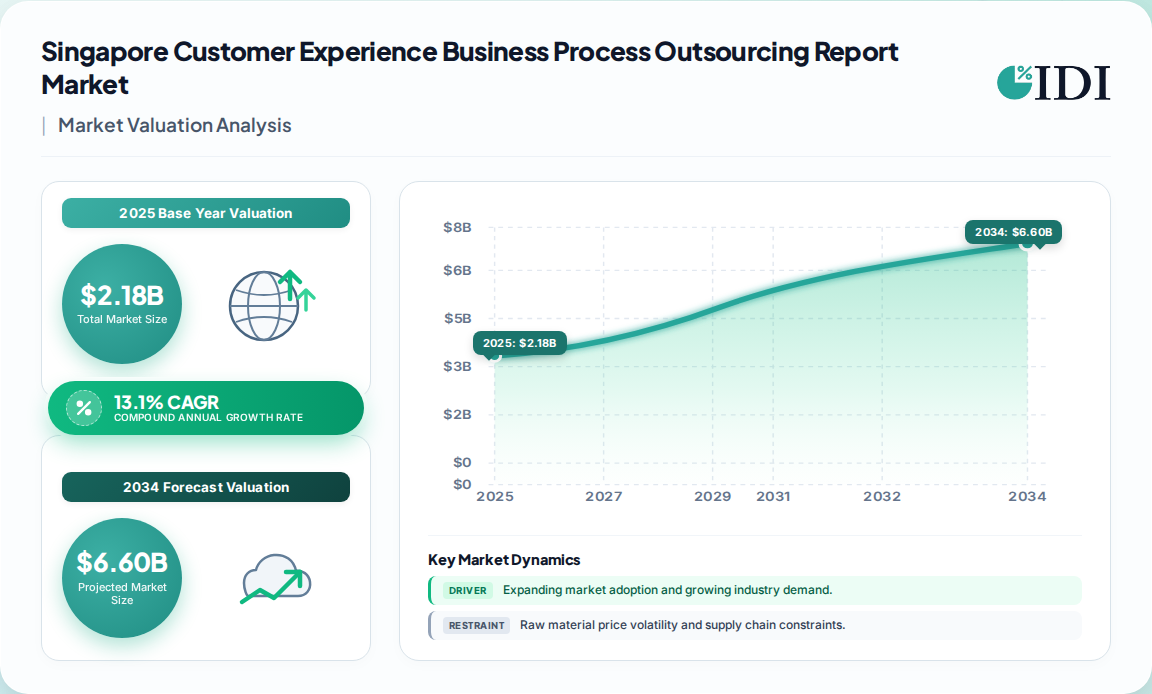
The Singapore Customer Experience BPO Market Report sizes the market at USD 2,175.49 Million in 2025, rising to USD 6,571.66 Million by 2034.
The outlook implies a 13.1% CAGR over 2025–2034, roughly double national services-sector growth expectations.
Outbound services led revenue in 2024; voice remains the dominant support channel despite non-voice acceleration.
Singapore anchors regional CX delivery for BFSI, technology, healthcare, e-commerce, manufacturing and automotive clients.
Leading vendors include Accenture, Concentrix, Foundever, TDCX, Teleperformance, TaskUs, SMCBPO and Star CRM.
Singapore represents roughly 2% of the global CX BPO market, punching above its population weight.
Why this matters for decision-makers: Buyers should renegotiate multi-year voice contracts now, because AI-assisted deflection will reset unit pricing before 2028 — locking volume-based pricing today protects margin while capability gaps remain.
Singapore Customer Experience Business Process Outsourcing Market Report Market Size (In Billion)
5.0B
4.0B
3.0B
2.0B
1.0B
0
1.930 B
2024
2.180 B
2025
2.460 B
2026
2.780 B
2027
3.140 B
2028
3.560 B
2029
4.020 B
2030
Singapore Customer Experience Business Process Outsourcing Market Report Market Size (In Billion)
Year
Market Size
2024
1.930 B
2025
2.180 B
2026
2.460 B
2027
2.780 B
2028
3.140 B
2029
3.560 B
2030
4.020 B
What is the Singapore Customer Experience Business Process Outsourcing Market Report?
It is a segmentation-based forecast of third-party customer experience outsourcing revenue booked in Singapore, covering inbound and outbound services across onshore, offshore and nearshore delivery models, voice and non-voice channels, and major end-use industries.
Scope: what this report covers and excludes
This report measures revenue earned by third-party CX BPO providers for customer service, technical support, sales support, telemarketing and survey operations delivered from or managed within Singapore. Segmentation spans service type, outsourcing model, support channel and end-use industry.
It includes traditional contact-centre outsourcing plus managed AI, analytics and workflow services bundled into CX contracts. This analysis does not cover captive in-house contact centres, IT outsourcing, payroll or HR BPO, finance and accounting BPO, or pure software licensing revenue from CX platforms.
How big is the market for Singapore Customer Experience Business Process Outsourcing Market Report?
Published estimates converge on a market near USD 2.2 Billion in 2025 and USD 6.2–6.6 Billion by the mid-2030s, with CAGRs clustered between 13% and 14%.
Estimate
Base year
Horizon
CAGR
Definition / scope
Attribution
USD 6,571.66 Mn
2024 (USD 1,929.34 Mn)
2034
13.1%
Revenue, by service, outsourcing, channel, end use
One published estimate
USD 6,224.2 Mn
2025 (USD 2,216.0 Mn)
2033
14.0%
Outbound/inbound revenue, global databook
A competing analysis
USD 4.04 Bn
2025 (USD 2.18 Bn)
2030
13.1%
Short-horizon country statistics
A third published estimate
The 13.1% path is the most defensible: it reconciles the 2024 and 2025 base values within 1%, and the shorter-horizon estimate lands almost exactly on the same curve. Our analysis suggests the 14% variant reflects a slightly narrower outbound-weighted scope rather than a genuinely faster market. Buyers should treat 13–14% as a consensus band, not a precise number.
How is the market segmented?
The market segments four ways — service type, outsourcing model, support channel and end-use industry — with each axis behaving very differently in growth terms.
Parent segment
Children
By Service
Inbound, Outbound
By Outsourcing Model
Onshore, Offshore, Nearshore
By Support Channel
Voice, Non-voice
By End-Use Industry
Automotive, BFSI, Healthcare, Manufacturing, Media & Entertainment, IT & Telecommunications, Education, Retail, Travel & Hospitality, E-commerce, Others
Outbound dominance is a Singapore-specific anomaly. Proactive sales, retention and survey calling is concentrated here because regional headquarters teams centralise campaign governance on the island. Voice leadership is more conventional — high-value BFSI and healthcare interactions still escalate to humans. Our analysis suggests non-voice will outgrow voice on volume but not on revenue before 2030.
Which sub-region leads in Singapore Customer Experience Business Process Outsourcing Market Report?
Central Singapore leads, concentrating regional headquarters, BFSI operations and the largest contact-centre floors, with the East and West corridors absorbing overflow capacity as rents rise.
Singapore Customer Experience Business Process Outsourcing Market Report Regional Market Share
Loading chart...
Singapore Customer Experience Business Process Outsourcing Market Report Regional Market Share
Region
Market Share (%)
Central Singapore
0.34%
East Singapore
0.22%
West Singapore
0.19%
North Singapore
0.14%
North-East Singapore
0.11%
Parent
Children
Singapore
Central Singapore, East Singapore, West Singapore, North Singapore, North-East Singapore
Demand follows real estate and talent, not geography. Central Singapore captures client-facing, high-value and multilingual work; East and West host large-seat operations and back-office support; North and North-East serve as lower-cost satellite delivery zones. The practical implication is that site-selection risk is now a cost-of-delivery variable, so buyers should negotiate location-flexibility clauses rather than fixed-site commitments.
What is driving growth — and what is holding it back?
Government digital incentives, sector demand concentration and Singapore's regional connectivity drive growth; wage inflation, talent scarcity and AI transition costs restrain it.
Factor
Direction
Evidence strength
Mechanism
Smart Nation grants and upskilling support
Driver
High
Subsidises AI and automation adoption, lowering buyer switching costs
BFSI, tech, healthcare, e-commerce demand
Driver
High
Rising transaction and support volumes require scalable third-party capacity
Regional connectivity and hub status
Driver
High
Centralised multilingual support for Southeast Asia and beyond
Labour cost and talent scarcity
Restraint
Medium-high
Rising agent wages compress vendor margins and raise pricing
AI transition and reskilling costs
Restraint
Medium
Near-term capex ahead of productivity payback
Data residency and compliance burden
Restraint
Medium
Onboarding and audit costs slow contract cycles
The balance favours growth, but the mix is shifting. Our analysis suggests volume-led expansion is being replaced by value-led expansion — vendors winning on automation and analytics rather than seat count. That transition exposes sub-scale providers, and buyers should expect consolidation among mid-tier local operators within the forecast window.
Who are the leading vendors?
The market is served by a mix of global majors and Singapore-headquartered specialists, differentiated by scale, localisation and platform capability.
Vendor type
Examples
Differentiation
Global integrators
Accenture, Concentrix, Foundever, Teleperformance
Scale, multi-country delivery, AI platforms
Regional specialists
TDCX, TaskUs, SMCBPO
Southeast Asia multilingual depth, agility
Local operators
Star CRM, Connect Centre, Antasis, Asian Technology Solutions
Cost flexibility, niche vertical expertise
Competitive moats rest on three assets: multilingual talent pipelines, certified data-handling infrastructure, and proprietary analytics layered onto client workflows. Our analysis suggests global majors win large BFSI and technology contracts on compliance depth, while local operators defend mid-market accounts on responsiveness and price. The strategic vulnerability for local players is AI capex — a gap that favours partnership or acquisition.
What do buyers and operators need to know?
Selection now hinges on AI maturity, data-governance certification, multilingual coverage and workforce stability — not headcount. Procurement teams should demand documented deflection rates, containment accuracy and human-escalation SLAs, because AI-driven savings claims are frequently unverified at contract stage.
Switching costs are rising. Once a vendor embeds analytics into CRM and ticketing workflows, migration risk extends beyond service continuity into data integrity and model retraining. Buyers should negotiate data portability and model ownership upfront. Regulatory compliance under Singapore's PDPA, plus sector rules in BFSI and healthcare, makes audit trails and offshore data routing a contract-critical term, not an afterthought.
Strategic Recommendations & Analyst Perspective
The balance of evidence favours a 13–14% growth path with margin compression, not pure volume expansion. The consensus sizing is unusually consistent, which raises confidence in the top line but masks divergence underneath: outbound leadership, voice reliance and labour-cost inflation cannot all persist unchanged through 2030.
The strongest counter-argument is that AI deflection could shrink addressable agent hours faster than forecasts assume, flattening revenue before 2032. We regard this as a pricing risk rather than a demand risk — CX complexity is rising, and brands will redirect savings into higher-value managed services rather than exit outsourcing.
Investors: Prioritise vendors with proven AI containment metrics and multi-country delivery, not seat-count scale.
Buyers: Lock pricing tiers and data-portability terms now, ahead of anticipated 2027–2028 repricing.
Operators: Invest in multilingual talent and compliance certification to defend against global-major encroachment.
What would change our conclusion: two consecutive quarters of declining contract values or a sharp drop in outbound campaign spend would signal structural, not cyclical, deceleration. The full report quantifies these scenarios by segment and end-use industry.
Singapore Customer Experience Business Process Outsourcing Market Report Regional Market Share
Higher Coverage
Lower Coverage
No Coverage
Singapore Customer Experience Business Process Outsourcing Market Report REPORT HIGHLIGHTS
Research Methodology & Data Sources
Our rigorous research methodology combines multi-layered approaches with comprehensive quality assurance, ensuring precision, accuracy, and reliability in every market analysis.
Primary Research & Industry Fieldwork
Our analysis follows a 70/30 primary-to-secondary research split. We conducted in-depth interviews with stakeholders across the CX BPO value chain, including global BPO providers, Singapore-headquartered specialists, captive shared-service operators, CX technology platform vendors and enterprise procurement teams. Interviewees included VP-level Sourcing and Vendor Management leads, Heads of Customer Operations, Chief Digital Officers and Contact Centre Transformation Directors. Interviews focused on contract structures, pricing mechanics, AI deployment maturity and site-selection economics.
Key Stakeholders Interviewed
Key Stakeholders Interviewed
Stakeholder Role
Interview Share (%)
Sourcing & Vendor Management VPs
38%
Customer Operations Heads
32%
Digital & Transformation Directors
18%
Compliance & Data Protection Leads
12%
Industry Ecosystem Breakdown
Industry Ecosystem Breakdown
Company Type
Representation (%)
Global BPO Providers
40%
Singapore-HQ Specialists
30%
CX Technology Vendors
18%
Enterprise Procurement Teams
12%
Secondary Benchmarking & Public Trade Validation
Findings were benchmarked against official multilateral and regulatory sources, including WTO services trade statistics, Singapore Department of Statistics services output data, IMDA digital economy reporting, PDPA compliance guidance and listed-company annual filings (10-K and investor presentations) from globally traded BPO operators. Patent and trademark activity in conversational AI and workflow automation was reviewed to gauge vendor capability pipelines.
Demand Modeling & Market Sizing Triangulation
We triangulated top-down macroeconomic and industry-segment allocation against bottom-up vendor revenue, seat capacity and contract-value modelling. Divergences between the two approaches were reconciled at segment level, with outbound and voice revenue weighted by observed campaign volumes.
Data Triangulation & Validation Matrix
Dimension
Analytical Scope
Methodology Applied
Validation Level
Base-Year Market Size
Value in USD for base year
Bottom-up revenue and seat-capacity triangulation
High
Forecast Horizon
Multi-year compound projection
Historical CAGR, regression analysis and demand elasticity
High
Regional Distribution
Sub-region share breakdown
Site-location mapping and commercial lease analysis
High
Competitive Landscape
Leading market players
Annual reports, contract awards and capacity mapping
High
Sources Referenced
Singapore Department of Statistics — services sector output and employment data
Infocomm Media Development Authority (IMDA) — digital economy and Smart Nation reporting
Personal Data Protection Commission (PDPC) — PDPA compliance frameworks
1. Singapore Customer Experience Business Process Outsourcing Market Report Introduction
1.1. Research Scope
1.2. Market Segmentation
1.3. Research Objective
1.4. Definitions and Assumptions
2. Singapore Customer Experience Business Process Outsourcing Market Report Executive Summary
2.1. Market Snapshot
3. Singapore Customer Experience Business Process Outsourcing Market Report Dynamics
3.1. Introduction
3.2. Market Drivers
3.3. Market Restrains
3.4. Market Trends
4. Singapore Customer Experience Business Process Outsourcing Market Report Factor Analysis
4.1. Porters Five Forces
4.1.1. Bargaining Power of Suppliers
4.1.2. Bargaining Power of Buyers
4.1.3. Threat of New Entrants
4.1.4. Threat of Substitutes
4.1.5. Competitive Rivalry
4.2. PESTEL analysis
4.3. BCG Analysis
4.3.1. Stars (High Growth, High Market Share)
4.3.2. Cash Cows (Low Growth, High Market Share)
4.3.3. Question Mark (High Growth, Low Market Share)
4.3.4. Dogs (Low Growth, Low Market Share)
4.4. Ansoff Matrix Analysis
4.5. Supply Chain Analysis
4.6. Regulatory Landscape
4.7. Current Market Potential and Opportunity Assessment (TAM–SAM–SOM Framework)
4.8. IDI Analyst Note
5. Singapore Customer Experience Business Process Outsourcing Market Report Analysis, Insights and Forecast, 2020-2034
5.1. Analysis, Insights and Forecast - by Service
5.1.1. Inbound
5.1.2. Outbound
5.2. Analysis, Insights and Forecast - by Outsourcing Model
5.2.1. Onshore
5.2.2. Offshore
5.2.3. Nearshore
5.3. Analysis, Insights and Forecast - by Support Channel
5.3.1. Voice
5.3.2. Non-voice
5.4. Analysis, Insights and Forecast - by End-Use Industry
5.4.1. Automotive
5.4.2. BFSI
5.4.3. Healthcare
5.4.4. Manufacturing
5.4.5. Media & Entertainment
5.4.6. IT & Telecommunications
5.4.7. Education
5.4.8. Retail
5.4.9. Travel & Hospitality
5.4.10. E-commerce
5.4.11. Others
5.5. Analysis, Insights and Forecast - by Region
5.5.1. Singapore
6. Singapore Customer Experience Business Process Outsourcing Market Report Competitive Analysis
6.1. Company Profiles
6.2. Market Entropy
6.2.1. Company's Key Areas Served
6.2.2. Recent Developments
6.3. Company Market Share Analysis, 2026
6.3.1. Top 5 Companies Market Share Analysis
6.3.2. Top 3 Companies Market Share Analysis
6.4. List of Potential Customers
7. Singapore Customer Experience Business Process Outsourcing Market Report Research Methodology
List of Figures
Figure 1: Singapore Customer Experience Business Process Outsourcing Market Report Revenue Breakdown (Billion, %) by Product 2026 & 2034
Figure 2: Singapore Customer Experience Business Process Outsourcing Market Report Value Share (%), by Service 2026 & 2034
Figure 3: Singapore Customer Experience Business Process Outsourcing Market Report Value Share (%), by Outsourcing Model 2026 & 2034
Figure 4: Singapore Customer Experience Business Process Outsourcing Market Report Value Share (%), by Support Channel 2026 & 2034
Figure 5: Singapore Customer Experience Business Process Outsourcing Market Report Value Share (%), by End-Use Industry 2026 & 2034
Figure 6: Singapore Customer Experience Business Process Outsourcing Market Report Share (%) by Company 2026
List of Tables
Table 1: Singapore Customer Experience Business Process Outsourcing Market Report Revenue Billion Forecast, by Service 2020 & 2034
Table 2: Singapore Customer Experience Business Process Outsourcing Market Report Revenue Billion Forecast, by Outsourcing Model 2020 & 2034
Table 3: Singapore Customer Experience Business Process Outsourcing Market Report Revenue Billion Forecast, by Support Channel 2020 & 2034
Table 4: Singapore Customer Experience Business Process Outsourcing Market Report Revenue Billion Forecast, by End-Use Industry 2020 & 2034
Table 5: Singapore Customer Experience Business Process Outsourcing Market Report Revenue Billion Forecast, by Region 2020 & 2034
Table 6: Singapore Singapore Customer Experience Business Process Outsourcing Market Report Revenue Billion Forecast, by Service 2020 & 2034
Table 7: Singapore Singapore Customer Experience Business Process Outsourcing Market Report Revenue Billion Forecast, by Outsourcing Model 2020 & 2034
Table 8: Singapore Singapore Customer Experience Business Process Outsourcing Market Report Revenue Billion Forecast, by Support Channel 2020 & 2034
Table 9: Singapore Singapore Customer Experience Business Process Outsourcing Market Report Revenue Billion Forecast, by End-Use Industry 2020 & 2034
Table 10: Singapore Singapore Customer Experience Business Process Outsourcing Market Report Revenue Billion Forecast, by Country 2020 & 2034
Table 11: Central Singapore Singapore Customer Experience Business Process Outsourcing Market Report Revenue (Billion) Forecast, by Application 2020 & 2034
Table 12: East Singapore Singapore Customer Experience Business Process Outsourcing Market Report Revenue (Billion) Forecast, by Application 2020 & 2034
Table 13: West Singapore Singapore Customer Experience Business Process Outsourcing Market Report Revenue (Billion) Forecast, by Application 2020 & 2034
Frequently Asked Questions
1. How large is the Singapore customer experience BPO market?
The market is estimated at USD 2,175.49 million in 2025, according to one published estimate, and is forecast to reach USD 6,571.66 million by 2034. A competing analysis places 2025 revenue slightly higher at USD 2,216.0 million.
2. What is the growth rate of the Singapore CX BPO market?
Published forecasts cluster between 13.1% and 14.0% CAGR through the early 2030s. The 13.1% path is most defensible because it reconciles both base-year values and the shorter-horizon estimate on a single curve.
3. Which segment leads the Singapore CX BPO market?
Outbound services generated the largest revenue share in 2024 and 2025, driven by telemarketing, retention and customer survey campaigns. Voice remains the leading support channel, though non-voice is growing faster on volume.
4. Who are the key players in Singapore's CX BPO market?
Leading vendors include Accenture, Concentrix, Foundever, Teleperformance, TDCX, TaskUs, SMCBPO, Star CRM, Connect Centre and Antasis. Global majors compete on scale and compliance; local operators compete on agility and price.
5. Why is Singapore a hub for customer experience outsourcing?
Singapore's regional connectivity, multilingual workforce, strong data-protection regime and government digital incentives make it a preferred base for centralised Southeast Asian CX delivery. It accounts for roughly 2% of global CX BPO revenue.
Table 14: North Singapore Singapore Customer Experience Business Process Outsourcing Market Report Revenue (Billion) Forecast, by Application 2020 & 2034
Table 15: North-East Singapore Singapore Customer Experience Business Process Outsourcing Market Report Revenue (Billion) Forecast, by Application 2020 & 2034