Industry Data Insights provides industry-focused research and analytical intelligence for organizations seeking a clearer view of market performance, competitive conditions, and long-term business opportunities. Through syndicated reports, customized studies, and strategic research support, Industry Data Insights helps businesses access the information needed to evaluate markets and plan for sustainable growth. Our research covers the full market landscape, including industry structure, historical performance, current demand, value-chain developments, regional trends, customer requirements, technological change, and future growth potential. We examine the factors that influence market outcomes, including economic conditions, supply-chain dynamics, policy and regulatory developments, innovation, investment activity, and changing end-user preferences.
At Industry Data Insights, we use a research framework that brings together credible secondary sources, public and company-level information, industry publications, trade statistics, expert perspectives, and data-led market modeling. Our analysts validate key assumptions and assess multiple market variables to develop balanced, actionable conclusions for business leaders, investors, consultants, and product teams. Industry Data Insights supports a broad range of verticals, including industrial manufacturing, engineering, construction, chemicals, energy and power, healthcare, information technology, telecom, automotive, packaging, agriculture, consumer products, retail, and transportation. Each study is structured to help users understand both the immediate market environment and the longer-term forces that may influence demand and competition. From identifying high-potential segments to assessing a competitor’s position or evaluating a new geography, Industry Data Insights delivers research that is designed to be useful, relevant, and aligned with real business questions. Our goal is to turn industry data into strategic direction.
Styrene Butadiene Styrene Market Report by Type (Oil-Extended SBS, Non-Oil-Extended SBS), by Application (Footwear, Asphalt Modification, Polymer Modification/Compounding, Adhesives and Sealants, Other Applications), by Asia-Pacific (China, Japan, India, South Korea, Indonesia, Vietnam), by North America (USA, Canada, Mexico), by Europe (Germany, UK, France, Italy, Spain), by Middle East & Africa (Saudi Arabia, UAE, South Africa), by South America (Brazil, Argentina, Mexico) Forecast 2026-2034
Access in-depth insights on industries, companies, trends, and global markets. Our expertly curated reports provide the most relevant data and analysis in a condensed, easy-to-read format.
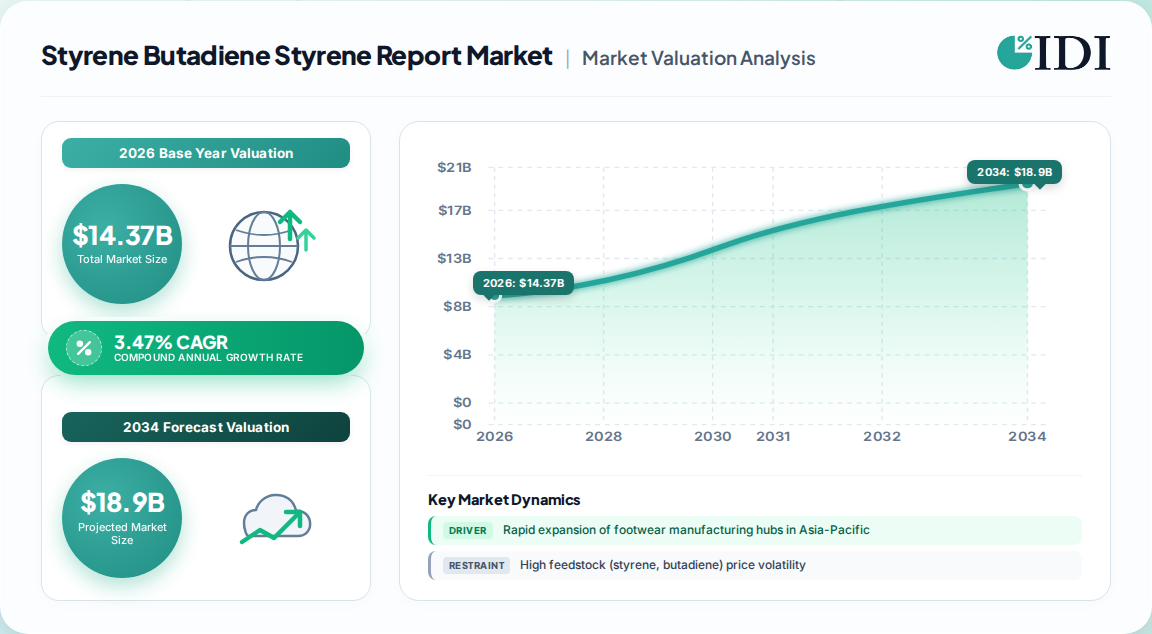
USD 14.37 billion: the global Styrene Butadiene Styrene (SBS) market size in 2026, forecast to reach USD 17.04 billion by 2031 at a 3.47% CAGR (2026–2031).
Oil-extended grades dominate with 57.85% of 2025 share, but non-oil-extended SBS is the fastest-growing type at 4.05% CAGR through 2031.
Asphalt modification is the largest application at 42.10% of 2025 revenue; adhesives and sealants grow fastest at 4.86% CAGR.
Asia-Pacific leads with 45.75% of global revenue in 2025; Middle East & Africa is the fastest-growing region at 3.75% CAGR.
Leading vendors: LG Chem, LCY, Kumho Petrochemical, Kraton Corporation and Dynasol Group anchor a medium-concentration competitive landscape.
Feedstock volatility (styrene, butadiene) is the single largest restraint, with an estimated −1.1% impact on CAGR.
Why this matters for decision-makers: SBS is transitioning from a bulk-price commodity to a specification-driven specialty material — vendors that do not secure integrated monomer supply and bio-attributed grades risk structural margin compression, while buyers must lock in qualified non-oil-extended and bio-based volumes early.
Styrene Butadiene Styrene Market Report Market Size (In Billion)
20.0B
15.0B
10.0B
5.0B
0
13.89 B
2025
14.37 B
2026
14.87 B
2027
15.39 B
2028
15.92 B
2029
16.47 B
2030
17.04 B
2031
Styrene Butadiene Styrene Market Report Market Size (In Billion)
Year
Market Size
2025
13.89 B
2026
14.37 B
2027
14.87 B
2028
15.39 B
2029
15.92 B
2030
16.47 B
2031
17.04 B
What is the Styrene Butadiene Styrene Market Report?
A Styrene Butadiene Styrene Market Report is a structured market intelligence study covering SBS thermoplastic elastomer supply, demand, pricing and competitive dynamics. It quantifies market size by type (oil-extended and non-oil-extended), application (footwear, asphalt modification, polymer modification, adhesives and sealants) and geography, and forecasts growth to support procurement, investment and product-development decisions.
Scope: what this report covers and excludes
This report covers the global SBS thermoplastic elastomer market, segmented by type (oil-extended SBS, non-oil-extended SBS), application (footwear, asphalt modification, polymer modification/compounding, adhesives and sealants, other applications) and geography across five regions. All market values are stated in USD at manufacturer-level revenue.
This analysis does not cover styrene-butadiene rubber (SBR) for tire manufacturing, hydrogenated SEBS, or other styrenic block copolymer families except where they are referenced as competitive substitutes.
How big is the market for Styrene Butadiene Styrene Market Report?
The most defensible global estimate places the SBS market at USD 14.37 billion in 2026, rising to USD 17.04 billion by 2031 at 3.47% CAGR. Competing analyses diverge materially because scopes differ — several conflate SBS with the broader SBR tire elastomer market.
Estimate
Base Year
Horizon
CAGR
Definition / Scope
Attribution
USD 14.37 Billion → 17.04 Billion
2026
2031
3.47%
Global SBS thermoplastic elastomer, value (USD)
One published estimate
USD 13.89 Billion
2025
2026
~3.47%
Global SBS, value (USD)
Same publisher, prior base year
USD 2,229.3 Million
2030
2022–2030
5.4%
North America SBS only
A competing analysis
USD 1,383.4 Million
2021
2030
5.4%
North America SBS, 2021 base
Same competing analysis
Our analysis suggests the ~3.5% global CAGR is the most defensible figure for pure-play SBS. The higher 5.4% North American figure reflects a narrower, higher-value product mix (non-oil-extended grades) rather than faster underlying volume growth. The SBR market figures (USD 4.95–8.8 billion) circulating in the same sources describe a different product — tire elastomer — and should not be substituted for SBS sizing.
How is the market segmented?
SBS segments primarily by type and application, with oil-extended grades dominant today but non-oil-extended grades capturing the fastest incremental growth as sustainability specifications tighten.
Parent Segment
Children
2025 Share / Growth
By Type
Oil-Extended SBS, Non-Oil-Extended SBS
Oil-extended 57.85%; non-oil 4.05% CAGR (fastest)
By Application
Footwear, Asphalt Modification, Polymer Modification/Compounding, Adhesives & Sealants, Other
Asphalt 42.10%; adhesives 4.86% CAGR (fastest)
By Grade Format
Pellets, Powder, Crumb
Grade format follows application specification
Which region leads in the Styrene Butadiene Styrene Market Report?
Asia-Pacific leads the global SBS market with 45.75% of 2025 revenue, underpinned by integrated styrene-butadiene supply chains and clustered footwear and compounding demand. The Middle East & Africa region is the fastest-growing at 3.75% CAGR, driven by SBS-modified bitumen for road and roofing programs.
North America (~26.5%): premium non-oil-extended and adhesive-grade demand; constrained by styrene supply.
Europe (~17.5%): regulatory-driven substitution toward recyclable and bio-attributed grades.
MEA (~6.5%): infrastructure-led bitumen modification, fastest growth.
South America (~3.8%): smaller, import-dependent, price-sensitive.
What is driving growth — and what is holding it back?
Growth is anchored by SBS-modified bitumen demand and footwear manufacturing expansion, while feedstock volatility and competition from SEBS cap the upside. The net balance supports steady mid-single-digit expansion rather than breakout growth.
Factor
Direction
Evidence Strength
Mechanism
SBS-modified bitumen in roads/roofing
Driver (+1.2% CAGR)
High
40% service-life extension vs conventional asphalt
Footwear manufacturing hubs
Driver (+0.8% CAGR)
High
APAC corridor demand for midsole/outsole grades
Hot-melt adhesives & sealants
Driver (+0.9% CAGR)
Medium-High
Solvent-to-hot-melt conversion, VOC reduction
Recyclable TPE substitution
Driver (+0.6% CAGR)
Medium
EU EPR rules reward multi-recycle stability
Feedstock price volatility
Restraint (−1.1% CAGR)
High
Styrene/butadiene cost exposure ~31% of COGS
SEBS & advanced TPE competition
Restraint (−0.7% CAGR)
Medium
Superior UV/thermal stability in premium uses
VOC/environmental regulation
Restraint (−0.5% CAGR)
Medium
Compliance cost in EU and California
The driver-restraint balance implies net growth of roughly 3–4% CAGR, consistent with the 3.47% base case. The critical second-order effect: bitumen demand is project-cyclical and policy-dependent, so a slowdown in MEA or Indian highway programs would disproportionately hit the largest application segment.
Who are the leading vendors?
LG Chem, LCY, Kumho Petrochemical, Kraton Corporation and Dynasol Group lead a medium-concentration SBS market where differentiation increasingly rests on grade purity, bio-attributed content and application-specific performance rather than bulk price.
Vendor
HQ
Strategic Position
Differentiator
LG Chem
South Korea
Integrated monomer-to-SBS
Scale and feedstock integration
LCY Chemical
Taiwan
Thermoplastic elastomer specialist
Broad SBS/SEBS portfolio
Kumho Petrochemical
South Korea
Global SBS leader
Capacity scale, APAC reach
Kraton Corporation
USA
Premium specialty SBS
Innovation, adhesives-grade focus
Dynasol Group
Spain
Integrated producer
European and Latin American reach
Competitive moats are built on monomer integration and qualification cycles in adhesives and bitumen specifications. Kraton's April 2025 list-price increase illustrates how vendors are defending margins against styrene spikes — a signal that pricing power is shifting toward integrated, specialty-focused producers.
What do buyers and operators need to know?
Procurement decisions in SBS hinge on grade qualification, feedstock-linked pricing mechanisms and regulatory compliance. Buyers should prioritize suppliers with integrated styrene and butadiene streams, since the 31% raw-material cost exposure transmits directly into contract volatility. Non-oil-extended grades offer superior multi-recycle stability (tensile strength above 18 MPa after two reprocessing cycles), making them the safer specification under EU extended producer responsibility regimes. Switching costs are moderate but real: bitumen and adhesive formulations require re-qualification, so multi-year supply agreements with dual sourcing are prudent. Regulatory watch items include VOC limits in California and the EU, and bio-attributed content verification through mass-balance certification.
Strategic Recommendations & Analyst Perspective
The balance of evidence favors a steady-state, specialty-shifting market: 3.47% CAGR is credible, but the composition of growth matters more than the headline rate. The strongest counter-argument is that MEA infrastructure spending could accelerate bitumen demand beyond forecast — but this is project-lumpy and vulnerable to fiscal cycles, so we treat it as upside rather than base case.
Our analysis suggests the most important structural shift is from oil-extended commodity SBS toward non-oil-extended and bio-attributed grades. Buyers specifying recyclable consumer goods and adhesives are already piloting these grades, and regulatory mandates will make them default specifications in Europe and North America within the forecast window.
Actionable strategy:
Producers: prioritize monomer integration and bio-attributed SBS capacity to protect margins and capture premium adhesive and footwear demand.
Buyers: lock multi-year, dual-sourced contracts for qualified non-oil-extended grades before specification mandates tighten.
Investors: favor integrated APAC producers and specialty-focused Western suppliers over non-integrated commodity formulators.
Evidence that would change our conclusion: a sustained styrene price collapse (restoring commodity margins), or a faster-than-expected SEBS substitution in bitumen and footwear. While this overview captures the strategic picture, precise sub-segment forecasting and vendor-level share analysis require the full report.
Our rigorous research methodology combines multi-layered approaches with comprehensive quality assurance, ensuring precision, accuracy, and reliability in every market analysis.
Primary Research & Industry Fieldwork
This study applies a 70/30 primary-to-secondary research split. In-depth interviews were conducted with stakeholders across the SBS value chain, including raw material and monomer suppliers, specialized thermoplastic elastomer producers, contract formulators and compounders, and global industrial distributors. Decision-maker designations interviewed include VP of Sourcing, Heads of R&D and Formulation, Technical Directors, and Commercial Operations Leads. Interviews probed grade qualification cycles, pricing mechanisms, substitution thresholds and regulatory readiness.
Key Stakeholders Interviewed
Key Stakeholders Interviewed
Stakeholder Role
Interview Share (%)
R&D & Formulation Heads
35%
Procurement & Sourcing Directors
30%
Technical & Quality Directors
20%
Commercial Operations Leads
15%
Industry Ecosystem Breakdown
Industry Ecosystem Breakdown
Company Type
Representation (%)
Raw Material & Monomer Producers
30%
Specialized SBS Producers
35%
Contract Formulators & Compounders
20%
Global Distributors & Traders
15%
Secondary Benchmarking & Public Trade Validation
Secondary validation draws on official multilateral trade databases (UN Comtrade, WTO, US ITC, Eurostat), corporate annual filings and 10-K disclosures, patent databases, and recognized non-profit technical standards and industry associations. Trade flow data is used to reconcile regional production-consumption balances and identify net exporters and import-dependent markets.
Demand Modeling & Market Sizing Triangulation
Market sizing triangulates top-down macroeconomic and industry segment allocation against bottom-up manufacturer capacity, product pricing and end-use consumption modeling. Divergences between the two approaches are resolved through trade validation and stakeholder confirmation.
Table 13: North America Styrene Butadiene Styrene Market Report Revenue Billion Forecast, by Type 2020 & 2034
Table 14: North America Styrene Butadiene Styrene Market Report Revenue Billion Forecast, by Application 2020 & 2034
Table 15: North America Styrene Butadiene Styrene Market Report Revenue Billion Forecast, by Country 2020 & 2034
Frequently Asked Questions
1. What is the Styrene Butadiene Styrene market size in 2026?
The global SBS market is valued at USD 14.37 billion in 2026, forecast to reach USD 17.04 billion by 2031 at a 3.47% CAGR, according to the base-case estimate in this report.
2. Which region leads the Styrene Butadiene Styrene market?
Asia-Pacific leads with 45.75% of global revenue in 2025, supported by integrated monomer supply and footwear manufacturing clusters. The Middle East & Africa is the fastest-growing region at 3.75% CAGR.
3. What is the largest application for SBS?
Asphalt modification is the largest application, accounting for 42.10% of 2025 market share. Adhesives and sealants are the fastest-growing application at 4.86% CAGR through 2031.
4. Who are the leading Styrene Butadiene Styrene manufacturers?
LG Chem, LCY, Kumho Petrochemical, Kraton Corporation and Dynasol Group are the major companies operating in a medium-concentration global SBS market.
5. What is driving SBS market growth?
Key drivers include rising SBS-modified bitumen use in roads and roofing (+1.2% CAGR impact), footwear manufacturing expansion (+0.8%), and hot-melt adhesive demand (+0.9%), partly offset by feedstock volatility.
Figure 16: Europe Styrene Butadiene Styrene Market Report Revenue (Billion), by Application 2026 & 2034
Figure 17: Europe Styrene Butadiene Styrene Market Report Revenue Share (%), by Application 2026 & 2034
Figure 18: Europe Styrene Butadiene Styrene Market Report Revenue (Billion), by Country 2026 & 2034
Figure 19: Europe Styrene Butadiene Styrene Market Report Revenue Share (%), by Country 2026 & 2034
Figure 20: Middle East & Africa Styrene Butadiene Styrene Market Report Revenue (Billion), by Type 2026 & 2034
Figure 21: Middle East & Africa Styrene Butadiene Styrene Market Report Revenue Share (%), by Type 2026 & 2034
Figure 22: Middle East & Africa Styrene Butadiene Styrene Market Report Revenue (Billion), by Application 2026 & 2034
Figure 23: Middle East & Africa Styrene Butadiene Styrene Market Report Revenue Share (%), by Application 2026 & 2034
Figure 24: Middle East & Africa Styrene Butadiene Styrene Market Report Revenue (Billion), by Country 2026 & 2034
Figure 25: Middle East & Africa Styrene Butadiene Styrene Market Report Revenue Share (%), by Country 2026 & 2034
Figure 26: South America Styrene Butadiene Styrene Market Report Revenue (Billion), by Type 2026 & 2034
Figure 27: South America Styrene Butadiene Styrene Market Report Revenue Share (%), by Type 2026 & 2034
Figure 28: South America Styrene Butadiene Styrene Market Report Revenue (Billion), by Application 2026 & 2034
Figure 29: South America Styrene Butadiene Styrene Market Report Revenue Share (%), by Application 2026 & 2034
Figure 30: South America Styrene Butadiene Styrene Market Report Revenue (Billion), by Country 2026 & 2034
Figure 31: South America Styrene Butadiene Styrene Market Report Revenue Share (%), by Country 2026 & 2034
Table 16: USA Styrene Butadiene Styrene Market Report Revenue (Billion) Forecast, by Application 2020 & 2034