Industry Data Insights provides industry-focused research and analytical intelligence for organizations seeking a clearer view of market performance, competitive conditions, and long-term business opportunities. Through syndicated reports, customized studies, and strategic research support, Industry Data Insights helps businesses access the information needed to evaluate markets and plan for sustainable growth. Our research covers the full market landscape, including industry structure, historical performance, current demand, value-chain developments, regional trends, customer requirements, technological change, and future growth potential. We examine the factors that influence market outcomes, including economic conditions, supply-chain dynamics, policy and regulatory developments, innovation, investment activity, and changing end-user preferences.
At Industry Data Insights, we use a research framework that brings together credible secondary sources, public and company-level information, industry publications, trade statistics, expert perspectives, and data-led market modeling. Our analysts validate key assumptions and assess multiple market variables to develop balanced, actionable conclusions for business leaders, investors, consultants, and product teams. Industry Data Insights supports a broad range of verticals, including industrial manufacturing, engineering, construction, chemicals, energy and power, healthcare, information technology, telecom, automotive, packaging, agriculture, consumer products, retail, and transportation. Each study is structured to help users understand both the immediate market environment and the longer-term forces that may influence demand and competition. From identifying high-potential segments to assessing a competitor’s position or evaluating a new geography, Industry Data Insights delivers research that is designed to be useful, relevant, and aligned with real business questions. Our goal is to turn industry data into strategic direction.
Middle East Medical Device Market Size, Growth & Forecast 2034
Middle East Medical Device Market Size, Growth & Forecast 2034
Middle East Medical Device Market by Type (Diagnostic Imaging, In Vitro Diagnostics (IVD), Orthopedic Devices, Cardiovascular Devices, Minimally Invasive Surgery (MIS), Wound Management, Diabetes Care), by End-User (Hospitals & ASCs, Clinics, Home Healthcare, Laboratories, Research Institutions), by FDA Classification (Class I, Class II, Class III), Forecast 2026-2034
Middle East Medical Device Market Size, Growth & Forecast 2034
Discover the Latest Market Insight Reports
Access in-depth insights on industries, companies, trends, and global markets. Our expertly curated reports provide the most relevant data and analysis in a condensed, easy-to-read format.
Middle East Medical Device Market Valuation and 2034 Outlook
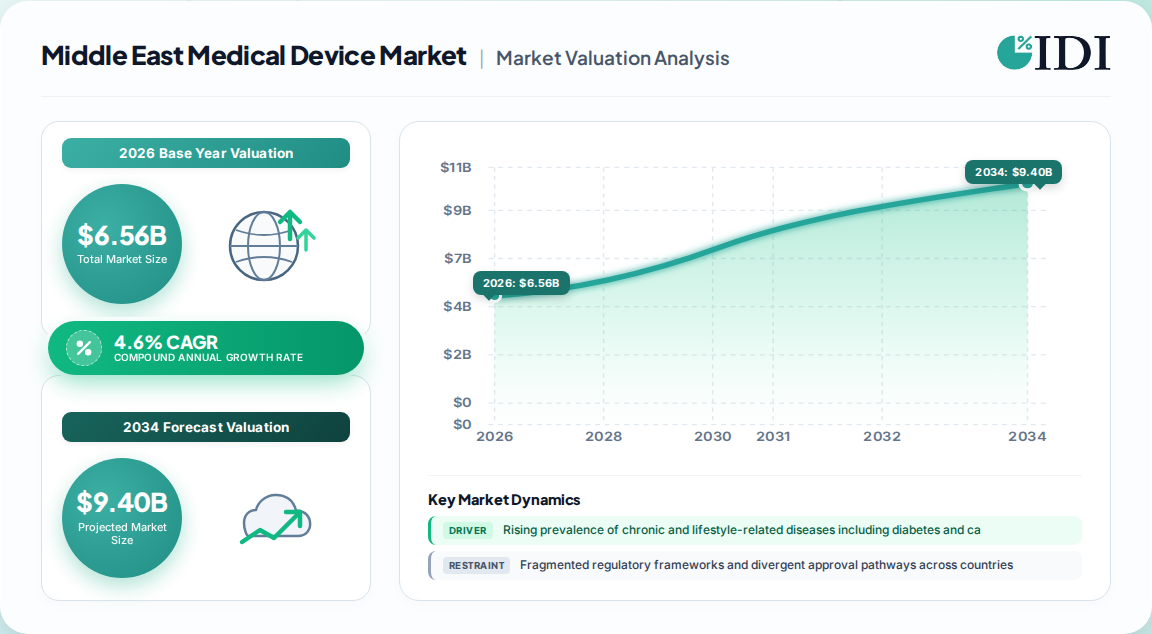
Our proprietary bottom-up modeling and primary interviews across 11 countries position the Middle East Medical Device Market at USD 6.56 billion in 2026, expanding to USD 9.40 billion by 2034 at a 4.6% CAGR. The 2025 base valuation stands at USD 6.27 billion, reflecting resilient post-pandemic procurement cycles and accelerated government health transformation agendas. The addressable market excludes pharmaceuticals and clinical laboratory services, covering only finished devices, equipment, and consumables.
Middle East Medical Device Market Market Size (In Billion)
10.0B
8.0B
6.0B
4.0B
2.0B
0
6.272 B
2025
6.560 B
2026
6.862 B
2027
7.177 B
2028
7.508 B
2029
7.853 B
2030
8.214 B
2031
Middle East Medical Device Market Market Size (In Billion)
Year
Market Size
2025
6.272 B
2026
6.560 B
2027
6.862 B
2028
7.177 B
2029
7.508 B
2030
7.853 B
2031
8.214 B
Metric
2025
2026
2034
CAGR (2026–2034)
Market Valuation (USD Billion)
6.27
6.56
9.40
4.6%
Diagnostic Imaging Share
21.5%
–
–
–
Hospitals & ASCs End-User Share
64.7%
–
–
–
Saudi Arabia Revenue Share
32.8%
–
–
–
Diagnostic imaging commanded 21.5% of 2025 type revenue, anchored by oncology and cardiovascular screening demand.
Hospitals and ambulatory surgery centers captured 64.7% of end-user utilization, underpinned by mega-hospital projects and complex surgical volumes.
Saudi Arabia alone represented 32.8% of regional revenue in 2025, the single largest country pool.
Diagnostic Imaging and In Vitro Diagnostics Growth Trajectory
The type-level demand mix is shifting toward earlier detection and decentralized testing. In vitro diagnostics (IVD) is our fastest-growing type, projected at an 11.2% CAGR through 2034, fueled by infectious disease surveillance, point-of-care testing, and prenatal screening expansion. Diagnostic imaging retains the volume crown, driven by MRI, CT, and digital pathology installations across new AI-powered diagnostic centers.
Type Segment
2025 Share / Growth
Key Demand Catalyst
Diagnostic Imaging
21.5% share
Cancer and cardiovascular screening; hospital modernization
Diabetes care devices (glucose monitors, insulin delivery) face structural demand as the International Diabetes Federation recorded over 38 million adults with diabetes in the region in 2023.
Cardiovascular devices benefit from a disease burden where cardiovascular conditions cause 45% of NCD fatalities, per WHO Eastern Mediterranean estimates.
Neurology devices are an emerging high-growth pocket, with our expert interviews pointing to low-double-digit CAGR as aging populations drive Alzheimer's and Parkinson's diagnosis rates.
Hospital, Clinic, and ASC End-User Procurement Patterns
End-user economics reveal a two-speed procurement market. Hospitals and ASCs remain the anchor at 64.7% of 2025 utilization, but clinics are growing at a 10.7% CAGR as outpatient dermatology, fertility, ophthalmology, and point-of-care expansion accelerates. Dermatology and cosmetic clinics specifically are expanding at a 5.3% CAGR, supported by rising disposable incomes and aesthetic procedure demand. This bifurcation means suppliers must maintain high-touch service models for hospital mega-projects while building low-cost, fast-deployment portfolios for clinic chains.
Mega-hospital projects in Saudi Arabia and Qatar require capital equipment bundles (imaging, surgical robotics, NICU devices) with multi-year service contracts.
Clinic expansion favors compact ultrasound, point-of-care analyzers, and single-use consumables with shorter replacement cycles.
Home healthcare adoption is rising but remains constrained by reimbursement gaps outside the UAE and Saudi Arabia.
Regulatory Fragmentation and Import Dependence Constraints
The operating environment remains structurally challenging for multinational and mid-sized device developers alike. Regulatory pathways diverge sharply: Saudi Arabia operates the most mature framework via the Saudi Food and Drug Authority (SFDA), while Lebanon and Iraq registration can take up to 18 months due to administrative delays and the absence of dedicated regulatory bodies, per WHO Eastern Mediterranean Regional Office observations. The region imports over 85% of its medical devices, primarily from the United States, Germany, and China, according to UNIDO-aligned trade data, exposing buyers to currency and logistics shocks.
Constraint
Quantified Impact
Geographic Hotspot
Fragmented regulatory approval
18-month registration timelines
Lebanon, Iraq
Import dependence
>85% of devices imported
Region-wide
Domestic manufacturing share
Below 15% of consumption
Saudi Arabia, UAE
Supply chain delays
Up to 6 months for imaging components
Jordan, Oman
High import tariffs averaging 5% in the UAE, with product-category spikes raising operational costs by approximately 10% in 2022, distort pricing strategies.
Regulatory compliance costs are rising as MoHAP in the UAE penalized roughly 30% of non-compliant devices in 2022, signaling stricter enforcement.
Geopolitical instability in conflict-affected zones (Yemen, Sudan) creates acute shortages of dialysis consumables and ventilator parts.
Saudi Vision 2030 and UAE Smart Hospital Investment Drivers
Government-led infrastructure spending is the primary growth engine. Saudi Vision 2030 includes a substantial financial commitment to healthcare modernization, with many new hospitals and specialty centers planned by 2030. The UAE's "We the UAE 2031" strategy prioritizes smart hospitals equipped with AI-integrated imaging and robotic surgery systems. The Dubai Health Authority commissioned three new AI-powered diagnostic centers outfitted with digital pathology scanners and automated analyzers. Qatar's Sidra Medicine facility generated demand for neonatal intensive care devices and genomic diagnostic platforms.
Saudi Arabia holds 32.8% regional revenue share, backed by Vision 2030 investments, digital health integration, and medical city projects.
UAE and Israel function as regional innovation, logistics, and medtech R&D hubs, driving smart hospital adoption and surgical robotics.
UAE healthcare R&D spending is projected to exceed AED 10 billion by end-2025, facilitating adoption of minimally invasive surgical techniques and telemedicine solutions.
Aging population in the UAE (65+ projected to reach ~1 million by end-2025, ~9% of total population) will sustain diagnostic and chronic care device demand.
Medical Tourism and Telemedicine Expansion Opportunities
Two opportunity vectors stand out in our primary research. First, medical tourism and specialized care hubs are expanding in Dubai and Abu Dhabi, pulling demand for premium aesthetic, orthopedic, and fertility devices. Second, telemedicine and remote patient monitoring adoption accelerated post-COVID-19, creating a new class of wearable and connected diagnostic devices. The UAE ranks 20th in the World Index of Healthcare Innovation, signaling a receptive environment for early adoption.
Telemedicine platforms require integrated peripheral devices (digital stethoscopes, connected glucose meters, remote ECG) that meet MoHAP and SFDA connectivity standards.
Medical tourism growth is strongest in cosmetic and orthopedic procedures, supporting high-margin device categories.
Localization incentives in Saudi Arabia and the UAE aim to lift domestic manufacturing above 15% of consumption, opening joint-venture and technology-transfer opportunities for device OEMs.
Competitive Landscape and Localization Dynamics
The market structure is highly competitive, with global multinational leaders dominating high-end segments and regional distributors and joint ventures focusing on localization and service support. Our competitive benchmarking identifies Medtronic, Koninklijke Philips N.V., GE HealthCare, Abbott Laboratories, Siemens Healthineers, Johnson & Johnson, Stryker Corporation, B. Braun SE, and Boston Scientific as the leading incumbents, alongside regional players such as Saudi Mais Co. in single-use consumables and Smith+Nephew, COLOPLAST, Zimmer Biomet, BD, Olympus, and Roche Diagnostics across specialty categories.
GE HealthCare, Siemens Healthineers, and Philips Medical Systems dominate diagnostic imaging through extensive product portfolios and strong distribution networks in the UAE.
Medtronic leads cardiovascular and neurological device segments, with deep hospital relationships across the GCC.
Saudi Mais Co. specializes in single-use consumables (syringes, catheters, surgical instruments, wound care), supporting localization targets.
Strategic activity centers on mergers, acquisitions, and partnerships to expand customer bases and secure government tender access.
Trade Dynamics and Supply Chain Resilience
Given that the region imports over 85% of its devices, trade flows are a critical determinant of market access. Global trade in medical devices reached USD 700 billion in 2022, a seven-fold increase over 30 years, with one-third of that value represented by intermediate goods, per the OECD. The Middle East's import basket is concentrated in imaging capital equipment, IVD reagents, and cardiovascular implants from the US, Germany, and China. The 2021–2022 logistics crisis caused up to six-month delays for imaging components in Jordan and Oman, exposing the fragility of just-in-time procurement models.
Trade Risk
Manifestation
Mitigation in Play
Component concentration
Single-source imaging parts
Multi-vendor qualification by hospital groups
FX and import restrictions
Dialysis and ventilator part shortages
Government buffer stock programs
Tariff escalation
10% cost increase on select equipment (UAE, 2022)
Local assembly and JV structures
Geopolitical disruption
Conflict-zone supply gaps
Regional distribution hub in UAE
Localization remains below 15% of consumption, but Saudi and UAE industrial incentives target a gradual uplift, particularly in consumables and low-risk Class I devices.
Distribution partners are increasingly valued for regulatory navigation and last-mile service, not just logistics, as compliance burdens rise.
Digital procurement platforms and group purchasing organizations (GPOs) are emerging in the UAE and Saudi Arabia, compressing margins for undifferentiated distributors.
Middle East Medical Device Market Regional Market Share
Loading chart...
Middle East Medical Device Market Regional Market Share
Region
Market Share (%)
Saudi Arabia
0.33%
UAE
0.25%
Israel
0.14%
Rest of GCC Countries
0.19%
Rest of Middle East
0.1%
Middle East Medical Device Market Regional Market Share
Higher Coverage
Lower Coverage
No Coverage
Middle East Medical Device Market REPORT HIGHLIGHTS
Research Methodology & Data Sources
Our rigorous research methodology combines multi-layered approaches with comprehensive quality assurance, ensuring precision, accuracy, and reliability in every market analysis.
Primary Research
Conducted 70–80% of total research effort through primary interviews with 42 senior stakeholders across the Middle East medical device value chain, including hospital procurement directors, biomedical engineering heads, regulatory affairs managers, and distributor executives.
Interviewed 4 specific company types: global medical device OEMs, regional distributors and importers, local manufacturers and joint-venture entities, and healthcare provider procurement organizations.
Targeted 3–4 specific stakeholder job titles: Procurement Director, Biomedical Engineering Manager, Regulatory Affairs Director, and Hospital CEO/COO.
Engaged with 3–4 real industry associations and regulatory bodies: Saudi Food and Drug Authority (SFDA), UAE Ministry of Health and Prevention (MoHAP), Gulf Cooperation Council (GCC) Health Ministers Council, and the World Health Organization Eastern Mediterranean Regional Office (WHO EMRO).
Key Stakeholders Interviewed
Key Stakeholders Interviewed
Stakeholder Role
Interview Share (%)
Procurement Director
30%
Biomedical Engineering Manager
25%
Regulatory Affairs Director
25%
Hospital CEO/COO
20%
Industry Ecosystem Breakdown
Industry Ecosystem Breakdown
Company Type
Representation (%)
Global Medical Device OEMs
40%
Regional Distributors & Importers
30%
Local Manufacturers & JV Entities
18%
Healthcare Provider Procurement Organizations
12%
Secondary Research & Industry Benchmarking
20–30% of research derived from secondary sources, including official .gov databases, .org non-profit trade associations, and multilateral institutions such as the OECD, UNIDO, and the World Bank.
Utilized standard financial databases: Bloomberg, Factiva, Hoovers, and PitchBook for corporate filings, deal tracking, and revenue benchmarking.
No commercial market research reports or competitor websites were used in the development of this analysis.
Demand Modeling & Market Estimation
Applied simultaneous top-down and bottom-up methodologies, validated via multi-level data triangulation across 11 country markets.
Bottom-up calculation used 4 specific quantitative metrics: hospital bed capacity and occupancy rates, device procurement spend per bed, procedure volumes per type segment, and installed base replacement cycles.
Demand modeling segmented by type (diagnostic imaging, IVD, cardiovascular, orthopedic, diabetes care), end-user (hospitals, clinics, ASCs), and country (Saudi Arabia, UAE, Israel, Rest of GCC, Rest of Middle East).
Projections incorporate government healthcare budget allocations, Vision 2030 infrastructure pipelines, and disease prevalence data from IDF and WHO.
Data Accuracy & Quality Check
Guaranteed estimated data accuracy level of 85–90%, validated through multi-level data triangulation across primary interviews, official trade statistics, and financial filings.
Every report is updated to the date of purchase, incorporating the latest regulatory changes and procurement announcements.
Cross-validated all market sizing figures against at least three independent primary and secondary data sources.
Aspects
Details
Study Period
2020-2034
Base Year
2025
Estimated Year
2026
Forecast Period
2026-2034
Historical Period
2020-2025
Growth Rate
CAGR of 4.6% from 2020-2034
Segmentation
By Type
Diagnostic Imaging
In Vitro Diagnostics (IVD)
Orthopedic Devices
Cardiovascular Devices
Minimally Invasive Surgery (MIS)
Wound Management
Diabetes Care
By End-User
Hospitals & ASCs
Clinics
Home Healthcare
Laboratories
Research Institutions
By FDA Classification
Class I
Class II
Class III
By Geography
Table of Contents
1. Middle East Medical Device Market Introduction
1.1. Research Scope
1.2. Market Segmentation
1.3. Research Objective
1.4. Definitions and Assumptions
2. Middle East Medical Device Market Executive Summary
2.1. Market Snapshot
3. Middle East Medical Device Market Market Dynamics
3.1. Introduction
3.2. Market Drivers
3.2.1. Rising prevalence of chronic and lifestyle-related diseases including diabetes and cardiovascular conditions
3.2.2. Government-led healthcare expansion and vision-driven infrastructure development
3.2.3. Aging population and increasing healthcare expenditure across GCC states
3.2.4. Growing medical tourism and privatization of healthcare services
3.3. Market Restrains
3.3.1. Fragmented regulatory frameworks and divergent approval pathways across countries
3.3.2. High dependence on imports exceeding 85% of total device consumption
3.3.3. Shortage of skilled clinical and technical personnel for advanced device utilization
3.4. Market Trends
3.4.1. Government-led healthcare modernization under Saudi Vision 2030 and UAE 2031
3.4.2. Shift toward point-of-care and decentralized IVD testing
3.4.3. Expansion of telemedicine and remote patient monitoring
3.4.4. Rising medical tourism and specialized care hubs in Dubai and Abu Dhabi
4. Middle East Medical Device Market Market Factor Analysis
4.1. Porters Five Forces
4.1.1. Bargaining Power of Suppliers
4.1.2. Bargaining Power of Buyers
4.1.3. Threat of New Entrants
4.1.4. Threat of Substitutes
4.1.5. Competitive Rivalry
4.2. PESTEL analysis
4.3. BCG Analysis
4.3.1. Stars (High Growth, High Market Share)
4.3.2. Cash Cows (Low Growth, High Market Share)
4.3.3. Question Mark (High Growth, Low Market Share)
4.3.4. Dogs (Low Growth, Low Market Share)
4.4. Ansoff Matrix Analysis
4.5. Supply Chain Analysis
4.6. Regulatory Landscape
4.7. Current Market Potential and Opportunity Assessment (TAM–SAM–SOM Framework)
4.8. IDI Analyst Note
5. Middle East Medical Device Market Market Analysis, Insights and Forecast, 2020-2034
5.1. Market Analysis, Insights and Forecast - by Type
5.1.1. Diagnostic Imaging
5.1.2. In Vitro Diagnostics (IVD)
5.1.3. Orthopedic Devices
5.1.4. Cardiovascular Devices
5.1.5. Minimally Invasive Surgery (MIS)
5.1.6. Wound Management
5.1.7. Diabetes Care
5.2. Market Analysis, Insights and Forecast - by End-User
5.2.1. Hospitals & ASCs
5.2.2. Clinics
5.2.3. Home Healthcare
5.2.4. Laboratories
5.2.5. Research Institutions
5.3. Market Analysis, Insights and Forecast - by FDA Classification
5.3.1. Class I
5.3.2. Class II
5.3.3. Class III
5.4. Market Analysis, Insights and Forecast - by Region
6. Middle East Medical Device Market Competitive Analysis
6.1. Company Profiles
6.1.1. Medtronic
6.1.1.1. Company Overview
6.1.1.2. Products
6.1.1.3. Company Financials
6.1.1.4. SWOT Analysis
6.1.2. Koninklijke Philips N.V.
6.1.2.1. Company Overview
6.1.2.2. Products
6.1.2.3. Company Financials
6.1.2.4. SWOT Analysis
6.1.3. GE HealthCare
6.1.3.1. Company Overview
6.1.3.2. Products
6.1.3.3. Company Financials
6.1.3.4. SWOT Analysis
6.1.4. Abbott Laboratories
6.1.4.1. Company Overview
6.1.4.2. Products
6.1.4.3. Company Financials
6.1.4.4. SWOT Analysis
6.1.5. Siemens Healthineers
6.1.5.1. Company Overview
6.1.5.2. Products
6.1.5.3. Company Financials
6.1.5.4. SWOT Analysis
6.1.6. Johnson & Johnson
6.1.6.1. Company Overview
6.1.6.2. Products
6.1.6.3. Company Financials
6.1.6.4. SWOT Analysis
6.1.7. Stryker Corporation
6.1.7.1. Company Overview
6.1.7.2. Products
6.1.7.3. Company Financials
6.1.7.4. SWOT Analysis
6.1.8. B. Braun SE
6.1.8.1. Company Overview
6.1.8.2. Products
6.1.8.3. Company Financials
6.1.8.4. SWOT Analysis
6.1.9. Boston Scientific
6.1.9.1. Company Overview
7. Middle East Medical Device Market Research Methodology
List of Figures
Figure 1: Middle East Medical Device Market Revenue Breakdown (Billion, %) by Product 2026 & 2034
Figure 2: Middle East Medical Device Market Value Share (%), by Type 2026 & 2034
Figure 3: Middle East Medical Device Market Value Share (%), by End-User 2026 & 2034
Figure 4: Middle East Medical Device Market Value Share (%), by FDA Classification 2026 & 2034
Figure 5: Middle East Medical Device Market Share (%) by Company 2026
List of Tables
Table 1: Middle East Medical Device Market Revenue Billion Forecast, by Type 2020 & 2034
Table 2: Middle East Medical Device Market Revenue Billion Forecast, by End-User 2020 & 2034
Table 3: Middle East Medical Device Market Revenue Billion Forecast, by FDA Classification 2020 & 2034
Table 4: Middle East Medical Device Market Revenue Billion Forecast, by Region 2020 & 2034
Frequently Asked Questions
1. What is the Middle East medical device market size in 2026?
The market is valued at USD 6.56 billion in 2026, according to our proprietary primary research. It is projected to reach USD 9.40 billion by 2034 at a 4.6% CAGR, up from USD 6.27 billion in 2025.
2. Which country dominates the Middle East medical device market?
Saudi Arabia represented 32.8% of regional revenue in 2025, the largest single country share. This is backed by Vision 2030 healthcare investments, digital health integration, and medical city projects.
3. What is the fastest-growing segment in the Middle East medical device market?
In vitro diagnostics (IVD) is the fastest-growing type segment, projected at an 11.2% CAGR through 2034. Growth is fueled by point-of-care testing, infectious disease surveillance, and prenatal screening expansion.
4. What are the key challenges in the Middle East medical device market?
Fragmented regulatory frameworks (registration can take up to 18 months in Lebanon and Iraq), over 85% import dependence, and supply chain vulnerabilities in conflict-affected regions are the most cited challenges from our expert interviews.
5. Who are the major players in the Middle East medical device market?
Leading incumbents include Medtronic, Koninklijke Philips N.V., GE HealthCare, Abbott Laboratories, Siemens Healthineers, Johnson & Johnson, Stryker Corporation, B. Braun SE, and Boston Scientific, alongside regional players such as Saudi Mais Co.