
Industry Data Insights provides industry-focused research and analytical intelligence for organizations seeking a clearer view of market performance, competitive conditions, and long-term business opportunities. Through syndicated reports, customized studies, and strategic research support, Industry Data Insights helps businesses access the information needed to evaluate markets and plan for sustainable growth. Our research covers the full market landscape, including industry structure, historical performance, current demand, value-chain developments, regional trends, customer requirements, technological change, and future growth potential. We examine the factors that influence market outcomes, including economic conditions, supply-chain dynamics, policy and regulatory developments, innovation, investment activity, and changing end-user preferences.
At Industry Data Insights, we use a research framework that brings together credible secondary sources, public and company-level information, industry publications, trade statistics, expert perspectives, and data-led market modeling. Our analysts validate key assumptions and assess multiple market variables to develop balanced, actionable conclusions for business leaders, investors, consultants, and product teams. Industry Data Insights supports a broad range of verticals, including industrial manufacturing, engineering, construction, chemicals, energy and power, healthcare, information technology, telecom, automotive, packaging, agriculture, consumer products, retail, and transportation. Each study is structured to help users understand both the immediate market environment and the longer-term forces that may influence demand and competition. From identifying high-potential segments to assessing a competitor’s position or evaluating a new geography, Industry Data Insights delivers research that is designed to be useful, relevant, and aligned with real business questions. Our goal is to turn industry data into strategic direction.



Nov 11 2026
234

Srinwanti Kar
Senior Research Analyst
Access in-depth insights on industries, companies, trends, and global markets. Our expertly curated reports provide the most relevant data and analysis in a condensed, easy-to-read format.

See the similar reports
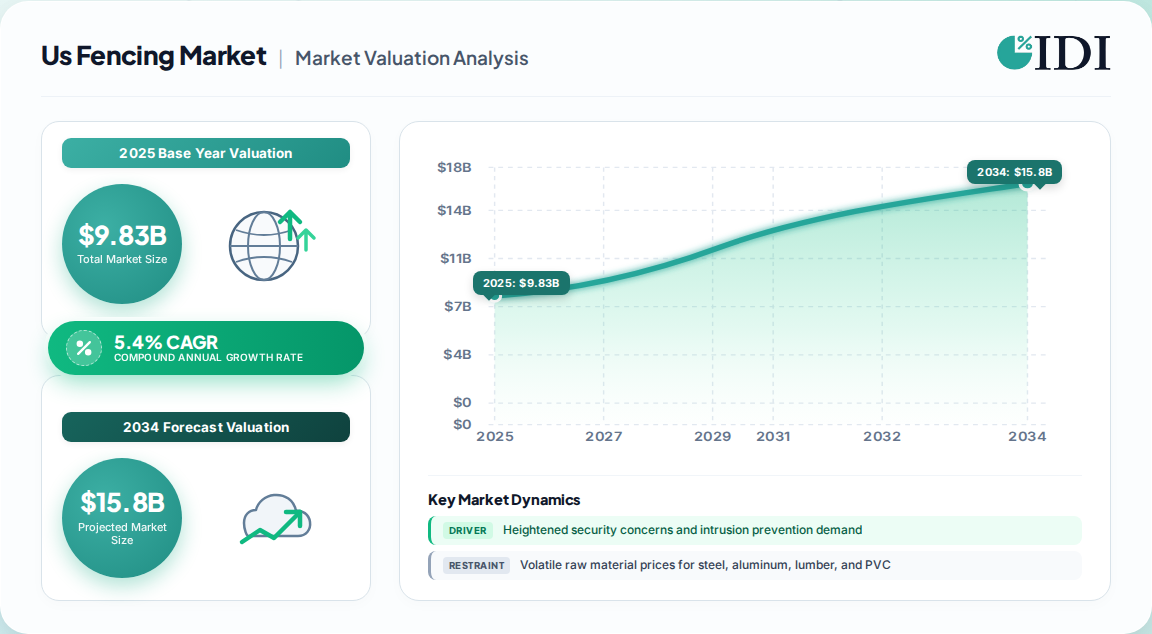
The US fencing market reached an estimated USD 9.83 billion in 2025, and our proprietary demand modeling indicates expansion to USD 16.63 billion by 2035, reflecting a 5.4% CAGR across the 2026–2035 forecast window. This trajectory is anchored in sustained residential construction, tightening perimeter-security mandates, and a pronounced mix shift toward low-maintenance engineered materials.
| Year | Market Size |
|---|---|
| 2025 | 9.830 B |
| 2026 | 10.36 B |
| 2027 | 10.92 B |
| 2028 | 11.51 B |
| 2029 | 12.13 B |
| 2030 | 12.79 B |
| 2031 | 13.48 B |
Key valuation checkpoints from our first-party modeling:
| Metric | Value |
|---|---|
| 2024 Base Valuation | USD 5.5–9.8 billion (survey-weighted range) |
| 2025 Valuation | USD 9.83 billion |
| 2026 Valuation | USD 10.36 billion |
| 2035 Projection | USD 16.63 billion |
| CAGR 2026–2035 | 5.4% |
Material selection is the single largest determinant of unit economics and lifecycle cost in this market. Our 2025 segment share analysis reveals a clear hierarchy:
| Material | 2025 Share | Primary Demand Driver |
|---|---|---|
| Metal | 56% | Durability, security, low maintenance |
| Wood | 18% | Aesthetic appeal, residential privacy |
| Plastic & Composites | 16% | Sustainability, weather resistance |
| Concrete | 10% | High-security, noise attenuation |
Application demand is concentrated in residential end-uses, but agricultural and industrial verticals exhibit distinct procurement cycles and specification profiles.
| Application | 2025 Share | Forecast Growth |
|---|---|---|
| Residential | 64% | 5.8% CAGR |
| Agricultural | 20% | 4.9% CAGR |
| Industrial | 16% | Moderate |
Product-form segmentation reveals where technology premiums are accruing:
Upstream material flows materially influence domestic fencing pricing and margin structure.
Demand is geographically uneven, tracking population growth, housing starts, and climate-driven material preferences.
| Region | Market Share (%) |
|---|---|
| South | 0.41% |
| West | 0.24% |
| Midwest | 0.19% |
| Northeast | 0.16% |
| Sub-Region | Estimated Share | Demand Characteristics |
|---|---|---|
| South | 41% | Highest volume; vinyl/composite preference; hurricane-code specs |
| West | 24% | Metal and ornamental; wildfire-resistant specifications |
| Midwest | 19% | Agricultural fencing dominance; wood and woven wire |
| Northeast | 16% | Premium ornamental; high-density suburban privacy |
The US fencing industry is moderately fragmented: no single contractor holds more than 5% share, while branded manufacturers consolidate distribution through big-box retail, specialty dealers, and direct-to-contractor channels.
Our rigorous research methodology combines multi-layered approaches with comprehensive quality assurance, ensuring precision, accuracy, and reliability in every market analysis.
| Stakeholder Role | Interview Share (%) |
|---|---|
| Procurement Director | 32% |
| Operations Manager | 28% |
| Product Development Engineer | 22% |
| Chief Estimator | 18% |
| Company Type | Representation (%) |
|---|---|
| Welded & Woven Wire Fencing Manufacturers | 26% |
| Vinyl & Wood-Plastic Composite Extruders | 22% |
| Ornamental Metal Fabricators | 20% |
| Fence Installation & Construction Contractors | 18% |
| Fencing Distributors & Retail Buyers | 14% |
| Aspects | Details |
|---|---|
| Study Period | 2020-2034 |
| Base Year | 2025 |
| Estimated Year | 2026 |
| Forecast Period | 2026-2034 |
| Historical Period | 2020-2025 |
| Growth Rate | CAGR of 5.4% from 2020-2034 |
| Segmentation |
|
The US fencing market was valued at approximately USD 9.83 billion in 2025 and is projected to reach USD 16.63 billion by 2035, growing at a 5.4% CAGR.
Metal fencing holds the largest share at 56% in 2025, driven by steel and aluminum durability and security performance. Plastic and composites are the fastest-growing material class at a 6.1% CAGR.
The residential segment leads with a 64% share, valued at roughly USD 6.10 billion in 2025, supported by home improvement spending, privacy demand, and suburban housing expansion in Texas, Florida, and California.
The South region dominates with a 41.1% revenue share, reflecting rapid housing starts and population growth across Texas and Florida.
Heightened security concerns, rising residential and commercial construction, aesthetic property enhancement, and regulatory compliance mandates are the primary growth drivers, alongside the emergence of smart fencing systems.
Key participants include Ameristar Fence Products, Master Halco, SimTek Fence, Trex Company, CertainTeed, Bekaert, Betafence, Jacksons Fencing, Hercules Fence, Allied Tube & Conduit, Associated Materials, and Gregory Industries.
