Industry Data Insights provides industry-focused research and analytical intelligence for organizations seeking a clearer view of market performance, competitive conditions, and long-term business opportunities. Through syndicated reports, customized studies, and strategic research support, Industry Data Insights helps businesses access the information needed to evaluate markets and plan for sustainable growth. Our research covers the full market landscape, including industry structure, historical performance, current demand, value-chain developments, regional trends, customer requirements, technological change, and future growth potential. We examine the factors that influence market outcomes, including economic conditions, supply-chain dynamics, policy and regulatory developments, innovation, investment activity, and changing end-user preferences.
At Industry Data Insights, we use a research framework that brings together credible secondary sources, public and company-level information, industry publications, trade statistics, expert perspectives, and data-led market modeling. Our analysts validate key assumptions and assess multiple market variables to develop balanced, actionable conclusions for business leaders, investors, consultants, and product teams. Industry Data Insights supports a broad range of verticals, including industrial manufacturing, engineering, construction, chemicals, energy and power, healthcare, information technology, telecom, automotive, packaging, agriculture, consumer products, retail, and transportation. Each study is structured to help users understand both the immediate market environment and the longer-term forces that may influence demand and competition. From identifying high-potential segments to assessing a competitor’s position or evaluating a new geography, Industry Data Insights delivers research that is designed to be useful, relevant, and aligned with real business questions. Our goal is to turn industry data into strategic direction.
UK Pet Food Market Size, Trends & Forecast to 2030
Uk Pet Food Market by Product (Dry Pet Food, Wet Pet Food, Snacks/Treats, Pet Nutraceuticals/Supplements, Pet Veterinary Diets), by Pet Type (Dogs, Cats, Other Pets), by Category (Premium, Mainstream, Economy), by Distribution Channel (Supermarkets/Hypermarkets, Specialty Stores, Online Channel, Convenience Stores, Other Channels), Forecast 2026-2034
UK Pet Food Market Size, Trends & Forecast to 2030
Discover the Latest Market Insight Reports
Access in-depth insights on industries, companies, trends, and global markets. Our expertly curated reports provide the most relevant data and analysis in a condensed, easy-to-read format.
UK Pet Food Market Valuation and Growth Trajectory
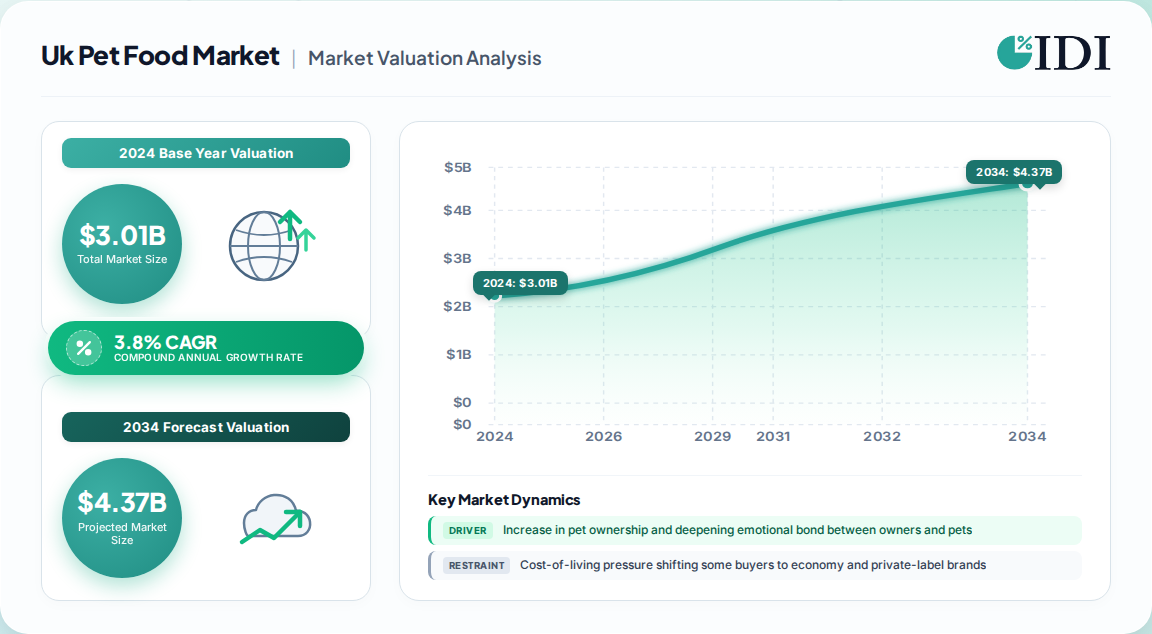
The UK pet food market was estimated at USD 3.01 billion in 2024 and is projected to expand at a CAGR of 3.8% from 2025 to 2030. This growth is anchored in sustained pet ownership levels—13.5 million dogs and 12.5 million cats in 2024, each rising by 1.5 million year-on-year—and a deepening emotional bond between owners and companion animals.
Uk Pet Food Market Market Size (In Billion)
4.0B
3.0B
2.0B
1.0B
0
3.124 B
2025
3.243 B
2026
3.366 B
2027
3.494 B
2028
3.627 B
2029
3.765 B
2030
3.908 B
2031
Uk Pet Food Market Market Size (In Billion)
Year
Market Size
2025
3.124 B
2026
3.243 B
2027
3.366 B
2028
3.494 B
2029
3.627 B
2030
3.765 B
2031
3.908 B
Humanization of pets is the single largest demand driver, lifting average unit prices as owners demand human-grade, transparently sourced recipes.
Single-person and senior households are adopting companion animals at a rising rate, sustaining volume growth and favoring portion-controlled packs and auto-replenishment.
Digital commerce now accounts for a material share of purchases; online pet food sales are forecast to grow at a 6.1% CAGR through 2031, outpacing all physical channels.
Metric
Value
Base-year market size (2024)
USD 3.01 billion
Forecast CAGR (2025–2030)
3.8%
Dog population (2024)
13.5 million
Cat population (2024)
12.5 million
Average weekly household spend on pet food
GBP 2.8–3.4
Dry Kibble Dominance and Functional Formulation Trends
Dry pet food accounted for a 59.2% revenue share in 2024, underpinned by convenience, longer shelf life, cost-effectiveness per kilogram, and dental benefits from kibble abrasion. The segment's resilience is reinforced by a widening array of specialized dry formulas—grain-free, high-protein, breed-specific, and life-stage diets—that command premium price points.
Wet food retains a stable share in cat nutrition, where pouch and tray formats align with single-serve convenience and moisture intake.
Snacks and treats are the fastest-growing product tier at a 4.1% CAGR (2025–2030), propelled by functional claims (joint support, dental care, calming) and the use of treats as a bonding and training mechanism.
Veterinary and therapeutic diets are gaining ground as owners seek clinically endorsed nutrition for allergies, obesity, and chronic conditions.
Premiumization and Natural Ingredient Consumer Preferences
UK consumers are increasingly ingredient-literate, scrutinizing labels for artificial additives, preservatives, and fillers. This has shifted demand decisively toward premium, natural, and organic offerings.
Grain-free, raw, freeze-dried, and high-protein formats are gaining traction, especially among urban and health-conscious pet parents influenced by human food trends.
Functional benefits—joint support, digestion aid, skin and coat health, weight management—are decisive purchase criteria, with owners willing to pay a premium for formulas aligned to specific health needs.
Clean-label and limited-ingredient products are proliferating, alongside breed- and age-specific nutrition plans.
Boutique and challenger brands emphasizing locally sourced ingredients and sustainable packaging are capturing share in specialty retail and online. Newer entrants are commercializing insect-based and cultivated proteins, meeting demand from eco-conscious owners.
Alternative Protein Innovation and Sustainable Sourcing
The UK became the first European country to approve lab-grown meat for pet food, a regulatory milestone that signals a structural shift toward greener protein choices. In February 2025, the world's first lab-grown meat dog treats—combining plant-based ingredients with cultivated chicken—were launched in the UK market.
Insect-based proteins are being positioned as low-carbon, hypoallergenic alternatives in dry and treat formats.
Up-cycled and circular-economy ingredients are attracting early-adopter segments and aligning with retailer sustainability mandates.
Recyclable and refillable packaging is becoming a brand differentiator as environmental scrutiny on meat-based carbon footprints intensifies.
Omnichannel Distribution and Subscription Commerce
Supermarkets and hypermarkets controlled a 33.3% share in 2025, but the online channel is the fastest-growing route to market at a 6.1% CAGR through 2031. As of 2022, approximately 37.7% of pet food purchases were conducted online, a share expected to exceed 43% by 2029.
Subscription models offering tailored meal plans, home delivery, and auto-replenishment appeal to busy owners and younger demographics valuing digital convenience.
Direct-to-consumer brands bypass shelf-space constraints, deploy targeted advertising, and use first-party data to refine formulations.
Specialty stores and veterinary clinics remain critical gatekeepers for therapeutic and premium diets, lending clinical credibility to new entrants.
Import Dependence and Post-Brexit Trade Dynamics
The UK is a net importer of pet food, with imports exceeding USD 1.7 billion in 2024, up over 57% since 2014, while exports of dog and cat food were approximately USD 391 million. France and Germany are the leading countries of origin.
Trade Flow
Value (2024)
Key Partners
Imports
USD 1.7+ billion
France, Germany, Netherlands
Exports
USD 391 million
EU member states, Ireland
Post-Brexit regulatory divergence—Export Health Certificates, veterinary inspections, and customs friction—raises import costs and squeezes margins for import-dependent manufacturers.
Currency volatility adds landed-cost uncertainty, prompting brands to invest in domestic capacity and near-shoring of supply.
Conversely, UK-manufactured premium and specialist products retain export traction in EU markets, supported by recognized food-safety standards.
Competitive Landscape and Strategic Brand Positioning
The market is characterized by low concentration, with global incumbents coexisting alongside agile premium and boutique challengers.
Global leaders—Mars Incorporated, Nestlé Purina, Hill's Pet Nutrition (Colgate-Palmolive), Royal Canin, and Pedigree—dominate mainstream retail and veterinary-recommended segments through longstanding nutritional research and quality reputations.
Premium and boutique brands—Lily's Kitchen, Edgard & Cooper, Forthglade, and Pooch & Mutt—emphasize natural, locally sourced ingredients and sustainable packaging, resonating with ethically minded consumers.
Emerging innovators—Yora and Scrumbles—are commercializing insect-based and alternative proteins, targeting eco-conscious owners.
Retail consolidation is squeezing smaller brands' shelf space, while cost-of-living pressure prompts some trading down to private-label lines. Premium players are responding with value extensions and smaller pack sizes to retain price-sensitive users.
Uk Pet Food Market REPORT HIGHLIGHTS
Research Methodology & Data Sources
Our rigorous research methodology combines multi-layered approaches with comprehensive quality assurance, ensuring precision, accuracy, and reliability in every market analysis.
Primary Research
70–80% of the research effort is dedicated to primary research, engaging stakeholders across the UK pet food value chain via structured interviews, CATI surveys, and expert panels.
We interview 4–5 specific company types: pet food manufacturers (extrusion and wet-format producers), ingredient and functional-additive suppliers, contract packers and private-label producers, specialist pet retailers and online marketplaces, and veterinary diet distributors.
Target stakeholder job titles include Procurement Director, Head of Product Development, Category Manager (Pet Care), and Veterinary Nutrition Advisor.
Primary interviews are conducted with 3–4 real industry associations and regulatory bodies for validation: UK Pet Food (formerly PFMA), the Food Standards Agency (FSA), the European Commission's Directorate-General for Health and Food Safety (animal feed unit), and the British Veterinary Association (BVA).
3–4 specific quantitative metrics captured at source include average weekly household expenditure on pet food (GBP 2.8–3.4), kilograms of dry kibble purchased per household per annum, online share of category purchases (37.7% in 2022), and import volumes of dog and cat food (HS 230910) into the UK.
Key Stakeholders Interviewed
Key Stakeholders Interviewed
Stakeholder Role
Interview Share (%)
Procurement Director
30%
Head of Product Development
25%
Category Manager (Pet Care)
25%
Veterinary Nutrition Advisor
20%
Industry Ecosystem Breakdown
Industry Ecosystem Breakdown
Company Type
Representation (%)
Pet Food Manufacturers (Dry & Wet)
35%
Ingredient & Functional Additive Suppliers
20%
Contract Packers & Private-Label Producers
20%
Specialist Retailers & Online Marketplaces
15%
Veterinary Diet Distributors
10%
Secondary Research & Industry Benchmarking
20–30% of the research effort draws on secondary sources, including official trade statistics from UN Comtrade and the World Bank WITS database for HS 230910 trade flows, Eurostat for EU-UK pet food trade, and FAO feed-sector data.
Financial and corporate data are sourced from Bloomberg, Factiva, Hoovers, and PitchBook, alongside company annual reports and filings.
All sources are triangulated; no commercial market research firm data is used.
Demand Modeling & Market Estimation
We employ top-down and bottom-up methodologies simultaneously, validated via multi-level data triangulation across product, pet type, and distribution channel.
The bottom-up model is built from per-capita pet food consumption (kilograms per dog and cat per annum), pet population counts (13.5 million dogs and 12.5 million cats in 2024), and average price per kilogram by product tier.
The top-down model reconciles category retail sales from channel-level data (supermarkets 33.3% share, online 37.7% of purchases) against total household expenditure (GBP 2.8–3.4 per week).
Segment-level CAGRs—dry food at 59.2% share, treats at 4.1% CAGR, online at 6.1% CAGR—are cross-validated against historical trade volumes and manufacturer shipment data.
Data Accuracy & Quality Check
We guarantee an estimated data accuracy level of 85–90%, achieved through multi-level triangulation and expert review.
Every report is updated to the date of purchase, incorporating the latest available trade statistics, regulatory changes, and company developments.
Outlier screening and sanity checks are applied to all quantitative inputs; discrepancies between primary and secondary sources are resolved through follow-up interviews.
Final estimates are validated by a senior analyst panel and cross-checked against official import/export data (USD 1.7 billion imports in 2024).
Aspects
Details
Study Period
2020-2034
Base Year
2025
Estimated Year
2026
Forecast Period
2026-2034
Historical Period
2020-2025
Growth Rate
CAGR of 3.8% from 2020-2034
Segmentation
By Product
Dry Pet Food
Wet Pet Food
Snacks/Treats
Pet Nutraceuticals/Supplements
Pet Veterinary Diets
By Pet Type
Dogs
Cats
Other Pets
By Category
Premium
Mainstream
Economy
By Distribution Channel
Supermarkets/Hypermarkets
Specialty Stores
Online Channel
Convenience Stores
Other Channels
By Geography
Table of Contents
1. Uk Pet Food Market Introduction
1.1. Research Scope
1.2. Market Segmentation
1.3. Research Objective
1.4. Definitions and Assumptions
2. Uk Pet Food Market Executive Summary
2.1. Market Snapshot
3. Uk Pet Food Market Market Dynamics
3.1. Introduction
3.2. Market Drivers
3.2.1. Increase in pet ownership and deepening emotional bond between owners and pets
3.2.2. Growth in single-person and senior households adopting companion animals
3.2.4. Focus on functional ingredients and veterinary-endorsed therapeutic diets
3.3. Market Restrains
3.3.1. Cost-of-living pressure shifting some buyers to economy and private-label brands
3.3.2. Post-Brexit regulatory divergence and border friction raising import costs
3.3.3. Retail consolidation squeezing smaller brand shelf space
3.3.4. Sustainability scrutiny on meat-based carbon footprints
3.4. Market Trends
3.4.1. Premiumization and humanization of pets driving demand for human-grade, functional, and grain-free recipes
3.4.2. Rapid growth of online and subscription-based pet food retail channels
3.4.3. Rising interest in alternative proteins including insect-based and lab-grown pet food, Clean-label, limited-ingredient, and breed-specific nutrition gaining share
4. Uk Pet Food Market Market Factor Analysis
4.1. Porters Five Forces
4.1.1. Bargaining Power of Suppliers
4.1.2. Bargaining Power of Buyers
4.1.3. Threat of New Entrants
4.1.4. Threat of Substitutes
4.1.5. Competitive Rivalry
4.2. PESTEL analysis
4.3. BCG Analysis
4.3.1. Stars (High Growth, High Market Share)
4.3.2. Cash Cows (Low Growth, High Market Share)
4.3.3. Question Mark (High Growth, Low Market Share)
4.3.4. Dogs (Low Growth, Low Market Share)
4.4. Ansoff Matrix Analysis
4.5. Supply Chain Analysis
4.6. Regulatory Landscape
4.7. Current Market Potential and Opportunity Assessment (TAM–SAM–SOM Framework)
4.8. IDI Analyst Note
5. Uk Pet Food Market Market Analysis, Insights and Forecast, 2020-2034
5.1. Market Analysis, Insights and Forecast - by Product
5.1.1. Dry Pet Food
5.1.2. Wet Pet Food
5.1.3. Snacks/Treats
5.1.4. Pet Nutraceuticals/Supplements
5.1.5. Pet Veterinary Diets
5.2. Market Analysis, Insights and Forecast - by Pet Type
5.2.1. Dogs
5.2.2. Cats
5.2.3. Other Pets
5.3. Market Analysis, Insights and Forecast - by Category
5.3.1. Premium
5.3.2. Mainstream
5.3.3. Economy
5.4. Market Analysis, Insights and Forecast - by Distribution Channel
5.4.1. Supermarkets/Hypermarkets
5.4.2. Specialty Stores
5.4.3. Online Channel
5.4.4. Convenience Stores
5.4.5. Other Channels
5.5. Market Analysis, Insights and Forecast - by Region
6. Uk Pet Food Market Competitive Analysis
6.1. Company Profiles
6.1.1. Mars Incorporated
6.1.1.1. Company Overview
6.1.1.2. Products
6.1.1.3. Company Financials
6.1.1.4. SWOT Analysis
6.1.2. Nestlé Purina
6.1.2.1. Company Overview
6.1.2.2. Products
6.1.2.3. Company Financials
6.1.2.4. SWOT Analysis
6.1.3. Hill's Pet Nutrition (Colgate-Palmolive)
6.1.3.1. Company Overview
6.1.3.2. Products
6.1.3.3. Company Financials
6.1.3.4. SWOT Analysis
6.1.4. Royal Canin
6.1.4.1. Company Overview
6.1.4.2. Products
6.1.4.3. Company Financials
6.1.4.4. SWOT Analysis
6.1.5. Pedigree
6.1.5.1. Company Overview
6.1.5.2. Products
6.1.5.3. Company Financials
6.1.5.4. SWOT Analysis
6.1.6. Lily's Kitchen
6.1.6.1. Company Overview
6.1.6.2. Products
6.1.6.3. Company Financials
6.1.6.4. SWOT Analysis
6.1.7. Edgard & Cooper
6.1.7.1. Company Overview
6.1.7.2. Products
6.1.7.3. Company Financials
6.1.7.4. SWOT Analysis
6.1.8. Forthglade
6.1.8.1. Company Overview
6.1.8.2. Products
6.1.8.3. Company Financials
6.1.8.4. SWOT Analysis
6.1.9. Pooch & Mutt
6.1.9.1. Company Overview
6.1.9.2. Products
7. Uk Pet Food Market Research Methodology
List of Figures
Figure 1: Uk Pet Food Market Revenue Breakdown (Billion, %) by Product 2026 & 2034
Figure 2: Uk Pet Food Market Value Share (%), by Product 2026 & 2034
Figure 3: Uk Pet Food Market Value Share (%), by Pet Type 2026 & 2034
Figure 4: Uk Pet Food Market Value Share (%), by Category 2026 & 2034
Figure 5: Uk Pet Food Market Value Share (%), by Distribution Channel 2026 & 2034
Figure 6: Uk Pet Food Market Share (%) by Company 2026
List of Tables
Table 1: Uk Pet Food Market Revenue Billion Forecast, by Product 2020 & 2034
Table 2: Uk Pet Food Market Revenue Billion Forecast, by Pet Type 2020 & 2034
Table 3: Uk Pet Food Market Revenue Billion Forecast, by Category 2020 & 2034
Table 4: Uk Pet Food Market Revenue Billion Forecast, by Distribution Channel 2020 & 2034
Table 5: Uk Pet Food Market Revenue Billion Forecast, by Region 2020 & 2034
Frequently Asked Questions
1. What is the size of the UK pet food market?
The UK pet food market was estimated at USD 3.01 billion in 2024 and is projected to reach higher valuations by 2030, growing at a CAGR of 3.8% from 2025 to 2030.
2. Which product segment dominates the UK pet food market?
Dry pet food accounted for a 59.2% revenue share in 2024, driven by convenience, longer shelf life, and dental health benefits, while snacks and treats are the fastest-growing segment at a 4.1% CAGR.
3. How large is the UK pet population?
In 2024, the UK had 13.5 million dogs and 12.5 million cats, each increasing by 1.5 million from the previous year, sustaining demand for pet food across all segments.
4. What share of UK pet food purchases are made online?
As of 2022, approximately 37.7% of pet food purchases were conducted online, a share expected to grow to over 43% by 2029, with online sales forecast to grow at a 6.1% CAGR through 2031.
5. Who are the leading companies in the UK pet food market?
Major players include Mars Incorporated, Nestlé Purina, Hill's Pet Nutrition (Colgate-Palmolive), Royal Canin, and Pedigree, alongside premium challengers such as Lily's Kitchen, Edgard & Cooper, Forthglade, and Pooch & Mutt.