Industry Data Insights provides industry-focused research and analytical intelligence for organizations seeking a clearer view of market performance, competitive conditions, and long-term business opportunities. Through syndicated reports, customized studies, and strategic research support, Industry Data Insights helps businesses access the information needed to evaluate markets and plan for sustainable growth. Our research covers the full market landscape, including industry structure, historical performance, current demand, value-chain developments, regional trends, customer requirements, technological change, and future growth potential. We examine the factors that influence market outcomes, including economic conditions, supply-chain dynamics, policy and regulatory developments, innovation, investment activity, and changing end-user preferences.
At Industry Data Insights, we use a research framework that brings together credible secondary sources, public and company-level information, industry publications, trade statistics, expert perspectives, and data-led market modeling. Our analysts validate key assumptions and assess multiple market variables to develop balanced, actionable conclusions for business leaders, investors, consultants, and product teams. Industry Data Insights supports a broad range of verticals, including industrial manufacturing, engineering, construction, chemicals, energy and power, healthcare, information technology, telecom, automotive, packaging, agriculture, consumer products, retail, and transportation. Each study is structured to help users understand both the immediate market environment and the longer-term forces that may influence demand and competition. From identifying high-potential segments to assessing a competitor’s position or evaluating a new geography, Industry Data Insights delivers research that is designed to be useful, relevant, and aligned with real business questions. Our goal is to turn industry data into strategic direction.
Paints and Coatings Market Size, Share & Forecast 2026-2033
Paints and Coatings Market Size, Share & Forecast 2026-2033
Paints Coatings Market by Resin (Acrylic, Alkyd, Polyurethane, Epoxy, Others), by Technology (Waterborne, Solvent-borne, Powder Coating, UV-Cured Coating, Radiation-cured), by End-User Industry (Architectural, Automotive, Wood, Protective Coating, Packaging, Others), by Product (Waterborne Coatings, Solvent-borne Coatings, Powder Coatings, Radiation-cured Coatings), by North America (USA, Canada, Mexico), by Europe (Germany, UK, France, Italy, Spain), by Asia Pacific (China, India, Japan, South Korea, Southeast Asia), by South America (Brazil, Argentina), by Middle East & Africa (Saudi Arabia, UAE, South Africa) Forecast 2026-2034
Paints and Coatings Market Size, Share & Forecast 2026-2033
Discover the Latest Market Insight Reports
Access in-depth insights on industries, companies, trends, and global markets. Our expertly curated reports provide the most relevant data and analysis in a condensed, easy-to-read format.
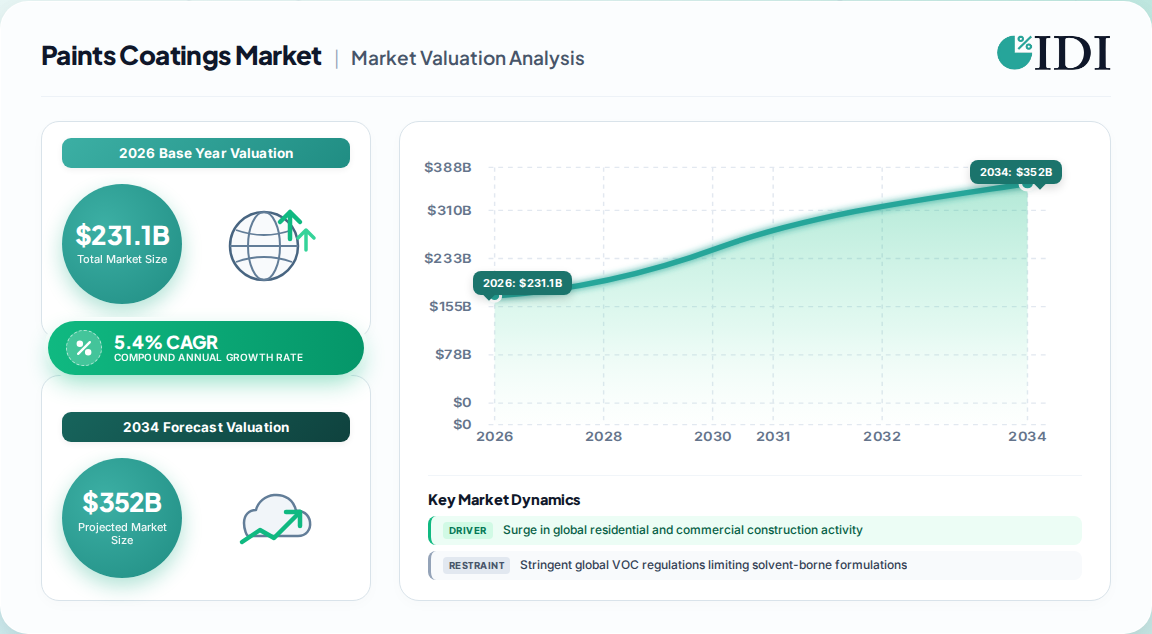
Paints Coatings Market Valuation Timeline and Growth Outlook
Our proprietary research estimates the global paints and coatings market at USD 231.1 billion in 2026, projected to reach USD 333.6 billion by 2033, reflecting a CAGR of 5.4%. This expansion is anchored by resilient construction activity, automotive production growth, and regulatory-driven reformulation toward low-VOC technologies.
Paints Coatings Market Market Size (In Billion)
400.0B
300.0B
200.0B
100.0B
0
219.3 B
2025
231.1 B
2026
243.6 B
2027
256.7 B
2028
270.6 B
2029
285.2 B
2030
300.6 B
2031
Paints Coatings Market Market Size (In Billion)
Year
Market Size
2025
219.3 B
2026
231.1 B
2027
243.6 B
2028
256.7 B
2029
270.6 B
2030
285.2 B
2031
300.6 B
Metric
2025
2026
2033
Market Size (USD Billion)
219.9
231.1
333.6
CAGR (2026-2033)
-
-
5.4%
Asia Pacific commands the largest regional share at 35.4% (2025), driven by urbanization and infrastructure spending in India and China.
Waterborne coatings dominate the product mix, accounting for 40.9% of total revenue in 2025.
The market exhibits moderate concentration, balancing multinational leaders with regional specialists.
Architectural Finishes and Residential Construction Demand Engine
Architectural coatings represent the largest end-use segment, contributing USD 103.24 billion in 2025 and absorbing roughly 52% of total volume output. Residential and commercial construction remains the primary demand driver.
China's Ministry of Housing reported 2.1 billion square meters of floor space under construction in 2024.
India's PMAY-U 2.0 program sanctioned 141,000 additional houses in October 2025, with a target of 29.5 million affordable units by 2025.
Australia recorded 52,201 dwelling commencements in the June 2026 quarter, up 14.4% year-over-year.
Premiumization in India, Vietnam, and Indonesia is shifting demand from commodity whitewash to premium branded emulsions, supporting above-average revenue growth for established brands.
Waterborne, Powder, and Radiation-Cured Technology Migration
Technology migration is reshaping the competitive landscape. Waterborne coatings held 54.1% of the market in 2025, while powder coatings are expanding at a 4.68% CAGR through 2035.
Technology
2025 Share
CAGR (2026-2035)
Key Drivers
Waterborne
54.1%
4.22%
VOC regulations (EU Directive 2004/42/EC, China GB 18582-2020)
Global capex on waterborne and UV-cured production lines exceeded USD 4.2 billion in 2024.
The EU Industrial Emissions Directive caps VOC content at 250 g/L for interior wall coatings.
China's GB 18582-2020 standard lowered permissible VOC levels by 30% versus the prior edition.
Acrylic, Polyurethane, and Epoxy Resin Performance Matrix
Acrylic resins led with a 38.2% share in 2025, favored for weatherability and compatibility with waterborne systems. Polyurethane systems are projected to grow at a 4.45% CAGR through 2035, driven by corrosion-resistant infrastructure coatings.
Resin
2025 Share
Growth Outlook
Primary Applications
Acrylic
38.2%
Stable (4.0-4.2% CAGR)
Exterior architectural, light industrial
Alkyd
~20%
Declining
Solvent-borne trim, industrial maintenance
Polyurethane
~15%
4.45% CAGR
Heavy infrastructure, marine, automotive
Epoxy
~12%
Moderate
Marine, oil & gas, flooring, protective
Epoxy remains essential for protective coatings in marine, oil-and-gas, and flooring end uses.
Bio-based and circular-economy resins represent a long-term opportunity, particularly in Europe and North America.
Automotive OEM, EV Production, and Refinish Coatings Expansion
Automotive coatings represent the fastest-growing end-user vertical. Global vehicle production rose from 92.7 million units in 2024 to 96.4 million in 2025, a 3.9% increase. EV production surpassed 18 million units in 2024, lifting average coatings value per vehicle by 12-15% relative to ICE platforms.
Mixed-material body-in-white designs (aluminum, carbon fiber, high-strength steel) demand advanced primer and topcoat systems.
General Motors announced a USD 157 million investment in paint shop modernization at Wentzville Assembly in July 2026, including a 28,000-square-foot expansion.
Production of waterborne automotive coatings in Southeast Asia and faster vehicle-repair basecoats connect supplier investment with specific manufacturing needs.
TiO₂ Feedstock Volatility and Trade Flow Dynamics
Titanium dioxide (TiO₂) remains the single most critical raw material, representing 15-25% of coating formulation costs. Feedstock volatility is a persistent margin risk.
The EU imposed duties on Chinese-origin titanium dioxide, adding formulation requirements and sourcing costs.
North American and European producers are diversifying TiO₂ sourcing toward alternative pigments and high-opacity grades.
Replacing specialized pigment grades can add testing and reformulation work, slowing product development cycles.
Trade dynamics:
Asia Pacific is the largest net exporter of finished coatings, led by China, South Korea, and Japan.
Europe maintains a strong trade surplus in specialty and protective coatings.
North America is a net importer of architectural paints, with Mexico emerging as a key manufacturing hub.
Regional Growth Trajectories and Country-Level Nuances
Asia Pacific dominates with a 46.79% share in 2026, projected to grow at a 5.13% CAGR through 2032. India leads country-level growth at 5.2% CAGR, followed by China at 4.0%.
Paints Coatings Market Regional Market Share
Loading chart...
Paints Coatings Market Regional Market Share
Region
Market Share (%)
North America
0.23%
Europe
0.22%
Asia-Pacific
0.42%
South America
0.07%
Middle East & Africa
0.06%
Country
CAGR (2026-2035)
Key Growth Drivers
India
5.2%
Urban housing, infrastructure, premiumization
China
4.0%
Construction volume, regulatory reformulation
Mexico
3.0%
Manufacturing reshoring, automotive
Germany
2.7%
Sustainability mandates, bio-based resins
USA
2.6%
Infrastructure rehabilitation, reshoring
South Korea
2.5%
Advanced technology integration
Japan
2.3%
Replacement demand, mature market
North America is projected to reach USD 52.78 billion by 2035, supported by the Infrastructure Investment and Jobs Act's USD 550 billion allocation.
Europe holds roughly 22.4% of global revenue, underpinned by stringent sustainability mandates.
The American Society of Civil Engineers estimated a USD 2.6 trillion infrastructure shortfall in the U.S., driving protective coating demand.
Smart Coatings, Bio-Based Resins, and Circular Economy Pathways
Functional and smart coatings are emerging as a high-value opportunity. Antimicrobial, scratch-resistant, and self-healing formulations command premium pricing in healthcare, electronics, and automotive applications.
Bio-based resins are gaining traction in Europe and North America, supported by circular-economy regulations and corporate sustainability targets.
Digital color-matching platforms and AI-driven tinting systems are reducing waste and accelerating formulation cycles, with a 0.24% CAGR impact in South Korea alone.
Smart factory adoption is improving supply-chain agility, with automated plant scheduling and real-time quality management becoming standard.
Antimicrobial and easy-clean coatings are expanding in healthcare and food-processing facilities, driven by post-pandemic hygiene standards.
Paints Coatings Market Regional Market Share
Higher Coverage
Lower Coverage
No Coverage
Paints Coatings Market REPORT HIGHLIGHTS
Research Methodology & Data Sources
Our rigorous research methodology combines multi-layered approaches with comprehensive quality assurance, ensuring precision, accuracy, and reliability in every market analysis.
Primary Research
70–80% of research effort is dedicated to primary research, including interviews with formulation chemists, procurement directors, plant operations managers, and coatings specifiers across architectural, automotive, and industrial end-use sectors.
We conduct 500+ interviews annually across the value chain, covering raw material suppliers (TiO₂, acrylic resins, solvents), coatings manufacturers, distributors, and applicators.
Stakeholder job titles interviewed include VP of Coatings R&D, Procurement Director (Raw Materials), Plant Operations Manager, and Specifications Engineer.
Primary research validates volume consumption by end-use vertical, pricing trends, channel inventory levels, and technology adoption rates.
Financial databases including Bloomberg, Factiva, Hoovers, and PitchBook are used for company-level revenue benchmarking and M&A tracking.
All reports are updated to the date of purchase, ensuring the latest regulatory changes, trade flows, and company developments are reflected.
Demand Modeling & Market Estimation
We employ both top-down and bottom-up methodologies simultaneously, validated via multi-level data triangulation.
Bottom-up market sizing is built from plant-level production volumes, capacity utilization rates, average selling prices by product grade, and import/export trade flows across 42 countries.
Demand modeling integrates construction starts and completions data, automotive production volumes, infrastructure spending pipelines, and coatings consumption per square meter by end-use application.
Segment-level forecasts are calibrated against macroeconomic indicators, raw-material price indices, and regulatory phase-in schedules.
Data Accuracy & Quality Check
We guarantee an estimated data accuracy level of 85–90%, achieved through rigorous cross-validation of primary and secondary data sources.
Every data point is subjected to three-tier validation: source credibility assessment, internal consistency checks, and expert panel review.
Discrepancies between top-down and bottom-up estimates exceeding 5% trigger a re-interview and data reconciliation process.
Final market estimates are reviewed by our Senior Industry Analyst panel before publication.
Aspects
Details
Study Period
2020-2034
Base Year
2025
Estimated Year
2026
Forecast Period
2026-2034
Historical Period
2020-2025
Growth Rate
CAGR of 5.4% from 2020-2034
Segmentation
By Resin
Acrylic
Alkyd
Polyurethane
Epoxy
Others
By Technology
Waterborne
Solvent-borne
Powder Coating
UV-Cured Coating
Radiation-cured
By End-User Industry
Architectural
Automotive
Wood
Protective Coating
Packaging
Others
By Product
Waterborne Coatings
Solvent-borne Coatings
Powder Coatings
Radiation-cured Coatings
By Geography
North America
USA
Canada
Mexico
Europe
Germany
UK
France
Italy
Spain
Asia Pacific
China
India
Japan
South Korea
Southeast Asia
South America
Brazil
Argentina
Middle East & Africa
Saudi Arabia
UAE
South Africa
Table of Contents
1. Paints Coatings Market Introduction
1.1. Research Scope
1.2. Market Segmentation
1.3. Research Objective
1.4. Definitions and Assumptions
2. Paints Coatings Market Executive Summary
2.1. Market Snapshot
3. Paints Coatings Market Market Dynamics
3.1. Introduction
3.2. Market Drivers
3.2.1. Surge in global residential and commercial construction activity
3.2.2. Expanding automotive production and EV manufacturing
3.2.3. Infrastructure rehabilitation programs in mature economies
3.2.4. Rapid urban population growth in Asia Pacific
3.2.5. Government incentives for green building and low-VOC products
3.3. Market Restrains
3.3.1. Stringent global VOC regulations limiting solvent-borne formulations
3.3.2. Volatility in titanium dioxide and petrochemical feedstock prices
3.3.3. Longer drying and curing times for waterborne systems
3.3.4. High regulatory compliance costs for formulators
3.4. Market Trends
3.4.1. Regulatory-driven shift from solvent-borne to waterborne and powder coatings
3.4.2. Premiumization of architectural paints in India and Southeast Asia
3.4.3. Rising adoption of bio-based and circular-economy resins
3.4.4. Integration of AI-driven color-matching and smart factory systems
3.4.5. Growth of EV production demanding advanced multi-substrate coatings
4. Paints Coatings Market Market Factor Analysis
4.1. Porters Five Forces
4.1.1. Bargaining Power of Suppliers
4.1.2. Bargaining Power of Buyers
4.1.3. Threat of New Entrants
4.1.4. Threat of Substitutes
4.1.5. Competitive Rivalry
4.2. PESTEL analysis
4.3. BCG Analysis
4.3.1. Stars (High Growth, High Market Share)
4.3.2. Cash Cows (Low Growth, High Market Share)
4.3.3. Question Mark (High Growth, Low Market Share)
4.3.4. Dogs (Low Growth, Low Market Share)
4.4. Ansoff Matrix Analysis
4.5. Supply Chain Analysis
4.6. Regulatory Landscape
4.7. Current Market Potential and Opportunity Assessment (TAM–SAM–SOM Framework)
4.8. IDI Analyst Note
5. Paints Coatings Market Market Analysis, Insights and Forecast, 2020-2034
5.1. Market Analysis, Insights and Forecast - by Resin
5.1.1. Acrylic
5.1.2. Alkyd
5.1.3. Polyurethane
5.1.4. Epoxy
5.1.5. Others
5.2. Market Analysis, Insights and Forecast - by Technology
5.2.1. Waterborne
5.2.2. Solvent-borne
5.2.3. Powder Coating
5.2.4. UV-Cured Coating
5.2.5. Radiation-cured
5.3. Market Analysis, Insights and Forecast - by End-User Industry
5.3.1. Architectural
5.3.2. Automotive
5.3.3. Wood
5.3.4. Protective Coating
5.3.5. Packaging
5.3.6. Others
5.4. Market Analysis, Insights and Forecast - by Product
5.4.1. Waterborne Coatings
5.4.2. Solvent-borne Coatings
5.4.3. Powder Coatings
5.4.4. Radiation-cured Coatings
5.5. Market Analysis, Insights and Forecast - by Region
5.5.1. North America
5.5.2. Europe
5.5.3. Asia Pacific
5.5.4. South America
5.5.5. Middle East & Africa
6. Paints Coatings Market North America Market Analysis, Insights and Forecast, 2020-2034
6.1. Market Analysis, Insights and Forecast - by Resin
6.1.1. Acrylic
6.1.2. Alkyd
6.1.3. Polyurethane
6.1.4. Epoxy
6.1.5. Others
6.2. Market Analysis, Insights and Forecast - by Technology
6.2.1. Waterborne
6.2.2. Solvent-borne
6.2.3. Powder Coating
6.2.4. UV-Cured Coating
6.2.5. Radiation-cured
6.3. Market Analysis, Insights and Forecast - by End-User Industry
6.3.1. Architectural
6.3.2. Automotive
6.3.3. Wood
6.3.4. Protective Coating
6.3.5. Packaging
6.3.6. Others
6.4. Market Analysis, Insights and Forecast - by Product
6.4.1. Waterborne Coatings
6.4.2. Solvent-borne Coatings
6.4.3. Powder Coatings
6.4.4. Radiation-cured Coatings
7. Paints Coatings Market Europe Market Analysis, Insights and Forecast, 2020-2034
7.1. Market Analysis, Insights and Forecast - by Resin
7.1.1. Acrylic
7.1.2. Alkyd
7.1.3. Polyurethane
7.1.4. Epoxy
7.1.5. Others
7.2. Market Analysis, Insights and Forecast - by Technology
7.2.1. Waterborne
7.2.2. Solvent-borne
7.2.3. Powder Coating
7.2.4. UV-Cured Coating
7.2.5. Radiation-cured
7.3. Market Analysis, Insights and Forecast - by End-User Industry
7.3.1. Architectural
7.3.2. Automotive
7.3.3. Wood
7.3.4. Protective Coating
7.3.5. Packaging
7.3.6. Others
7.4. Market Analysis, Insights and Forecast - by Product
7.4.1. Waterborne Coatings
7.4.2. Solvent-borne Coatings
7.4.3. Powder Coatings
7.4.4. Radiation-cured Coatings
8. Paints Coatings Market Asia Pacific Market Analysis, Insights and Forecast, 2020-2034
8.1. Market Analysis, Insights and Forecast - by Resin
8.1.1. Acrylic
8.1.2. Alkyd
8.1.3. Polyurethane
8.1.4. Epoxy
8.1.5. Others
8.2. Market Analysis, Insights and Forecast - by Technology
8.2.1. Waterborne
8.2.2. Solvent-borne
8.2.3. Powder Coating
8.2.4. UV-Cured Coating
8.2.5. Radiation-cured
8.3. Market Analysis, Insights and Forecast - by End-User Industry
8.3.1. Architectural
8.3.2. Automotive
8.3.3. Wood
8.3.4. Protective Coating
8.3.5. Packaging
8.3.6. Others
8.4. Market Analysis, Insights and Forecast - by Product
8.4.1. Waterborne Coatings
8.4.2. Solvent-borne Coatings
8.4.3. Powder Coatings
8.4.4. Radiation-cured Coatings
9. Paints Coatings Market South America Market Analysis, Insights and Forecast, 2020-2034
9.1. Market Analysis, Insights and Forecast - by Resin
9.1.1. Acrylic
9.1.2. Alkyd
9.1.3. Polyurethane
9.1.4. Epoxy
9.1.5. Others
9.2. Market Analysis, Insights and Forecast - by Technology
9.2.1. Waterborne
9.2.2. Solvent-borne
9.2.3. Powder Coating
9.2.4. UV-Cured Coating
9.2.5. Radiation-cured
9.3. Market Analysis, Insights and Forecast - by End-User Industry
9.3.1. Architectural
9.3.2. Automotive
9.3.3. Wood
9.3.4. Protective Coating
9.3.5. Packaging
9.3.6. Others
9.4. Market Analysis, Insights and Forecast - by Product
9.4.1. Waterborne Coatings
9.4.2. Solvent-borne Coatings
9.4.3. Powder Coatings
9.4.4. Radiation-cured Coatings
10. Paints Coatings Market Middle East & Africa Market Analysis, Insights and Forecast, 2020-2034
10.1. Market Analysis, Insights and Forecast - by Resin
10.1.1. Acrylic
10.1.2. Alkyd
10.1.3. Polyurethane
10.1.4. Epoxy
10.1.5. Others
10.2. Market Analysis, Insights and Forecast - by Technology
10.2.1. Waterborne
10.2.2. Solvent-borne
10.2.3. Powder Coating
10.2.4. UV-Cured Coating
10.2.5. Radiation-cured
10.3. Market Analysis, Insights and Forecast - by End-User Industry
10.3.1. Architectural
10.3.2. Automotive
10.3.3. Wood
10.3.4. Protective Coating
10.3.5. Packaging
10.3.6. Others
10.4. Market Analysis, Insights and Forecast - by Product
10.4.1. Waterborne Coatings
10.4.2. Solvent-borne Coatings
10.4.3. Powder Coatings
10.4.4. Radiation-cured Coatings
11. Paints Coatings Market Competitive Analysis
11.1. Company Profiles
11.1.1. Sherwin-Williams
11.1.1.1. Company Overview
11.1.1.2. Products
11.1.1.3. Company Financials
11.1.1.4. SWOT Analysis
11.1.2. AkzoNobel
11.1.2.1. Company Overview
11.1.2.2. Products
11.1.2.3. Company Financials
11.1.2.4. SWOT Analysis
11.1.3. PPG Industries
11.1.3.1. Company Overview
11.1.3.2. Products
11.1.3.3. Company Financials
11.1.3.4. SWOT Analysis
11.1.4. Nippon Paint Holdings
11.1.4.1. Company Overview
11.1.4.2. Products
11.1.4.3. Company Financials
11.1.4.4. SWOT Analysis
11.1.5. RPM International
11.1.5.1. Company Overview
11.1.5.2. Products
11.1.5.3. Company Financials
11.1.5.4. SWOT Analysis
11.1.6. Asian Paints
11.1.6.1. Company Overview
11.1.6.2. Products
11.1.6.3. Company Financials
11.1.6.4. SWOT Analysis
11.1.7. Surventis
11.1.7.1. Company Overview
11.1.7.2. Products
11.1.7.3. Company Financials
11.1.7.4. SWOT Analysis
11.2. Market Entropy
11.2.1. Company's Key Areas Served
11.2.2. Recent Developments
11.3. Company Market Share Analysis, 2026
11.3.1. Top 5 Companies Market Share Analysis
11.3.2. Top 3 Companies Market Share Analysis
12. Paints Coatings Market Research Methodology
List of Figures
Figure 1: Paints Coatings Market Revenue Breakdown (Billion, %) by Region 2026 & 2034
Figure 2: North America Paints Coatings Market Revenue (Billion), by Resin 2026 & 2034
Figure 3: North America Paints Coatings Market Revenue Share (%), by Resin 2026 & 2034
Figure 4: North America Paints Coatings Market Revenue (Billion), by Technology 2026 & 2034
Figure 5: North America Paints Coatings Market Revenue Share (%), by Technology 2026 & 2034
Figure 6: North America Paints Coatings Market Revenue (Billion), by End-User Industry 2026 & 2034
Figure 7: North America Paints Coatings Market Revenue Share (%), by End-User Industry 2026 & 2034
Figure 8: North America Paints Coatings Market Revenue (Billion), by Product 2026 & 2034
Figure 9: North America Paints Coatings Market Revenue Share (%), by Product 2026 & 2034
Figure 10: North America Paints Coatings Market Revenue (Billion), by Country 2026 & 2034
Figure 11: North America Paints Coatings Market Revenue Share (%), by Country 2026 & 2034
Figure 12: Europe Paints Coatings Market Revenue (Billion), by Resin 2026 & 2034
Figure 13: Europe Paints Coatings Market Revenue Share (%), by Resin 2026 & 2034
Figure 14: Europe Paints Coatings Market Revenue (Billion), by Technology 2026 & 2034
Figure 15: Europe Paints Coatings Market Revenue Share (%), by Technology 2026 & 2034
Figure 16: Europe Paints Coatings Market Revenue (Billion), by End-User Industry 2026 & 2034
Europe Paints Coatings Market Revenue Share (%), by End-User Industry 2026 & 2034
Table 14: Europe Paints Coatings Market Revenue Billion Forecast, by Resin 2020 & 2034
Table 15: Europe Paints Coatings Market Revenue Billion Forecast, by Technology 2020 & 2034
Table 16: Europe Paints Coatings Market Revenue Billion Forecast, by End-User Industry 2020 & 2034
Frequently Asked Questions
1. What is the current size of the global paints and coatings market?
The global paints and coatings market was valued at USD 219.9 billion in 2025 and is projected to reach USD 333.6 billion by 2033, growing at a CAGR of 5.4% from 2026 to 2033.
2. Which region dominates the paints and coatings market?
Asia Pacific holds the largest share at 35.4% of global revenue in 2025, driven by rapid urbanization and infrastructure investment in India and China. India is the fastest-growing country, with a projected CAGR of 5.2% through 2035.
3. What are the key drivers of the paints and coatings market?
Key drivers include residential and commercial construction growth, regulatory-driven migration to waterborne coatings, infrastructure rehabilitation in mature economies, and expanding automotive production, particularly electric vehicles.
4. Which technology segment leads the paints and coatings market?
Waterborne coatings dominate with a 54.1% share in 2025, as VOC regulations such as the EU Directive 2004/42/EC and China's GB 18582-2020 mandate low-emission formulations. Powder coatings are the fastest-growing technology at a 4.68% CAGR.
5. Who are the major players in the paints and coatings market?
Leading companies include Sherwin-Williams, AkzoNobel, PPG Industries, Nippon Paint Holdings, RPM International, and Asian Paints, collectively holding a significant share of the moderate-concentration global market.
11.4. List of Potential Customers
Figure 17:
Figure 18: Europe Paints Coatings Market Revenue (Billion), by Product 2026 & 2034
Figure 19: Europe Paints Coatings Market Revenue Share (%), by Product 2026 & 2034
Figure 20: Europe Paints Coatings Market Revenue (Billion), by Country 2026 & 2034
Figure 21: Europe Paints Coatings Market Revenue Share (%), by Country 2026 & 2034
Figure 22: Asia Pacific Paints Coatings Market Revenue (Billion), by Resin 2026 & 2034
Figure 23: Asia Pacific Paints Coatings Market Revenue Share (%), by Resin 2026 & 2034
Figure 24: Asia Pacific Paints Coatings Market Revenue (Billion), by Technology 2026 & 2034
Figure 25: Asia Pacific Paints Coatings Market Revenue Share (%), by Technology 2026 & 2034
Figure 26: Asia Pacific Paints Coatings Market Revenue (Billion), by End-User Industry 2026 & 2034
Figure 27: Asia Pacific Paints Coatings Market Revenue Share (%), by End-User Industry 2026 & 2034
Figure 28: Asia Pacific Paints Coatings Market Revenue (Billion), by Product 2026 & 2034
Figure 29: Asia Pacific Paints Coatings Market Revenue Share (%), by Product 2026 & 2034
Figure 30: Asia Pacific Paints Coatings Market Revenue (Billion), by Country 2026 & 2034
Figure 31: Asia Pacific Paints Coatings Market Revenue Share (%), by Country 2026 & 2034
Figure 32: South America Paints Coatings Market Revenue (Billion), by Resin 2026 & 2034
Figure 33: South America Paints Coatings Market Revenue Share (%), by Resin 2026 & 2034
Figure 34: South America Paints Coatings Market Revenue (Billion), by Technology 2026 & 2034
Figure 35: South America Paints Coatings Market Revenue Share (%), by Technology 2026 & 2034
Figure 36: South America Paints Coatings Market Revenue (Billion), by End-User Industry 2026 & 2034
Figure 37: South America Paints Coatings Market Revenue Share (%), by End-User Industry 2026 & 2034
Figure 38: South America Paints Coatings Market Revenue (Billion), by Product 2026 & 2034
Figure 39: South America Paints Coatings Market Revenue Share (%), by Product 2026 & 2034
Figure 40: South America Paints Coatings Market Revenue (Billion), by Country 2026 & 2034
Figure 41: South America Paints Coatings Market Revenue Share (%), by Country 2026 & 2034
Figure 42: Middle East & Africa Paints Coatings Market Revenue (Billion), by Resin 2026 & 2034
Figure 43: Middle East & Africa Paints Coatings Market Revenue Share (%), by Resin 2026 & 2034
Figure 44: Middle East & Africa Paints Coatings Market Revenue (Billion), by Technology 2026 & 2034
Figure 45: Middle East & Africa Paints Coatings Market Revenue Share (%), by Technology 2026 & 2034
Figure 46: Middle East & Africa Paints Coatings Market Revenue (Billion), by End-User Industry 2026 & 2034
Figure 47: Middle East & Africa Paints Coatings Market Revenue Share (%), by End-User Industry 2026 & 2034
Figure 48: Middle East & Africa Paints Coatings Market Revenue (Billion), by Product 2026 & 2034
Figure 49: Middle East & Africa Paints Coatings Market Revenue Share (%), by Product 2026 & 2034
Figure 50: Middle East & Africa Paints Coatings Market Revenue (Billion), by Country 2026 & 2034
Figure 51: Middle East & Africa Paints Coatings Market Revenue Share (%), by Country 2026 & 2034
Table 17: Europe Paints Coatings Market Revenue Billion Forecast, by Product 2020 & 2034
Table 18: Europe Paints Coatings Market Revenue Billion Forecast, by Country 2020 & 2034