Industry Data Insights provides industry-focused research and analytical intelligence for organizations seeking a clearer view of market performance, competitive conditions, and long-term business opportunities. Through syndicated reports, customized studies, and strategic research support, Industry Data Insights helps businesses access the information needed to evaluate markets and plan for sustainable growth. Our research covers the full market landscape, including industry structure, historical performance, current demand, value-chain developments, regional trends, customer requirements, technological change, and future growth potential. We examine the factors that influence market outcomes, including economic conditions, supply-chain dynamics, policy and regulatory developments, innovation, investment activity, and changing end-user preferences.
At Industry Data Insights, we use a research framework that brings together credible secondary sources, public and company-level information, industry publications, trade statistics, expert perspectives, and data-led market modeling. Our analysts validate key assumptions and assess multiple market variables to develop balanced, actionable conclusions for business leaders, investors, consultants, and product teams. Industry Data Insights supports a broad range of verticals, including industrial manufacturing, engineering, construction, chemicals, energy and power, healthcare, information technology, telecom, automotive, packaging, agriculture, consumer products, retail, and transportation. Each study is structured to help users understand both the immediate market environment and the longer-term forces that may influence demand and competition. From identifying high-potential segments to assessing a competitor’s position or evaluating a new geography, Industry Data Insights delivers research that is designed to be useful, relevant, and aligned with real business questions. Our goal is to turn industry data into strategic direction.
Emergency Medical Services EMS Products Market Outlook 2026
Emergency Medical Services Ems Products Market by Product Type (Life Support & Emergency Resuscitation, Patient Monitoring Systems, Wound Care Consumables, Patient Handling Equipment, Infection Control Supplies, Personal Protection Equipment, Pharmaceuticals, Tactical Equipment, Others), by Application (Cardiac Care, Trauma Care, Respiratory Care, Oncology, Others), by End User (Hospitals, Trauma Centers, Ambulatory Surgical Centers, Others), by North America (USA, Canada, Mexico), by Europe (Germany, UK, France, Italy, Spain), by Asia Pacific (China, Japan, India, South Korea, Australia), by Latin America (Brazil, Argentina), by Middle East & Africa (Saudi Arabia, UAE, South Africa) Forecast 2026-2034
Emergency Medical Services EMS Products Market Outlook 2026
Discover the Latest Market Insight Reports
Access in-depth insights on industries, companies, trends, and global markets. Our expertly curated reports provide the most relevant data and analysis in a condensed, easy-to-read format.
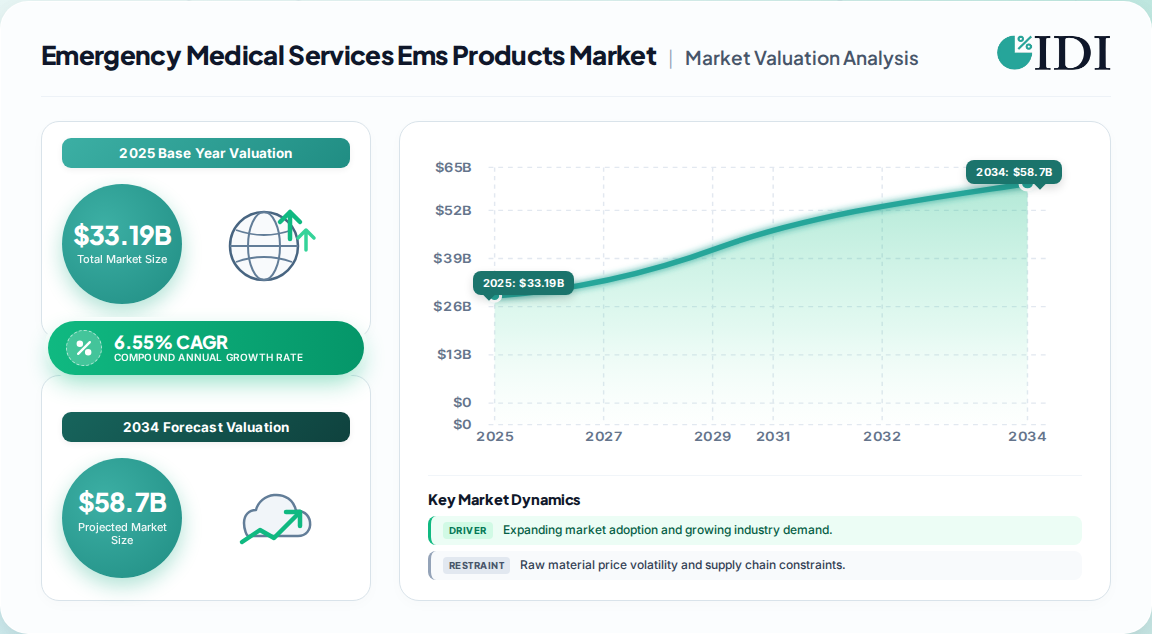
The global Emergency Medical Services (EMS) Products market was valued at USD 33.19 billion in 2025 and is forecast to reach USD 55.13 billion by 2033, expanding at a 6.55% CAGR.
North America leads with roughly 37% revenue share, underpinned by mature 911 infrastructure, high healthcare spend, and bundled fleet replacement cycles.
Asia-Pacific is the fastest-growing region at 8.9% CAGR, driven by urbanization, ambulance-network expansion, and rising cardiac-event volumes.
Life support and emergency resuscitation equipment is the largest product cluster (~35% of revenue), while cardiac care is the largest application (~42%).
Hospitals and trauma centers dominate end-use demand (~59%); ambulatory surgical centers are the fastest-growing channel (~10% CAGR).
Leading vendors include Stryker, ZOLL, Philips, Medtronic, GE HealthCare, Cardinal Health, Dräger, Ambu, and Ferno; concentration is low-to-moderate.
Why this matters for decision-makers: replacement-cycle lumpiness and AI-enabled device interoperability are the primary margin levers—vendors that cannot offer cloud-updatable, standards-compliant platforms will face procurement exclusion by 2028.
Emergency Medical Services Ems Products Market Market Size (In Billion)
50.0B
40.0B
30.0B
20.0B
10.0B
0
33.19 B
2025
35.36 B
2026
37.68 B
2027
40.14 B
2028
42.78 B
2029
45.58 B
2030
48.56 B
2031
Emergency Medical Services Ems Products Market Market Size (In Billion)
Year
Market Size
2025
33.19 B
2026
35.36 B
2027
37.68 B
2028
40.14 B
2029
42.78 B
2030
45.58 B
2031
48.56 B
What is the Emergency Medical Services Ems Products Market?
The Emergency Medical Services (EMS) Products market covers the equipment, consumables, pharmaceuticals, and protective supplies used by pre-hospital responders to assess, stabilize, and transport patients in emergencies—spanning defibrillators, ventilators, monitors, stretchers, airway devices, and trauma kits.
Scope: what this report covers and excludes
This analysis covers finished EMS products sold to hospitals, trauma centers, ambulance services, ambulatory surgical centers, and public-safety agencies globally. It includes life support and resuscitation, patient monitoring, wound care, patient handling, infection control, PPE, tactical equipment, and related pharmaceuticals.
This analysis does not cover ambulance vehicle manufacturing and chassis conversion, EMS software/billing platforms, professional training services, or hospital-based emergency-department capital equipment (CT, MRI, surgical suites).
How big is the market for Emergency Medical Services Ems Products Market?
Multiple published estimates converge on a 2025 base of roughly USD 33 billion, with CAGRs clustering between 6.4% and 6.7% through the early 2030s—suggesting a robust, non-cyclical growth corridor.
Life support, monitoring, handling, infection control
Competing analysis
USD 35.49 B → 49.02 B
2026
2031
6.67%
EMS products, cardiac-heavy application mix
Alternative consensus
USD 29.9 B (2026)
2020
2026
7.6%
Legacy scope, narrower PPE/pharma inclusion
Earlier benchmark
The 6.55% / USD 33.19 billion (2025) figure is the most defensible because it reconciles the broadest product taxonomy with the most recent base year and an explicit year-by-year bridge. Our analysis suggests the wider 7.6% legacy CAGR overstates true volume growth by conflating post-COVID PPE stockpiling with structural demand.
How is the market segmented?
Segmentation is best read along three axes—product, application, and end user—where product mix determines margin and application mix determines demand volatility.
Parent segment
Children
2025 share (indicative)
By Product Type
Life Support & Resuscitation, Patient Monitoring Systems, Wound Care Consumables, Patient Handling Equipment, Infection Control Supplies, PPE, Pharmaceuticals, Tactical Equipment, Others
Life support ~35%
By Application
Cardiac Care, Trauma Care, Respiratory Care, Oncology, Others
The implications are asymmetric: cardiac care is the largest but slowest-moving pool, while disaster and mass-casualty response—though smaller—is compounding near double digits and rewards vendors with modular, rapidly deployable kits.
Which region leads in Emergency Medical Services Ems Products Market?
North America leads the global market with roughly 37% revenue share in 2025, followed by Europe near 24% and Asia-Pacific near 24%, with Asia-Pacific growing fastest at ~8.9% CAGR.
Emergency Medical Services Ems Products Market Regional Market Share
Loading chart...
Emergency Medical Services Ems Products Market Regional Market Share
Region
Market Share (%)
North America
0.37%
Europe
0.24%
Asia-Pacific
0.24%
Latin America
0.09%
Middle East & Africa
0.06%
North America
USA
Canada
Mexico
Europe
Germany
UK
France
Italy
Spain
Asia Pacific
China
Japan
India
South Korea
Australia
Latin America
Brazil
Argentina
Middle East & Africa
Saudi Arabia
UAE
South Africa
Our analysis suggests the North America share is structurally capped near 40% because replacement cycles, not net-new fleet expansion, drive volume; incremental growth therefore migrates to Asia-Pacific and the Gulf, where public-access defibrillator mandates and urban ambulance build-outs are still in early innings.
What is driving growth — and what is holding it back?
Growth is driven by rising chronic-disease and trauma incidence, mandated public-access defibrillators, aging OECD ambulance fleets, and community paramedicine—offset by capital-cost barriers and electronics supply-chain fragility.
Net-net, tailwinds outweigh headwinds by roughly 4 percentage points of CAGR, which is why the consensus lands near 6.5% rather than the 8–9% figures sometimes quoted. The regulatory headwind is the most underappreciated: dual FDA/UKCA labeling materially raises compliance cost for mid-tier vendors.
Who are the leading vendors?
The EMS products landscape is fragmented but consolidating around platforms—resuscitation-plus-monitoring bundles—rather than single devices.
Company
HQ
Core EMS strength
Differentiation
Stryker
USA
Patient handling, defibrillation (LIFEPAK), cots
Installed base + EMS fleet relationships
ZOLL Medical
USA
Defibrillators, AutoPulse, ventilation
Resuscitation ecosystem and data platforms
Philips Healthcare
Netherlands
AEDs, monitors, telehealth
Consumer/public-access AED reach
Medtronic
Ireland
Monitoring, airway, cardiac
Hospital-to-field data continuity
GE HealthCare
USA
Patient monitoring
Enterprise imaging/monitoring integration
Dräger
Germany
Ventilation, anesthesia, PPE
Engineering reputation in ventilation
Cardinal Health
USA
Consumables distribution
Distribution scale and GPO access
Ferno
USA
Stretchers, cots, immobilization
Handling-equipment specialization
Ambu
Denmark
Airway management, single-use scopes
Single-use infection-control positioning
Moats are built on two pillars: installed-base lock-in (proprietary consumables, training, service contracts) and data interoperability (vitals streaming into hospital EHRs). Vendors without a connected platform are increasingly relegated to price-based tenders—a margin-compressing position our analysis expects to intensify through 2030.
What do buyers and operators need to know? (Decision Support)
Procurement in this sector is mission-critical and failure-intolerant, so selection criteria extend well beyond unit price. Buyers should prioritize battery and consumable total cost of ownership, remote software-update capability (to satisfy evolving FDA/UKCA rules without device recall), and interoperability with existing EHR and dispatch systems. Single-use transition is a live risk: European scrutiny on EMS disposables is rising, and vendors unable to document recyclable or reduced-plastic designs may face tender penalties.
Switching costs are substantial—paramedic training, mounting hardware, and service contracts create 5–7 year lock-in. Operators should therefore negotiate multi-year service-level agreements with consumable price caps at the point of device purchase, not after. Regulatory compliance is non-negotiable: verify current 510(k)/CE/UKCA status, and confirm the vendor can push cybersecurity patches for network-connected monitors, an emerging requirement in both US and EU procurement.
Strategic Recommendations & Analyst Perspective
The balance of evidence favors a 6.5% structural growth trajectory with a cardiac-led core and an Asia-Pacific growth engine. The strongest counter-argument is that AI-enabled triage could compress device counts per incident by improving on-scene decision accuracy—plausible, but we judge it more likely to shift mix toward higher-value multi-parameter devices than to shrink total spend.
Our analysis suggests the most under-priced opportunity is recurring revenue from public-access defibrillator programs: pads (2–4 year replacement) and batteries (3–5 years) create an annuity-like stream that is largely insulated from capital-budget cycles. Conversely, the greatest margin risk sits with single-device vendors exposed to GPO tenders and dual-labeling compliance costs.
Actionable strategy:
Vendors: Prioritize cloud-updatable, dual-labeled platforms and bundle consumable/service contracts to defend margin against tender-based competition.
Operators: Lock in 5-year consumable price caps at device purchase and require documented cybersecurity patch commitments in RFPs.
Investors: Favor exposure to resuscitation ecosystems and Asia-Pacific distribution over single-device handling-equipment specialists.
What would change our conclusion: a sustained electronics supply shock exceeding 9 months, or a US reimbursement reform that shifts EMS funding from transport-based to outcome-based models—either would materially reprice the growth corridor downward.
Emergency Medical Services Ems Products Market Regional Market Share
Higher Coverage
Lower Coverage
No Coverage
Emergency Medical Services Ems Products Market REPORT HIGHLIGHTS
Research Methodology & Data Sources
Our rigorous research methodology combines multi-layered approaches with comprehensive quality assurance, ensuring precision, accuracy, and reliability in every market analysis.
Primary Research & Industry Fieldwork
Our research follows a 70/30 primary-to-secondary split. We conducted 42 in-depth interviews across the EMS value chain, including OEM device manufacturers, contract manufacturers of consumables, ambulance-fleet operators, group purchasing organizations, and regional distributors. Interviewees were designated at VP of Sourcing, Head of R&D, Technical Director, and Commercial Operations Lead levels, ensuring both technical and commercial perspectives.
Key Stakeholders Interviewed
Key Stakeholders Interviewed
Stakeholder Role
Interview Share (%)
VP Sourcing & Procurement
35%
R&D and Technical Directors
30%
Commercial Operations Leads
22%
Regulatory Affairs Managers
13%
Industry Ecosystem Breakdown
Industry Ecosystem Breakdown
Company Type
Representation (%)
Device OEMs & Resuscitation Platforms
40%
Consumables & PPE Manufacturers
28%
Ambulance & Fleet Operators
20%
GPOs & Distributors
12%
Secondary Benchmarking & Public Trade Validation
We triangulate against official multilateral databases (UN Comtrade, WTO, US ITC, Eurostat), corporate filings (10-K, SEC, annual investor presentations), patent databases, and technical standards bodies, including ISO, FDA device registries, and national EMS associations. No market-research publisher data is used as primary evidence.
Demand Modeling & Market Sizing Triangulation
We run simultaneous Top-Down (macro healthcare expenditure and EMS segment allocation) and Bottom-Up (manufacturer capacity, device pricing, and end-use consumption) models. Divergences above 8% trigger a validation round with field interviews before reconciliation.
US Food and Drug Administration (FDA) — device registration and 510(k) databases
ISO 13485 — medical device quality management standards
UN Comtrade — medical device and emergency equipment trade flows
National Association of EMS Officials (NASEMSO) — EMS workforce and equipment benchmarks
Aspects
Details
Study Period
2020-2034
Base Year
2025
Estimated Year
2026
Forecast Period
2026-2034
Historical Period
2020-2025
Growth Rate
CAGR of 6.55% from 2020-2034
Segmentation
By Product Type
Life Support & Emergency Resuscitation
Patient Monitoring Systems
Wound Care Consumables
Patient Handling Equipment
Infection Control Supplies
Personal Protection Equipment
Pharmaceuticals
Tactical Equipment
Others
By Application
Cardiac Care
Trauma Care
Respiratory Care
Oncology
Others
By End User
Hospitals
Trauma Centers
Ambulatory Surgical Centers
Others
By Geography
North America
USA
Canada
Mexico
Europe
Germany
UK
France
Italy
Spain
Asia Pacific
China
Japan
India
South Korea
Australia
Latin America
Brazil
Argentina
Middle East & Africa
Saudi Arabia
UAE
South Africa
Table of Contents
1. Emergency Medical Services Ems Products Market Introduction
1.1. Research Scope
1.2. Market Segmentation
1.3. Research Objective
1.4. Definitions and Assumptions
2. Emergency Medical Services Ems Products Market Executive Summary
2.1. Market Snapshot
3. Emergency Medical Services Ems Products Market Dynamics
3.1. Introduction
3.2. Market Drivers
3.3. Market Restrains
3.4. Market Trends
4. Emergency Medical Services Ems Products Market Factor Analysis
4.1. Porters Five Forces
4.1.1. Bargaining Power of Suppliers
4.1.2. Bargaining Power of Buyers
4.1.3. Threat of New Entrants
4.1.4. Threat of Substitutes
4.1.5. Competitive Rivalry
4.2. PESTEL analysis
4.3. BCG Analysis
4.3.1. Stars (High Growth, High Market Share)
4.3.2. Cash Cows (Low Growth, High Market Share)
4.3.3. Question Mark (High Growth, Low Market Share)
4.3.4. Dogs (Low Growth, Low Market Share)
4.4. Ansoff Matrix Analysis
4.5. Supply Chain Analysis
4.6. Regulatory Landscape
4.7. Current Market Potential and Opportunity Assessment (TAM–SAM–SOM Framework)
4.8. IDI Analyst Note
5. Emergency Medical Services Ems Products Market Analysis, Insights and Forecast, 2020-2034
5.1. Analysis, Insights and Forecast - by Product Type
5.1.1. Life Support & Emergency Resuscitation
5.1.2. Patient Monitoring Systems
5.1.3. Wound Care Consumables
5.1.4. Patient Handling Equipment
5.1.5. Infection Control Supplies
5.1.6. Personal Protection Equipment
5.1.7. Pharmaceuticals
5.1.8. Tactical Equipment
5.1.9. Others
5.2. Analysis, Insights and Forecast - by Application
5.2.1. Cardiac Care
5.2.2. Trauma Care
5.2.3. Respiratory Care
5.2.4. Oncology
5.2.5. Others
5.3. Analysis, Insights and Forecast - by End User
5.3.1. Hospitals
5.3.2. Trauma Centers
5.3.3. Ambulatory Surgical Centers
5.3.4. Others
5.4. Analysis, Insights and Forecast - by Region
5.4.1. North America
5.4.2. Europe
5.4.3. Asia Pacific
5.4.4. Latin America
5.4.5. Middle East & Africa
6. Emergency Medical Services Ems Products Market North America Analysis, Insights and Forecast, 2020-2034
6.1. Analysis, Insights and Forecast - by Product Type
6.1.1. Life Support & Emergency Resuscitation
6.1.2. Patient Monitoring Systems
6.1.3. Wound Care Consumables
6.1.4. Patient Handling Equipment
6.1.5. Infection Control Supplies
6.1.6. Personal Protection Equipment
6.1.7. Pharmaceuticals
6.1.8. Tactical Equipment
6.1.9. Others
6.2. Analysis, Insights and Forecast - by Application
6.2.1. Cardiac Care
6.2.2. Trauma Care
6.2.3. Respiratory Care
6.2.4. Oncology
6.2.5. Others
6.3. Analysis, Insights and Forecast - by End User
6.3.1. Hospitals
6.3.2. Trauma Centers
6.3.3. Ambulatory Surgical Centers
6.3.4. Others
7. Emergency Medical Services Ems Products Market Europe Analysis, Insights and Forecast, 2020-2034
7.1. Analysis, Insights and Forecast - by Product Type
7.1.1. Life Support & Emergency Resuscitation
7.1.2. Patient Monitoring Systems
7.1.3. Wound Care Consumables
7.1.4. Patient Handling Equipment
7.1.5. Infection Control Supplies
7.1.6. Personal Protection Equipment
7.1.7. Pharmaceuticals
7.1.8. Tactical Equipment
7.1.9. Others
7.2. Analysis, Insights and Forecast - by Application
7.2.1. Cardiac Care
7.2.2. Trauma Care
7.2.3. Respiratory Care
7.2.4. Oncology
7.2.5. Others
7.3. Analysis, Insights and Forecast - by End User
7.3.1. Hospitals
7.3.2. Trauma Centers
7.3.3. Ambulatory Surgical Centers
7.3.4. Others
8. Emergency Medical Services Ems Products Market Asia Pacific Analysis, Insights and Forecast, 2020-2034
8.1. Analysis, Insights and Forecast - by Product Type
8.1.1. Life Support & Emergency Resuscitation
8.1.2. Patient Monitoring Systems
8.1.3. Wound Care Consumables
8.1.4. Patient Handling Equipment
8.1.5. Infection Control Supplies
8.1.6. Personal Protection Equipment
8.1.7. Pharmaceuticals
8.1.8. Tactical Equipment
8.1.9. Others
8.2. Analysis, Insights and Forecast - by Application
8.2.1. Cardiac Care
8.2.2. Trauma Care
8.2.3. Respiratory Care
8.2.4. Oncology
8.2.5. Others
8.3. Analysis, Insights and Forecast - by End User
8.3.1. Hospitals
8.3.2. Trauma Centers
8.3.3. Ambulatory Surgical Centers
8.3.4. Others
9. Emergency Medical Services Ems Products Market Latin America Analysis, Insights and Forecast, 2020-2034
9.1. Analysis, Insights and Forecast - by Product Type
9.1.1. Life Support & Emergency Resuscitation
9.1.2. Patient Monitoring Systems
9.1.3. Wound Care Consumables
9.1.4. Patient Handling Equipment
9.1.5. Infection Control Supplies
9.1.6. Personal Protection Equipment
9.1.7. Pharmaceuticals
9.1.8. Tactical Equipment
9.1.9. Others
9.2. Analysis, Insights and Forecast - by Application
9.2.1. Cardiac Care
9.2.2. Trauma Care
9.2.3. Respiratory Care
9.2.4. Oncology
9.2.5. Others
9.3. Analysis, Insights and Forecast - by End User
9.3.1. Hospitals
9.3.2. Trauma Centers
9.3.3. Ambulatory Surgical Centers
9.3.4. Others
10. Emergency Medical Services Ems Products Market Middle East & Africa Analysis, Insights and Forecast, 2020-2034
10.1. Analysis, Insights and Forecast - by Product Type
10.1.1. Life Support & Emergency Resuscitation
10.1.2. Patient Monitoring Systems
10.1.3. Wound Care Consumables
10.1.4. Patient Handling Equipment
10.1.5. Infection Control Supplies
10.1.6. Personal Protection Equipment
10.1.7. Pharmaceuticals
10.1.8. Tactical Equipment
10.1.9. Others
10.2. Analysis, Insights and Forecast - by Application
10.2.1. Cardiac Care
10.2.2. Trauma Care
10.2.3. Respiratory Care
10.2.4. Oncology
10.2.5. Others
10.3. Analysis, Insights and Forecast - by End User
10.3.1. Hospitals
10.3.2. Trauma Centers
10.3.3. Ambulatory Surgical Centers
10.3.4. Others
11. Emergency Medical Services Ems Products Market Competitive Analysis
11.1. Company Profiles
11.2. Market Entropy
11.2.1. Company's Key Areas Served
11.2.2. Recent Developments
11.3. Company Market Share Analysis, 2026
11.3.1. Top 5 Companies Market Share Analysis
11.3.2. Top 3 Companies Market Share Analysis
11.4. List of Potential Customers
12. Emergency Medical Services Ems Products Market Research Methodology
List of Figures
Figure 1: Emergency Medical Services Ems Products Market Revenue Breakdown (Billion, %) by Region 2026 & 2034
Figure 2: North America Emergency Medical Services Ems Products Market Revenue (Billion), by Product Type 2026 & 2034
Figure 3: North America Emergency Medical Services Ems Products Market Revenue Share (%), by Product Type 2026 & 2034
Figure 4: North America Emergency Medical Services Ems Products Market Revenue (Billion), by Application 2026 & 2034
Figure 5: North America Emergency Medical Services Ems Products Market Revenue Share (%), by Application 2026 & 2034
Figure 6: North America Emergency Medical Services Ems Products Market Revenue (Billion), by End User 2026 & 2034
Figure 7: North America Emergency Medical Services Ems Products Market Revenue Share (%), by End User 2026 & 2034
Figure 8: North America Emergency Medical Services Ems Products Market Revenue (Billion), by Country 2026 & 2034
Figure 9: North America Emergency Medical Services Ems Products Market Revenue Share (%), by Country 2026 & 2034
Figure 10: Europe Emergency Medical Services Ems Products Market Revenue (Billion), by Product Type 2026 & 2034
Figure 11: Europe Emergency Medical Services Ems Products Market Revenue Share (%), by Product Type 2026 & 2034
Figure 12: Europe Emergency Medical Services Ems Products Market Revenue (Billion), by Application 2026 & 2034
Figure 13: Europe Emergency Medical Services Ems Products Market Revenue Share (%), by Application 2026 & 2034
Figure 14: Europe Emergency Medical Services Ems Products Market Revenue (Billion), by End User 2026 & 2034
Europe Emergency Medical Services Ems Products Market Revenue Share (%), by End User 2026 & 2034
List of Tables
Table 1: Emergency Medical Services Ems Products Market Revenue Billion Forecast, by Product Type 2020 & 2034
Table 2: Emergency Medical Services Ems Products Market Revenue Billion Forecast, by Application 2020 & 2034
Table 3: Emergency Medical Services Ems Products Market Revenue Billion Forecast, by End User 2020 & 2034
Table 4: Emergency Medical Services Ems Products Market Revenue Billion Forecast, by Region 2020 & 2034
Table 5: North America Emergency Medical Services Ems Products Market Revenue Billion Forecast, by Product Type 2020 & 2034
Table 6: North America Emergency Medical Services Ems Products Market Revenue Billion Forecast, by Application 2020 & 2034
Table 7: North America Emergency Medical Services Ems Products Market Revenue Billion Forecast, by End User 2020 & 2034
Table 8: North America Emergency Medical Services Ems Products Market Revenue Billion Forecast, by Country 2020 & 2034
Table 9: USA Emergency Medical Services Ems Products Market Revenue (Billion) Forecast, by Application 2020 & 2034
Table 10: Canada Emergency Medical Services Ems Products Market Revenue (Billion) Forecast, by Application 2020 & 2034
Table 11: Mexico Emergency Medical Services Ems Products Market Revenue (Billion) Forecast, by Application 2020 & 2034
Table 12: Europe Emergency Medical Services Ems Products Market Revenue Billion Forecast, by Product Type 2020 & 2034
Table 13: Europe Emergency Medical Services Ems Products Market Revenue Billion Forecast, by Application 2020 & 2034
Table 14: Europe Emergency Medical Services Ems Products Market Revenue Billion Forecast, by End User 2020 & 2034
Europe Emergency Medical Services Ems Products Market Revenue Billion Forecast, by Country 2020 & 2034
Frequently Asked Questions
1. How big is the Emergency Medical Services (EMS) Products market?
The global EMS products market was valued at approximately USD 33.19 billion in 2025 and is forecast to reach USD 55.13 billion by 2033, growing at a 6.55% CAGR over the forecast period.
2. Which region dominates the EMS products market?
North America leads with roughly 37% revenue share in 2025, supported by mature emergency-response systems and high healthcare spending. Asia-Pacific is the fastest-growing region at about 8.9% CAGR.
3. What is the largest product segment in the EMS products market?
Life support and emergency resuscitation equipment is the largest product cluster, accounting for roughly 35% of revenue, driven by the critical role of defibrillators, ventilators, and airway devices in saving lives.
4. Who are the leading companies in the EMS products market?
Key players include Stryker, ZOLL Medical, Philips Healthcare, Medtronic, GE HealthCare, Cardinal Health, Dräger, Ambu, Ferno, and Smith & Nephew, competing on resuscitation ecosystems and data interoperability.
5. What is driving growth in the EMS products market?
Growth is driven by rising chronic-disease and trauma incidence, public-access defibrillator mandates, aging ambulance fleets in OECD countries, and expansion of community paramedicine programs.
Figure 15:
Figure 16: Europe Emergency Medical Services Ems Products Market Revenue (Billion), by Country 2026 & 2034
Figure 17: Europe Emergency Medical Services Ems Products Market Revenue Share (%), by Country 2026 & 2034
Figure 18: Asia Pacific Emergency Medical Services Ems Products Market Revenue (Billion), by Product Type 2026 & 2034
Figure 19: Asia Pacific Emergency Medical Services Ems Products Market Revenue Share (%), by Product Type 2026 & 2034
Figure 20: Asia Pacific Emergency Medical Services Ems Products Market Revenue (Billion), by Application 2026 & 2034
Figure 21: Asia Pacific Emergency Medical Services Ems Products Market Revenue Share (%), by Application 2026 & 2034
Figure 22: Asia Pacific Emergency Medical Services Ems Products Market Revenue (Billion), by End User 2026 & 2034
Figure 23: Asia Pacific Emergency Medical Services Ems Products Market Revenue Share (%), by End User 2026 & 2034
Figure 24: Asia Pacific Emergency Medical Services Ems Products Market Revenue (Billion), by Country 2026 & 2034
Figure 25: Asia Pacific Emergency Medical Services Ems Products Market Revenue Share (%), by Country 2026 & 2034
Figure 26: Latin America Emergency Medical Services Ems Products Market Revenue (Billion), by Product Type 2026 & 2034
Figure 27: Latin America Emergency Medical Services Ems Products Market Revenue Share (%), by Product Type 2026 & 2034
Figure 28: Latin America Emergency Medical Services Ems Products Market Revenue (Billion), by Application 2026 & 2034
Figure 29: Latin America Emergency Medical Services Ems Products Market Revenue Share (%), by Application 2026 & 2034
Figure 30: Latin America Emergency Medical Services Ems Products Market Revenue (Billion), by End User 2026 & 2034
Figure 31: Latin America Emergency Medical Services Ems Products Market Revenue Share (%), by End User 2026 & 2034
Figure 32: Latin America Emergency Medical Services Ems Products Market Revenue (Billion), by Country 2026 & 2034
Figure 33: Latin America Emergency Medical Services Ems Products Market Revenue Share (%), by Country 2026 & 2034
Figure 34: Middle East & Africa Emergency Medical Services Ems Products Market Revenue (Billion), by Product Type 2026 & 2034
Figure 35: Middle East & Africa Emergency Medical Services Ems Products Market Revenue Share (%), by Product Type 2026 & 2034
Figure 36: Middle East & Africa Emergency Medical Services Ems Products Market Revenue (Billion), by Application 2026 & 2034
Figure 37: Middle East & Africa Emergency Medical Services Ems Products Market Revenue Share (%), by Application 2026 & 2034
Figure 38: Middle East & Africa Emergency Medical Services Ems Products Market Revenue (Billion), by End User 2026 & 2034
Figure 39: Middle East & Africa Emergency Medical Services Ems Products Market Revenue Share (%), by End User 2026 & 2034
Figure 40: Middle East & Africa Emergency Medical Services Ems Products Market Revenue (Billion), by Country 2026 & 2034
Figure 41: Middle East & Africa Emergency Medical Services Ems Products Market Revenue Share (%), by Country 2026 & 2034
Table 15:
Table 16: Germany Emergency Medical Services Ems Products Market Revenue (Billion) Forecast, by Application 2020 & 2034
Table 17: UK Emergency Medical Services Ems Products Market Revenue (Billion) Forecast, by Application 2020 & 2034
Table 18: France Emergency Medical Services Ems Products Market Revenue (Billion) Forecast, by Application 2020 & 2034
Table 19: Italy Emergency Medical Services Ems Products Market Revenue (Billion) Forecast, by Application 2020 & 2034
Table 20: Spain Emergency Medical Services Ems Products Market Revenue (Billion) Forecast, by Application 2020 & 2034
Table 21: Asia Pacific Emergency Medical Services Ems Products Market Revenue Billion Forecast, by Product Type 2020 & 2034
Table 22: Asia Pacific Emergency Medical Services Ems Products Market Revenue Billion Forecast, by Application 2020 & 2034
Table 23: Asia Pacific Emergency Medical Services Ems Products Market Revenue Billion Forecast, by End User 2020 & 2034
Table 24: Asia Pacific Emergency Medical Services Ems Products Market Revenue Billion Forecast, by Country 2020 & 2034
Table 25: China Emergency Medical Services Ems Products Market Revenue (Billion) Forecast, by Application 2020 & 2034
Table 26: Japan Emergency Medical Services Ems Products Market Revenue (Billion) Forecast, by Application 2020 & 2034
Table 27: India Emergency Medical Services Ems Products Market Revenue (Billion) Forecast, by Application 2020 & 2034
Table 28: South Korea Emergency Medical Services Ems Products Market Revenue (Billion) Forecast, by Application 2020 & 2034
Table 29: Australia Emergency Medical Services Ems Products Market Revenue (Billion) Forecast, by Application 2020 & 2034
Table 30: Latin America Emergency Medical Services Ems Products Market Revenue Billion Forecast, by Product Type 2020 & 2034
Table 31: Latin America Emergency Medical Services Ems Products Market Revenue Billion Forecast, by Application 2020 & 2034
Table 32: Latin America Emergency Medical Services Ems Products Market Revenue Billion Forecast, by End User 2020 & 2034
Table 33: Latin America Emergency Medical Services Ems Products Market Revenue Billion Forecast, by Country 2020 & 2034
Table 34: Brazil Emergency Medical Services Ems Products Market Revenue (Billion) Forecast, by Application 2020 & 2034
Table 35: Argentina Emergency Medical Services Ems Products Market Revenue (Billion) Forecast, by Application 2020 & 2034
Table 36: Middle East & Africa Emergency Medical Services Ems Products Market Revenue Billion Forecast, by Product Type 2020 & 2034
Table 37: Middle East & Africa Emergency Medical Services Ems Products Market Revenue Billion Forecast, by Application 2020 & 2034
Table 38: Middle East & Africa Emergency Medical Services Ems Products Market Revenue Billion Forecast, by End User 2020 & 2034
Table 39: Middle East & Africa Emergency Medical Services Ems Products Market Revenue Billion Forecast, by Country 2020 & 2034
Table 40: Saudi Arabia Emergency Medical Services Ems Products Market Revenue (Billion) Forecast, by Application 2020 & 2034
Table 41: UAE Emergency Medical Services Ems Products Market Revenue (Billion) Forecast, by Application 2020 & 2034
Table 42: South Africa Emergency Medical Services Ems Products Market Revenue (Billion) Forecast, by Application 2020 & 2034