Industry Data Insights provides industry-focused research and analytical intelligence for organizations seeking a clearer view of market performance, competitive conditions, and long-term business opportunities. Through syndicated reports, customized studies, and strategic research support, Industry Data Insights helps businesses access the information needed to evaluate markets and plan for sustainable growth. Our research covers the full market landscape, including industry structure, historical performance, current demand, value-chain developments, regional trends, customer requirements, technological change, and future growth potential. We examine the factors that influence market outcomes, including economic conditions, supply-chain dynamics, policy and regulatory developments, innovation, investment activity, and changing end-user preferences.
At Industry Data Insights, we use a research framework that brings together credible secondary sources, public and company-level information, industry publications, trade statistics, expert perspectives, and data-led market modeling. Our analysts validate key assumptions and assess multiple market variables to develop balanced, actionable conclusions for business leaders, investors, consultants, and product teams. Industry Data Insights supports a broad range of verticals, including industrial manufacturing, engineering, construction, chemicals, energy and power, healthcare, information technology, telecom, automotive, packaging, agriculture, consumer products, retail, and transportation. Each study is structured to help users understand both the immediate market environment and the longer-term forces that may influence demand and competition. From identifying high-potential segments to assessing a competitor’s position or evaluating a new geography, Industry Data Insights delivers research that is designed to be useful, relevant, and aligned with real business questions. Our goal is to turn industry data into strategic direction.
Hemorrhagic Ischemic Stroke Treatment Devices Market Report by Treatment (Aneurysm & Hemorrhagic Stroke Interventions(Embolization Coiling Systems, Intrasaccular Flow Disruption Devices, Flow Diversion Systems, Liquid Embolization Agents, cSDH/MMA Embolization), Cerebral Angioplasty & Vascular Remodeling(Balloon Angioplasty, Coil-Assisted Adjunctive Devices, Intracranial & Carotid Stenting), Ischemic Mechanical Revascularization(Aspiration Thrombectomy, Stent Retriever Thrombectomy), Ancillary & Procedural Access(Microcatheters, Guiding & Distal Access Catheters, Access Sheaths & Wires)), by End User (Hospitals, Specialty Neurosurgery Centers, Ambulatory Surgical Centers), by North America (USA, Canada, Mexico), by Europe (Germany, UK, France, Italy, Spain), by Asia Pacific (China, Japan, India, South Korea), by Latin America (Brazil, Mexico, Argentina), by Middle East & Africa (Saudi Arabia, UAE, South Africa) Forecast 2026-2034
Access in-depth insights on industries, companies, trends, and global markets. Our expertly curated reports provide the most relevant data and analysis in a condensed, easy-to-read format.
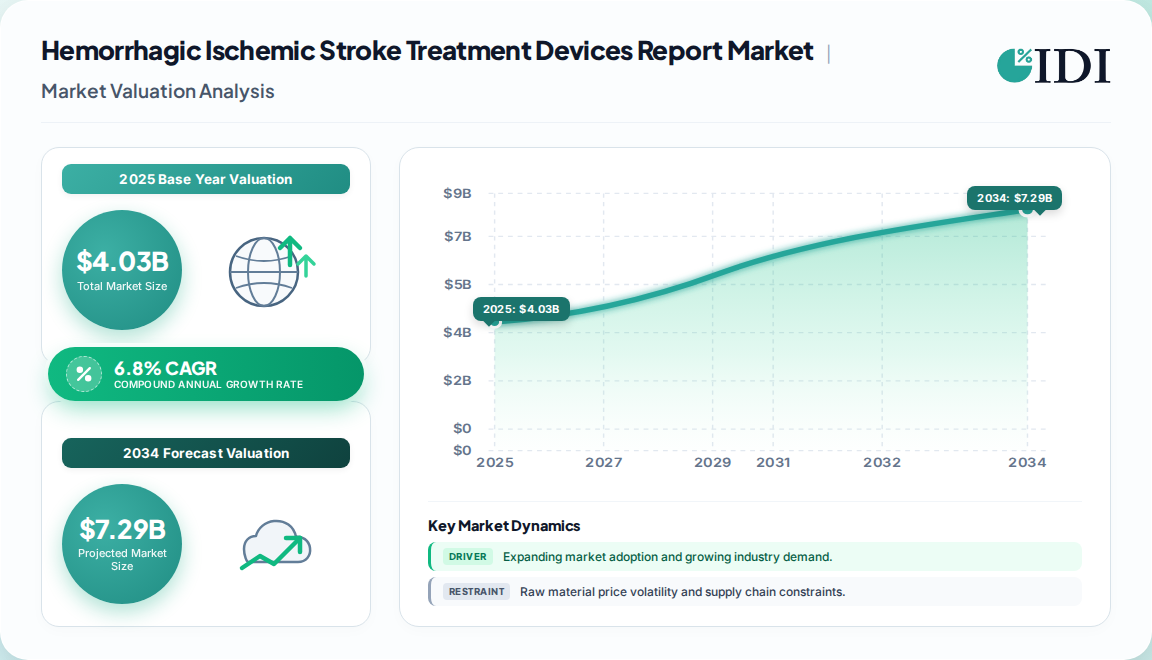
USD 4.03 Billion in 2025 — global hemorrhagic and ischemic stroke treatment devices market, base-year valuation (combined hemorrhagic plus ischemic intervention platforms).
USD 7.65 Billion by 2035, a 6.8% CAGR over 2026–2035. Neurothrombectomy-only platforms grow faster at double digits, showing where value concentrates.
Aneurysm and hemorrhagic stroke interventions led in 2025, driven by the clinical urgency of intracerebral hemorrhage and specialist endovascular demand.
Hospitals hold the largest end-user share (roughly two-thirds), with specialty neurosurgery centers the fastest-growing channel.
North America leads with roughly 41% revenue share, but Asia-Pacific is the fastest-growing region on stroke-center build-out.
Core vendors: Medtronic, Stryker, Penumbra, Johnson & Johnson MedTech, Terumo, MicroPort, Acandis, phenox, Balt, Boston Scientific.
Why this matters for decision-makers: mechanical thrombectomy is outpacing the blended category at ~11% versus 6.8% — portfolio weight must shift toward clot-retrieval and access platforms or vendors risk growth dilution from slower coil and embolic-agent lines.
What is the Hemorrhagic Ischemic Stroke Treatment Devices Market Report?
The hemorrhagic ischemic stroke treatment devices market report covers endovascular and surgical technologies used to stop intracranial bleeding, remove clots, and restore cerebral blood flow — coils, flow diverters, intrasaccular devices, liquid embolics, stent retrievers, aspiration systems, balloon guide catheters, and procedural access devices — with sizing, segmentation, and vendor analysis.
Scope: what this report covers and excludes
Scope is global, with country-level splits across five continents. Covered: aneurysm and hemorrhagic interventions (coiling, flow diversion, intrasaccular disruption, liquid embolics, cSDH/MMA embolization), cerebral angioplasty and vascular remodeling, ischemic mechanical revascularization (aspiration and stent-retriever thrombectomy), and ancillary access devices across hospitals, specialty neurosurgery centers, and ASCs. This analysis does not cover stroke pharmaceuticals (thrombolytics, anticoagulants, neuroprotectants), diagnostic imaging hardware, rehabilitation and post-stroke care equipment, or intracranial pressure monitoring standalone devices.
How big is the market for Hemorrhagic Ischemic Stroke Treatment Devices Market Report?
Published valuations diverge sharply because scope differs: some track only ischemic neuro-interventional hardware, others bundle hemorrhagic devices or drug-plus-device treatment. The table isolates each figure and its definition.
The USD 4.03 Billion combined figure is the most defensible for total-addressable planning because hemorrhagic (~USD 1.9–2.0 Billion) and ischemic hardware estimates sum near it. Our analysis suggests the 6.8% blended CAGR masks a two-speed market: thrombectomy grows near 11%, while mature coil and liquid-embolic lines grow mid-single digits. Buyers sizing greenfield capacity should underwrite the faster sub-segment, not the blend.
How is the market segmented?
Segmentation runs on treatment platform, end user, and geography; the table lists non-geographic parents and their device-level children, which drive differentiated pricing and reimbursement.
Which region leads in Hemorrhagic Ischemic Stroke Treatment Devices Market Report?
North America leads with roughly 41% revenue share in 2025, underpinned by certified stroke-center density, favorable reimbursement, and early adoption of next-generation retrieval and flow-diversion platforms. Asia-Pacific is the fastest-growing region as China and India expand neuro-interventional capacity.
The divergence implies Western vendors should defend premium ASPs in North America and Europe while localizing low-profile, cost-efficient devices for Asia-Pacific tenders, where volume growth outpaces price.
What is driving growth — and what is holding it back?
Growth is anchored in an aging population, rising hypertension and diabetes prevalence, guideline expansion of the thrombectomy window to 24 hours, and stroke-center build-out; the binding constraint is device and procedure cost plus a thin pool of neuro-interventional specialists.
Factor
Direction
Evidence strength
Mechanism
Aging population & metabolic risk
Driver
High
Expands eligible large-vessel-occlusion and ICH population
The balance favors growth: guideline expansion and infrastructure are structural, while cost and specialist constraints are addressable through training programs and tiered device portfolios. Our analysis suggests first-pass success rates now function as the primary purchasing criterion, shifting competition toward outcomes data rather than catalog breadth.
Who are the leading vendors?
The competitive field is moderately fragmented and led by Medtronic, Stryker, and Penumbra in thrombectomy and aspiration, with Johnson & Johnson MedTech, Terumo, MicroPort, Acandis, phenox, Balt, and Boston Scientific contesting flow diversion, coiling, and access.
Vendor
Core strength
Differentiation
Medtronic
Coils, flow diversion, thrombectomy breadth
Broad neurovascular portfolio and installed base
Stryker
Stent retrievers, aspiration
Strong clinical evidence and stroke-center relationships
Cost-competitive devices and European clinical credibility
Moats rest on physician training networks, outcomes registries, and access-device pull-through rather than patents alone; vendors that pair retrieval platforms with proprietary access catheters lock in procedural share. This dynamic implies consolidation pressure on single-product coil makers.
What do buyers and operators need to know?
Procurement decisions hinge on first-pass recanalization data, compatibility across stent-retriever and aspiration workflows, and the total cost of a full procedural kit rather than unit price. Switching costs are high: physician familiarity, inventory standardization, and reprocessing/sterilization protocols create multi-year lock-in once a platform is adopted. Regulatory compliance is non-trivial — FDA clearance or CE marking plus local registration in Asia-Pacific markets — and buyers should verify post-market surveillance records and recall history. Operators expanding stroke centers must budget for specialist training alongside devices, because device availability without credentialed interventionists yields no procedural volume. Our analysis suggests buyers negotiate bundled access-plus-retrieval contracts to avoid margin leakage from single-source catheter pricing.
Strategic Recommendations & Analyst Perspective
The balance of evidence favors a bullish but selective outlook: the blended 6.8% CAGR understates the ~11% growth in neurothrombectomy, where guideline expansion and infrastructure build-out are compounding. Strongest counter-argument: cost pressure and specialist scarcity could cap emerging-market conversion, muting volume gains even as device innovation accelerates — plausible, but the 24-hour window and AI triage are already pulling borderline patients into treatment.
We judge the hemorrhagic intervention segment defensible as a cash-generating core while thrombectomy and aspiration represent the growth engine; vendor portfolios skewed to mature coils will underperform the blended market. Buyers should treat bundling of access and retrieval as the key negotiating lever, and investors should weight exposure to large-bore aspiration and next-generation flow diversion.
Vendors: Prioritize large-bore aspiration and surface-modified flow diverters to capture the fastest-growing sub-segments.
Operators: Bundle access-plus-retrieval procurement and fund interventionist training to convert device access into procedural volume.
Investors: Underwrite Asia-Pacific localization strategies over premium-ASP Western expansion.
What would change this conclusion: a reimbursement rollback in the US, or clinical evidence narrowing the extended thrombectomy window, would compress the growth thesis — the full report models these scenarios segment by segment.
Research Methodology
Primary Research & Industry Fieldwork
Our team applies a 70/30 primary-to-secondary research split, conducting structured interviews across the neurovascular value chain — device component suppliers, specialized catheter and coil producers, contract manufacturers, and global distributors — with decision-makers including VP-level Sourcing leads, Heads of Neurovascular R&D, Technical Directors, and Commercial Operations Leads. Interviews probe first-pass success benchmarking, pricing and bundling behavior, and procurement timelines.
Secondary Benchmarking & Public Trade Validation
We validate against UN Comtrade and US ITC import/export flows for neurovascular catheters and embolic devices, Eurostat and WTO trade records, corporate 10-K and annual investor filings, patent databases, and standards from ISO and the World Stroke Organization's Global Stroke Fact Sheet.
Demand Modeling & Market Sizing Triangulation
We triangulate top-down macroeconomic and segment allocation against bottom-up manufacturer capacity, product pricing, and end-use consumption modeling to reconcile divergent published estimates.
Our rigorous research methodology combines multi-layered approaches with comprehensive quality assurance, ensuring precision, accuracy, and reliability in every market analysis.
Primary Research & Industry Fieldwork
Our team applies a 70/30 primary-to-secondary research split, conducting structured interviews across the neurovascular value chain — device component suppliers, specialized catheter and coil producers, contract manufacturers, and global distributors — with decision-makers including VP-level Sourcing leads, Heads of Neurovascular R&D, Technical Directors, and Commercial Operations Leads. Interviews probe first-pass success benchmarking, pricing and bundling behavior, and procurement timelines.
Key Stakeholders Interviewed
Key Stakeholders Interviewed
Stakeholder Role
Interview Share (%)
VP Sourcing & Procurement Leads
35%
Heads of Neurovascular R&D
30%
Technical Directors
20%
Commercial Operations Leads
15%
Industry Ecosystem Breakdown
Industry Ecosystem Breakdown
Company Type
Representation (%)
Device Component Suppliers
30%
Specialized Catheter & Coil Producers
35%
Contract Manufacturers
20%
Global Distributors
15%
Secondary Benchmarking & Public Trade Validation
We validate against UN Comtrade and US ITC import/export flows for neurovascular catheters and embolic devices, Eurostat and WTO trade records, corporate 10-K and annual investor filings, patent databases, and standards from ISO and the World Stroke Organization's Global Stroke Fact Sheet.
Demand Modeling & Market Sizing Triangulation
We triangulate top-down macroeconomic and segment allocation against bottom-up manufacturer capacity, product pricing, and end-use consumption modeling to reconcile divergent published estimates.
Table 14: UK Hemorrhagic Ischemic Stroke Treatment Devices Market Report Revenue (Billion) Forecast, by Application 2020 & 2034
Frequently Asked Questions
1. How big is the hemorrhagic ischemic stroke treatment devices market?
The combined global market was valued at USD 4.03 Billion in 2025 and is projected to reach USD 7.65 Billion by 2035 at a 6.8% CAGR, spanning hemorrhagic interventions and ischemic mechanical revascularization devices.
2. Which segment leads the stroke treatment devices market?
Aneurysm and hemorrhagic stroke interventions held the largest share in 2025, driven by the clinical urgency of intracerebral hemorrhage. Neurothrombectomy is the fastest-growing sub-segment at roughly 11% CAGR.
3. Which region dominates stroke treatment device demand?
North America led with about 41% revenue share in 2025, supported by certified stroke centers and favorable reimbursement. Asia-Pacific is the fastest-growing region as China and India expand neuro-interventional capacity.
4. Who are the leading vendors in this market?
Medtronic, Stryker, and Penumbra lead thrombectomy and aspiration, while Johnson & Johnson MedTech, Terumo, MicroPort, Acandis, phenox, Balt, and Boston Scientific contest flow diversion, coiling, and access devices.
5. What is driving growth in stroke treatment devices?
An aging population, rising hypertension and diabetes, guideline extension of the thrombectomy window to 24 hours, and stroke-center build-out are the principal drivers, partly offset by high device costs and specialist shortages.
Figure 15: Asia Pacific Hemorrhagic Ischemic Stroke Treatment Devices Market Report Revenue Share (%), by Treatment 2026 & 2034
Figure 16: Asia Pacific Hemorrhagic Ischemic Stroke Treatment Devices Market Report Revenue (Billion), by End User 2026 & 2034
Figure 17: Asia Pacific Hemorrhagic Ischemic Stroke Treatment Devices Market Report Revenue Share (%), by End User 2026 & 2034
Figure 18: Asia Pacific Hemorrhagic Ischemic Stroke Treatment Devices Market Report Revenue (Billion), by Country 2026 & 2034
Figure 19: Asia Pacific Hemorrhagic Ischemic Stroke Treatment Devices Market Report Revenue Share (%), by Country 2026 & 2034
Figure 20: Latin America Hemorrhagic Ischemic Stroke Treatment Devices Market Report Revenue (Billion), by Treatment 2026 & 2034
Figure 21: Latin America Hemorrhagic Ischemic Stroke Treatment Devices Market Report Revenue Share (%), by Treatment 2026 & 2034
Figure 22: Latin America Hemorrhagic Ischemic Stroke Treatment Devices Market Report Revenue (Billion), by End User 2026 & 2034
Figure 23: Latin America Hemorrhagic Ischemic Stroke Treatment Devices Market Report Revenue Share (%), by End User 2026 & 2034
Figure 24: Latin America Hemorrhagic Ischemic Stroke Treatment Devices Market Report Revenue (Billion), by Country 2026 & 2034
Figure 25: Latin America Hemorrhagic Ischemic Stroke Treatment Devices Market Report Revenue Share (%), by Country 2026 & 2034
Figure 26: Middle East & Africa Hemorrhagic Ischemic Stroke Treatment Devices Market Report Revenue (Billion), by Treatment 2026 & 2034
Figure 27: Middle East & Africa Hemorrhagic Ischemic Stroke Treatment Devices Market Report Revenue Share (%), by Treatment 2026 & 2034
Figure 28: Middle East & Africa Hemorrhagic Ischemic Stroke Treatment Devices Market Report Revenue (Billion), by End User 2026 & 2034
Figure 29: Middle East & Africa Hemorrhagic Ischemic Stroke Treatment Devices Market Report Revenue Share (%), by End User 2026 & 2034
Figure 30: Middle East & Africa Hemorrhagic Ischemic Stroke Treatment Devices Market Report Revenue (Billion), by Country 2026 & 2034
Figure 31: Middle East & Africa Hemorrhagic Ischemic Stroke Treatment Devices Market Report Revenue Share (%), by Country 2026 & 2034
Table 15: France Hemorrhagic Ischemic Stroke Treatment Devices Market Report Revenue (Billion) Forecast, by Application 2020 & 2034