Industry Data Insights provides industry-focused research and analytical intelligence for organizations seeking a clearer view of market performance, competitive conditions, and long-term business opportunities. Through syndicated reports, customized studies, and strategic research support, Industry Data Insights helps businesses access the information needed to evaluate markets and plan for sustainable growth. Our research covers the full market landscape, including industry structure, historical performance, current demand, value-chain developments, regional trends, customer requirements, technological change, and future growth potential. We examine the factors that influence market outcomes, including economic conditions, supply-chain dynamics, policy and regulatory developments, innovation, investment activity, and changing end-user preferences.
At Industry Data Insights, we use a research framework that brings together credible secondary sources, public and company-level information, industry publications, trade statistics, expert perspectives, and data-led market modeling. Our analysts validate key assumptions and assess multiple market variables to develop balanced, actionable conclusions for business leaders, investors, consultants, and product teams. Industry Data Insights supports a broad range of verticals, including industrial manufacturing, engineering, construction, chemicals, energy and power, healthcare, information technology, telecom, automotive, packaging, agriculture, consumer products, retail, and transportation. Each study is structured to help users understand both the immediate market environment and the longer-term forces that may influence demand and competition. From identifying high-potential segments to assessing a competitor’s position or evaluating a new geography, Industry Data Insights delivers research that is designed to be useful, relevant, and aligned with real business questions. Our goal is to turn industry data into strategic direction.
Veterinary Stents Market Report: Size, CAGR & 2035 Outlook
Veterinary Stents Market Report: Size, CAGR & 2035 Outlook
Veterinary Stents Market Report by Product (Airway Stents, Urethral Stents, Vascular Stents, Other Stents), by Animal (Dogs, Cats, Other Animals), by Application (Airway Collapse, Urinary Tract Obstructions, Vascular Obstructions, Other Applications), by Material (Nitinol, Biodegradable Polymer), by End-use (Veterinary Hospitals & Clinics, Academic & Research Institutions, Rescue Centers & Shelters), by North America (USA, Canada, Mexico), by Europe (Germany, UK, France, Italy, Spain, Denmark, Sweden), by Asia Pacific (Japan, China, India, South Korea, Australia, Thailand), by Latin America (Brazil, Argentina), by Middle East & Africa (Saudi Arabia, UAE, South Africa, Kuwait) Forecast 2026-2034
Veterinary Stents Market Report: Size, CAGR & 2035 Outlook
Discover the Latest Market Insight Reports
Access in-depth insights on industries, companies, trends, and global markets. Our expertly curated reports provide the most relevant data and analysis in a condensed, easy-to-read format.
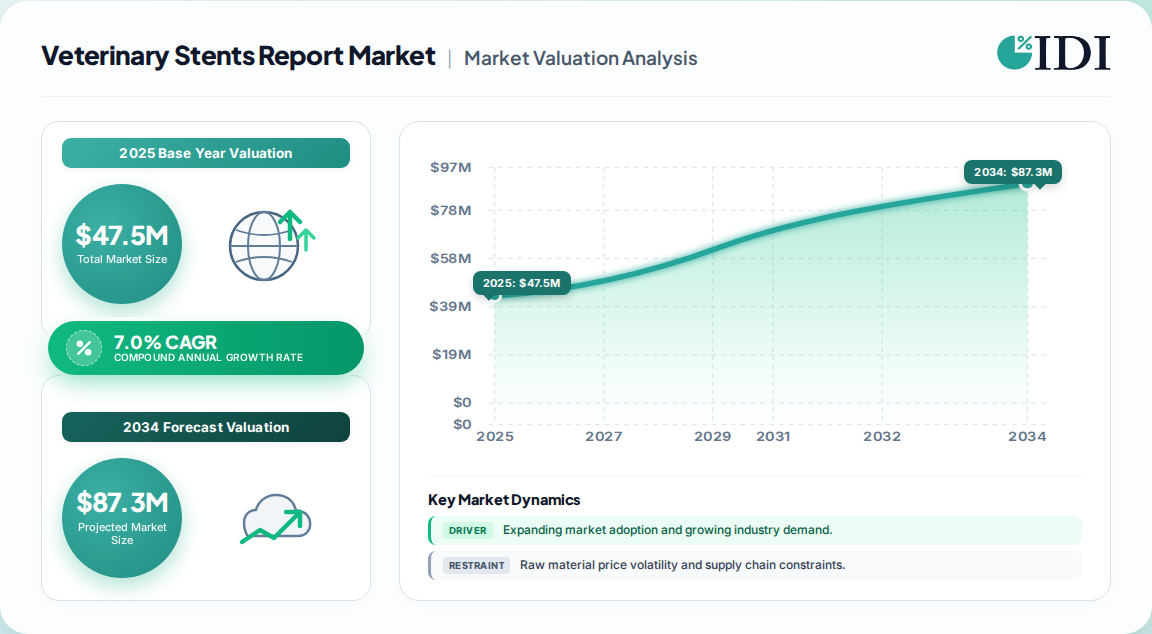
USD 47.5 million in 2025, the global veterinary stents market expands to roughly USD 92 million by 2035 at a 7% CAGR — a niche interventional-device category compounding faster than human coronary stenting.
Airway stents dominate, holding about 39% of revenue, led by tracheal-collapse management in small-breed dogs.
North America commands 50.2% of global revenue, reflecting the deepest specialty-hospital and referral-center infrastructure worldwide.
Dogs account for roughly 59% of procedure volume; nitinol remains the material of choice on elasticity, kink resistance and biocompatibility.
The top five vendors — Infiniti Medical, Dextronix Animal Health, TaeWoong Medical and peers — hold only about 35% combined share, confirming a fragmented, contestable field.
Why this matters for decision-makers: With a sub-USD 100M total addressable pool and low concentration, scale economics are weak — vendors must win through procedural training, referral-center lock-in and human-device technology transfer, not price.
Veterinary Stents Market Report Market Size (In Million)
75.0M
60.0M
45.0M
30.0M
15.0M
0
48.00 M
2025
51.00 M
2026
54.00 M
2027
58.00 M
2028
62.00 M
2029
67.00 M
2030
71.00 M
2031
Veterinary Stents Market Report Market Size (In Million)
Year
Market Size
2025
48.00 M
2026
51.00 M
2027
54.00 M
2028
58.00 M
2029
62.00 M
2030
67.00 M
2031
71.00 M
What is the Veterinary Stents Market Report?
The veterinary stents market report quantifies global revenue from tubular implants — airway, urethral, vascular and other stents — placed in companion and livestock animals to restore patency in collapsed or obstructed ducts. It covers product, animal, application, material, end-use and regional segmentation, plus vendor share, pricing dynamics and forecast demand through 2035.
Scope: what this report covers and excludes
Scope is global, covering revenue from veterinary stent devices and delivery systems across companion animals (dogs, cats) and other animals (including ruminants), segmented by product, application, material and end-use setting (veterinary hospitals and clinics, academic and research institutions, rescue centers and shelters). Both the 2025 base year and the 2026–2035 forecast horizon are addressed.
This analysis does not cover human coronary or peripheral stents, balloon-dilation catheters sold without stents, general veterinary orthopedic implants, or veterinary imaging and endoscopy capital equipment except where bundled into stenting procedure economics.
How big is the market for Veterinary Stents Market Report?
Published estimates converge tightly near USD 47–48 million for 2024–2025, then diverge materially on the horizon — one forecast lands near USD 71 million by 2030, another at USD 92 million by 2035. The base year is defensible; the long-range spread is where buyer judgment matters.
Estimate
Base Year
Horizon
CAGR
Definition / scope
Attribution
USD 48.3M
2024
2030
6.9%
Global veterinary stent device revenue, all products
One published estimate
USD 47.5M
2025
2035
7.0%
Global veterinary stents, airway to vascular
A competing analysis
USD 71.4M by 2030
2024
2030
6.84%
Same scope, press-release variant
One published estimate (alternate vintage)
Our analysis suggests the ~7% CAGR is the most defensible consensus: both publishers independently land within 10 basis points on growth, and historical movement from USD 40.8M (2022) to USD 45M (2024) implies roughly 5% realized growth accelerating modestly as specialty capacity expands. The divergence sits almost entirely in the outer years, where 2035 values depend on assumptions about referral-center penetration in Asia Pacific — precisely the variable a buyer cannot verify from headline figures alone.
How is the market segmented?
Segmentation follows clinical anatomy first, then species and material, because procedure economics are driven by which duct is being stented and who performs it. Airway dominates; vascular carries the fastest expected growth on active R&D.
Parent Segment
Children
Product
Airway stents, Urethral stents, Vascular stents, Other stents
Animal
Dogs, Cats, Other animals
Application
Airway collapse, Urinary tract obstructions, Vascular obstructions, Other applications
Material
Nitinol, Biodegradable polymer
End-use
Veterinary hospitals & clinics, Other (academic, rescue, shelters)
Airway stents reached roughly USD 18.7 million in 2025, per one published estimate, underpinned by chronic tracheal collapse in Yorkshire Terriers, Pomeranians and Chihuahuas. Urethral stenting is the quieter volume story: feline urethral obstruction incidence of 1.5%–9% and high ruminant rates create steady livestock-side demand outside the premium companion-animal market.
Which region leads in Veterinary Stents Market Report?
North America leads with 50.2% of global revenue, followed by Europe and a fast-urbanizing Asia Pacific. Leadership reflects procedure infrastructure — board-certified interventionalists, fluoroscopy suites and referral networks — rather than pet population alone.
USA: deepest referral-center density and pet-insurance penetration
Canada: concentrated specialty hospital clusters
Mexico: emerging, price-sensitive
Europe: Germany, UK, France, Italy, Spain, Denmark, Sweden
Asia Pacific: Japan, China, India, South Korea, Australia, Thailand
Latin America: Brazil, Argentina
Middle East & Africa: Saudi Arabia, UAE, South Africa, Kuwait
This concentration cuts both ways. It implies North America will absorb the majority of near-term incremental revenue, but also that a single reimbursement or consolidation shock there moves the global number by several points. Our analysis suggests Asia Pacific is where share will actually shift, as corporate veterinary chains import interventional capability.
What is driving growth — and what is holding it back?
The core driver is clinical substitution: stents replace invasive surgery or palliative medication for tracheal collapse and urethral obstruction, with shorter recovery and lower complication risk. Restraints are economic and structural — cost, substitute procedures and thin specialist supply.
Factor
Direction
Evidence strength
Mechanism
Rising pet ownership & humanization
Driver
Strong
~1 billion pets globally; owners fund advanced care
Deters first-time adoption by general practitioners
Vendor transaction volatility
Restraint
Weak
Retracted acquisitions create supply uncertainty
The balance favors growth, but growth is procedural, not demographic. Every incremental stent requires a trained operator and a facility equipped for fluoroscopy — which is why the constraint is specialist labor, not demand. This dynamic favors vendors that bundle training and proctoring with device sales.
Who are the leading vendors?
No vendor exceeds roughly 20% share, and the top five together hold about 35% — making this one of the least concentrated niches in veterinary medical devices. Differentiation rests on stent design breadth and clinical relationships rather than manufacturing scale.
Company
Positioning
Notable capability
Infiniti Medical
Market leader (~19.5% share)
Broad veterinary interventional portfolio
Dextronix Animal Health
Top-five
Veterinary-specific stent distribution
TaeWoong Medical
Top-five
Human-to-veterinary technology transfer
Create Medic
Established
Airway and non-vascular stenting
AbtVet (Stening Group)
Clinical case leadership
Silicone tracheal stent procedures
M.I.Tech
Established
Stent manufacturing heritage
UltraVet Medical Devices
Emerging innovator
Bifurcated bronchial stent in development
Competitive moats are shallow. Human-device manufacturers can enter by repurposing approved platforms — Dumon silicone stents, developed for human airway stenosis, already show efficacy in grade IV canine tracheal collapse. The strategic risk for incumbents is not rival veterinarians but human-medtech adjacencies.
What do buyers and operators need to know?
Selection is dominated by fit over price. Stent diameter, radial force and conformability must match the collapsed segment; a nitinol self-expanding platform that kinks or migrates creates a revision case costing far more than the device. Buyers should weight design breadth and sizing inventory above unit cost.
Procurement risk concentrates in supply continuity. Because several vendors have experienced ownership disruption — including retracted acquisitions involving TaeWoong Medical and M.I.Tech — buyers should verify manufacturing continuity, backorder exposure and regulatory documentation before standardizing on a single platform.
Regulatory compliance is lighter than human devices but not trivial: veterinary stents often ride human-clearance pathways or fall under jurisdiction-specific device rules, so documentation quality varies by vendor. Operators should request biocompatibility and sterility evidence, and confirm post-market complaint handling. Switching costs are moderate — restocking a new platform requires retraining and inventory duplication, which quietly locks in incumbents. Training access, not device specification, is the real switching barrier.
Strategic Recommendations & Analyst Perspective
The balance of evidence favors a procedural-infrastructure thesis, not a volume thesis. At under USD 50 million today, this category cannot support broad-market distribution economics; value accrues to whoever controls the trained operator and the referral center. Vendors that pair devices with proctoring, case-selection support and sizing inventory will compound share faster than those competing on price.
The strongest counter-argument is commoditization through human-device spillover: if approved human airway and vascular platforms are routinely repurposed, veterinary-specific design premiums erode and pricing converges toward off-label human pricing. That is a genuine risk — but it cuts both ways, since it also expands the total treatable population and rewards whoever builds the clinical evidence base first.
For investors: prioritize vendors with installed referral-center relationships and defensible design IP over those with raw capacity; the fragmented 35% top-five share signals consolidation runway.
For operators: budget for training and inventory duplication when switching platforms; negotiate supply-continuity clauses, not just price.
For entrants: target underserved indications — urethral and vascular — where airway is already contested and differentiation is achievable.
What would change our conclusion: documented evidence of rapid, low-cost human-device substitution at scale, or reimbursement reform in North America that funds veterinary stenting beyond insured populations. Absent those, the 7% trajectory holds — but precise sub-segment and country-level forecasting requires the full report's bottom-up model.
Our rigorous research methodology combines multi-layered approaches with comprehensive quality assurance, ensuring precision, accuracy, and reliability in every market analysis.
Primary Research & Industry Fieldwork
This study applies a 70/30 primary-to-secondary research split. In-depth interviews were conducted across the veterinary interventional value chain, including stent material suppliers, specialized device manufacturers, contract coating and assembly partners, and global veterinary distributors. Decision-maker designations interviewed included VP-level Sourcing, Heads of R&D, Technical Directors and Commercial Operations Leads at specialty veterinary hospitals and referral networks. Fieldwork captured real-world stent selection, sizing inventory practice and revision-case economics, which inform our pricing and adoption assumptions.
Key Stakeholders Interviewed
Key Stakeholders Interviewed
Stakeholder Role
Interview Share (%)
R&D & Technical Directors
40%
Procurement & Sourcing Leads
35%
Clinical & Regulatory Affairs Leads
25%
Industry Ecosystem Breakdown
Industry Ecosystem Breakdown
Company Type
Representation (%)
Stent Material & Component Suppliers
40%
Specialized Device Manufacturers
35%
Veterinary Distributors & Referral Networks
25%
Secondary Benchmarking & Public Trade Validation
Secondary validation drew on official multilateral trade databases (UN Comtrade, WTO, US ITC, Eurostat), corporate annual filings and investor presentations (10-K and equivalent disclosures), patent databases for nitinol and biodegradable polymer stent designs, and recognized technical standards and veterinary industry associations. Human-device clearance records were cross-referenced to assess technology-transfer pathways into veterinary use.
Demand Modeling & Market Sizing Triangulation
Sizing triangulates a top-down allocation of veterinary healthcare expenditure against a bottom-up model built from manufacturer capacity, average selling prices by stent category, and end-use procedural consumption. Historical movement from 2022 to 2024 anchors the base, while regression and demand-elasticity assumptions drive the 2026–2035 projection.
Europe Veterinary Stents Market Report Revenue Million Forecast, by Product 2020 & 2034
Frequently Asked Questions
1. How big is the veterinary stents market?
The global veterinary stents market was valued at approximately USD 47.5 million in 2025, with one comparable estimate placing 2024 at USD 48.3 million. Both converge near USD 47–48 million, confirming a small but steadily expanding interventional-device niche.
2. What is the veterinary stents market growth rate?
Growth is approximately 7% annually, with published estimates ranging from 6.84% to 7.0% through the forecast horizon. Our analysis treats the ~7% CAGR as the defensible consensus because independent publishers land within 10 basis points of each other.
3. Which segment dominates the veterinary stents market?
Airway stents lead with roughly 39% of revenue, valued near USD 18.7 million in 2025. Demand is anchored by chronic tracheal collapse in small dog breeds such as Yorkshire Terriers, Pomeranians and Chihuahuas, where stenting restores airway patency.
4. Which region leads the veterinary stents market?
North America leads with 50.2% of global revenue, supported by the densest referral-center and interventionalist infrastructure worldwide. Europe holds the second position, while Asia Pacific is the fastest-urbanizing region as corporate veterinary chains import interventional capability.
5. Who are the key players in the veterinary stents market?
Leading vendors include Infiniti Medical, Dextronix Animal Health, TaeWoong Medical, Create Medic, AbtVet (Stening Group), M.I.Tech and UltraVet Medical Devices. Infiniti Medical leads with roughly 19.5% share; the top five hold only about 35% combined, indicating a fragmented field.
Figure 17: Europe Veterinary Stents Market Report Revenue Share (%), by Animal 2026 & 2034
Figure 18: Europe Veterinary Stents Market Report Revenue (Million), by Application 2026 & 2034
Figure 19: Europe Veterinary Stents Market Report Revenue Share (%), by Application 2026 & 2034
Figure 20: Europe Veterinary Stents Market Report Revenue (Million), by Material 2026 & 2034
Figure 21: Europe Veterinary Stents Market Report Revenue Share (%), by Material 2026 & 2034
Figure 22: Europe Veterinary Stents Market Report Revenue (Million), by End-use 2026 & 2034
Figure 23: Europe Veterinary Stents Market Report Revenue Share (%), by End-use 2026 & 2034
Figure 24: Europe Veterinary Stents Market Report Revenue (Million), by Country 2026 & 2034
Figure 25: Europe Veterinary Stents Market Report Revenue Share (%), by Country 2026 & 2034
Figure 26: Asia Pacific Veterinary Stents Market Report Revenue (Million), by Product 2026 & 2034
Figure 27: Asia Pacific Veterinary Stents Market Report Revenue Share (%), by Product 2026 & 2034
Figure 28: Asia Pacific Veterinary Stents Market Report Revenue (Million), by Animal 2026 & 2034
Figure 29: Asia Pacific Veterinary Stents Market Report Revenue Share (%), by Animal 2026 & 2034
Figure 30: Asia Pacific Veterinary Stents Market Report Revenue (Million), by Application 2026 & 2034
Figure 31: Asia Pacific Veterinary Stents Market Report Revenue Share (%), by Application 2026 & 2034
Figure 32: Asia Pacific Veterinary Stents Market Report Revenue (Million), by Material 2026 & 2034
Figure 33: Asia Pacific Veterinary Stents Market Report Revenue Share (%), by Material 2026 & 2034
Figure 34: Asia Pacific Veterinary Stents Market Report Revenue (Million), by End-use 2026 & 2034
Figure 35: Asia Pacific Veterinary Stents Market Report Revenue Share (%), by End-use 2026 & 2034
Figure 36: Asia Pacific Veterinary Stents Market Report Revenue (Million), by Country 2026 & 2034
Figure 37: Asia Pacific Veterinary Stents Market Report Revenue Share (%), by Country 2026 & 2034
Figure 38: Latin America Veterinary Stents Market Report Revenue (Million), by Product 2026 & 2034
Figure 39: Latin America Veterinary Stents Market Report Revenue Share (%), by Product 2026 & 2034
Figure 40: Latin America Veterinary Stents Market Report Revenue (Million), by Animal 2026 & 2034
Figure 41: Latin America Veterinary Stents Market Report Revenue Share (%), by Animal 2026 & 2034
Figure 42: Latin America Veterinary Stents Market Report Revenue (Million), by Application 2026 & 2034
Figure 43: Latin America Veterinary Stents Market Report Revenue Share (%), by Application 2026 & 2034
Figure 44: Latin America Veterinary Stents Market Report Revenue (Million), by Material 2026 & 2034
Figure 45: Latin America Veterinary Stents Market Report Revenue Share (%), by Material 2026 & 2034
Figure 46: Latin America Veterinary Stents Market Report Revenue (Million), by End-use 2026 & 2034
Figure 47: Latin America Veterinary Stents Market Report Revenue Share (%), by End-use 2026 & 2034
Figure 48: Latin America Veterinary Stents Market Report Revenue (Million), by Country 2026 & 2034
Figure 49: Latin America Veterinary Stents Market Report Revenue Share (%), by Country 2026 & 2034
Figure 50: Middle East & Africa Veterinary Stents Market Report Revenue (Million), by Product 2026 & 2034
Figure 51: Middle East & Africa Veterinary Stents Market Report Revenue Share (%), by Product 2026 & 2034
Figure 52: Middle East & Africa Veterinary Stents Market Report Revenue (Million), by Animal 2026 & 2034
Figure 53: Middle East & Africa Veterinary Stents Market Report Revenue Share (%), by Animal 2026 & 2034
Figure 54: Middle East & Africa Veterinary Stents Market Report Revenue (Million), by Application 2026 & 2034
Figure 55: Middle East & Africa Veterinary Stents Market Report Revenue Share (%), by Application 2026 & 2034
Figure 56: Middle East & Africa Veterinary Stents Market Report Revenue (Million), by Material 2026 & 2034
Figure 57: Middle East & Africa Veterinary Stents Market Report Revenue Share (%), by Material 2026 & 2034
Figure 58: Middle East & Africa Veterinary Stents Market Report Revenue (Million), by End-use 2026 & 2034
Figure 59: Middle East & Africa Veterinary Stents Market Report Revenue Share (%), by End-use 2026 & 2034
Figure 60: Middle East & Africa Veterinary Stents Market Report Revenue (Million), by Country 2026 & 2034
Figure 61: Middle East & Africa Veterinary Stents Market Report Revenue Share (%), by Country 2026 & 2034
Table 16:
Table 17: Europe Veterinary Stents Market Report Revenue Million Forecast, by Animal 2020 & 2034
Table 18: Europe Veterinary Stents Market Report Revenue Million Forecast, by Application 2020 & 2034
Table 19: Europe Veterinary Stents Market Report Revenue Million Forecast, by Material 2020 & 2034
Table 20: Europe Veterinary Stents Market Report Revenue Million Forecast, by End-use 2020 & 2034
Table 21: Europe Veterinary Stents Market Report Revenue Million Forecast, by Country 2020 & 2034