Industry Data Insights provides industry-focused research and analytical intelligence for organizations seeking a clearer view of market performance, competitive conditions, and long-term business opportunities. Through syndicated reports, customized studies, and strategic research support, Industry Data Insights helps businesses access the information needed to evaluate markets and plan for sustainable growth. Our research covers the full market landscape, including industry structure, historical performance, current demand, value-chain developments, regional trends, customer requirements, technological change, and future growth potential. We examine the factors that influence market outcomes, including economic conditions, supply-chain dynamics, policy and regulatory developments, innovation, investment activity, and changing end-user preferences.
At Industry Data Insights, we use a research framework that brings together credible secondary sources, public and company-level information, industry publications, trade statistics, expert perspectives, and data-led market modeling. Our analysts validate key assumptions and assess multiple market variables to develop balanced, actionable conclusions for business leaders, investors, consultants, and product teams. Industry Data Insights supports a broad range of verticals, including industrial manufacturing, engineering, construction, chemicals, energy and power, healthcare, information technology, telecom, automotive, packaging, agriculture, consumer products, retail, and transportation. Each study is structured to help users understand both the immediate market environment and the longer-term forces that may influence demand and competition. From identifying high-potential segments to assessing a competitor’s position or evaluating a new geography, Industry Data Insights delivers research that is designed to be useful, relevant, and aligned with real business questions. Our goal is to turn industry data into strategic direction.
US Frozen Snacks Market Report 2026: Size, Share & Forecast
Us Frozen Snacks Market Report by Product (French Fries, Nuggets, Mozzarella Sticks, Fish Fingers, Plant-Based Snacks, Handheld Entrees, Frozen Desserts), by Distribution Channel (Traditional Grocery Stores, Hypermarkets & Supermarkets, Club Stores, Online, Foodservice), by Source (Branded, Private Label), Forecast 2026-2034
US Frozen Snacks Market Report 2026: Size, Share & Forecast
Discover the Latest Market Insight Reports
Access in-depth insights on industries, companies, trends, and global markets. Our expertly curated reports provide the most relevant data and analysis in a condensed, easy-to-read format.
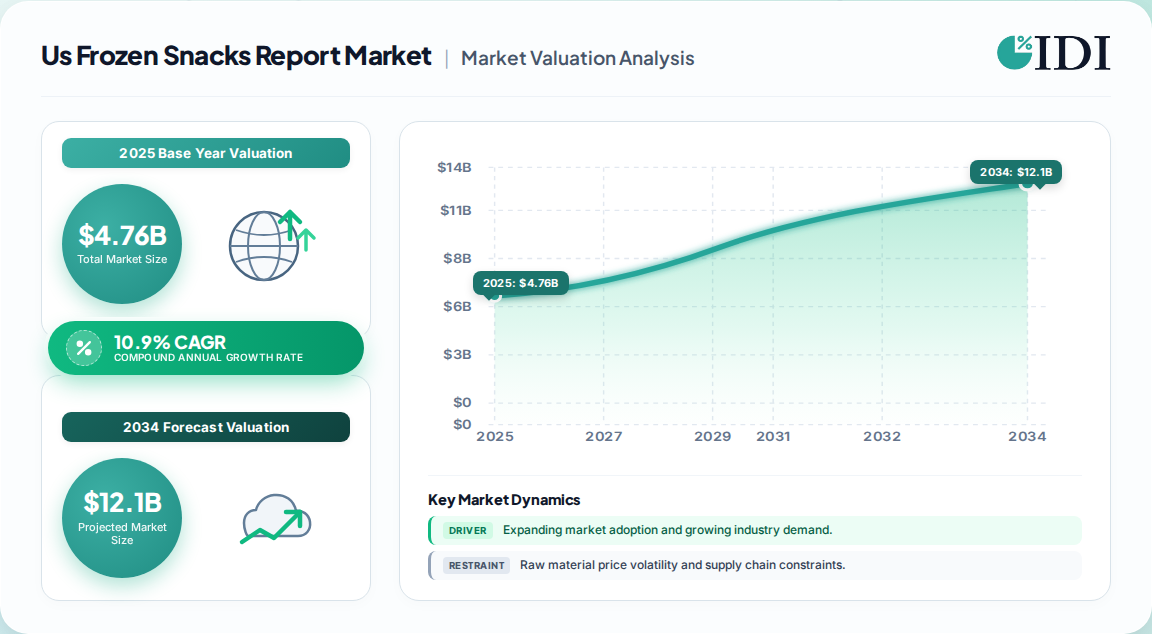
USD 4.76 Billion in 2025 — the U.S. frozen snacks market base, per one published estimate.
10.9% CAGR (2026–2033) is the aggressive case; a competing global analysis implies a more conservative ~6–7% U.S. trajectory.
Frozen french fries lead with 38.26% revenue share; online is the fastest channel at 15.2% CAGR.
South Central U.S. grows fastest at 13.6% CAGR; the Northeast holds the largest regional share (16.47%).
Retail retains the majority of distribution revenue, but foodservice and club-store formats are accelerating.
Major players include Nestlé, Conagra Brands, General Mills, Tyson Foods, Kraft Heinz, McCain Foods and Amy's Kitchen.
Why this matters for decision-makers: The spread between 10.9% and ~6.6% growth is not academic — it determines whether capacity investment in air-fryer formats and clean-label lines pays back inside five years. Buyers must pressure-test the high case before committing capital.
Us Frozen Snacks Market Report Market Size (In Billion)
10.0B
8.0B
6.0B
4.0B
2.0B
0
4.760 B
2025
5.280 B
2026
5.860 B
2027
6.500 B
2028
7.210 B
2029
8.000 B
2030
8.870 B
2031
Us Frozen Snacks Market Report Market Size (In Billion)
Year
Market Size
2025
4.760 B
2026
5.280 B
2027
5.860 B
2028
6.500 B
2029
7.210 B
2030
8.000 B
2031
8.870 B
What is the U.S. Frozen Snacks Market Report?
The U.S. frozen snacks market report quantifies retail and foodservice sales of frozen, ready-to-heat appetizers, handheld entrees, potato-based snacks, plant-based bites and dessert snacks across U.S. census regions. It covers product, distribution channel and regional segmentation with a 2025 base year and forecast horizon to 2033.
Scope: what this report covers and excludes
This analysis covers frozen appetizers, snack rolls, pretzels, handheld entrees, potato-based snacks, plant-based snacks, meat-based snacks, dairy-based snacks and frozen desserts sold through retail and foodservice in the 50 U.S. states. It covers both branded and private-label products, measured at retail selling prices excluding sales tax.
This analysis does not cover frozen breaded vegetables, standalone frozen chicken products such as tenders and nuggets sold as center-of-plate proteins, frozen dinners or entrées, or refrigerated and shelf-stable snacks. It also excludes raw frozen ingredients sold for further manufacturing.
How big is the U.S. frozen snacks market?
One published estimate places the U.S. frozen snacks market at USD 4.76 Billion in 2025, rising to USD 10.95 Billion by 2033 at a 10.9% CAGR. A competing global analysis implies the U.S. grows nearer 6.6% annually, so the defensible planning range is roughly USD 4.8–5.0 Billion today.
The divergence matters. The high case assumes aggressive premiumization, air-fryer-driven household penetration and rapid plant-based adoption; the low case assumes price elasticity and store-brand trading down cap growth. Our analysis suggests the truth sits between them, closer to the global benchmark of 5.5–6.6% once inflation normalizes — a 10.9% CAGR sustained for eight years implies the category nearly triples, which requires a structural step-change in per-capita snack occasions rather than simple inflation pass-through.
Estimate
Base year
Horizon
CAGR
Definition / scope
Attribution
USD 4,761.4 Million
2025
2033
10.9%
U.S. frozen snacks, retail+foodservice
One published estimate
USD 38.39 Billion
2025
2035
6.64%
U.S. frozen snacks, broad product basket
A competing analysis
USD 146.22 Billion
2025
2031
5.53%
Global frozen snacks
A competing analysis
USD 154.71 Billion
2026
2031
5.53%
Global frozen snacks
A competing analysis
Visual anchor: The USD 38.39 Billion figure reflects a far broader basket — including frozen desserts, confectionery and meat substitutes — which explains most of the gap versus the narrower USD 4.76 Billion definition. Scope, not error, drives the divergence.
How is the market segmented?
The U.S. frozen snacks market segments primarily by product (fries, nuggets, mozzarella sticks, fish fingers, plant-based and handheld entrees) and by distribution channel (grocery, hypermarkets, club stores, online and foodservice). Product and channel together explain most of the variance in margin and velocity.
Parent segment
Children
By Product
French Fries, Nuggets, Mozzarella Sticks, Fish Fingers, Plant-Based Snacks, Handheld Entrees, Frozen Desserts
By Distribution Channel
Traditional Grocery Stores, Hypermarkets & Supermarkets, Club Stores, Online, Foodservice
By Source
Branded, Private Label
Frozen french fries hold 38.26% of revenue — a concentration risk and an opportunity. Potato-based items globally command 32.62% share, confirming fries as the anchor SKU that drives basket traffic. Plant-based lines are the fastest-growing product family at roughly 6.13% CAGR globally, which our analysis suggests will outpace that rate in the U.S. given clean-label momentum.
Which U.S. region leads the frozen snacks market?
The Northeast leads with 16.47% revenue share in 2025, but the South Central region is the fastest-growing at 13.6% CAGR. The Midwest and West hold the largest combined share and are the volume battleground for club-store formats.
Us Frozen Snacks Market Report Regional Market Share
Loading chart...
Us Frozen Snacks Market Report Regional Market Share
Region
Market Share (%)
Northeast
0.16%
South Central
0.15%
Midwest
0.24%
South Atlantic
0.2%
West
0.24%
Northeast — 16.47% share; mature, premium-skewed, high private-label penetration.
South Central — fastest growth (13.6% CAGR); population inflow and QSR density drive trial.
Midwest — largest volume base; club stores and value packs dominate.
South Atlantic — demographic growth corridor; strong online grocery adoption.
West — innovation test-bed; highest air-fryer and plant-based penetration.
This regional dispersion implies a differentiated go-to-market: premium and clean-label launches should pilot in the Northeast and West, while value-pack and family-size formats should lead in the South Central and Midwest. National rollouts that ignore this split will misallocate trade spend.
What is driving growth — and what is holding it back?
Convenience demand, snackification, clean-label innovation and cold-chain expansion are the primary growth engines. Price sensitivity, ultra-processed-food (UPF) concerns and nutritional skepticism are the principal brakes — and our analysis suggests the brakes are strengthening faster than most forecasts assume.
Factor
Direction
Evidence strength
Mechanism
Convenience & time-saving
Driver
High
Dual-income households, longer hours
Snackification
Driver
High
Smaller, more frequent eating occasions
Air-fryer adoption
Driver
Medium
Shortens prep, broadens formats
Clean-label & plant-based
Driver
Medium
Health-conscious, younger cohorts
Price sensitivity
Restraint
High
39% cite price; 52% in tight finances
UPF & nutrition concerns
Restraint
High
Bigger barrier than price for frequency
Store-brand parity
Restraint
Medium
64% see store brands as equal
The balance is tighter than headline CAGRs imply. Mintel-style consumer evidence shows nutrition and UPF concerns suppress repeat purchase more than price does, which means reformulation — not discounting — is the lever that lifts frequency. Dinner is the largest under-penetrated occasion: 75% of consumers eat dinner daily but only 40% of frozen snack buyers use the category for easy dinners.
Who are the leading vendors?
The U.S. frozen snacks market is moderately concentrated, with a long tail of regional and private-label players. J.M. Smucker leads on appetizer and handheld share; Conagra, General Mills, Tyson and Kraft Heinz compete across frozen handhelds and protein-led snacks; McCain and Lamb Weston anchor the fries segment.
Company
Core strength
Strategic posture
J.M. Smucker
Appetizers & handheld entrees
Share leader; premiumization focus
Conagra Brands
Frozen handhelds & snacks
Portfolio breadth; value tiers
General Mills
Frozen appetizers
Brand equity; family packs
Tyson Foods
Protein-led frozen snacks
Air-fryer formats
Kraft Heinz
Frozen snacks
Distribution scale
McCain Foods
Frozen fries
Potato specialization
Amy's Kitchen
Organic & plant-based
Clean-label moat
Differentiation is shifting from brand to formulation. Companies that control their own ingredient narrative — organic, non-GMO, high-protein, fiber-rich — can defend price premiums even as 64% of consumers view store brands as equal to name brands. Our analysis suggests the moat is no longer the brand name but the reformulation pipeline and the cold-chain relationship with quick-commerce platforms.
What do buyers and operators need to know?
Procurement decisions in this category hinge on four criteria: freezer-space productivity, formulation compliance (clean-label, sodium and allergen labeling), landed cost per serving under volatile energy costs, and cold-chain reliability with online grocery partners. Switching costs are moderate for retailers but high for foodservice operators locked into menu-engineering contracts. Regulatory risk concentrates in FDA labeling and sodium-reduction guidance, plus state-level UPF disclosure proposals. Buyers should require suppliers to document reformulation roadmaps and air-fryer performance data, not just price schedules.
Strategic Recommendations & Analyst Perspective
The balance of evidence favors a mid-single-digit to low-double-digit growth range, with the high case (10.9%) credible only if plant-based and air-fryer formats scale faster than current adoption curves suggest. The strongest counter-argument is that snackification and dinner occasion capture could structurally lift per-capita consumption enough to sustain double-digit growth — but that requires the category to solve its nutrition and UPF perception problem first.
Our judgment: the dinner occasion is the single largest unclaimed prize. Fewer than half of frozen snack buyers use the category for dinner despite 87% using it for meals overall. Brands that reposition from "snack" to "meal solution" — with protein- and fiber-rich formulations and pairing suggestions — can capture incremental occasions without new freezer space.
Actionable strategy:
Prioritize protein- and fiber-rich reformulation over price promotion to lift purchase frequency.
Pilot family-size value packs in the South Central and Midwest to capture the fastest-growing, price-sensitive cohorts.
Build quick-commerce and club-store channel partnerships to lock in the 15.2% online CAGR before private label closes the gap.
The evidence that would change our conclusion: sustained double-digit volume (not price) growth for four consecutive quarters, or a regulatory shift that mandates UPF labeling and accelerates clean-label winners.
Research Methodology
Primary Research & Industry Fieldwork
This study applies a 70/30 primary-to-secondary research split. We conducted in-depth interviews across the value chain with raw material suppliers (potato and poultry), specialized frozen producers, contract formulators, cold-chain distributors and quick-commerce grocery operators. Decision-maker designations interviewed included VP of Sourcing, Heads of R&D, Technical Directors and Commercial Operations Leads. Interviews were structured to validate volume, pricing and reformulation pipelines.
Secondary Benchmarking & Public Trade Validation
We triangulated official trade and standards data from UN Comtrade, US ITC, Eurostat and WTO databases, alongside corporate 10-K filings, SEC disclosures and investor presentations from listed frozen food manufacturers. Patent databases and non-profit technical standards informed formulation and packaging trend validation.
Demand Modeling & Market Sizing Triangulation
We run simultaneous Top-Down allocation (macroeconomic consumption and category share) and Bottom-Up modeling (manufacturer capacity, product pricing and end-use consumption). The two paths are reconciled to a single base-year value and forecast band.
U.S. Department of Agriculture (USDA) Economic Research Service — food expenditure and price data
U.S. Food and Drug Administration (FDA) — labeling and sodium-reduction guidance
UN Comtrade — frozen prepared food trade flows
U.S. International Trade Commission (USITC) — import/export statistics for frozen potato and prepared foods
National Frozen & Refrigerated Foods Association (NFRA) — category consumption benchmarks
Us Frozen Snacks Market Report Regional Market Share
Higher Coverage
Lower Coverage
No Coverage
Us Frozen Snacks Market Report REPORT HIGHLIGHTS
Research Methodology & Data Sources
Our rigorous research methodology combines multi-layered approaches with comprehensive quality assurance, ensuring precision, accuracy, and reliability in every market analysis.
Primary Research & Industry Fieldwork
This study applies a 70/30 primary-to-secondary research split. We conducted in-depth interviews across the value chain with raw material suppliers (potato and poultry), specialized frozen producers, contract formulators, cold-chain distributors and quick-commerce grocery operators. Decision-maker designations interviewed included VP of Sourcing, Heads of R&D, Technical Directors and Commercial Operations Leads. Interviews validated volume, pricing and reformulation pipelines.
Key Stakeholders Interviewed
Key Stakeholders Interviewed
Stakeholder Role
Interview Share (%)
R&D & Formulation Directors
35%
Procurement & Sourcing Leads
35%
Commercial & Category Operations
30%
Industry Ecosystem Breakdown
Industry Ecosystem Breakdown
Company Type
Representation (%)
Raw Material & Agricultural Suppliers
30%
Specialized Frozen Producers
40%
Cold-Chain Distributors & Logistics
30%
Secondary Benchmarking & Public Trade Validation
We triangulated official trade and standards data from UN Comtrade, US ITC, Eurostat and WTO databases, alongside corporate 10-K filings, SEC disclosures and investor presentations from listed frozen food manufacturers. Patent databases and non-profit technical standards informed formulation and packaging trend validation.
Demand Modeling & Market Sizing Triangulation
We run simultaneous Top-Down allocation (macroeconomic consumption and category share) and Bottom-Up modeling (manufacturer capacity, product pricing and end-use consumption). The two paths are reconciled to a single base-year value and forecast band.
U.S. Department of Agriculture (USDA) Economic Research Service
U.S. Food and Drug Administration (FDA) labeling and sodium-reduction guidance
UN Comtrade frozen prepared food trade flows
U.S. International Trade Commission (USITC) import/export statistics
National Frozen & Refrigerated Foods Association (NFRA) category benchmarks
Aspects
Details
Study Period
2020-2034
Base Year
2025
Estimated Year
2026
Forecast Period
2026-2034
Historical Period
2020-2025
Growth Rate
CAGR of 10.9% from 2020-2034
Segmentation
By Product
French Fries
Nuggets
Mozzarella Sticks
Fish Fingers
Plant-Based Snacks
Handheld Entrees
Frozen Desserts
By Distribution Channel
Traditional Grocery Stores
Hypermarkets & Supermarkets
Club Stores
Online
Foodservice
By Source
Branded
Private Label
By Geography
Table of Contents
1. Us Frozen Snacks Market Report Introduction
1.1. Research Scope
1.2. Market Segmentation
1.3. Research Objective
1.4. Definitions and Assumptions
2. Us Frozen Snacks Market Report Executive Summary
2.1. Market Snapshot
3. Us Frozen Snacks Market Report Dynamics
3.1. Introduction
3.2. Market Drivers
3.3. Market Restrains
3.4. Market Trends
4. Us Frozen Snacks Market Report Factor Analysis
4.1. Porters Five Forces
4.1.1. Bargaining Power of Suppliers
4.1.2. Bargaining Power of Buyers
4.1.3. Threat of New Entrants
4.1.4. Threat of Substitutes
4.1.5. Competitive Rivalry
4.2. PESTEL analysis
4.3. BCG Analysis
4.3.1. Stars (High Growth, High Market Share)
4.3.2. Cash Cows (Low Growth, High Market Share)
4.3.3. Question Mark (High Growth, Low Market Share)
4.3.4. Dogs (Low Growth, Low Market Share)
4.4. Ansoff Matrix Analysis
4.5. Supply Chain Analysis
4.6. Regulatory Landscape
4.7. Current Market Potential and Opportunity Assessment (TAM–SAM–SOM Framework)
4.8. IDI Analyst Note
5. Us Frozen Snacks Market Report Analysis, Insights and Forecast, 2020-2034
5.1. Analysis, Insights and Forecast - by Product
5.1.1. French Fries
5.1.2. Nuggets
5.1.3. Mozzarella Sticks
5.1.4. Fish Fingers
5.1.5. Plant-Based Snacks
5.1.6. Handheld Entrees
5.1.7. Frozen Desserts
5.2. Analysis, Insights and Forecast - by Distribution Channel
5.2.1. Traditional Grocery Stores
5.2.2. Hypermarkets & Supermarkets
5.2.3. Club Stores
5.2.4. Online
5.2.5. Foodservice
5.3. Analysis, Insights and Forecast - by Source
5.3.1. Branded
5.3.2. Private Label
5.4. Analysis, Insights and Forecast - by Region
6. Us Frozen Snacks Market Report Competitive Analysis
6.1. Company Profiles
6.2. Market Entropy
6.2.1. Company's Key Areas Served
6.2.2. Recent Developments
6.3. Company Market Share Analysis, 2026
6.3.1. Top 5 Companies Market Share Analysis
6.3.2. Top 3 Companies Market Share Analysis
6.4. List of Potential Customers
7. Us Frozen Snacks Market Report Research Methodology
List of Figures
Figure 1: Us Frozen Snacks Market Report Revenue Breakdown (Billion, %) by Product 2026 & 2034
Figure 2: Us Frozen Snacks Market Report Value Share (%), by Product 2026 & 2034
Figure 3: Us Frozen Snacks Market Report Value Share (%), by Distribution Channel 2026 & 2034
Figure 4: Us Frozen Snacks Market Report Value Share (%), by Source 2026 & 2034
Figure 5: Us Frozen Snacks Market Report Share (%) by Company 2026
List of Tables
Table 1: Us Frozen Snacks Market Report Revenue Billion Forecast, by Product 2020 & 2034
Table 2: Us Frozen Snacks Market Report Revenue Billion Forecast, by Distribution Channel 2020 & 2034
Table 3: Us Frozen Snacks Market Report Revenue Billion Forecast, by Source 2020 & 2034
Table 4: Us Frozen Snacks Market Report Revenue Billion Forecast, by Region 2020 & 2034
Frequently Asked Questions
1. How large is the U.S. frozen snacks market?
One published estimate values it at USD 4.76 Billion in 2025, rising to USD 10.95 Billion by 2033 at 10.9% CAGR. Broader definitions including frozen desserts place it materially higher.
2. What is the fastest-growing segment in U.S. frozen snacks?
Online distribution is the fastest-growing channel at 15.2% CAGR, while plant-based frozen snacks grow near 6.13% globally. Air-fryer-optimized formats lead product innovation.
3. Which U.S. region leads frozen snacks sales?
The Northeast holds the largest share at 16.47%, but the South Central region grows fastest at 13.6% CAGR, driven by population inflow and quick-service restaurant density.
4. Who are the leading frozen snack vendors in the U.S.?
J.M. Smucker, Conagra Brands, General Mills, Tyson Foods, Kraft Heinz, McCain Foods and Amy's Kitchen lead the market, with private label gaining share rapidly.
5. What is holding back U.S. frozen snack consumption?
Ultra-processed-food and nutrition concerns are a bigger barrier to purchase frequency than price, per consumer evidence. Price is cited by 39% of buyers, rising to 52% among constrained households.