Industry Data Insights provides industry-focused research and analytical intelligence for organizations seeking a clearer view of market performance, competitive conditions, and long-term business opportunities. Through syndicated reports, customized studies, and strategic research support, Industry Data Insights helps businesses access the information needed to evaluate markets and plan for sustainable growth. Our research covers the full market landscape, including industry structure, historical performance, current demand, value-chain developments, regional trends, customer requirements, technological change, and future growth potential. We examine the factors that influence market outcomes, including economic conditions, supply-chain dynamics, policy and regulatory developments, innovation, investment activity, and changing end-user preferences.
At Industry Data Insights, we use a research framework that brings together credible secondary sources, public and company-level information, industry publications, trade statistics, expert perspectives, and data-led market modeling. Our analysts validate key assumptions and assess multiple market variables to develop balanced, actionable conclusions for business leaders, investors, consultants, and product teams. Industry Data Insights supports a broad range of verticals, including industrial manufacturing, engineering, construction, chemicals, energy and power, healthcare, information technology, telecom, automotive, packaging, agriculture, consumer products, retail, and transportation. Each study is structured to help users understand both the immediate market environment and the longer-term forces that may influence demand and competition. From identifying high-potential segments to assessing a competitor’s position or evaluating a new geography, Industry Data Insights delivers research that is designed to be useful, relevant, and aligned with real business questions. Our goal is to turn industry data into strategic direction.
France Cashmere Clothing Market Report 2026: Size, Share, Trends
France Cashmere Clothing Market Report
Updated On
Nov 18 2026
Total Pages
234
Shweta Thorat
Research Associate
France Cashmere Clothing Market Report 2026: Size, Share, Trends
France Cashmere Clothing Market Report by Product (Sweaters & Coats, Pants & Trousers, Tees & Polo, Others), by End Use (Men, Women), by Distribution Channel (Online/E-commerce, Offline), by France (Île-de-France, Auvergne-Rhône-Alpes, Provence-Alpes-Côte dAzur, Nouvelle-Aquitaine, Occitanie, Hauts-de-France, Other Regions) Forecast 2026-2034
France Cashmere Clothing Market Report 2026: Size, Share, Trends
Discover the Latest Market Insight Reports
Access in-depth insights on industries, companies, trends, and global markets. Our expertly curated reports provide the most relevant data and analysis in a condensed, easy-to-read format.
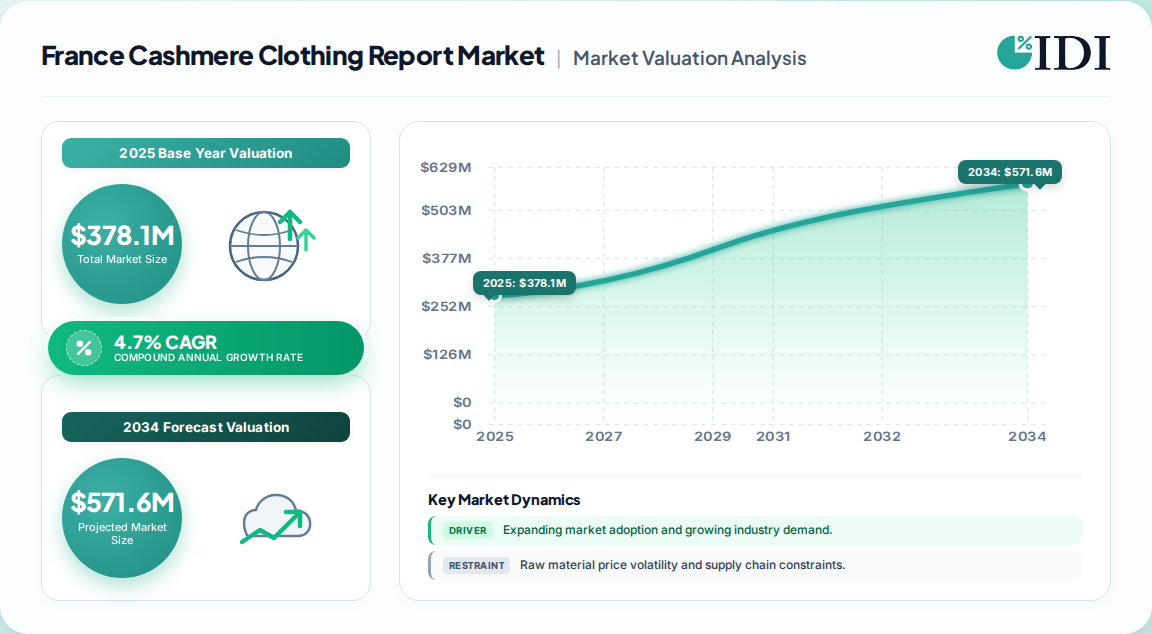
The France cashmere clothing market was valued at 378.1 Million in 2025, one of the most credible base-year figures across published estimates for this category.
Revenue is projected to reach 546.0 Million by 2033, implying a 4.7% CAGR over the 2026–2033 forecast horizon.
Sweaters & Coats dominate product mix at 51.2% of 2025 revenue, confirming knitwear as the commercial core of French cashmere.
Women represent 59.3% of demand, while offline channels still capture 68.5% of sales, underlining the enduring power of boutiques and department stores.
Competitive intensity is high, with Éric Bompard, Loro Piana, Brunello Cucinelli, Chanel and LVMH-linked maisons shaping brand share and pricing power.
Sustainability is now a purchasing criterion, not a niche: 42% of European consumers say ethical or eco-friendly clothing matters to them.
Why this matters for decision-makers: With offline still holding two-thirds of revenue, brands that defund physical retail to chase e-commerce risk ceding the premium touchpoint that justifies cashmere's price premium.
France Cashmere Clothing Market Report Market Size (In Million)
500.0M
400.0M
300.0M
200.0M
100.0M
0
378.0 M
2025
396.0 M
2026
415.0 M
2027
434.0 M
2028
454.0 M
2029
476.0 M
2030
498.0 M
2031
France Cashmere Clothing Market Report Market Size (In Million)
Year
Market Size
2025
378.0 M
2026
396.0 M
2027
415.0 M
2028
434.0 M
2029
454.0 M
2030
476.0 M
2031
498.0 M
What is the France Cashmere Clothing Market Report?
The France cashmere clothing market report is a segmented revenue forecast covering sweaters and coats, pants and trousers, and tees and polos sold to men and women through online and offline channels in France, with historical data from 2021 and projections to 2033.
Scope: what this report covers and excludes
This analysis covers finished cashmere apparel sold in France across product, end-use and distribution-channel dimensions, including domestic and tourist-driven purchases at French retail. It examines brand-level competitive positioning, consumer behaviour and pricing dynamics.
This analysis does not cover raw cashmere fibre trading, greasy or scoured fibre processing, cashmere-blend home textiles, or non-cashmere luxury knitwear. Adjacent categories such as wool knitwear, generic premium apparel, and second-hand resale platforms are excluded except where they materially influence cashmere demand.
How big is the France cashmere clothing market?
Published estimates diverge materially, and the gap is almost entirely methodological rather than real. The table below reconciles the competing figures.
Our analysis suggests the 378.1 Million figure is the most defensible for buyer decision-making: it sits between the narrow and broad definitions, uses a retail-value lens consistent with luxury pricing, and its 4.7% CAGR aligns with the 4.8% and 5.3% growth expectations published elsewhere. The 204.4 Million estimate likely excludes accessory-adjacent knitwear or reports at wholesale value, while the 470 Million figure probably folds in cashmere blends. Both are directionally useful but not directly comparable.
The practical implication is that a buyer sizing the addressable premium-knitwear opportunity should anchor on the central figure and stress-test ±15% for definitional drift, not treat the divergence as market volatility.
How is the market segmented?
Segmentation is clean and three-dimensional: product form, gender end use, and distribution channel. Sweaters and coats are the anchor segment, while tees and polos represent the fastest-growing frontier.
Two structural reads matter here. First, the 51.2% sweater-and-coat share means any brand without a credible knitwear hero product is structurally marginal in France. Second, the fast growth flagged in tees and polos suggests cashmere is migrating from seasonal outerwear into year-round, lighter-weight wardrobe staples — a shift that compresses seasonality and rewards supply chains built for smaller, more frequent drops.
Our analysis suggests the pants and trousers segment remains underdeveloped relative to knitwear, representing the clearest white space for a differentiated entrant.
Which French regions lead in cashmere clothing demand?
Demand concentrates heavily in Île-de-France, where Paris functions as both a domestic consumption hub and a global luxury-tourism magnet. Regional shares below are indicative of retail-value concentration, not audited statistics.
France Cashmere Clothing Market Report Regional Market Share
Loading chart...
France Cashmere Clothing Market Report Regional Market Share
Region
Market Share (%)
Île-de-France
0.34%
Auvergne-Rhône-Alpes
0.16%
Provence-Alpes-Côte d'Azur
0.12%
Nouvelle-Aquitaine
0.11%
Occitanie
0.1%
Hauts-de-France
0.09%
Other Regions
0.08%
Region
Approx. Share
Demand Character
Île-de-France
34%
Luxury tourism, flagship boutiques, Golden Triangle retail
Auvergne-Rhône-Alpes
16%
Affluent domestic base, Alpine winter demand
Provence-Alpes-Côte d'Azur
12%
Seasonal/second-home affluence, Riviera tourism
Nouvelle-Aquitaine
11%
Dispersed affluent urban centres
Occitanie
10%
Growing metropolitan demand
Hauts-de-France
9%
Value-sensitive, cross-border influence
Other Regions
8%
Residual national demand
Indented view: France → Île-de-France; Auvergne-Rhône-Alpes; Provence-Alpes-Côte d'Azur; Nouvelle-Aquitaine; Occitanie; Hauts-de-France; Other Regions.
The concentration in Île-de-France creates a dual exposure: Paris drives disproportionate revenue but is also the most tourist-elastic. Vendors should treat Paris as a marketing and brand-equity investment and the regions as volume-stability plays.
What is driving growth — and what is holding it back?
Growth is structurally supported by France's luxury heritage and a sustainability-driven shift toward fewer, higher-quality purchases. Restraints are chiefly macro-consumption and raw-material cost volatility rather than demand erosion.
Factor
Direction
Evidence strength
Mechanism
Luxury fashion culture
Driver
High
Clothing ≈42.8% of French luxury sales; premium knitwear is a natural outlet
Sustainability shift
Driver
Medium-High
42% of EU consumers value ethical clothing; 27% of French buyers cut purchases for ethical reasons
Paris Golden Triangle generates lump-sum international revenue
Raw cashmere price volatility
Restraint
Medium
Fibre cost squeezes gross margin at fixed retail price points
Consumer spending caution
Restraint
Medium
Premium apparel is discretionary and deferrable
Counterfeit and blend dilution
Restraint
Low-Medium
Quality scepticism can erode willingness to pay
The balance of evidence favours the drivers. The sustainability narrative is unusually powerful here because it converts a luxury purchase into a values-consistent one — a rare alignment that removes psychological friction from high price points. The genuine risk is not demand but margin: fibre cost shocks transmit directly into a category where consumers resist rapid price increases.
Who are the leading vendors?
France's competitive set blends French cashmere specialists, Italian luxury fibre houses and global luxury conglomerates. Differentiation rests on fibre provenance, craft heritage and retail experience rather than price.
Éric Bompard's moat is authenticity: a French cashmere specialist with four decades of category focus, which translates into consumer trust that diversified maisons cannot easily replicate in knitwear. Loro Piana and Brunello Cucinelli compete on fibre-sourcing pedigree and craft storytelling at higher price tiers.
Our analysis suggests the most contested ground is the mid-premium tier between specialist and maison pricing, where traceability claims and recycled-cashmere credentials are becoming the decisive differentiator.
What do buyers and operators need to know?
Mission-critical selection criteria are fibre provenance documentation, blend transparency and certified traceability, because these now underpin both consumer trust and sustainability marketing claims. Buyers should demand chain-of-custody evidence rather than marketing language.
Procurement risk concentrates in fibre supply: cashmere prices are volatile and quality varies by origin. Operators should secure multi-origin sourcing and consider recycled-cashmere inputs to hedge cost while strengthening sustainability positioning.
Switching costs are moderate for brands but high for consumers — once a buyer trusts a cashmere label's hand-feel and durability, repurchase loyalty is strong. Regulatory exposure centres on EU textile labelling and green-claims scrutiny; unsubstantiated eco-claims carry reputational and legal risk. Offline's 68.5% share means store experience and staff expertise remain operational priorities, not legacy overhead.
Strategic Recommendations & Analyst Perspective
The balance of evidence favours a constructive outlook: a 4.7% CAGR to 546.0 Million by 2033 is modest but durable, and it is built on structural French advantages — luxury heritage, fashion tourism and a genuine sustainability shift — rather than cyclical exuberance. The strongest counter-argument is definitional: competing estimates range from 204 Million to 470 Million, and if the true addressable category is narrower than assumed, growth ambitions may be chasing a smaller pool than expected. Even so, the growth rate converges across sources, which is the more reliable signal.
Our judgment is that the decisive competitive variable over the forecast period is traceability, not design. Recycled and responsibly sourced cashmere will move from differentiator to table stake, and brands caught without credible fibre documentation will be priced out of the premium tier. The Paris concentration is a double-edged asset: invest in flagship experience, but build regional resilience against tourist-demand swings.
For investors: Prioritise brands with vertical fibre relationships or certified traceability; these hold pricing power when raw cashmere costs spike.
For operators: Defend offline economics while building a seamless online complement — do not cannibalise the boutique touchpoint that justifies premium pricing.
For new entrants: Target underpenetrated pants and trousers and the fast-growing tees-and-polos segment rather than attacking the crowded sweater core.
The evidence that would change our conclusion: a sustained collapse in raw cashmere supply, or EU regulatory action severely restricting recycled-fibre claims, would materially reset both margin structure and the sustainability-driven demand thesis.
France Cashmere Clothing Market Report Regional Market Share
Higher Coverage
Lower Coverage
No Coverage
France Cashmere Clothing Market Report REPORT HIGHLIGHTS
Research Methodology & Data Sources
Our rigorous research methodology combines multi-layered approaches with comprehensive quality assurance, ensuring precision, accuracy, and reliability in every market analysis.
Primary Research & Industry Fieldwork
Our research programme applies a 70/30 primary-to-secondary split, prioritising direct validation of revenue, volume and pricing behaviour. In-depth interviews span the full value chain: raw cashmere fibre traders and suppliers, specialised knitwear producers, contract manufacturers serving luxury maisons, and premium apparel distributors. Decision-maker designations include Heads of Sourcing, Product and Merchandising Directors, Commercial Operations Leads, and Sustainability and Compliance Managers. Fieldwork captures brand-level pricing architecture, channel economics and fibre-procurement strategy.
Key Stakeholders Interviewed
Key Stakeholders Interviewed
Stakeholder Role
Interview Share (%)
Heads of Sourcing & Procurement
35%
Product & Merchandising Directors
28%
Commercial Operations Leads
22%
Sustainability & Compliance Managers
15%
Industry Ecosystem Breakdown
Industry Ecosystem Breakdown
Company Type
Representation (%)
Raw Cashmere Fibre Suppliers & Traders
30%
Specialised Knitwear & Contract Producers
35%
Premium Apparel Distributors & Retailers
22%
Sustainability & Certification Bodies
13%
Secondary Benchmarking & Public Trade Validation
Findings are cross-checked against official multilateral databases — UN Comtrade and Eurostat textile and apparel trade flows, WTO tariff schedules, and EU textile labelling regulations — together with corporate annual filings and investor presentations from listed luxury groups, patent and design registries, and recognised industry associations. This triangulation anchors category sizing in verifiable trade and corporate disclosure.
Demand Modeling & Market Sizing Triangulation
We run simultaneous top-down allocation from French luxury apparel spending and bottom-up modelling from manufacturer capacity, unit pricing and end-use consumption. Divergences between channel-level retail values and wholesale volumes are reconciled through margin and mark-up analysis.
UN Comtrade — international trade statistics for apparel and textile fibres
Eurostat — EU textile and clothing trade and consumption data
EU Regulation on textile fibre names and labelling
Fédération de la Haute Couture et de la Mode — French fashion industry association
Aspects
Details
Study Period
2020-2034
Base Year
2025
Estimated Year
2026
Forecast Period
2026-2034
Historical Period
2020-2025
Growth Rate
CAGR of 4.7% from 2020-2034
Segmentation
By Product
Sweaters & Coats
Pants & Trousers
Tees & Polo
Others
By End Use
Men
Women
By Distribution Channel
Online/E-commerce
Offline
By Geography
France
Île-de-France
Auvergne-Rhône-Alpes
Provence-Alpes-Côte dAzur
Nouvelle-Aquitaine
Occitanie
Hauts-de-France
Other Regions
Table of Contents
1. France Cashmere Clothing Market Report Introduction
1.1. Research Scope
1.2. Market Segmentation
1.3. Research Objective
1.4. Definitions and Assumptions
2. France Cashmere Clothing Market Report Executive Summary
2.1. Market Snapshot
3. France Cashmere Clothing Market Report Dynamics
3.1. Introduction
3.2. Market Drivers
3.3. Market Restrains
3.4. Market Trends
4. France Cashmere Clothing Market Report Factor Analysis
4.1. Porters Five Forces
4.1.1. Bargaining Power of Suppliers
4.1.2. Bargaining Power of Buyers
4.1.3. Threat of New Entrants
4.1.4. Threat of Substitutes
4.1.5. Competitive Rivalry
4.2. PESTEL analysis
4.3. BCG Analysis
4.3.1. Stars (High Growth, High Market Share)
4.3.2. Cash Cows (Low Growth, High Market Share)
4.3.3. Question Mark (High Growth, Low Market Share)
4.3.4. Dogs (Low Growth, Low Market Share)
4.4. Ansoff Matrix Analysis
4.5. Supply Chain Analysis
4.6. Regulatory Landscape
4.7. Current Market Potential and Opportunity Assessment (TAM–SAM–SOM Framework)
4.8. IDI Analyst Note
5. France Cashmere Clothing Market Report Analysis, Insights and Forecast, 2020-2034
5.1. Analysis, Insights and Forecast - by Product
5.1.1. Sweaters & Coats
5.1.2. Pants & Trousers
5.1.3. Tees & Polo
5.1.4. Others
5.2. Analysis, Insights and Forecast - by End Use
5.2.1. Men
5.2.2. Women
5.3. Analysis, Insights and Forecast - by Distribution Channel
5.3.1. Online/E-commerce
5.3.2. Offline
5.4. Analysis, Insights and Forecast - by Region
5.4.1. France
6. France Cashmere Clothing Market Report Competitive Analysis
6.1. Company Profiles
6.2. Market Entropy
6.2.1. Company's Key Areas Served
6.2.2. Recent Developments
6.3. Company Market Share Analysis, 2026
6.3.1. Top 5 Companies Market Share Analysis
6.3.2. Top 3 Companies Market Share Analysis
6.4. List of Potential Customers
7. France Cashmere Clothing Market Report Research Methodology
List of Figures
Figure 1: France Cashmere Clothing Market Report Revenue Breakdown (Million, %) by Product 2026 & 2034
Figure 2: France Cashmere Clothing Market Report Value Share (%), by Product 2026 & 2034
Figure 3: France Cashmere Clothing Market Report Value Share (%), by End Use 2026 & 2034
Figure 4: France Cashmere Clothing Market Report Value Share (%), by Distribution Channel 2026 & 2034
Figure 5: France Cashmere Clothing Market Report Share (%) by Company 2026
List of Tables
Table 1: France Cashmere Clothing Market Report Revenue Million Forecast, by Product 2020 & 2034
Table 2: France Cashmere Clothing Market Report Revenue Million Forecast, by End Use 2020 & 2034
Table 3: France Cashmere Clothing Market Report Revenue Million Forecast, by Distribution Channel 2020 & 2034
Table 4: France Cashmere Clothing Market Report Revenue Million Forecast, by Region 2020 & 2034
Table 5: France France Cashmere Clothing Market Report Revenue Million Forecast, by Product 2020 & 2034
Table 6: France France Cashmere Clothing Market Report Revenue Million Forecast, by End Use 2020 & 2034
Table 7: France France Cashmere Clothing Market Report Revenue Million Forecast, by Distribution Channel 2020 & 2034
Table 8: France France Cashmere Clothing Market Report Revenue Million Forecast, by Country 2020 & 2034
Table 9: Île-de-France France Cashmere Clothing Market Report Revenue (Million) Forecast, by Application 2020 & 2034
Table 10: Auvergne-Rhône-Alpes France Cashmere Clothing Market Report Revenue (Million) Forecast, by Application 2020 & 2034
Table 11: Provence-Alpes-Côte dAzur France Cashmere Clothing Market Report Revenue (Million) Forecast, by Application 2020 & 2034
Table 12: Nouvelle-Aquitaine France Cashmere Clothing Market Report Revenue (Million) Forecast, by Application 2020 & 2034
Table 13: Occitanie France Cashmere Clothing Market Report Revenue (Million) Forecast, by Application 2020 & 2034
Table 14: Hauts-de-France France Cashmere Clothing Market Report Revenue (Million) Forecast, by Application 2020 & 2034
Table 15: Other Regions France Cashmere Clothing Market Report Revenue (Million) Forecast, by Application 2020 & 2034
Frequently Asked Questions
1. How big is the France cashmere clothing market?
The France cashmere clothing market was valued at 378.1 Million USD in 2025 and is projected to reach 546.0 Million USD by 2033. Growth runs at a 4.7% CAGR across the 2026–2033 forecast period, supported by luxury demand and sustainability trends.
2. What is the fastest-growing segment in French cashmere clothing?
Tees and polo shirts are flagged as the fastest-growing product segment, reflecting cashmere's migration from seasonal outerwear into lighter, year-round wardrobe staples. Sweaters and coats remain the largest segment at 51.2% of 2025 revenue.
3. Which distribution channel dominates cashmere sales in France?
Offline channels accounted for 68.5% of 2025 revenue, driven by boutiques, department stores and Paris luxury retail hubs. Online remains a meaningful and growing complement, but physical retail still anchors the premium purchase experience and brand trust.
4. Who are the leading cashmere clothing companies in France?
Key players include Éric Bompard, the French cashmere specialist founded in 1984, alongside Loro Piana, Brunello Cucinelli, Chanel and LVMH-owned maisons. Competition rests on fibre provenance, craft heritage, brand equity and retail experience rather than price.
5. Why is sustainability important to the France cashmere clothing market?
Surveys show 42% of European consumers value ethical or eco-friendly clothing, and 27% of French consumers have reduced purchases for ethical reasons. This favours durable natural fibres like cashmere and pushes brands toward traceable, recycled and responsibly sourced inputs.