Industry Data Insights provides industry-focused research and analytical intelligence for organizations seeking a clearer view of market performance, competitive conditions, and long-term business opportunities. Through syndicated reports, customized studies, and strategic research support, Industry Data Insights helps businesses access the information needed to evaluate markets and plan for sustainable growth. Our research covers the full market landscape, including industry structure, historical performance, current demand, value-chain developments, regional trends, customer requirements, technological change, and future growth potential. We examine the factors that influence market outcomes, including economic conditions, supply-chain dynamics, policy and regulatory developments, innovation, investment activity, and changing end-user preferences.
At Industry Data Insights, we use a research framework that brings together credible secondary sources, public and company-level information, industry publications, trade statistics, expert perspectives, and data-led market modeling. Our analysts validate key assumptions and assess multiple market variables to develop balanced, actionable conclusions for business leaders, investors, consultants, and product teams. Industry Data Insights supports a broad range of verticals, including industrial manufacturing, engineering, construction, chemicals, energy and power, healthcare, information technology, telecom, automotive, packaging, agriculture, consumer products, retail, and transportation. Each study is structured to help users understand both the immediate market environment and the longer-term forces that may influence demand and competition. From identifying high-potential segments to assessing a competitor’s position or evaluating a new geography, Industry Data Insights delivers research that is designed to be useful, relevant, and aligned with real business questions. Our goal is to turn industry data into strategic direction.
Taiwan Liquid Dietary Supplements Market Report by Ingredient (Vitamins, Botanicals, Minerals, Proteins & Amino Acids, Others), by Type (OTC, Prescribed), by Application (Bone & Joint Health, Immunity, Prenatal Health, General Wellness, Others), by End Use (Adults, Geriatric, Pediatric, Others), by Distribution Channel (Offline, Online), by Northern Taiwan (Taipei, New Taipei, Taoyuan, Hsinchu), by Central Taiwan (Taichung, Changhua, Nantou), by Southern Taiwan (Kaohsiung, Tainan, Pingtung), by Eastern Taiwan (Hualien, Taitung) Forecast 2026-2034
Access in-depth insights on industries, companies, trends, and global markets. Our expertly curated reports provide the most relevant data and analysis in a condensed, easy-to-read format.
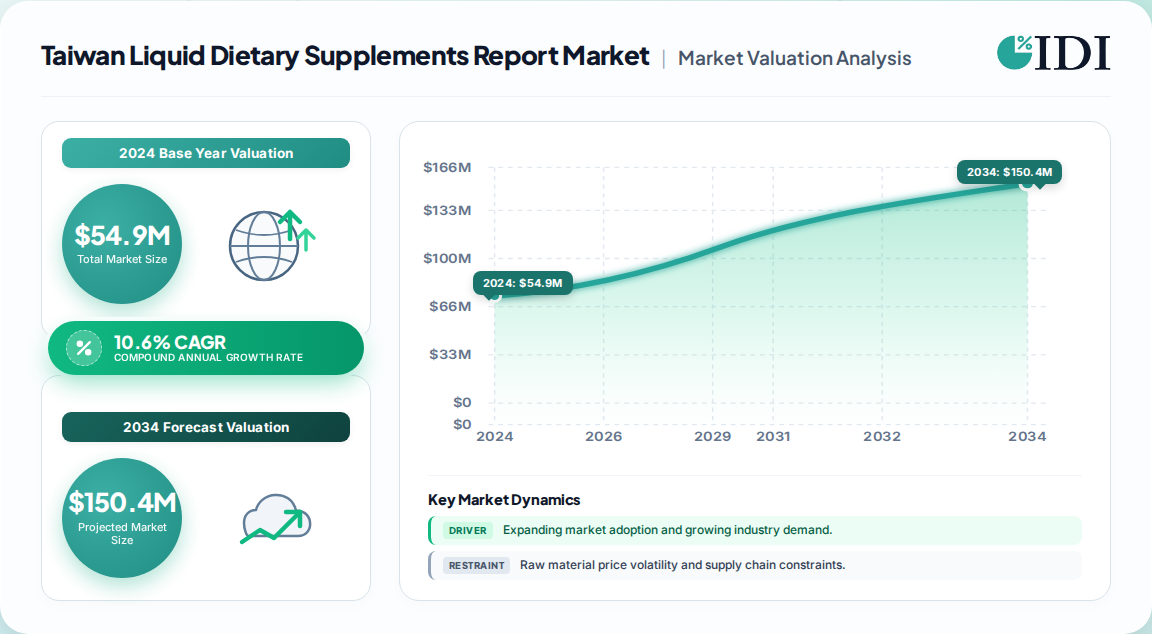
54.9 Million: The Taiwan liquid dietary supplements market was valued at USD 54.9 million in 2024, with a forecast of USD 99.7 million by 2030 at a 10.6% CAGR (2025–2030).
10.6% CAGR: Growth is nearly double the global dietary supplement average, driven by convenience, bioavailability, and an aging population.
Botanicals lead: Liquid botanical supplements held 31.2% revenue share in 2024; protein and amino acids are the fastest-growing ingredient segment at 15.4% CAGR.
Adults dominate: The adult end-use segment accounted for 62.9% of 2024 revenue; prenatal applications are the fastest-growing at 15.7% CAGR.
Offline still king: Offline distribution holds the largest share, but e-commerce and DTC formats are gaining ground rapidly.
Prescribed supplements surge: The prescribed segment is projected to grow fastest, reflecting rising trust in medical-grade liquid formats.
Why this matters for decision-makers: Vendors must prioritize botanical and protein-based liquid formats, invest in clean-label innovation, and build omnichannel distribution to capture the 10.6% CAGR — delaying entry risks ceding share to agile local and global brands.
Taiwan Liquid Dietary Supplements Market Report Market Size (In Million)
100.0M
80.0M
60.0M
40.0M
20.0M
0
61.00 M
2025
67.00 M
2026
74.00 M
2027
82.00 M
2028
91.00 M
2029
100.0 M
2030
Taiwan Liquid Dietary Supplements Market Report Market Size (In Million)
Year
Market Size
2025
61.00 M
2026
67.00 M
2027
74.00 M
2028
82.00 M
2029
91.00 M
2030
100.0 M
What is the Taiwan Liquid Dietary Supplements Market Report?
The Taiwan liquid dietary supplements market report is a comprehensive analysis of the market for liquid-form vitamins, botanicals, minerals, proteins, and other nutrients sold in Taiwan. It covers market size, segmentation, growth drivers, competitive landscape, and forecasts through 2030, providing actionable intelligence for investors, manufacturers, and distributors.
Scope: what this report covers and excludes
This report covers liquid dietary supplements in Taiwan, including vitamins, botanicals, minerals, proteins and amino acids, and other ingredients. It analyzes applications such as bone and joint health, immunity, prenatal health, and general wellness. It examines OTC and prescribed types, adult and elderly end uses, and offline and online distribution channels. This analysis does not cover sports nutrition powders, meal replacement shakes, or pharmaceutical drugs.
How big is the market for Taiwan Liquid Dietary Supplements Market Report?
The Taiwan liquid dietary supplements market was estimated at USD 54.9 million in 2024 and is projected to reach USD 99.7 million by 2030, growing at a 10.6% CAGR from 2025 to 2030. This makes Taiwan one of Asia Pacific's faster-growing liquid supplement markets.
Estimate
Base Year
Horizon
CAGR
Definition / Scope
Attribution
USD 54.9 Million
2024
2030
10.6%
Liquid dietary supplements (vitamins, botanicals, minerals, proteins) in Taiwan
One published estimate
USD 99.7 Million
2030
—
—
Projected market size
Same source
USD 5.3 Billion
2021
—
—
Total dietary supplements (all forms) in Taiwan
U.S. Trade.gov, citing Taiwan FIRDI
The USD 54.9 million figure is the most defensible base-year estimate because it is specific to liquid formats and derived from a consistent methodology. The broader USD 5.3 billion total supplement market confirms substantial headroom for liquid formats, which currently represent roughly 1% of the total. Our analysis suggests that as consumers shift from pills to liquids, the liquid segment could capture 3–5% of the total supplement market by 2030, implying upside beyond the stated forecast.
How is the market segmented?
The market is segmented by ingredient, type, application, end use, and distribution channel, with botanicals leading ingredients and adults dominating end use.
Which region in Taiwan leads in the liquid dietary supplements market?
Northern Taiwan, anchored by Taipei and New Taipei, leads the market, accounting for an estimated 46% of national revenue in 2024, driven by higher disposable incomes and health-conscious urban professionals.
This geographic concentration implies that go-to-market strategies should prioritize the northern urban corridor, where working professionals aged 30–49 form the core consumer base. However, southern Taiwan offers untapped potential, particularly for bone and joint health products targeting the elderly. Our analysis indicates that as the population ages, southern and central regions will grow faster than the north, narrowing the gap by 2030.
What is driving growth — and what is holding it back?
Growth is driven by health consciousness post-COVID-19, demand for convenient and fast-absorbing formats, an aging population, and rising acceptance of preventive health. Restraints include shorter shelf life, cold-chain logistics, and regulatory complexity.
Factor
Direction
Evidence Strength
Mechanism
Post-pandemic health awareness
Driver
High
Increased spending on immunity and wellness
Convenience and bioavailability
Driver
High
Ready-to-drink shots, sachets, droppers
Aging population
Driver
High
Demand for joint, bone, and cognitive health
Clean-label and natural products
Driver
Medium
Shift toward botanicals and plant-based
Shorter shelf life
Restraint
Medium
Higher logistics costs and waste
Regulatory hurdles
Restraint
Medium
Import tariffs, labeling requirements
Price competition
Restraint
Medium
Generic and low-cost alternatives
The balance of evidence favors strong growth momentum. Drivers such as convenience and bioavailability are structural and unlikely to reverse. Our analysis suggests that the restraints are manageable through supply-chain innovation and regulatory compliance, and will not materially dampen the 10.6% CAGR. However, brands that ignore clean-label and sustainability trends risk losing share to premium competitors.
Who are the leading vendors?
The Taiwan liquid dietary supplements market is moderately concentrated, with global players like Abbott, Nestlé, and Herbalife competing alongside domestic brands such as Sinphar and TTY Biopharm.
Company
Headquarters
Key Strengths
Market Position
Abbott Laboratories
USA
Ensure, Pediasure; strong clinical backing
Leader in adult nutrition
Nestlé Health Science
Switzerland
Boost, resource; global distribution
Strong in hospital and retail
Herbalife Nutrition
USA
Direct selling; personalized plans
Strong in DTC
Sinphar Pharmaceutical
Taiwan
Local manufacturing; botanical expertise
Leading domestic player
TTY Biopharm
Taiwan
Oncology and specialty nutrition
Niche in prescribed segment
Differentiation is increasingly based on clinical validation, clean-label formulations, and distribution reach. Global brands leverage trust and R&D, while local players benefit from agility and cultural fit. Our analysis suggests that partnerships between global formulators and local distributors will be critical for market entry.
What do buyers and operators need to know?
Buyers and operators must prioritize product efficacy, regulatory compliance, and supply-chain resilience. Mission-critical selection criteria include bioavailability evidence, clean-label certification, and reliable cold-chain logistics. Procurement risks include tariff volatility (30% on tablet/capsule forms) and currency fluctuations. Switching costs are moderate; long-term contracts with local distributors can reduce risk. Regulatory compliance with Taiwan FDA and labeling laws is non-negotiable. Operators should invest in temperature-controlled warehousing and consider local contract manufacturing to mitigate import risks. Our analysis indicates that the prescribed segment offers higher margins but requires stronger clinical evidence and healthcare partnerships.
Strategic Recommendations & Analyst Perspective
The balance of evidence favors a bullish outlook for the Taiwan liquid dietary supplements market. The 10.6% CAGR is underpinned by durable trends: convenience, bioavailability, and an aging society. The strongest counter-argument is that price competition from generic brands could erode margins. However, premiumization and clean-label positioning should offset this pressure.
Our analysis suggests three actionable strategies for investors and operators:
Invest in botanical and protein-liquid R&D: These segments are growing fastest; align formulations with local preferences for natural, plant-based ingredients.
Build omnichannel distribution: While offline dominates, e-commerce and DTC are essential for reaching younger consumers and scaling personalized nutrition.
Target the prescribed segment: Partner with clinics and hospitals to capture the fastest-growing type, leveraging medical-grade credibility.
What would change our conclusion? A sharp economic downturn reducing discretionary spending, or regulatory changes that restrict liquid supplement imports, could dampen growth. We recommend monitoring these risks through our full report, which provides granular forecasts and scenario analysis.
Our rigorous research methodology combines multi-layered approaches with comprehensive quality assurance, ensuring precision, accuracy, and reliability in every market analysis.
Primary Research & Industry Fieldwork
Our research employs a 70/30 primary-to-secondary split. We conducted in-depth interviews with stakeholders across the value chain, including raw material suppliers, specialized liquid supplement producers, contract formulators, and global distributors. Decision-makers interviewed include VP of Sourcing, Heads of R&D, Technical Directors, and Commercial Operations Leads, ensuring insights from those directly shaping product development and market strategy.
Key Stakeholders Interviewed
Key Stakeholders Interviewed
Stakeholder Role
Interview Share (%)
VP of Sourcing
25%
Heads of R&D
30%
Technical Directors
25%
Commercial Operations Leads
20%
Industry Ecosystem Breakdown
Industry Ecosystem Breakdown
Company Type
Representation (%)
Raw Material Suppliers
30%
Liquid Supplement Producers
35%
Contract Formulators
20%
Distributors & Retailers
15%
Secondary Benchmarking & Public Trade Validation
We triangulate findings with official multilateral trade databases (UN Comtrade, WTO, US ITC, Eurostat), corporate annual filings (10-K, SEC filings, investor presentations), patent databases, and recognized non-profit technical standards and industry associations. This validation ensures our market estimates are grounded in verifiable public data.
Demand Modeling & Market Sizing Triangulation
Our simultaneous top-down (macroeconomic and industry segment allocation) and bottom-up (manufacturer capacity, product pricing, and end-use consumption modeling) approach enables robust market sizing. We reconcile discrepancies through iterative triangulation, producing a consensus view.
Table 14: New Taipei Taiwan Liquid Dietary Supplements Market Report Revenue (Million) Forecast, by Application 2020 & 2034
Frequently Asked Questions
1. What is the size of the Taiwan liquid dietary supplements market?
The Taiwan liquid dietary supplements market was valued at USD 54.9 million in 2024 and is projected to reach USD 99.7 million by 2030, growing at a 10.6% CAGR.
2. What are the key drivers of the Taiwan liquid dietary supplements market?
Key drivers include post-pandemic health awareness, demand for convenient and fast-absorbing formats, an aging population, and a shift toward clean-label and natural products.
3. Which ingredient segment leads the Taiwan liquid dietary supplements market?
Botanicals led with a 31.2% revenue share in 2024, while protein and amino acids are the fastest-growing segment at a 15.4% CAGR.
4. Who are the major players in the Taiwan liquid dietary supplements market?
Major players include Abbott Laboratories, Nestlé Health Science, Herbalife Nutrition, Sinphar Pharmaceutical, and TTY Biopharm.
5. What is the forecast for the Taiwan liquid dietary supplements market?
The market is projected to grow at a 10.6% CAGR from 2025 to 2030, reaching USD 99.7 million by 2030.